

Alexander Grabovetskiy, woodcarver, School of Woodcarving · Published 2020
What does a wood carver mean by "for my taste"?
Quick answer: In my workshop 62 lesson I called a movement too long and kept working on it. Other lessons use these words about high spots, flat surfaces, deep concaves, ridges and a husk, and each passage sits here beside its lesson.
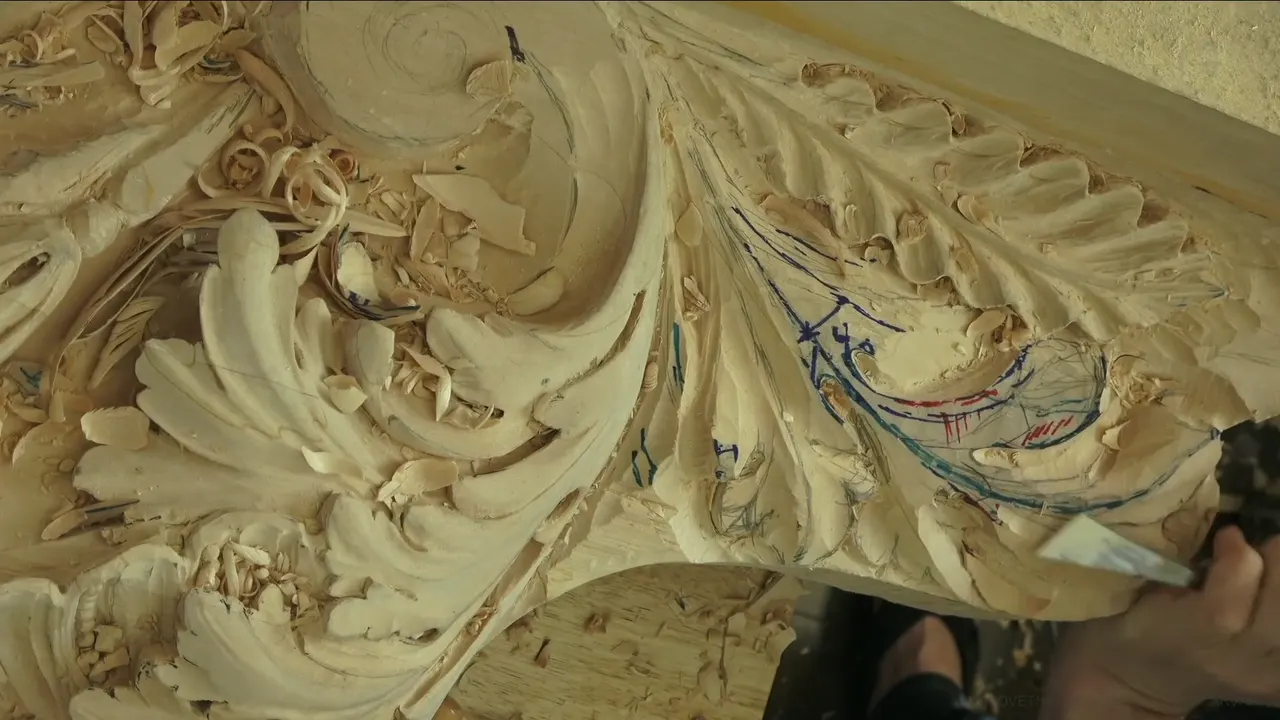

In workshop 62, part 4, I said "for my taste" about one long movement, and I still wanted another separation. My other lessons use the same words about high spots, flat surfaces, deep concaves and ridges, and this page sets those passages side by side.
Have you ever looked at a cut you made and thought it was fine, but not right for you? In the middle of a wood carving job, part 4 has that moment. A number 11 and a smooth transition come before it. After it comes a pipe, worked with a small tool and no rush. The lessons further down carry the same words beside other forms, each with its course and a link.
What did I say about the long movement?
I looked at one movement and said "this movement is a little too long for my taste, even if it's going to be a middle spine right there." Just before, I had told you "like I said, you can take a small section and use it somewhere else."
The movement stayed. "I still want to do another separation like that," I said, and repeated "Another separation like that." My guess was "I think it's going to be good."

A promise to return to it followed. "Later on," I said, I would fix a bit of the movement, and "right now, preliminary, you can see the idea." The job at hand: "Right now I'll develop it, this section off camera. I'm going to just cut and undercut. But now I need to clean a little bit this edge."
Which work came before that line?
The part opens with "Check this out" and "And make it much lower." Then a maybe: "And maybe I can actually go below that. But I'll use the number 11 right there, so it would make more sense." Beside it I wanted a hollow: "I need to create the concave, and I'll use number 11 for that. Try to make it smooth transition."
About the wood, I said "luckily, or on purpose I should say, I kept the extra thickness of this upper layer. I did not hit the glue yet. Maybe I will, I don't know." And in this case, "it doesn't really matter," I said, since the piece is paint grade. "So it's okay."

A verdict on the work came next: "That is actually more than good." Next I asked you to forgive me for the camera: "Again, on a video, on a camera, it doesn't look like in real life. So please forgive me that you don't really see the full development."
Where the shape would end, I said, was "a part going underneath," and "my point, somewhere right there." My plan was to "outline a little deeper to the first layer right now," and I called this section ready, I believed, "at least, or preliminary." My limit: "I'm not going to go all the way yet. I'm still going to keep it," to "get an idea" where "my boundary" would sit.
I put a question to you too: "Can you see the development?" And"Let me know if you like it, okay?"
What came after the line?
My next step was to "pop out this pipe," which meant "I need to create the concave right on the side." I called it "kind of really good concave, and I don't want to mess it up." Under it sat "an eye going underneath," because "I need that chunk." I needed the concave "without losing the overall movement."

For tools I planned "to start little by little with the smaller tool, seven millimeters" (0.28 in). A confession followed: "yes, I am breaking the rule and carving towards myself. Please forgive me for that, but I have to." I gave my reason right away: "Because I really don't have better position right now without sticking my head to a camera."
Along the grain I watched "how deep I'm carving and how much shavings I'm taking out." The danger was "a little too much, I can remove too much and can screw this up."

A promise to myself: "I'm not going to rush it. I do not want to rush it." Another plan: "maybe I need to take this spine even lower." And "let me get rid of this section."

Did the next parts of workshop 62 sound the same?
Part 5 opens on a ridge. I named "my middle ridge" and said "I think I need to soften it somehow." A slip followed: "Let me do some concaving. Convexing. I apologize. I guess I am getting a little tired." The tool, "number eight, by the way, and approximately 18 millimeters or so back bend" (0.71 in), gave this result: "Yep. Convexing it actually helped a lot."
The middle line matched part 4. "I'm not afraid" of it going lower, I said, and "That is absolutely okay." On the big pipes I said "I don't have a lot of depth to give a frame, but I still need to get about the same amount of shadows."
Carving direction came up there too. I would use "just 3 millimeters number 11" (0.12 in), and said "I really don't like to carve toward myself. Although it's okay. I'm able to do that, but it's not really convenient."
The words I am following sit in part 7. "I've got this pipe also. It's visible, but it's not deep enough for my taste." It mattered, I said: "it's really important for me to cast some shadows, and right now, it still doesn't." As a plan: "Maybe I'll just establish my depth with the back bend." And "So now I've got the preliminary depth." That tool "was, by the way, number eight, three-eighths of an inch, 10 millimeters."

Where else did I say it?
The rest of this page comes from my other lessons. Each passage says where it sits, and each lesson is linked to its page.
When was a form too high?
In Chamomile and Bow Rosette 2, part 2, I said "But for my taste, it's a little too high." Of the highest spot I said "should be right in the middle," and "I want to knock that down approximately six millimeters or so." And "So which means I can safely do that, about a quarter inch."

Lily Box 5, part 8, gives the same verdict. My thought was to "take it down a little bit," and the verdict was "A little too high for my taste." Next came "That should be enough," then "Let me get number seven again. This one's a little too big."

When is a surface too flat?
Over in workshop 72, part 9, I said "it doesn't look good, it just doesn't feel three-dimensional. It's just a little too flat for my taste." I do have main movements, main concaves and main convexes, I said. My plan: "I want to exaggerate this movement, this section, and I'm going to exaggerate partially this movement." About a pipe: "it's just not dimensional enough for me, so I need to exaggerate."
Workshop 40, part 6, has the words again. "I could go actually even more down if I wanted to, but let me see if I should or not. I'm talking about this because right now it's a little too flat for my taste." The next tool, "3 millimeters or 2 millimeters, number 11" (0.12 in or 0.08 in), came with a warning: "See, it's already too weak and I'm already starting to break it."
When is a concave too deep?
In workshop 38, part 4, I said "this concave is a little too deep to my taste. It doesn't look too good." A little earlier: "it's not too appealing to me." Then the tool: "the same number 11 to outline it," at "5 millimeters" (0.2 in).

One line there goes with the long movement in workshop 62: "See how important it is to keep extra material for the later times. Because those details you can always work on a little later."
The same words turn up in workshop 47, part 3, with a maybe: "a little too deep for my taste." Then "Maybe I should use just a number five, but not the six. But I did six." About the ridge: "Don't like that ridge to be too pronounced. Going to just take it out slightly."

How did I describe a point, a ridge or a stripe?
The letter S comes up in part 11 of the same lesson: "I think, going to look really cool right here. But that's a little too pointy for my taste, so I need to do something about it." I planned to "use number seven and bring this movement to more nicer shape," and for the S itself I wanted "a smaller tool," and named "number five."

The bumps in workshop 75, part 7, were "a little too bumpy for my taste." And of it: "going to give me a beautiful 3D movement." Later: "Everything's supposed to be gradual," and "really deep ridges like that. So that's not the goal."

Furniture Panel 19, part 8: "Maybe I should do a bigger concave on that side. Let me do that." Next, "It's just too stripey for my taste, okay. I really like the movements, but I don't like how it looks and how it feels, I should say." I did not stop there: "Let me just soften a little bit. Just slightly softer. And for me, it looks much better."

When was a form too bulky or too messy?
Here is workshop 14, part 4: "a second subdivision" and "just too bulky for me, to my taste." My start for the next cut: "start my concave cut from almost nothing, almost no pressure at all." On the other way: "it's not the way I like to do. Well, I shouldn't say that. I like to do what the original carvers did."

The Carving Hazelnuts course, lesson 6, part 3, has a husk on a hazelnut: "A little too huge in my taste. That husk." And "I can always chop and make it shorter if I wanted to a little later. But for now, it's okay." The size: "maybe 3/16, about five millimeters," and "I don't want to undercut too much."
A background came up in workshop 20, part 8. "I need to clean around because right now, just too messy. Too messy to my taste." Next I looked for a word: "Clean canvas." With "a big gouge" it would be "much quicker."

Workshop 76, part 1, has the closest match to part 4 of workshop 62. "Right now I'll just use a skew just to prove the point." Then "Even if I'm not too happy with this, too, because it doesn't look too appealing. Little too long, maybe, for my taste, this part." It is "much better than it used to be," I said, though "I must chop little bit of here."

Does the phrase ever mean it is right?
I used it that way too. Back in workshop 8, part 10, I said "I still don't kind of like it. I shouldn't say kind of it. Overall, just doesn't feel like it's flowing." Then "I need to move this line little bit this direction" would make it "to my taste."
Workshop 65, part 6, has it on a tool: "That's just a normal back bent, and I reshaped that as a skew. Okay, so that is exactly what I did. I just reshaped that to my taste." Before that I had said "you cannot buy that tool. You have to reshape." The first try: "And it did not break. That's good. I like it."

Which lessons use the words for my taste?
The table lists each lesson, what was too much, and the next step.
| Lesson | What I said | Next step |
|---|---|---|
| Lesson 62, part 4 (Venice Room) | Too long | Another separation, guessed to be good |
| Lesson 62, part 7 (Venice Room) | Not deep enough | A back bend, number eight, for the preliminary depth |
| Chamomile Rosette 2, part 2 | Too high | Knock it down approximately six millimeters |
| Lily Box 5, part 8, second layer | Slightly too high | A lower spot, then number seven again |
| Venice Room, lesson 72, part 9 | Just too flat | Exaggerate one movement partially, then the pipe |
| Part 6 of lesson 40 | Too flat | A number 11, 3 or 2 millimeters |
| Workshop 38, part 4 | Too deep | Number 11 at 5 millimeters to outline it |
| Venice 47, part 3 | Maybe too deep | Maybe a number five, not the six |
| Venice 47, part 11 (the letter S) | Too pointy | Use number seven for a nicer shape |
| Venice Room 75, part 7 | Too bumpy | A beautiful 3D movement, with gradual ridges |
| Furniture Panel 19, part 8 | Too stripey | A bigger concave, then slightly softer |
| Part 4 of lesson 14 | Too bulky | A second subdivision, and a concave from almost nothing |
| Hazelnuts 6, part 3 | Too huge | Maybe 3/16, about five millimeters, with a number 11 |
| Workshop 20, part 8 | Too messy | A clean canvas, then a big gouge |
| Venice lesson 76, part 1 (a skew) | Maybe too long | Chop some of it, right there |
Where can you watch the full video of each lesson?
Every lesson named above is inside one of my courses. This lesson holds all of workshop 62, and workshops 62 to 73 sit in Venice Room Part 6. The other courses named are Venice Room workshops 1 to 12, workshops 13 to 25, workshops 38 to 49, workshops 74 to 85, the Lily Box course, Furniture Panel, Chamomile and Bow Rosette and Carving Hazelnuts.
How it's done
- Name what is too much. I looked at a movement that ran long for my taste, even as a middle spine.
- Keep the plan. I thought one more separation would be good.
- Call it preliminary. A bit of that movement would be fixed down the road, and for now you could see the idea.
- Make the pipe stand out. My next step was the pipe, with a concave on its side that keeps the overall movement.
- Reach for a smaller tool. I planned to start with a smaller tool.
- Go slowly. Rushing it was not what I wanted, I said.
Frequently asked questions
Which tool did I name for the pipe in part 4?
The smaller tool, which I would start with little by little. Messing up the concave was what I did not want, and the pipe sat under an eye.
What was my plan for the long movement?
I wanted to make another separation, and my guess was that it would be good. A bit of the movement I would fix down the road.
What about the extra thickness?
I kept the extra thickness of the upper layer, luckily, or on purpose, I said. The glue was not hit yet, and in this case it did not matter much, because the piece is paint grade.
Did I carve toward myself in part 4?
What to carve next