

Alexander Grabovetskiy, woodcarver, School of Woodcarving · Published 2020
What are the signs that a wood carver is getting tired?
Quick answer: Right after concaving and then convexing in Venice Room 62.5, I told you I was a little tired. Other lessons name accumulating tools, a wrong word, a mumble, brain tired, and a plan to do most of the work off-camera.
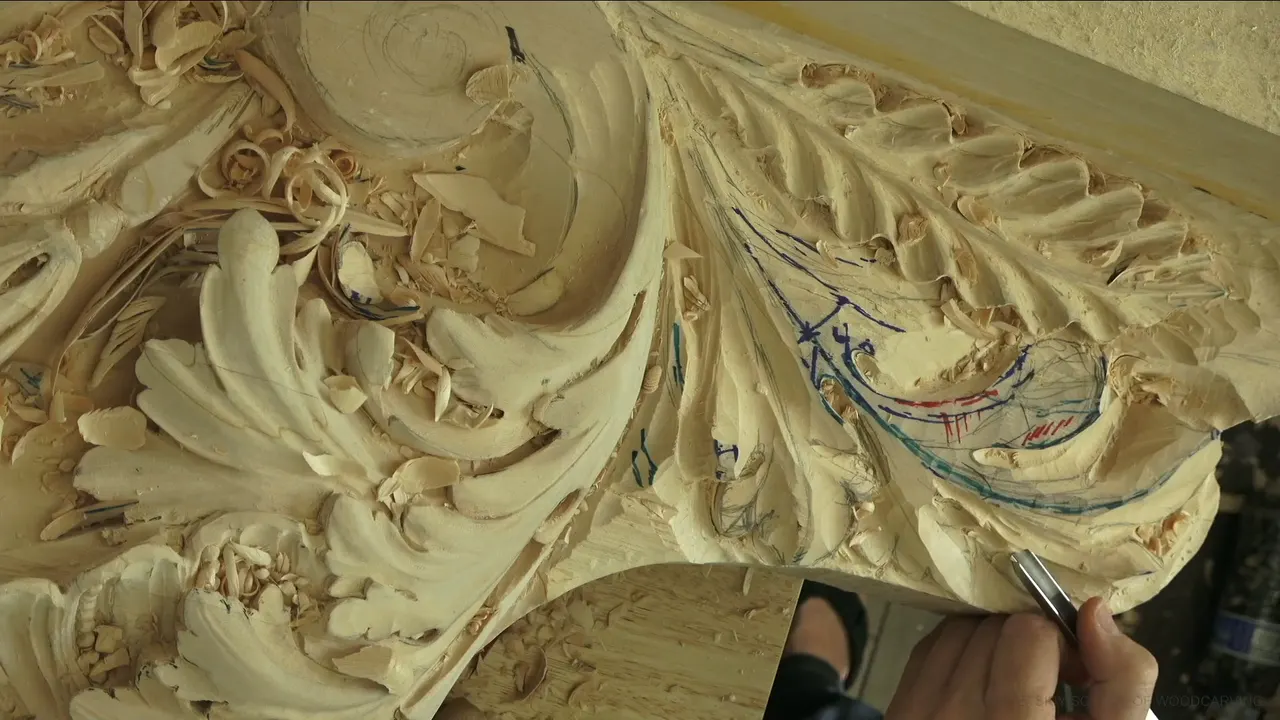

In Venice Room 62.5 I said I was a little tired right after I said concaving and then convexing. My other lessons name more of it: a bunch of tools on my workbench, a word said wrong, a mumble, and a plan to work off camera. This page sets each passage next to its lesson.
Do you notice what happens to your own wood carving when you are tired? Part 5 has my line about it, in the middle of a ridge and two pipes. The lessons further down carry more of it, each linked.
What did I say in part 5?
After "Somewhere right there," I called the spot "my middle ridge." The spot needed softening somehow, I said, or I could concave it completely and then just put micro cuts.
Next I said this: "Let me do some concaving. Convexing. I apologize. I guess I am getting a little tired. Convexing. That's what I'm going to do. Convexing it."

After that: "And that's big. See? That's what I was afraid of. Because it's along the grain, and that's not always helping." I named a tool in the same stretch: "This is number eight, by the way, and approximately 18 millimeters or so back bend" (0.71 inch).
Then my verdict: "Yep. Convexing it actually helped a lot. It helped a lot, and I can blend it, of course." About the blend: "it's supposed to look good. Supposed to."

I planned to blend a little of this ridge, and here I needed to take probably number 11. The middle line, I said, could get "a couple small lines just to indicate the movement," a couple on the sides. Those were preliminary, I said, and I would do them later like a clean cut. And "you should be able to see the overall development. Okay. Even on a camera, it should look good."
And now, the pipes
About the pipes: "just like I said, because I really want to pop out those pipes, this pipe and that pipe, so I need to lower down the middle section."
For the tool I planned number 11 at seven millimeters (0.28 inch). Soon after: "See? That's kind of wrong way of doing it. This is going to be the right way."

On the middle line: "And I'm not afraid that my middle line is going to be a little lower. That is absolutely okay." Of the ceiling I said "But now I've got the ceiling in the way. I need to go with this cut also."
Then, of the pipes: "So I've got my pipes. I've got two pipes exaggerated. I can reestablish my middle line with no problem, or middle spine. Spine? Line? I don't know what's the best way to say that."
I gave a reason for the pipes: "the reason why I'm doing those pipes really exaggerated, I don't have a lot of depth to give a frame, but I still need to get about the same amount of shadows. And that would be one of the ways. Just exaggerate those pipes, they're going to cast some shadows. Really big movements, okay? And I'm not afraid of doing it."

"Even if I have to lower down my middle lines, that's okay, too. That's absolutely okay." Then: "So let me double-check. So right here, I can actually get rid of some more in this section. Get actually much deeper cut. Going to help me to the right direction."
Beside a pipe, I said, "I also need to create a concave in this section. And for this, I need to use a smaller tool." And "I'll use just 3 millimeters number 11" (0.12 inch). Then: "Again, I'm doing the wrong way. But I really don't like to carve toward myself. Although it's okay. I'm able to do that, but it's not really convenient."
The part ends on a plan: "Let me hit that with the number 11 and 7 millimeters" (0.28 inch). And "Maybe I'll just widen it and make it a little better."

How do tools on the bench show it?
One sign I named sits on the bench. In Carving Floral and Molding for the Panel 5 (part 1) I said "the sign when I get tired, if I look at my bench and there's more than two or three tools, that means I am tired." I added "Right now, I'm okay to keep those two guys while I'm working, but when I start accumulating tools, it's time to take a break. At least that applies to me, okay? So just the time to take a break. Walk away for a few minutes and you should be fine."

Workshop 56 (part 7) says it about my tools: "And I accumulated the tools, which I usually don't. It happens only when I'm getting tired." Then I said "And when I'm filming and carving, I am getting tired a lot quicker because I have to talk, I have to explain what I'm doing and why I'm doing it." Later in that part: "But it's okay. As long as you like it, I'm happy."

In workshop 35 I said "I've got a bunch of tools on my workbench. And like I said too many times even, that I don't like it, but I still keep accumulating once in a while. And that's just usually indication that I got little bit tired and I'm leaving my tools right on my work, actually, in this case. But I usually don't like that. So that's not the best practice."

How do words that come out wrong show it?
A line in workshop 83 (part 4) is about it. I said "So it is starting to show some stuff," then reworded it as "it's just starting to show." Next came "I want to--" and then "Just I say one thing and I say another thing sometimes. I know why. Maybe I also getting tired."

Another line is about mumbling in the Floral lesson 5 video. There I said "I'm sorry for my mumbling today, so kind of tired." The next words were "So what I need now, I need to use one millimeter or even half a millimeter" (0.04 inch or 0.02 inch).
Floral lesson 3 (part 1) has me stopping on a word: "What's the thing, how you call that thing? Volute, okay. I'm getting brain tired, all right. The volute, of course."
When did I plan to work off camera?
In workshop 61 (part 9) I said "And I'm sorry that I kept quiet. I just got carried away with my thoughts." Most of it, I said, would go off-camera, "because really no need to, especially now, I'm getting tired, and I'm talking about talking because I'm filming and talking pretty much all day long today."

What did I say about a mistake?
In Furniture Panel 19 (part 2) I said "just to make sure if I'm going to get tired, then make the mistake. I don't want to make mistakes. Okay, let me do that. Again, carefully."

Why did I change tools?
Over in Carving Hashemi Flowers 25 (part 2) I said "Because sometimes you get tired of the same tool if you're using that every day, and you want to approach something with different tool." Then: "I am getting tired sometimes using same tool over and over. But looks like today, this tool works just fine for me."

In Floral 10 (part 3) I said I carve every day and also tire of the same tools, and "that's always joy to use some other tools." And in workshop 163: "I just kind of change my tools." Then "get tired sometimes with the same tools. And I want to make something different."

What about one area?
One spot on the piece gets the same word. In Venice Room 39.1 I was tired of one area, I said, and could probably jump to another section and then go back. And "otherwise, if I'm concentrating too long in one area, I'm losing interest."

Part 11 of workshop 4 has "And yes, you get tired when you're working on big details all the time. So that's why I try to do as much as possible, but it's a good idea to walk away and start doing something." From workshop 92: "You really get tired of one area."
Over in workshop 124 (part 1): "I'm kind of tired of this side, and I want to see overall picture, and sometimes it's a good idea to walk away from one area and jump on another. And that's what I want to do."

Here is workshop 67 (part 9): "But now I really would love to jump to do something else, because I'm pretty tired of this section." And Furniture Panel 29 (part 1) calls it good practice to jump to another area when you are getting tired.
What about being tired in the head?
On Furniture Panel 38 (part 1) I said "I think I'm gonna jump on this area right now because I know some of you probably already tired." In my Principles of Design in Wood Carving course, part 4 of lesson 4, I said "So, I think it is enough today for the design part. I know some of you are probably brain tired already."
The April 2020 livestream on clay modeling goes further than that: "literally, people get tired with the brains." The same talk has "When I start on Monday, by Tuesday evening, everybody's so tired." And "people who've been in my classes, they know by Tuesday night, they get really tired."
What do I say about not getting tired?
The Tray of Blessing 1 (part 1) has "I don't want to get tired. I let the tool do the work. I feel the tool how it does, okay?" and "otherwise you're gonna get tired and you're gonna get frustrated."

Floral lesson 1 (part 3) is about pushing: "They just push just like that, and that's no good." And about the cut: "your cut, the finish cut, is not going to look as nice, and you're going to get a lot quicker tired. So it's always better just to slice it."
Workshop 28 (part 12) brings in a mallet: "And maybe a little heavier mallet. So 12 ounce is not going to fly. It will, but I can get tired a lot quicker, so I need 30 ounces and let the mallet do the work." That is about 340 grams for the 12 and about 850 grams for the 30.
And in workshop 55 (part 3): "the mallet is supposed to be used only like a free-hanging, just inside of your palm. That's the right way to use it. That way, your hand is not becoming really tired." A few lines on: "if I going to use the whole body to bang on a mallet, I would get tired really quickly."

In Greek Acanthus 8 (part 3) I said "And now let me take again number five. I just love how it feels. Just so perfect when I'm laying my fingers right on the top of this tool, and underneath it has some slight roundish feel. My hand's not as tired."
Which lessons name it, in one table?
The table lists each sign, where I named it, and what stood beside it.
| What I named | Where | What stood beside it, in my words |
|---|---|---|
| Tools on the bench | Workshops 56.7 and 35.12, Floral 5.1 | A few minutes away, and tools left on the work are not the best practice |
| A word that came out wrong | Workshops 62.5 and 83.4 | I say one thing and another thing sometimes |
| A mumble | Floral 5.1 | Sorry for the mumbling today |
| Quiet, and then most of the work off-camera | Venice 61.9 | Most of it off-camera, with filming and talking all day long |
| A mistake | Furniture Panel 19.2, part 2 | Again, carefully, with no mistakes |
| One tool | Hashemi 25.2, Floral 10.3, workshop 163.1 | Something different |
| One area for too long | Venice 4.11, 39.1, 92.1, 124.1 and 67.9 | Work on a different spot, and then return to it |
| Tired in the head | Floral 3.1, Furniture Panel 38.1, the April 2020 livestream | I asked for a word and got it; a plan to jump on this area |
| Less force | Tray 1.1, Floral 1.3, Greek 8.3, workshops 28.12 and 55.3 | Slice it and let the tool work |
Where can you watch the full video of each lesson?
Every lesson named above sits inside one of my courses. This lesson holds all of workshop 62, and workshops 62 to 73 are in Venice Room Part 6. The other Venice Room courses are workshops 1 to 12, 26 to 37, 38 to 49, 50 to 61, 74 to 85, 86 to 97, 122 to 131 and 156 to 163. The rest are Floral and Molding for the Panel, Carving Hashemi Flowers, Furniture Panel, Furniture Panel part 2, Greek Acanthus and The Tray of Blessing.
How it's done
- Name the ridge. I called the spot "my middle ridge."
- Plan to soften it. The plan was to soften it somehow, or concave it completely and then add micro cuts.
- Say convexing. Convexing was the plan, and it actually helped.
- Name the tool. I named number eight, a back bend of about 18 millimeters (0.71 in).
- Plan the pipes. Next I needed to lower down the middle section so the two pipes pop out, using the 7 millimeter number 11 (0.28 in).
- Reach for a smaller tool. A smaller tool was needed for the concave beside a pipe, and I would use a number 11, 3 millimeters wide (0.12 in).
Frequently asked questions
Which words came after "a little tired" in part 5?
"Convexing." Then "And that's big."
Which size did I give for the number eight in part 5?
"This is number eight, by the way, and approximately 18 millimeters or so back bend" (0.71 in).
Which words did I use about my tools in workshop 56, part 7?
Accumulating them is something I usually don't do, and it happens only when I get tired.
How many tools did I name in Floral lesson 5?
What to carve next