
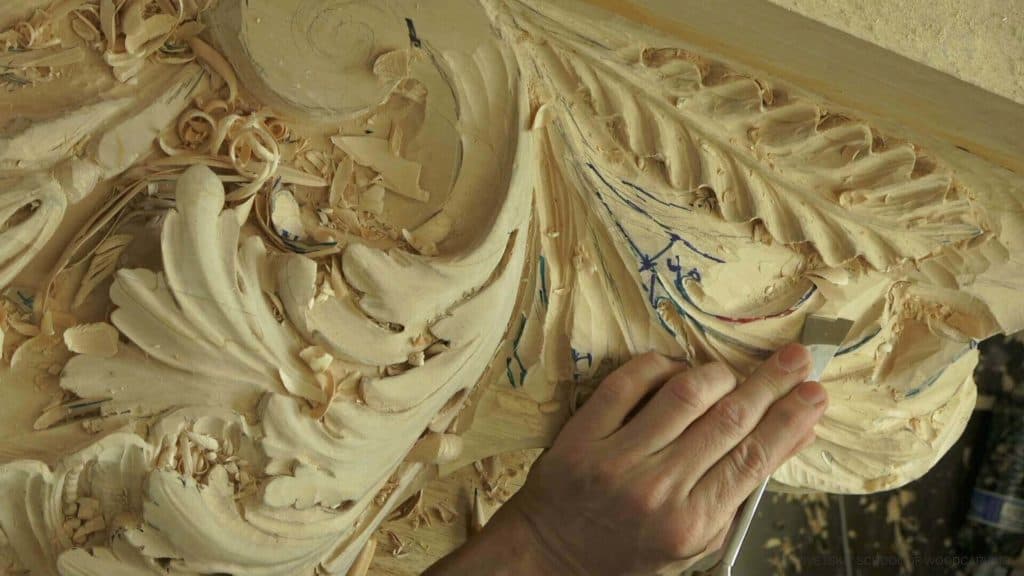
Alexander Grabovetskiy, woodcarver, School of Woodcarving · Published 2020
What does a wood carver mean by "I'll take"?
Quick answer: "I'll take" is how I name the next gouge before the pass, with its number and often its size. In Venice Room 62.6 it was a bigger 11, about 12 millimeters (0.472 in). Other lessons carry the same line over a smaller tool, a bigger tool, and a changed mind.
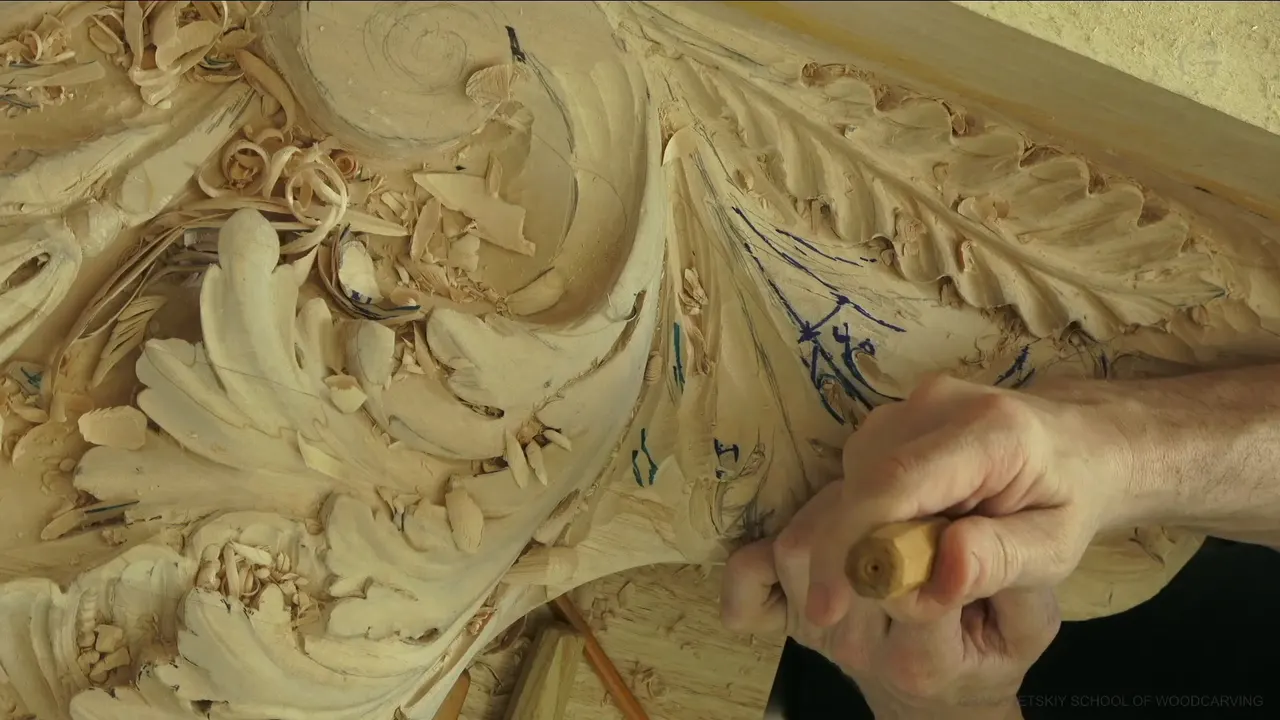

"I'll take" is how I name the next gouge out loud before the pass, and the number often comes with a size. In Venice Room 62.6 it was a bigger number 11, maybe 12 millimeters (0.47244 in), for a concave. Other lessons bring a smaller tool or a changed mind.
Have you ever watched a carver reach for a tool? Would it help to hear the number and the size said out loud, right before the wood moves? Part 6 has one such line, and the lessons below have the rest, each one linked.
What did I say in part 6?
The part opens on pipes and a shape I wanted to outline better, with an eye in it. We do not want to lose that eye, I said.
My first tool was a back bend: "Again, I'm going to use a back bend," with the aim to give "that roundness." For the rest of it, "I'll just use a different back bend." My reason came right after. Everything was in my way, and a straight tool was not convenient for me.

About a pipe I said "Maybe I'll be able to use even here to get that pipe a little bigger." I did not worry about what I left inside, and "I can always clean," I said. What I was after was "like a half-a-round shape right here, almost half a round in some cases, some spots."
The ridges got a plan too: "I can always hit with a different back bend and get rid of some of the ridges and clean that nicely."

Next: "Let me work on those pipes. I've got one, two, and three yet." A really long pass waited on the pipe I picked first. Around there I said "a lot less pressure in this area" and "I can do a lot more right here."
Then comes the line this page is named for. I was not going all the way yet, I said, because I needed to establish my concave. I put it like this, "I'll take bigger 11, maybe 12 millimeters, like half an inch, and I'll get my concave" (12 mm is 0.47 in, and the half inch is 12.70 mm).

The sentence has three parts. First comes the number, then a size said in two systems, and last the job, my concave.
Then: "Okay, so that's going to go this way." Another concave was to come on another side, and I said "Of course, let me do that right away." Then: "We've got concave, concave, and there is going to be somewhere a middle."

Two more tool lines close the part. The center of a ridge, I said, I could hit right away with the back bend. Then "that was number three," and "I could get actually a little more pronounced, I would say maybe with the number five." Once more, "Maybe with the number five." The last words are "And I'm going to use number 11 again and clean it a bit slightly more."

What did I say in parts 5 and 7?
The neighbors of part 6 are full of the same talk. In part 5 I said "Again, number 11 and seven millimeters" (0.2756 in), and a moment later I said it again, with "and let's start." Further on I planned a smaller tool, a number 11 of just 3 millimeters (0.118 in).
Part 5 also names a back bend, number eight, "approximately 18 millimeters or so" (0.71 in). Part 7 gives the number eight another size, "three-eighths of an inch, 10 millimeters" (9.5 mm, and 0.3937 in).
In the same part: "Now I need to take number 11 and seven, same what I used before, and continue my cut around." I also said "in this case actually, I could use an even bigger back bend. It's still number eight." Late in part 7 came "That is what I'm using," and then "Number 11, seven millimeters."

What do I say when I go bigger or smaller?
The direction changes with the lesson. In Hashemi 9 (part 3) I said "now it's all about cleaning," and then "Okay, I'll take a bigger number eight, 5/8 of an inch, and even smaller now, maybe half an inch, and clean those ridges" (15.9 mm, then 1.27 cm).

Hashemi 36 (part 4) goes "Make it maybe bigger with the same tool," just to make some interesting movement. And "A bigger number nine." The next plan was number four, to blend those cuts together.
Then Hashemi 7 (part 2): "Okay, I'll take smaller one, like a quarter inch, number five, and go even more to the edge" (6.35 mm).

Venice Room 66 (part 7) comes with a small slip. An eye of mine did not make me too happy, so I would move it slightly and get more chunk. "And I'll take a smaller tool, maybe about three millimeters" (0.1181 in), I said, to get the eye of acanthus "a little deeper right here and right there, just couple digs." Next: "Oops, that's not good enough, sometimes it happens, but not so much, just dropped my tool."

Under a part in Venice Room 129 (part 3), my plan was to reveal it on top: "And I'll take even smaller, like five millimeters" (0.197 in).
Venice Room 128 (part 2) goes smaller still. "And you know what," I said, and then "just probably 1 millimeter" (0.0394 in) for a number 11, to work over an eye. Next: "And I could probably take even half a millimeter" (0.0197 in), for "even deeper shadow."

What if I change my mind mid-sentence?
It happens in my sentences. Hashemi 12 (part 6) is a warning about the grain: right now you really can't work sometimes with the grain, I said, and you limit it. Then: "I'll take number seven again. Well, actually, no, I'll take number five, and it would be one inch also" (2.54 cm).

The reason came right after: "It's going to give me a little less sweep, and I can have more control."
Hashemi 2 (part 2) has two numbers in one breath. The ribbon part would go from underneath the leaf, I said, and create an even more three-dimensional look. Then: "Let me take just probably number 9 or number 8. Well, I'll take just number 8, approximately quarter inch" (0.635 cm). Right after: "And I'll make my preliminary cut, because I don't want to lose later on the overall picture."

A spot needed saving in Venice Room 124 (part 2), so a plug cut was the plan. My words were "A number nine, and in this case, I'll take 10 millimeters" (0.39 in), and then "Number nine." Next: "Well, actually, you know what, I'll take bigger." My choice was about a half inch (1.27 cm) for the plug cut.

Chamomile and Bow Rosette 3 (part 2) has the same turn: "I'll take maybe about 4 millimeters" (0.157 in). I stopped there, and "I can probably use a bigger one," I said, "about 6 millimeters, like quarter inch or so" (0.236 in).

Hashemi 16 (part 3) has me thinking out loud first, "Let me think which tool I have to use," and then the pick, "number seven," and "that's one inch" (2.54 cm).
Hashemi 19 (part 4) gives a small piece of advice. "If you feel like there's too much tension, it's better to take a smaller tool and just clean inside and then continue to work." The size I named for it was a little too big, I said, and "I think 3/32nds is better in this case" (2.4 mm).
Which size goes with which number?
The line sometimes carries two figures at once, and a Venice Room 70 part shows it twice. Part 4 has me saying I needed a different number 11, smaller or bigger. After "I'll take" came "a seven millimeters number 11 veiner, and create little deeper excavation right here" (0.28 in).

That part also has a concave I did not want too deep: "Maybe I do, maybe I don't, we'll see." For that spot I named "five millimeters number 11 veiner" (0.1969 in) and planned to start "little by little," and soon after I named the ceiling as my limitation, "I've got to attack from opposite direction."
A spot in Venice Room 65 (part 7) did not look the way I wanted. "But I really want to make it look good," I said. The number came first, "Number 11." Then: "In this case, I'll take just one and a half millimeters, 16th of an inch" (0.059 in; 1.59 mm). And again, "one millimeter and a half." Further on I said "Beautiful tool."
How much to keep comes first in Venice Room 73 (part 9): "Maybe I'll just keep a little bigger section right here." A veiner came again, and "I'll take probably seven millimeters or so, a little bigger than a quarter inch" (0.276 in; 6.350 mm).
Getting rid of ridges is the job in Venice Room 82 (part 9). My pick there was "just probably flat, like number three," and then "the second side, the same thing." A section had a little too much going on in Venice Room 78 (part 10). My pick was number five at a quarter inch (6.4 mm), and "let me outline it a little better."

A back bend is the tool in Venice Room 74 (part 9), and I said it is not upside down. I named a number 11 at "10 millimeters, three-eighths of an inch" (0.394 in; 9.53 mm), to excavate little deeper, "but I don't have too much material left."

A plug cut on the inside was the plan in Venice Room 85 (part 1), for a deep shadow. The words were "number 9 1/8 of an inch, three millimeters, and place a plug cut on inside right here" (3.18 mm; 0.12 in). I was not going deeper than that, I said, "at least not now."
Hashemi 11 (part 2) brings a V tool. I said "When I'm saying small," and named "the one millimeter, and it's also number 16" (0.04 in), and "I'll try to create the shadow." Right after: "Let me fix, actually, first my concave cut." My other pick was "the number seven" at 3/8 in (9.525 mm).

And Hashemi 22 (part 4): "I'll take smaller number seven, which is 14 millimeters, and kind of blend those two cuts together" (0.55 in). The V tool came next, "the three millimeters, number 16" (0.118 in), and "by the way, number 16 is not 45 degrees, it's 35 degrees, really sharp angle."
I could go underneath a part in Venice Room 76 (part 4), which I probably should. After "I'll take" came "a back bend, number five will do, and I'll just excavate this direction." It would give an even lighter feel, more airy.

Can "I'll take" name something other than a gouge?
I wanted to find out which parts I could easily take out in Hashemi 7 (part 1), so "Let me take a marker," and then "a black marker." After the marking came "a number eight, one inch, same big one" (25.40 mm).

The cardboard shows up in Carving Flower Rosette 1 (part 2): "Now I'll take my cardboard." I would apply glue on them, then face them the right direction.
Even a marking gauge gets the line. In Carving Rosette Workshop 1 I said "since I have to make 15 of them, and they have to be all equal, I'll take my marking gauge, find my eighth of an inch" (3.175 mm). After that I wanted to make sure it was exactly one inch (25 mm).

The knife gets the line too, in Hashemi 9 (part 3), before "Make a small notch." Then came a number nine of "5/16 of an inch" (7.9 mm).
Which lessons say it, in one table?
The table lists each place, the tool I named with its size, and what the tool was for.
| Lesson and part | Tool and size, as I said it | Its job |
|---|---|---|
| Workshop 62.6 | Number 11 at 12 mm (0.47 in), a bigger one | My concave |
| Hashemi 12.6 | Number five of one inch (25.4 mm), after number seven | Less sweep, more control |
| Hashemi 2.2 | Number eight of about a quarter inch (6.4 mm) | The preliminary cut |
| Workshop 124.2 | A half inch (12.7 mm), after 10 millimeters (0.39 in) | A plug cut |
| Chamomile 3.2 | About 6 millimeters (0.24 in), after 4 millimeters (0.16 in) | Two cavities |
| Workshop 70.4 | A seven millimeter number 11 (0.28 in), then five millimeters (0.2 in) | A deeper excavation |
| Workshop 65.7 | One and a half millimeters (0.06 in), a 16th of an inch (1.6 mm) | Making it look good |
| Workshop 128.2 | 1 millimeter (0.04 in), then 0.5 millimeter (0.02 in) | A deeper shadow |
| Hashemi 11.2 | V tool of one millimeter (0.039 in), number 16 | The shadow |
| Rosette Workshop 1 | A marking gauge, with 1/8 in (3.2 mm) to find | Fifteen of them, all equal |
Where can you watch the whole video of each lesson?
Every line above sits in one of my wood carving courses. This lesson holds all of workshop 62, and workshops 62 to 73 are in Venice Room Part 6. More of the Venice Room is in Part 7 and Part 11. The rest are Carving Hashemi Flowers, Chamomile and Bow Rosette, Carving Flower Rosette and Carving Antique Style Rosette.
How it's done
- Give a reason. In part 6 the reason for a back bend was that everything was in my way, and a straight tool was not convenient.
- Name the number. My plan for the center of a ridge was a back bend, and maybe the number five for a little more. Number 11 again was my plan, to clean it.
- Add the size. For the concave I named a bigger 11 of about 12 millimeters (about 0.5 in).
- Finish with the job. The job came last: my concave, with another concave planned on another side.
- Switch out loud. In Hashemi 12 I said number seven, then changed to number five at an inch (2.5 cm), for more control.
Frequently asked questions
Which tool did I name for the concave in part 6?
Number 11, a bigger one, maybe 12 mm (0.4724 in). The concave was the job.
Which sizes did I give for the number 11 across parts 5, 6 and 7?
Seven millimeters (0.276 in) in parts 5 and 7, and 3 millimeters (0.12 in) in part 5. Part 6 had a bigger one.
Why did I switch to number five in Hashemi 12?
Number seven came first. Number five followed at an inch (25 mm), and my reason was a little less sweep and more control.
Which sizes did I name for the plug cut in Venice Room 124, part 2?
What to carve next