

Alexander Grabovetskiy, woodcarver, School of Woodcarving · Published 2020
What does a wood carver mean by "half round"?
Quick answer: Half round is the sweep of a number 9 gouge, shaped like half a circle. I use the words about a pipe on a carved leaf too. A half-round movement was my plan in Venice Room 62.7, with a back bend, number eight. A number 11 is a U shape.
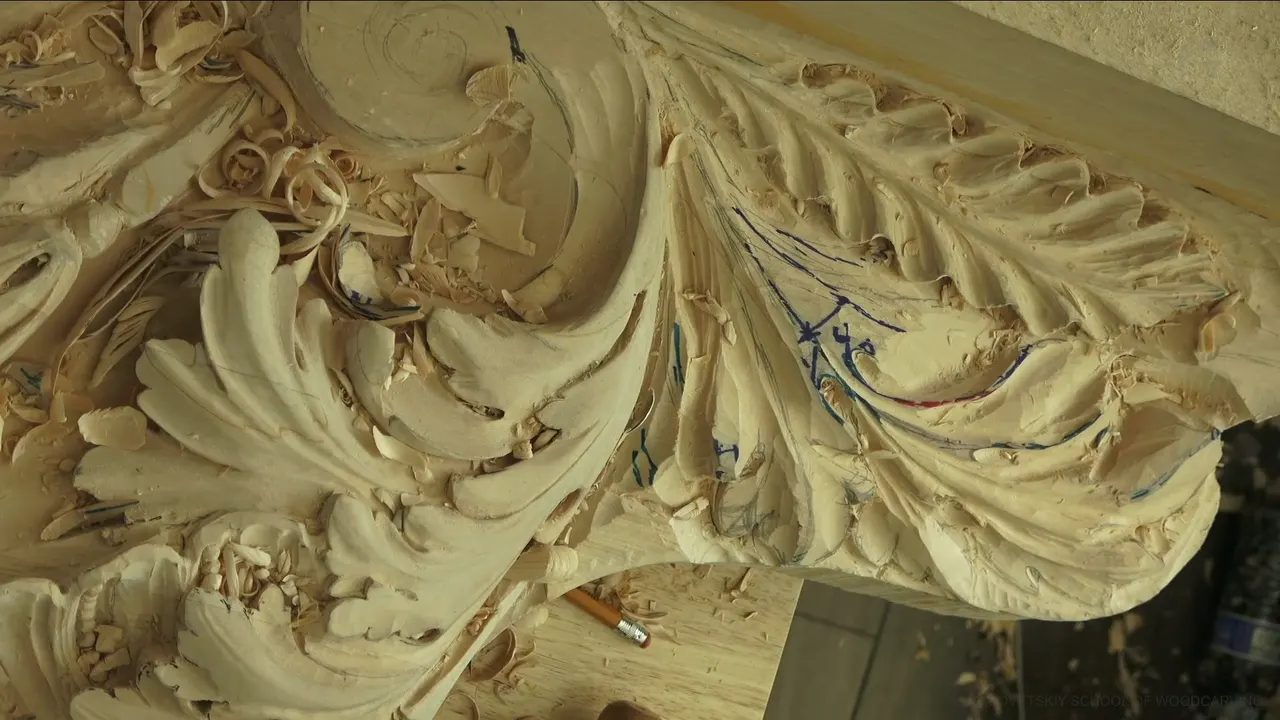

In my lessons a number nine is the half round gouge, and the same words fit a leaf pipe. The plan for a half-round movement is in part 7 of workshop 62, and it names a back bend that is a number eight. The 11 has the shape of a letter U.
Have you ever held a gouge and wondered what its curve will do to the wood? Did a pipe ever come out flatter than you drew it? One line in part 7 of workshop 62 is about a half-round movement, and my other lessons say the same two words about a tool and about a pipe.
What did I say about a half-round movement in part 7?
I said of one pipe "It's visible, but it's not deep enough for my taste." A little deeper was needed, I said, and the reason came straight away: "It's really important for me to cast some shadows, and right now, it still doesn't."
My plan was a back bend. "Maybe I'll just establish my depth with the back bend," I said, and "That way, I'll know exactly where it's supposed to be." Then: "So now I've got the preliminary depth." That back bend was a number eight, "three-eighths of an inch, 10 millimeters" (9.53 mm, and 0.39 in).
Next came a need. "Now I need to take number 11 and seven, same what I used before, and continue my cut around." Earlier work could be lost, I said: "Even if I'm destroying previous cuts, that's okay because I'm still establishing what's supposed to be good."

The pipes had to pop out. "Don't ask me why, because I said that hundreds of times why. Shadows." One area did not worry me much, since a flower was planned on it, but I did worry about this side.
Then: "Now I can see much better. Now let me do those pipes now." My center line was right there, and I did have a problem with it: two eyes pretty close to each other. So I had to go "really carefully right on the side of center line and establish my first pipe." One more thought: "Although maybe I'll just destroy it and then reestablish my center line."

The half-round line came next. "Okay. One is popped out. Let me use a back bend again. Pre-establish my half-round movement." Then: "What I want to see, and in this case actually, I could use an even bigger back bend." Right after, "It's still number eight." My next words were "I'll just hit like this."

"That's going to give me a really nice movement," I said, and "So beautiful, beautiful big pipe." One pipe, and now another. "Same idea. Just go on the side." Another side had to be attacked from the opposite direction, and "ceiling is in my way. It's kind of hard to do."
On another pipe the same operation using a back bend needed care, I said, "because of the grain." Then came a verdict, "That's no bueno." And "It's okay, but it's not good." A guess followed: "Maybe my tool is a little too dull for this operation."

I had chopped too much. "It's not a big deal," I said. Then, in the same breath: "I did not lose yet. Not yet. I mean, I'm not planning to lose. Still going to be beautiful and nice." Then a note to myself: "But yes, I have to be more careful. That's true."
The next side got a number 11 of seven millimeters (0.28 in). "That is what I'm using," I said. The last words of the part: "Everything's supposed to go to the center line. All of those movements, all of those pipes, and everything."
What did parts 6 and 8 add?
In part 6 I said "Now those pipes are really, really popping out. I like that." Then comes a plan, "So now I can convex them." An outline of "that little guy" needed to be a little better, and an eye was coming. "We do not want to lose that eye."
A back bend comes up in that part too. "I'm going to give that roundness," I said, and a moment later, "See? I just gave true round shape." The rest would take a different back bend, and the reason was plain: "Because everything is in my way now. I can't use a straight tool."

Part 6 has a half-round line too. About one pipe I said "I don't worry about what I left inside. I can always clean, but like I said, I'm really after that shape, like a half-a-round shape right here." Next: "Almost half a round in some cases, some spots."
Ridges got a plan: "I can always hit with a different back bend and get rid of some of the ridges and clean that nicely." The center of a ridge could take a back bend right away. Then "that was number three," and "I could get actually a little more pronounced, I would say maybe with the number five."
A bigger number 11 turns up in part 8: "And when I'm saying bigger, I mean maybe 5/8 of an inch, about 15 millimeters or so" (15.9 mm; 0.59 in). Shadow was the need, and big swoops, big cuts. For the eyes, I planned to excavate on the inside with the nine and create a plug cut.

Which gouge is a half round?
That is the nine. In the April 2020 livestream I said "And number nine, it's a true half round." My example of a good one was "a 20 millimeters number nine, and that is actually a three quarter of an inch" (0.79 in; 19 mm).
The beginner cutting board course gives the whole row. "It goes from number three, four, five, six, seven, eight, and ends at the number nine." The true gouge, I said, "will go only till number nine." Past nine, the gouge turns into a letter U.
Roman Acanthus 16 gives a picture. Almost the half round, I said of the nine, "a half of a circle." Draw a circle and half of it is exactly the half round.

Eight comes close. On end grain in Hashemi 12 the gouge was a half an inch number eight (12.7 mm), and I said "Number nine will work also. It's really close, actually, number eight and number nine." Then: "Number eight is a little less."

The pair comes back in Venice Room 57, in a pass that hits from two sides. Eight falls short of the half round, but with a nine "I could actually go all the way to the half round."
About a gouge in Roman Acanthus 10 I said "for me, it does look like number eight. It could be number nine." My verdict was a curve a little less than a half round.
Brands come in, too. One number nine, in Venice Room 65, is "equal to number eight to other brands."
The livestream also has a test for a good gouge. One that should be a number nine got this verdict: "it's not really good one. Okay? Because if you try to rotate, it's going to rock." And "The true gouge is supposed to create perfect round." A good number seven is another story: "So it's always going to end up at the same location."
The same livestream has a number ten. "In UK, there is a gouges number 10." And "So you're still able to get some number 10 gouges, which is also like a half round." And "Pretty much pretty close to number nine in Europe."
Is a number 11 a half round?
The 11 is "not half round" in Venice Room 50, part 2. It is "like a U-shape, like a letter U," and "the sides of it are just equal to number three tool." I can use just the side of it as a number three gouge.

Going into a separation, I said in Venice Room 38, takes care with the 11, since it is a U-shaped tool. I named "number 9 or number 8 even," because "you can rotate" with those two, and a U does not give you that.

Both tools sit side by side in Venice Room 16. The nine is a half round and I am "digging with the corners." The 11, in my words, is "more like a U shape," and one of its sides cleans the upper part. So "number 11 gives me cleaner cut."

A wiggle was the job in Venice Room 18, where a number nine "doesn't have extended wings," and "I think that would probably be a better tool." In Venice Room 41 the nine brings "more wiggling ability."

The veiner is different in Roman Acanthus 12. Mine is a number 11 of one millimeter, and I called it "little more than half round. It has a U shape."
The line between tools in Roman Acanthus 5 is the sweep. "If there is no sweep, it's called chisel," I said, and a sweep makes it a gouge, "until number nine." Past that: "But if it's more than half round, if it's more like a U shape, then it's already veiner."

In Roman Acanthus 15 I named an advantage of a tool with a U shape. I start laying on the left-hand side, and while I make the pass I move it toward the center part. The pass becomes more narrow, and I can continue it to the end.
How round should a pipe be?
In Hashemi 11 the pipe had to be rounded, and I said "my goal is to achieve a really true half-round pipe." Next: "I really like distinguished or exaggerated pipes." Next, a plain remark: "And that is a pipe, by the way. You should know that probably by now. So the pipe is just looking like a pipe. Pipe of the leaf."
In my Venice Room 5 lesson I said "Not half round, but almost half round." My tool for it: "And the best tool for that would be for me to use is just a back bent." Another part of that lesson says "So it has to cast a lot of shadows." Next: "So I really want to get deep cuts and make this convex really almost half a round."
Pipes come up in Venice Room 9 too, and I said I could "actually shape this future pipe with the back bend." Then, in full: "I want to see a full half of a round, at least at the beginning of the pipe."

In Venice Room 15 a pipe for the bottom would be "seen a lot, actually." I could start "probably even with the number eight." And "Start that pipe and create almost half round look." "I know it's just a little, maybe too extreme," I said, and then "Although this one looks a little too bold."

Exaggerating that pipe was my idea in Venice Room 19, starting from a back bend. A pass that took a lot out gave me "a really nice starting point" in Venice Room 20, and next I said "What I just done, I cut inside of the pipe. That's not good enough."
A warning sits in Venice Room 64. "Although, it's a good idea sometimes to use a more pronounced half-round pipe." And "I can use maybe number nine almost and hit little bit the sides. Number nine back bend, I mean." Then: "That's kind of dangerous because it's against the grain on one side." Also "So I got to stop." And "Don't want to overdo it."

Elsewhere in that lesson the plan was half the round first, then the tool turned the other way for exactly the same pass, then probably a full round, a full rotation.
A wrapping pipe sits in Venice Room 65. The half round would run to one point, I said. About the concave: "That's why I'm bringing my concave in this case, not always, but in this case, all the way there." Then "Because there's different types of acanthus." And "Not every acanthus is the same."
A different part of that lesson has "Two main things, the light and the shadow." My plan was a quarter-inch number nine, because it "just rotates beautifully." A quarter inch is 6.4 mm.
The number nine plug cut is in Venice Room 54, where a rotation makes "perfect round" and you are "just removing small plugs." I planned the rotation "without pressing too much."

The rosette course has the same words about the leaf. Carving Rosette Workshop 4: "So you can see right here it has a small round or half round where the pipe starts." The section called pipe sits a little raised above its two sides.
Furniture Panel 29 uses it for a flower. I could start from the center point and excavate a small hole, I said, then go outward and establish my petals. For that I can use pretty much any gouge as long as it's closer to the half round, like number nine or number eight.
Which lessons say half round, all in one table?
The table lists where I said it, the tool and size I named, and the shape I meant.
| Lesson and part | Tool and size, as I said it | Its shape |
|---|---|---|
| Venice Room 62.7 | A back bend, number eight, on pipes | Half-round movement |
| Venice Room 5.8 | Deep cuts on a convex, for shadows | Almost half |
| Hashemi Flowers 12.7 | Eight first, then nine will work too | Little less |
| Roman Acanthus 16.2 | Gouges that go up to number nine | Half circle |
| Carving Rosette Workshop 4 | A small round on the leaf, where the pipe starts | Raised pipe |
| Venice workshop 50, part 2 | Shaped like a letter U, a number 11 | Letter U |
| Beginner Workshop 16 | The true gouges stop at number nine | Ends there |
| Venice workshop 54, part 11 | Rotated for plug cuts, a number nine | Perfect round |
Where can you watch the lessons?
Every line above comes from one of my wood carving courses. This lesson holds all of workshop 62, and workshops 62 to 73 are in Venice Room Part 6. The other lessons sit in the earlier Venice Room courses and in Carving Hashemi Flowers, Carving Roman Acanthus Leaf, Beginner in Carving and Carving Antique Style Rosette.
How it's done
- Set the depth. The depth plan in part 7 is a back bend first.
- Plan the half round. Next came a half-round movement, again by back bend, bigger if needed.
- Check the sweep. Hashemi 12 says number eight is a little less than number nine.
- Take the U for the sides. Part 2 of workshop 50 calls the 11 a letter U, and its side can do a number three's work.
- Mind the grain. Grain is the care point in part 7, and Venice Room 64 calls a back bend against the grain kind of dangerous.
Frequently asked questions
Which gouge is a half round?
Nine, in my lessons. An eight comes close, and I called it a little less. In the beginner cutting board course the true gouges stop at nine, and a 10 or 11 is a letter U.
Is a number 11 a half round?
No. In Venice Room 50 I said the side of a number 11 can do the work of a number three. A veiner of one millimeter in Roman Acanthus 12 had a U shape, a bit past half round.
Which plan came with a half-round movement in workshop 62, part 7?
I planned a half-round movement and named a back bend for it, with a bigger one possible. It would still be number eight. The back bend for the depth was three-eighths of an inch (9.5 mm).
What to carve next