
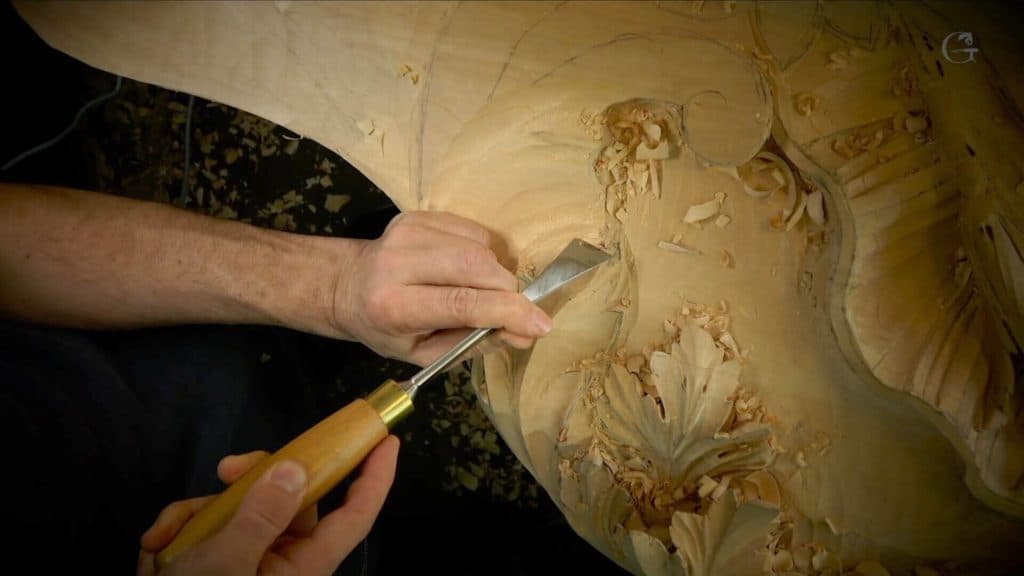
Alexander Grabovetskiy, woodcarver, School of Woodcarving · Published 2020
What does a wood carver mean by "quick fix"?
Quick answer: In Venice Room 66, part 1, I called one way a quick fix and named it: the big tools, for cleaning, and the skew. Other lessons of mine name a quick way too, with a skew, a bigger gouge or a knife, and a few of them say what it costs.
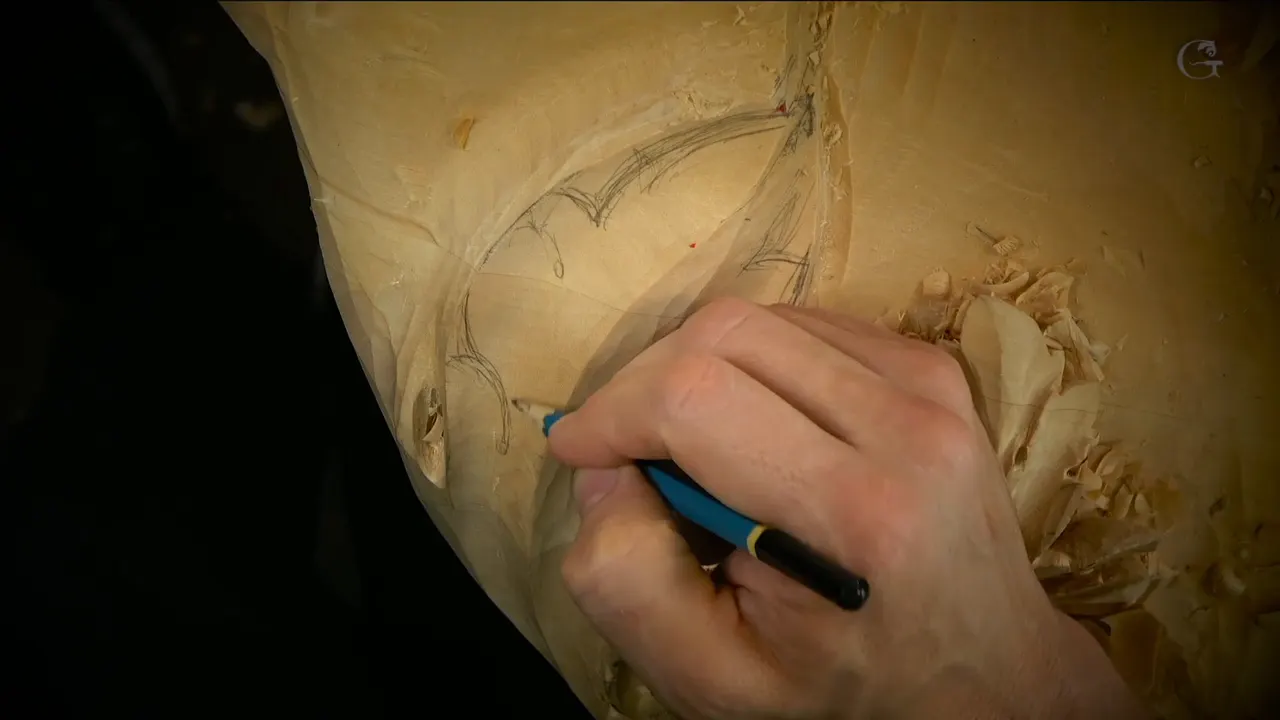

"There's always a quick way, quick fix, I should say." Those are my words near the end of Venice Room workshop 66, part 1, and I named the tool right after them. Other lessons of mine name a quick way too, and some say what it costs.
Have you ever stood over a wide, deep cut and wished its wall would clean up in one pass? Does a big gouge look like the fast way to you? Below are my own words from this part and from other lessons, each one tied to its lesson. Hear what I said the quick way gives, and what I said it leaves behind.
Where does a quick fix come up in my lessons?
- The skew chisel, to blend a cut and give it a slope.
- Bigger gouges, number 11 to 7.
- A knife, to outline first and work around.
- The price some lessons name: lost details, a tear, or a tool mark left on the background.
What did I say in part 1 of workshop 66?
The part opens with "I'm ready to do some details now." Next, "I kind of like the movement, although my middle line is supposed to go downhill right there." The plan came next: "And now I need to develop my details. At least the main divisions and the main subdivisions."
It was a long leaf, so I said "I have to do multiple divisions." Next I doubted myself: "I'm not sure if I should do that big, or maybe I should do one big division like that." My plan became a little wider area with just one division there. Then: "Yep. I like that."
I said you probably did not see what I was doing, because it was a little too high. I asked myself whether this part should overlap that part or go the opposite way, and said "probably, logically, I want to do this part going to overlap that." Then the tool, as a plan: "Three millimeters, number 11. That's what I'm going to use." That is 3 millimeters, or about 1/8 inch. After it I said "let's chop," and named "Some relief cuts."

About one area I said I did not want to go too deep, because of the lower part: "which I do not want to lose." A little later: "Yeah, don't be afraid." Then "Get little deeper excavation at the area of eye."

Then came the blend. "Let me use a big number 11, 30 millimeters," I said, which is about 1.2 inches. I named the cut: "cut opposite direction and blend that this way against the grain." Afterward: "But at least I kept the overall slope."


Another tool I weighed: "which I could use just probably number seven, I would say." Its size: "14 millimeters, by the way. It's a half an inch, number seven" (14 millimeters comes to about 0.55 inch). Then "So at least that already feels like it's going in."

The clean-up was a plan too. "Let me clean it first with the number 11." After that came "Let me chop the sides," and "let me establish this side." My reason: "I need that space open because that's going to be the lower part development, and I need to make it visible."

Near the end of the part: "Yes, of course, there's always a quick way, quick fix, I should say. Quick fix to use the big tools and clean with the big tools, just like that, with the skew. That's what I did, okay?"

What did parts 2 and 3 add to that line?
Part 2 starts with a size. If you have a big gouge, I said, like mine at three inches (about 76 millimeters), a little bigger than three inches, you can always chop that way too. Of the boundary: "it's going to give me the boundary. Good boundary." Then: "And that's it."

In part 3 I said "I can use probably just a skew." Later in the same stretch: "Okay, wonderful. So it curls."

Which tools did I name for the quick way?
Here are some of the lessons where I said quick or quickest, with the tool I named in each.
| Tool | Where I named it in my lessons | Words |
|---|---|---|
| The skew | Along with big tools, here in workshop 66 | Quick fix |
| A skew chisel | After weighing a number five, in workshop 34, part 6 | Quickest way |
| A bigger tool | To lower it down a lot, in workshop 36, part 2 | Quickest, I would say |
| A super huge gouge | To remove a mess, in workshop 75, part 1 | Really quick |
| A number 12 knife | To follow a pattern, in the Roman course | Much quicker |
| A back bend | On a cut I called not the safest way, in workshop 72, part 11 | Not the safe way |
Is the skew the quick way to blend?
Weighing tools for a blend, I said in Venice Room 34, part 6: "Maybe just the number five or so, or even number three." Then another pick: "The quickest way and just use a skew chisel." After it came "Yeah. Give a really nice slope like that."
The same pick again: "So it's always the quickest way I'd say. Quickest and sometimes it's the cleanest." Of how it comes out: "Gives really clean results, especially when you don't do a lot of details, let's say. So that would be a lifesaver because you can get your shapes really quickly."
The same pick appears in Venice Room 29, part 3: "there's multiple ways I could blend it. But quickest probably for me would be just use a skew." Next: "And take that down a little."

In workshop 94, part 7, I said "Skew is actually a really quick way, but I have to be careful." Then: "I still want to give that the feel of like a convex." Later: "I don't want to destroy my middle line because it has a really nice arch or arc."
When is a bigger gouge the quick way?
An outline comes first in Venice Room 36, part 2: "Well, first I need to outline nicely around." Then comes "the quickest way would be to use bigger tool," and I said "like number 11." The sizes I weighed: "18 millimeters or even 20 millimeters" (about 0.7 and 0.8 inch), "because I have to lower this down a lot."

I added "I have to be mindful the direction of the grain." If I kept going, I would damage it, I said.
A mess to remove comes up in Venice Room 75, part 1, "just to get really gradual movement." "The quickest way, probably just to use a super huge gouge like this, number seven," I said. After the pass: "Really quick." And "So I left approximately three-quarter of an inch, about 20 millimeters or so, in this area."

The Furniture Panel course says it too. Its lesson 21, part 5, has "And yes, there is a shortcut. You can always use a bigger tool, let's say like number 7, if you have." My size: "in my case, I could probably try to use 20 millimeters, number 7" (about 0.8 inch). Afterward, "So it automatically gives me really clean cut."

A closer match is the pick in Venice Room 57, part 1: "the quickest way is always just use whatever closest gouge you have." The pick: "In this case, I'm using number five, and this number five is about 10 millimeters, I would say, about three-eighths of an inch." Then "number six and about 16 millimeters" (about 5/8 inch).
For a profile, the Roman course has the same idea. From lesson 10, part 5: "if you do have a selection of gouges, you can find the gouge which fits the profile, and that's probably going to be the quickest." Then "just place it on the line and make your cut down." The size: "I'm using number six right now and a three-quarter of an inch" (about 19 millimeters).
One more comes from Venice Room 24, part 12: "That is not the right way I'm doing it, okay." Then "There is a much quicker way." And "I could use a bigger tool, but maybe" is an option I raised.
When is a knife the quick way?
I was outlining a border in Venice Room 92, part 9. "I can just outline it all." It was, I said, "probably one of the quickest ways." The one downside: "you really have to control the depth of cut, okay?" Cutting too deep, I said, "you can get in really big trouble."
What the knife gives me: "the quickest probably way I would say, at least for me." And "I can actually outline right away the whole border."

Lesson 22 of the Furniture Panel, part 10, has "You could take just a normal knife. In my case, it's a number 12." Then "you could use the knife to outline first and cut it." I called it "actually probably" among the "quickest ways."
An alternative to the gouges comes in Roman lesson 4, part 1: "we could use just a number 12 knife." Then "We can just follow the pattern just with that knife. And that's actually much, much quicker way to work around."
Part 1 of Corinthian Acanthus 3 has "I could actually take my carving knife, number 12, and just follow the line." And on the wood: "that works if the material you're using, it's lime wood or basswood." What I liked about it: "it's much quicker." The Greek course says it of lime wood: "I found with the knife, especially on the limewood, sometimes it's the quickest just to go this route," I said in Greek Acanthus 2, part 1.
In Greek Acroterion 3, part 2, I said "It's just probably the quickest way," and I was shaping the whole acroterion pretty much with one knife. The chips: "really big, you can call it chips or chunks of wood. Really heavy cuts."
Which price comes with a quick way?
Part 6 of Venice Room 20 says it outright. "And yes, I know there is much quicker ways to do all that stuff, but if you want to do a quick way, you're losing a lot of details. You are." And about trying it: "I've done quick."
"It's not always the best." Then "It's acceptable, but it's not an art," and "It's just a more as a trade."
In Venice Room 6, part 10, I called one way "a little more dangerous, but a little quicker." Its tool, as I said it: "a straight gouge, like a number one." Later I said "That is quickest way. Not always the best way, by the way. Okay?" The price, in my words: "that is actually creating some stress. So it spreads apart the fibers of the wood." The other way I named: "just take a V tool and create preliminary cuts," attacking "from the sides."

A different price is named in Venice Room 72, part 11. First "Let me use a back bend, same number five," then "So number five and half an inch" (about 13 millimeters). Of the cut, "A lot of tear. Like I said, that's not the safest way, but that's a really quick way for me, okay?" Then "Not the safe way, but really quick."
I weighed the knife there too: "I could get it done with the knife also, but knife doesn't have that sweep."
Furniture Panel lesson 22 gives the knife a price: "when you dig in, you limited how much undercut you're going to do." Its tool mark: "the point of the knife can leave, on a background or on a lower level, a mark, tool mark, which is not going to look as nice."
Is the quick way always a big tool?
A small tool answers that in Venice Room 14, part 5: "I could use probably a small 3 millimeters gouge for those sections because it doesn't create too much stress on the wood." Then "sometimes that small tool is actually the quickest way to create a clean notch without creating too much mess." Three millimeters is about 1/8 inch.
For a mid-molding in Venice Room 6, part 6, I said "Let me try first one of the technique. I should say this is a quick way." My tool was a plan: "I'm going to use a number eight backbend."
Another one is in Venice Room 37, part 11: "And maybe I should just do a quick way." Then "There is one." And: "I'm not afraid of losing the sides."
Where can you watch the whole part?
Every lesson above sits inside one of my carving courses, so a full video stands behind each quote. This workshop holds all twelve parts of workshop 66, and workshops 62 to 73 are in Venice Room Part 6. Go back to workshop 65 or on to workshop 67. To watch the full videos, start here.
How it's done
- Chop a boundary with the biggest gouge. Part 2 has me saying a gouge a little bigger than three inches (about 76 millimeters) can chop a boundary, even if I divide the area more afterward.
- Blend with a skew. Workshop 34 has me weighing a number 5 or a number 3 for the blend, then picking a skew chisel for a really nice slope.
- Match the closest gouge. From workshop 57: the quickest way is whatever closest gouge you have.
- Control the depth with a knife. With a knife, workshop 92 says, cutting too deep can get you in big trouble.
- Count the cost. A quick way costs detail, says workshop 20.
Frequently asked questions
What was the quick fix in workshop 66?
Right after saying it, I named the tools: the big ones, and the skew. Part 2 then adds that a big gouge can chop that way too and give me a good boundary, and part 3 comes back to the skew for a curl.
Is a skew a quick way to blend?
Three lessons say so. Workshop 34 calls a skew chisel the quickest, and sometimes the cleanest. Workshop 34 adds clean results when you do not do many details. Workshop 29 has quickest probably for me. Workshop 94 calls it really quick, then asks for care with it.
Does a quick way lose detail?
Workshop 20 says yes, and I said I had tried it. Quick is acceptable, I said, and not an art. Workshop 72 mentions a lot of tear on one back bend cut. Part 10 of workshop 6 says its quickest way creates stress and spreads apart the fibers.
What to carve next