
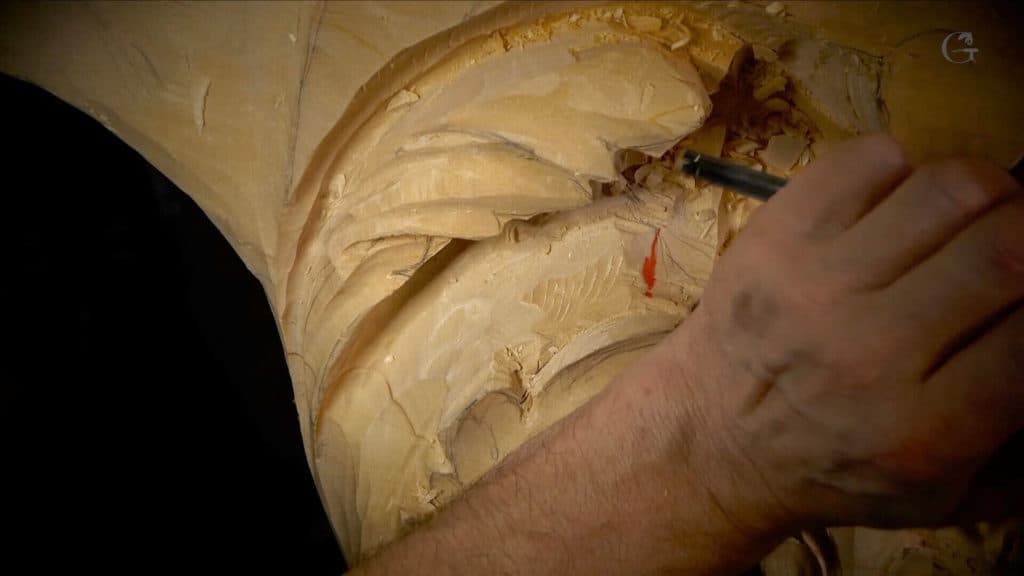
Alexander Grabovetskiy, woodcarver, School of Woodcarving · Published 2020
What does a wood carver mean by "now it's all about the details"?
Quick answer: The words came in Venice Room 66, part 8, after the last concave beside a pipe, and then I talked about a little junk and a ridge that was too hard. In other courses the same words come before cleaning, blending, patience and refinement, each lesson linked below.
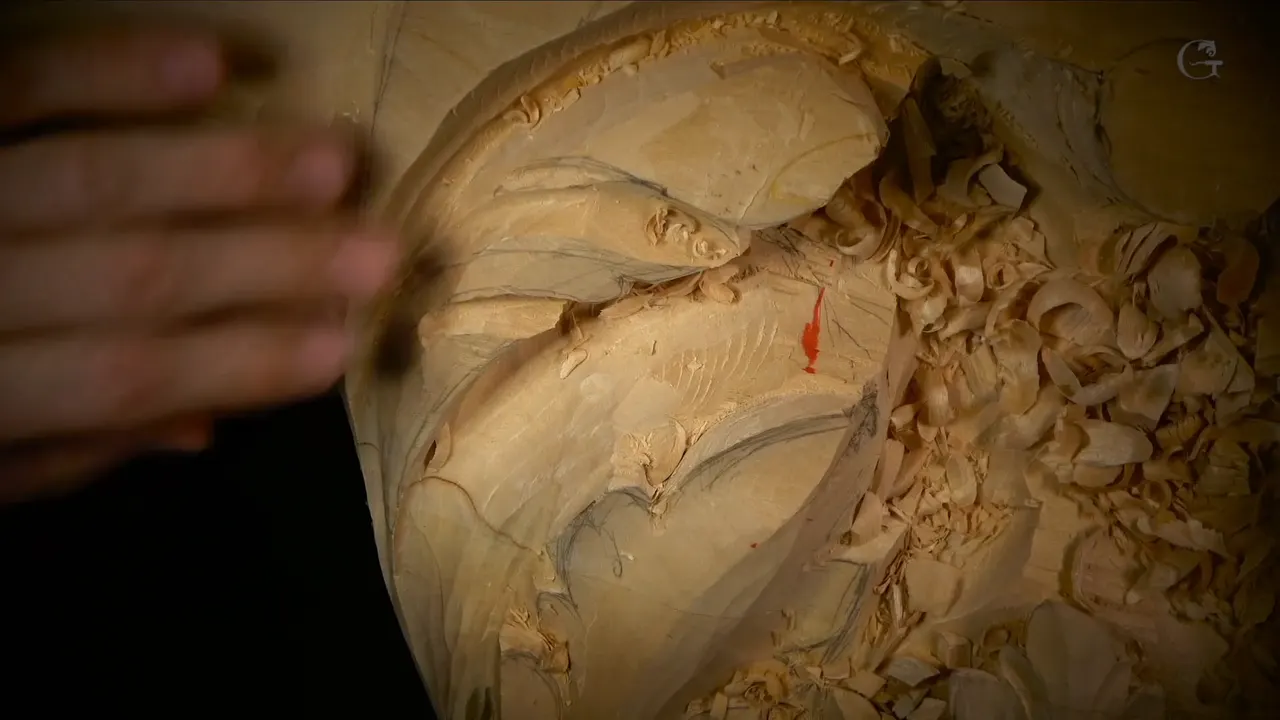

In Venice Room workshop 66, part 8, I got to the last concave beside a pipe, said "And that's it. Now, it's all about the details," and then talked about a little junk and a ridge. Below you get what came after those words, plus the places in my other courses where the same words turn up before cleaning, blending and refining.
Ever finished the big hollows of a wood carving piece and felt unsure what comes next? Would you like to hear what a carver does at that moment? Come along into part 8.
Which tool came before the line about details?
I opened with "Let me attack from that position, make a little cleaner cut." Then I said "All right. That's good," and said I needed a second concave: "And I need the second concave, and I'll get a bigger tool."

"I think bigger tool will work much better. Even maybe 20 millimeters. We'll see if it's going to work out or not." Next came the name: "20 millimeters, number 11. Okay. Right there. Three-quarter of an inch." A #11 sweep on a gouge, 20 millimeters across (about 0.79 in), is what I named.
I gave a reason: "And if you would ask me why, because I really need the concave-convex movement that gives me." Right away, I said, it "gives me clean cut."

My words were "I match really good," and the view from below came next: "And that's visible also from the bottom because I lowered down a little at this side." Next I said we attack and make sure it is visible from "all the positions."
What did I plan for the next concave?
Another division would come later on, right there, I said. For that spot I needed another concave, with that side raised a little, and I would use the same tool.

"And blend that little bit. But you should be able to see the three dimensions again. That is good." About depth I said "I did not create too deep concave right here. I could, but I don't really need to. Maybe just a little bit."
I called the next spot the last movement, and said a pipe would sit there. "I need to create a concave on the side of it. Use a big tool at the beginning." The concave would go, I said, "from all the way underneath."

How deep did I go beside the pipe?
"And that is good. I'm not going to go deeper than that because I still need some of the thickness." Before the line came the last words about depth: "All right. Some of the thickness." The next words were "Okay, wonderful. And that's it."

Which ridge came next?
The next words were about junk: "Clean a little bit this junk." Then a ridge. "Now, I need to soften a little bit this ridge because it's too hard, and that is not good."
My thought was a bent tool, "probably back bend." Then: "But which one should I use? That's the question because I think maybe number five or number three." I added "Maybe number five at half an inch" (12.7 mm).

"It is a little too hard." And this way, too. A slip came next: "Yes, I hit a little bit my raised-up concave, and that's no bueno. I'll just fix it with the big tool again."
Next, my verdict, with a hedge on it: "That is absolutely wonderful. Again, that is my opinion, of course."

Why did I call a part too pointy?
"Now I can put little nicer details on it, and there's going to be extra divisions on inside because right now it's just too pointy."
One movement was long. "And this one needs to be a little shortened also. Maybe yes, maybe I don't need to." Keeping it long was an option, I said, "because I'm explaining to you, but beside you, nobody else is going to know that on a Venetian style, you're not supposed to have long movements like that."

The last lines of the part were these. "Okay. It's okay. We'll develop something new and get that thing done. That division." And about the wood I said "And yes, I am working against the grain. I'm not supposed to, but it's okay. I hope it's not going to damage it."
Do the same words show up in my other courses on this site?
They do, and the next word changes. Details, final form, patience, blending and cleaning all follow it somewhere. Each lesson below is public, and each quote is from my own recorded words.
What comes after it when the word is details?
In Furniture Panel 6, part 2, I said it about an acanthus claw. Before it came "Let me work on details of this acanthus leaf," and after that "claw of the acanthus. That's how I call it."

Furniture Panel 23, part 4, puts it after "Now, I don't want to rush anything." It went on: "And we can do really beautiful details, or we can do really bad details." It ended with "how you take your time and just create something."
The same part has a plan for a second movement: "go from this point, go like that inward." I called it "just also to trick the eye, if you wish."
A ridge is in that part as well. I did not want to see ridges that were too sharp, and I needed "probably smaller number three, one-eighth of an inch, and blend everything nicely." One-eighth of an inch is 3.2 mm.
Lily Box 10, part 9, has it with a flower. "So overall flower actually has a shape already." I finished it with "how much detail I want to add to it." Next, a judgment of the flower: "This one has too much flatness. I'm talking about too flat right here. Okay. So I need to give some roundness."

Then: "Use a number one and double bevel with really low bevel." My next line was "And work on my details."
Over in Grape Onlay 9, part 3, it was "details pretty much." Just ahead of it I said "And maybe, uh, just a drop slightly this side," and after it "I'm gonna just drop it all the way to the background almost."

What follows when the word is the final form?
In Hashemi 22, part 3, what followed was "make the final form look nice, and I have to just find the right sweep." I tried one: "Try the number eight. It's pretty close, but it's too big or too small. Get the bigger ones. This one's good."

Hashemi 30, part 4, has me saying "make it look more or less finished." I gave a reason right away: "Because you can see some rough spots, and they're not too appealing." The tool was a maybe: "I could use, again, number five," and then "I'll make different movements with this."
I also said "it doesn't have to be really smooth." Then: "Also, maybe smaller number nine. Maybe quarter-inch number nine, and make some more concaves." A quarter inch is 6.35 mm.

Hashemi 33, part 4, has "I like overall shape." Then the line itself, ending with "just the refinement, just how extreme I want to go with that." A small tool came next: "Maybe I can use a really small, tiny gouge, like number eight, and create multiple spots, really small, tiny concaves or concave cuts."
"It's going to give me a more three-dimensional look, more shadows." Next: "Let me clean the edges."

Is the next job waiting instead of carving?
In Hashemi 6, part 5, I followed the line with "How patient am I?" The reason came next, "Because I can't rush it. I can make a big mistake if I'll do." I was using just number one, I said, "and I know sometimes my hand is in the way, but it's the only way I can get to it."
Waste was the word in Hashemi 9, part 2: "removing all that waste," and then "And for that, I'll take again number nine." One more plan was for the other side: "And I also going to attack from opposite side later on."

Of my cuts in Hashemi 32, part 2, I said it was "how you control your tool." Close behind came "there's almost absolutely no pressure. I don't create any pressure, I should say."
What changes when blending is the word that follows it in my lessons?
Venice Room 119, part 3, opens that way, and you can watch it in workshop 119. Next I said "Let me check what I do. Just blend everything." And "refining all of those separations that need to be refined."

For the tool I said: "I need to take number seven. Or actually, you know what? I'll take number five." After that, "And carefully establish my cut," and later "Really important for me not to rush it."
The same word turns up in Grinling Gibbons in Maine, class 9, part 3. Ahead of the word I said "I'm gonna excavate a little bit in the middle But again gotta be careful." Afterward came "Just indication."

Chamomile and Bow Rosette, lesson 1, part 3, runs it twice: I said it, and then said it again with blending at the end. Then: "It's blended, so you can just use a flatter tool and remove all those facets." Earlier in that part I had a plan: "Later on, I'm going to definitely undercut."

What if the next word is cleaning?
Over in Hashemi 20, part 2, it came as "cleaning, cleaning, and cleaning." Then came "Now it's looking rough," and "I have to blend it in." A plan followed. "Although, I could take just a big number 7, one inch, and make one beautiful cut." One inch is 25.4 mm.

Part 4 of Hashemi 39 has it right after "And that's it," just as workshop 66 does. Then: "every little detail like that creates a beautiful shadow and a light point." Next came a plan to "excavate even deeper underneath."

Of the spot I said "Though it's not the best area because it's the grain running this direction, but I should be fine."
Part 6 of Venice Room 3 has "cleaning on the inside." My thought was "I could actually use number three, just a spoon gouge." Then: "Well, actually, I need to cut a little deeper. I didn't cut deep enough right here."
I used the word junk in Venice Room 18, part 9, too: "Okay, that's all junk. Let me brush this out." After the line came "I think it's enough undercutting right here." Then: "This detail is too weak. I don't want to make it too weak."

Venice Room 83, part 9, goes on with "It's the same process that I've done before." Then: "Clean those eyes, get a really deep excavation."

Part 12 of Venice Room 87 has a tool in it. "Which I could do off camera very much. But I know some of you really want to see the process." Then: "It's still number three, but a different brand. This one is a Henry Taylor, and I have a really big bevel on this one. So I can shave really nice, almost like planing."
Part 7 of Hashemi 49 has the line after I talked about the last petal going underneath another one. Then: "It does look like a flower."
Where else did I end a stage with "And that's it"?
Back in Venice Room 119, part 3, I said "Now what I have to do, just clean up," and then "And that's it." Then: "The main movement is done. Just lots of cleanup and undercut, which is nothing exciting. It's pretty much the same operation as always." My next move was "I'm going to take number 11 and attack from different points of view and get my excavation deep."
Part 9 of Venice Room 83 has the same ending: "And that's it. Pretty much this section, what needs to be done is just to clean up and make it lighter, more light, airy, if you wish." Next: "And yes, maybe I should probably touch a little bit with the sandpaper."
How do those lessons line up side by side?
| Lesson | What I said | Next |
|---|---|---|
| Pipe, Venice 66.8 | That's it for the concave, now details | Clean junk |
| Flower, Lily 10.9 | The overall flower already has a shape | Too flat |
| Form, Hashemi 22.3 | Now make the final form look nice | Find sweep |
| Finish, Hashemi 30.4 | Make it look more or less finished | Rough spots |
| Refine, Hashemi 33.4 | I like the overall shape, now refinement | Tiny concaves |
| Wait, Hashemi 6.5 | Patience now, because I can't rush it | Number one |
| Blend, Venice 119.3 | Just blend everything, then refine the separations | Number five |
| Blend, Chamomile 1.3 | Blended, so use a flatter tool now | Remove facets |
| Clean, Hashemi 20.2 | Cleaning, cleaning, and cleaning, then blend | Number seven |
| Clean, Hashemi 39.4 | Every little detail creates shadow and light | Dig deeper |
| Clean, Venice 18.9 | I think that is enough undercutting here | Too weak |
| Clean, Venice 87.12 | Number three, big bevel, almost like planing | Henry Taylor |
Where can you watch every line in full?
This part belongs to workshop 66, and the whole panel sits in the Venice Room Part 6 course. The lessons before and after it are workshop 65 and workshop 67. More of my lines sit in Hashemi Flowers and in Furniture Panel, and each course is on this site, with the tuition shown on the start page.
How it's done
- Name a bigger tool. A number 11 came with a maybe in front of it, and I said we would see if it worked out.
- Lower one side. I lowered down a little at one side, so the concave stays visible from the bottom.
- Stop going deeper. Going deeper stopped there, I said, to keep some thickness.
- Name the junk. Right after "And that's it," I talked about junk, and then about a ridge I wanted to soften.
- Fix a slip. My raised-up concave took a small hit, and the big tool was my plan for the repair.
Frequently asked questions
Which gouge did I name for the ridge I wanted to soften?
A back bend, and then I asked myself which one. Number five or number three, I said, and then possibly the five at half an inch (12.7 mm). All of it was a maybe, spoken while I talked about that ridge.
What happened when I hit the concave I had raised?
I hit a little of it, and I called that no bueno. My plan was the big tool again. Once that was done I said the spot was absolutely wonderful, and I added that this was my opinion, of course.
Did I shorten the long movement?
I left it open. Maybe I would, and maybe I did not need to. Keeping it long was an option because I was explaining, and I said nobody else would know about the Venetian style and long movements like that.
What to carve next