
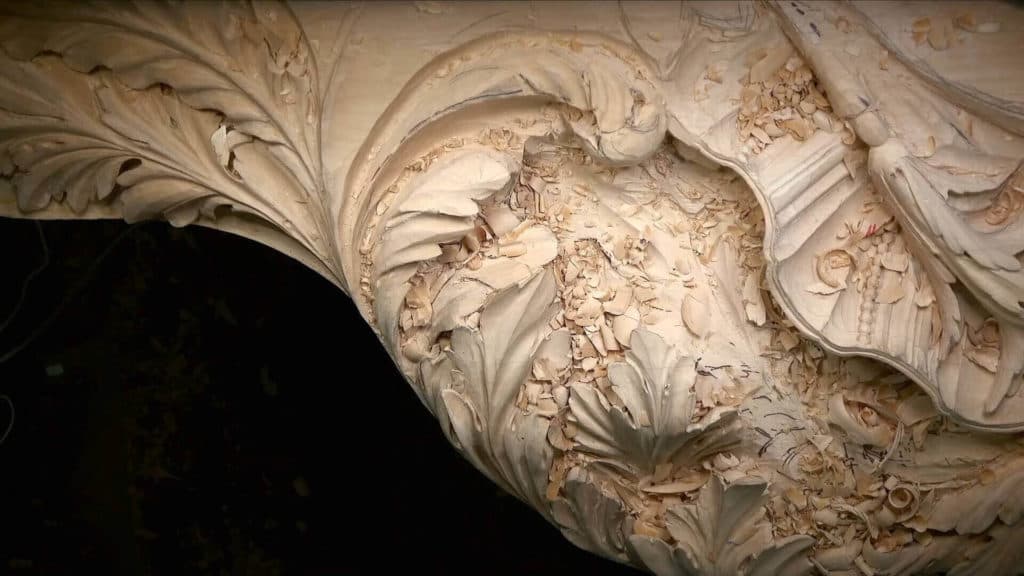
Alexander Grabovetskiy, woodcarver, School of Woodcarving · Published 2020
What does a wood carver mean by "taking shape"?
Quick answer: In part 10 of workshop 69 in the Venice Room I use these words about an acanthus head. In the same passage I say the head still needs work and more divisions. Below you get every other lesson with the same words in it, with the lines around them.
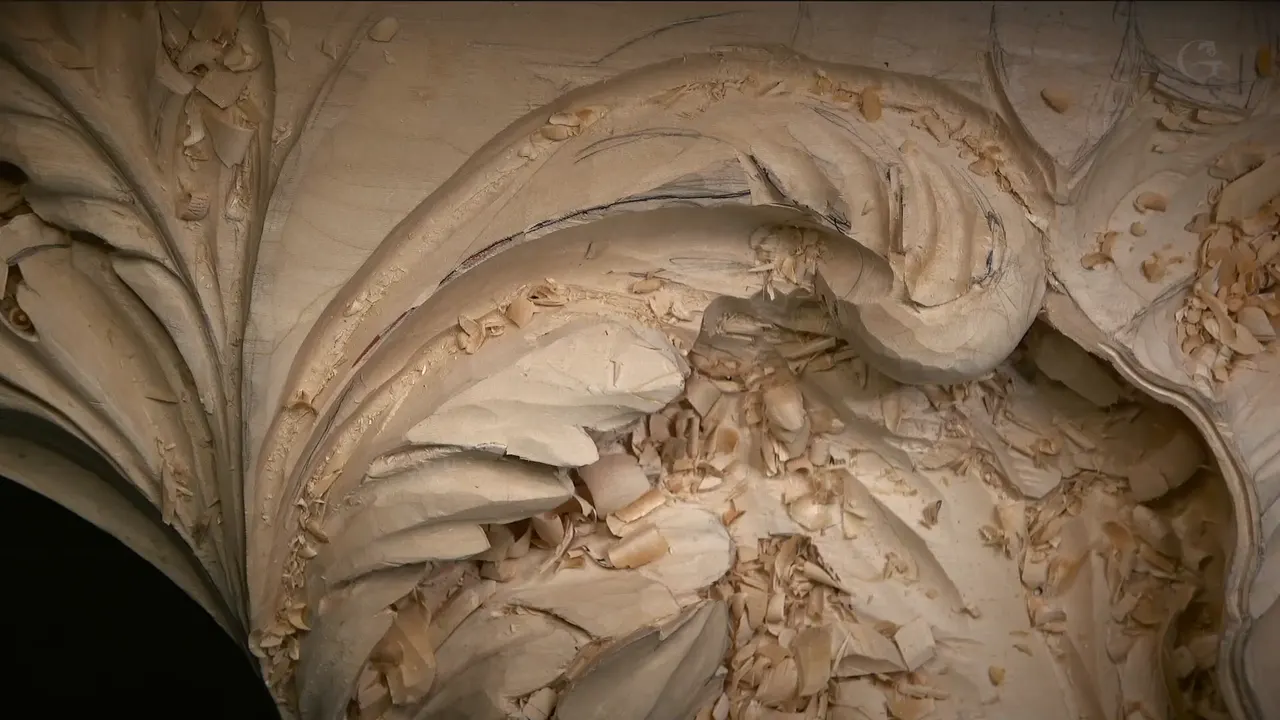

Part 10 of workshop 69 in the Venice Room holds these words about an acanthus head, and I say what is left to do on it. Below you get that part, then the other lessons that hold the words, each with the lines around them.
Ever stopped in the middle of a carving and wondered if it is going the right way? Come into this Venice Room wood carving lesson and hear what I say next.
What was I doing before I said it in part 10?
The video opens on "And maybe I can actually do a deeper," and goes on with "now I can actually get little longer cut if I want to." Then a plan: "let me use a twist little bit to the right and clean slightly this side."
Another side is next. "Let me cut on another side," I say, then "Same idea," then "Little by little."

My hand gets a mention: "But again see, I've got three fingers right now referencing and positioning really solid on the piece." Next comes "Okay, that is good. So now it's going to be convex, convex, and convex."
I look ahead: "Later on I'll fix the final shape, but now I'll just... Well, actually you know what? Why don't I use just a different tool, like maybe number three or so. And right away, just knock down those ridges. One side, then another side."

A limit comes up. "And yes, I'm not able to attack that from opposite direction," I say, and "That is already ceiling, so there is, for me, impossible to place a tool."
What did I say after the words?
The passage in full runs "Okay, and I think it is taking shape. I think it takes shape really good, actually. Except I still have to work on the main ball, or not the ball, but head of Acanthus."
I carry on with "And I need to make some more divisions, which is going to go somewhere right here."
Next, a thought about opening the piece: "And maybe actually can do extra division right at this region, and completely open up that part. I'm not sure if I should or not," I say, but I think it will look much better.

The idea grows. "Or even, you know what? What I can do, I can actually create huge eye, huge opening," I say, which will give me "extra shadow," and I think "extra beautiful movement" too. Then a pause: "Let me think before I do that."
Sizes follow. "So let me create that huge eye. I'll use a quarter inch, six millimeters, number nine, and create my hole." One quarter inch is 6.35 mm. Again: "like I said many times, it's a plug removal cut."

A second job: I need to "excavate some material from this triangle." That tool "would be little too big," so "I'll use three millimeters" (0.12 in), and "yes, number 11, of course."
Something happens, and I say it is okay, "because anyway, there's going to be another cut." Then "I know it looks messy yet, but it's going to look good."
The video ends on a plan. "And you know what? I could actually open up this section right away. Let me use a quarter inch again, and that would be number nine," and then comes a plan to create my cut inside.
What do the two parts next to it say about the same head?
Part 9 has "I like that that part is overlapping the main head of acanthus." Next, "And don't pay attention, that is little rough right now. It's not the final shape yet of this upper part," and "It's just a matter of cleanup." My overall view: "But overall movement, I am happy."

A gap shows in part 11: "I'm leaving about 10 millimeters space between the upper point and the lower, like a ceiling of my future dome" (0.39 in). It "also has to be strong."
It shows a hole, too: "I've got pretty deep hole inside." Depth: "Maybe about 20 millimeters or so. That's what I got. Like three-quarter of an inch" (0.79 in), and a shadow is my goal: "a shadow that I'm after."
"But preliminary, I'm happy what I see," I say. On how deep the next concave should go: "No, probably not, because I don't want to lose overall sphere feel." The part closes with "I don't really like how bulky this area is, but that's okay," and "We can always fix it."

Where else do I say it?
In Hashemi Flowers lesson 6, part 1, I start with a line: "I never put my line in the middle of the leaf. I still want to do toward one side or another." If this side is higher, I say, the middle line sits "closer to the higher side," and that creates "even more of a 3D look."
Undercutting follows: "So now I can actually go as deep as I wish with undercutting. And take a mallet." I call it "a preliminary undercutting." And: "you should get an idea the way I do it." And then "That's already taking shape."

Greek Acroterion lesson 3, part 4, puts the words on a concave: "But you can see that concave actually already taking shape, and that's a clean cut, so I don't need any sandpaper on that."
My hand comes next: "when you're now holding your gouge, you're trying to raise sometimes your gouge like this and just start digging, but you can't control that way." And: "You're placing your hand right on a piece of what you're working on, and your gouge is as low as possible."

A deep shell gets the words in Venice Room workshop 2, part 2: "It's actually taking shape." It goes on: "even if it's a three quarter of an inch on inside, but it's still I'm getting like a deep shell, and that feels really, really good." Three quarters of an inch is 19 mm.
A tool follows: "Let me get again number nine, 20 millimeters" (0.79 in), "and remove that waste I just produced, and I can actually go deeper." My reason: "Because I think that is a focal point of overall design, and I need to draw attention to it."

The wall comes up: "Now I've got about 25 millimeters wall, which is very good, I'd say. Could go even deeper" (1 in, nearly). And I say I should go deeper because it will be a big bowl, and "I want to make it look really nice."
A leaf in workshop 25, part 7, starts with "Straight tool or straighter, I should say, straighter tool." My plan: "I can use probably just number five and a quarter inch and attack those corners" (about 6 mm). Then "But by now you should see that leaf is taking shape. Okay?"
It is not done, and I say so: "I know it's not the final form because it doesn't look too clean and nice, but I will clean it. I'll clean it, and I'll make it to the perfection."

In workshop 48, part 11, a need comes first: "But probably I need to go a little deeper concave again." Then "I know it just doesn't look yet too appealing, but it will be. So that is the center."
Next: "But anyway, you should be able to see already it's taking shape. And that's not bad at all." Another need: "So I need to create another probably concave." And: "Maybe number seven will be sufficient."

On a pipe in workshop 71, part 9, I start with "So now, I'm going to give some roundness to this movement" and "I'm using back bend." I say it will be a pipe, "which is going to go all the way," and "I like how it takes shape already. I'm really happy."
I plan the next pass: "Let me clean a little bit with that number 11 and 5 millimeters" (0.2 in). I warn myself: "But I've got to be careful again. Really have to be careful." The next idea: "Maybe I need to use a smaller number 11," and I name 3 millimeters (nearly 1/8 in).

Short concaves come in workshop 91, part 3: "But still just create the illusion that it's folding this way. Just like that with the smaller number 11." One concave measures "five millimeters" (0.2 in). After that, "And yes, I need to blend it from underneath," and "At least I think it takes shape." Another plan: "Maybe I want to do a deeper concave right here."

Workshop 136, part 1, says "But that's already, you can see how it takes shape. That doesn't look too bad at all." I go on: "I want to slope it different directions," which will give "a lot nicer movement."
Tools: "Number two or number three will work." A size: "maybe about 5/8 of an inch or so, or 3/4 of an inch" (16 mm or 19 mm). "And use it upside down."

At the end of Lily Box lesson 10, part 14, I think of a smaller gouge: "I think it's time to move on a smaller gouge," and I name 3/32 of an inch, number eight (2.4 mm). That ends with "I think it's enough. It's enough for now."
Closing lines: "But for now, I see that it's taking shape. For me, it does look like a lily flower," although "there is some imperfections, like this one. It bugs me a lot, I should say, that it did not hold."

The grape onlay, lesson 1, part 3, has "Now I'm just framing my house." Also "if you wanna do a somewhat more accurate look of it, you could probably work on it," and I tell you that you can "obviously see" it taking shape.
I explain that touching it and working on other details turns it black, with oxidation and patina, which is sometimes good and sometimes not. And "That is why I don't really worry about the final, final, final look of it until the end."

In Greek Acanthus Leaf lesson 5, part 2, I call a step "not a really necessary step, what I'm doing," but "I kind of like to see" the outline "before I just do the next step." Then "you can see" it is "taking shape as we carve."
A fix follows: "I think I'm almost there, except what I said, I'm going to refine this detail because I kind of don't like how it looks, and move this line this way and this line that way."

Lesson 11 of the same course, part 1, opens with "we are doing an undercutting," then "taking shape right now, and I do like what I see." Once it is done, I say, it will look "much, much better."
Which other words do I use for the same moment?
In part 11 of workshop 25: "And you already should see how it's forming the shape." Next comes "And I can actually undercut right away, too, right here."
Over in workshop 28, part 7, I make it a point: "But I see the shape, and that matters."

The line in workshop 22, part 3, is "now it is starting to look like something," and I call it my main movement.
In workshop 50, part 11, I ask you to look at how it is shaping right now, and add "it has to be gradual movement, beautifully moving in three dimensions."
In Byzantine Acanthus lesson 8, part 1, I say you can see it "more established," and then "how it looks from all the points."
Acanthus over Moldings lesson 7, part 1: "It's still overall shape is pretty much the same. But I introduced some smaller cuts and made that uneven. Just like on a real life." Then "So you see the shape?"
Then workshop 67, part 4: "Because it's a really beautiful detail coming together. Those two leaves are coming together. Really nice."
Which moments, in one table?
| Lesson and part | What I was doing at the time | Tool named |
|---|---|---|
| Venice Room 69 | a plan to knock down those ridges | number three |
| Hashemi Flowers 6 | preliminary undercutting, as deep as I wish | a mallet |
| Greek Acroterion 3 | a clean concave, no sandpaper on that | your gouge |
| Room 2, Venice | a deep shell, 25 mm wall (1 in) | number nine |
| Room 48, Venice | the center, a little deeper concave again | number seven |
| Venice workshop 71 | a pipe rounded with a back bend | back bend |
| Venice, number 136 | a plan to slope it different directions | number two |
| Lily Box 10 | a lily flower, one imperfection bugging me | number eight |
| Greek Acanthus 11 | undercutting, much better once it is done | a V-tool |
Would you like to watch the head from workshop 69 grow, cut by cut, with the hollows and the eye going in? The Venice Room workshops 62 to 73 are open to you with school access, and workshop 69 is the one with this head. Its neighbors are workshop 68 and workshop 70.

Hashemi Flowers, the Grape Onlay course and the Greek Acanthus Leaf course hold further places where I say it.
How it's done
- Go deeper where it helps. I say a deeper pass may look better, and that a longer cut is possible now.
- Keep a hand on the piece. I point out three fingers referencing and positioning really solid on the piece.
- Try a flatter tool. For the ridges I float a number three, one side and then the other.
- Say what is still missing. I tell you the head needs more work, and that divisions are coming.
- Think first. Before a huge eye, I say I want to think it over.
Frequently asked questions
What did I say after the words in part 10?
That the head needed work, and that divisions were still to make.
Which tool did I name for the ridges?
A number three. It was a plan: I asked why I should not use a different tool.
What sizes did I name for the huge eye?
My plan for the hole was a number nine of a quarter inch (6 mm). For the triangle it was a number 11 of three millimeters, close to an eighth of an inch.
Can a concave be taking shape too?
What to carve next