
Alexander Grabovetskiy, woodcarver, School of Woodcarving · Published 2020
What does it mean to commission a carving tool?
Quick answer: Commissioning a tool is, in my April 2020 livestream, getting the tool ready, a word I said people in the UK use. In part 6 of workshop 69 I said my number seven had a bevel that was too high yet, and then I sharpened it.

Getting a tool ready is what some people call commissioning it, and in workshop 69, part 6, I used that word on a number seven before I sharpened it. It came up again on livestreams in April 2020. Every line is below, with what I said beside it.
Ever picked up a new gouge and wondered whether it was ready for wood carving, or whether its bevel was still too high to trust? Then you are standing where I stood.
What was I doing before I went to the sharpening machine?
The video starts with "Okay, good. So that is probably enough." Then: "I still have to later on carve this part, upper part." I was "looking from different points of view," and from one of them "it has too much spot right here, so I have to attack that again."
The tool was "number seven" again, "just a different brand, but still number seven." Its size was "about 14 millimeters" (0.55 in). Next came "All right, let me check, and looks like it's much better."

Which tool did I call the wrong one?
"There is multiple ways to make it smoother," I said, and "this is not the right tool, I've got wrong tool, this would be better tool." My better tool was "the flatter tool, like number three."
"I understand all of you don't have tools like me, and I should probably just do my normal way," I said, and the normal way "would get the bigger tool, which is going to fit, and I need to reshape that one also."

"My bevel on this one is not established yet the way I like, and that is also number seven." Then: "But I never commissioned that one yet, I never re-established my sharpening."
My words on the number seven: "just by number seven, I was able to create the main form really quickly, relatively quickly, I would say." With the bigger tool, "I can clean it," and "this side needs to be also taken care little better."

Further in that part I said it again: "This one is not commissioned yet, like I said, see, the bevel is too high yet, so I started to remove, but I did not finish." I added, "Maybe I should take care of it pretty soon, sooner the better." The next words were "Because I really like big tools."

Do I use the word commissioning, and where does it come from?
The spoon gouge livestream is where I said: "When you get brand-new tool, I always try to commission it, okay? I don't use that word, by the way, commissioning."
Where it comes from, I told you: "A lot of people in UK, they're saying commissioning tool, okay, which is getting the tool ready, which is okay." And for the British viewers: "I call it Great Britain because it is great, I love Great Britain."
In the Venice Room I used the word on the number seven. The wood movement livestream had a box of tools that came the day before. Of a tool I tried on a board, I said, "Out of the box, it gives me absolutely beautiful, clean cut, although, of course, I need to commission to my taste."
How do I get a brand-new tool ready?
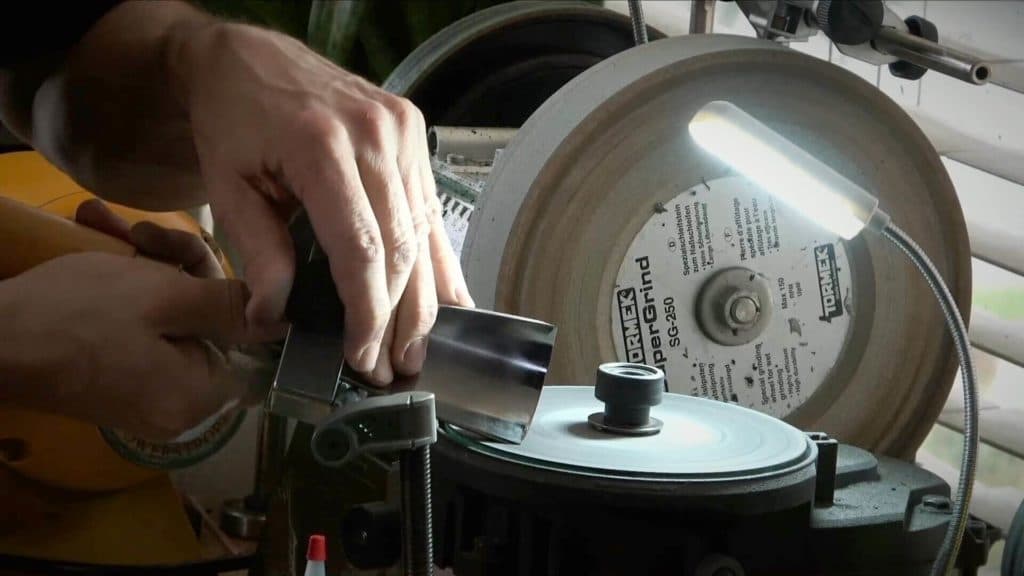
"Step number one, you have to reshape it," I said, "and the way I do, same way." Then: "If you have a tool and if you really want to get that long bevel, you're still using the same jig, okay?" Next: "It's the same like what you do on other tools, you just get the jig, and I like particularly this jig, okay, because it has a full motion rotation."
Next, the veiner livestream: "Let's say I get a new Veiner." It is "a U-shaped gouge, not the gouge, of course, it's a veiner." The number was 11, three millimeters (about 1/8 in). "And the way I commission it, couple ways," I said.

For the jig I said, "I also always check if it's straight or not, okay, so it's really important for me." And on the bar: "you place your tool on that bar, and until you hit whatever the bevel you're supposed to have." On the bevel: "you just adjust whatever the bevel you want to do, which in my case, it's usually like 22 degrees or so, even lower, I really like really low."
Next the 80 grit: "Let me get an 80 grit first." In the spoon gouge video I told you, "that is grit 80, okay, so it's really aggressive." And about the wheel: "Never use water on CBN wheels, never do that, I know some guys and some wood carvers do, but that's a big mistake."

How close do I go to the edge on the first grit?
"I usually go really close, but not too close, approximately 1/64 of an inch (0.4 mm) away from the edge because the metal consistency is not always there until I just change the grit." On the steel: "It's actually already the metal is taken out, and that's pretty quickly."
The time I saved: "I just saved right now a couple hours at least." And of the pressure: "I did not press at all, it took me literally just a few seconds."
Done by hand, the same job came to "a couple hours to take that heel out," I said in that video, and "a long, long time, even if you're going to use a diamond stone."

How did I commission the number seven in workshop 69?
"I'm pretty close right now," I said, "I'm actually after about 10 millimeters, three-eighths of an inch" between the edge and this line, "and I'm using 80 grit." The jig, "the same what I showed in a previous tutorials about the large tool."
"Yeah, pretty close, okay, 350," I said, and "okay, I'll take it to 600, really quick process." Then: "it just takes me so quick to change the grit."

"Let me get a couple steps, 800 grit and the 1,200 grit, I don't have to, it's already good." A moment later: "And 1,200 grit now."
The time I gave: "it takes me literally just a couple of minutes all together, even for the huge tool, maybe a little longer for the huge tool like that, but still really quick."
Of the finish: "that's already a really nice, beautiful finish, but I'll still take it to 3,600 and 6,000." That step, I said, is "really unnecessary, I would say. I just love it." After that: "I did right away on the 6,000, that's already giving me a really good finish."

Sometimes, I said, "I'm using a candlestick to just wax it," and "I didn't use it right now." After a grit I said, "I don't have any tool marks left, no tool marks."
The wheel does different things at different spots, I said: "Closer to outside you get, it's going to be a lot more aggressive." And: "If you want to be more aggressive, just go on outside, then just work your way in." The machine itself: "I love this machine because it's slow and it's not burning, okay, it's not burning my metal."
What did I say about the wire edge?
Right after the 6,000 I said, "Now, I do have a wire edge and I'll take care of it with another diamond stone." Next: "Anyway, I need to establish the inner bevel."

"Here you go, I've got the wire edge right now on another side." My plan was "let me take it on a leather first and just to kind of buff on inside, well, maybe actually can use a higher speed, I would say this one." My words were "pretty much just buffing out the inner bevel," and "I'm not taking out my jig yet because I still have a wire edge on another side."
"I need to use a different paste, maybe like a blue one, a finer one." Back at 6,000: "Let me take again on the 6,000, and I can pretty much remove all my wire edge like that, I even see how it flies out, that wire edge."

"Maybe a little bit just on a leather, just slightly, just in case if there is some wire edge left." Then one word: "Burr." And: "Without pushing too hard, I don't want a round effect, although it's not a big deal for me, no rounding effect."
"That is the last part of wire edge. You don't see it, but it's actually right here, right on my finger."
The burr came up on the veiner: "I'm usually working inside a micro bevel, which is always good idea to do." And: "Get my bevel in until I feel burr, which in this case already there, so I've got the burr or wire edge." Next: "Just pretty much buff it or strop it, I should say strop it." Of a glass wheel with sandpaper glued on top: "you just use that as a leather if you wish, if you're really afraid of wire edge."

What did the number seven look like when I finished?
"And that should be it, all I need is just to wipe out and take out my jig, and I'll be on the road, I think it's good, and that looks absolutely beautiful now."
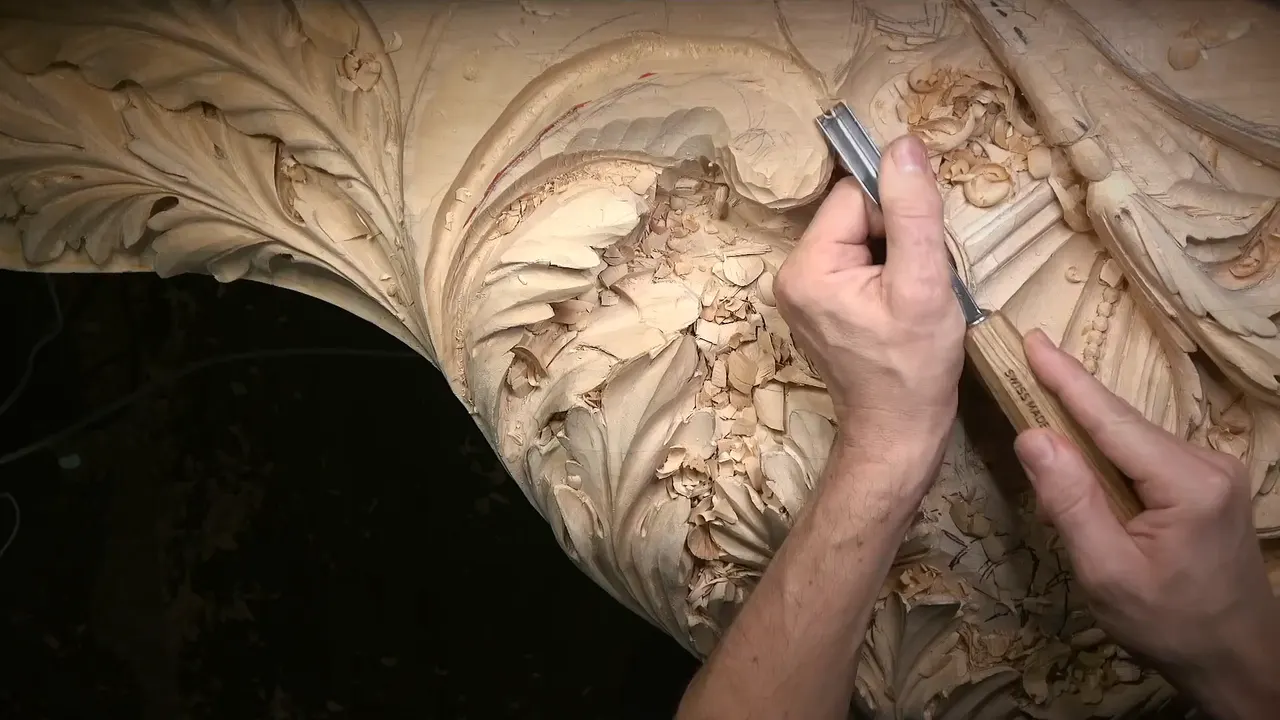
Part 7 opens with "So I've got approximately 10 millimeters, my bevel." Then: "It's absolutely gorgeous. Beautiful." And: "So now it's going to be a lot less effort to create that ball shape or whatever you call it, like a sphere shape." Also: "I can just slice through it, no problem, see, it's beautiful, I've got to be careful not to touch it because it's super sharp right now." And: "I'm checking from all the positions, and it does look like I'm getting a really good sphere."

Part 7 has the bevel line: "Why I didn't do bigger bevel on this particular tool, because I'm planning to use a mallet on that too, and I don't want to do too low bevel for the mallet tools." Then: "That makes sense because I still need to raise a little bit while I'm carving."
Do I commission only huge tools?
"I really like to use huge tools because it just gives me a much quicker result," I said in part 5, "but I do also understand that not all of you have exactly the same as what I have." I added, "I really want to make sure you're also able to do what I'm doing."
That veiner was a small tool, three millimeters (about 1/8 in). After the buff I said: "I just actually reshaped the tool, okay, so regrinds it, recommissioned, I would say, right now it's a proper bevel, and now I can just carve with the proper bevel."

Which stones did I name for the inside bevel?
My stones came up in the veiner livestream: "Translucent, I like Arkansas stones," and "first of all, it's soft." Also: "I get my inner bevel, okay, with the soft first, and then translucent."

The felt wheel finish: "I usually like to buff it, but it's actually not everyone likes to do, but I do." And: "I'm not afraid of rounding effect at all, as long as my tool carves really sharply." And the time: "Two seconds, and the tool is really sharp, okay? Well, not two seconds, two minutes without the talking."

Where do these lines sit side by side?
Here is each lesson, what the word was about and the word I used.
| Lesson | About | Word |
|---|---|---|
| Venice Room 69.6 | a number seven, bevel still too high | not commissioned |
| Spoon gouge livestream | step number one, reshape a brand-new tool | commission it |
| Veiner sharpening livestream | a new veiner, a number 11, U-shaped | commissioning, reshaping |
| Wood movement livestream | out of the box, a clean cut | my taste |
| Venice Room 69.7 | a bevel not too low, mallet tools | my bevel |
Where can you watch every lesson named on this page?
The number seven is in workshop 69, and workshops 62 to 73 are in Venice Room Part 6. The workshops on each side are 68 and 70.
The livestream lines come from Livestream April 2020. The school has a whole course on sharpening, with a lesson on the spoon gouge, one on the large gouge, one on the straight gouge and one on stropping, honing and buffing. The Maine class is there too, and so is the bar alternative. Big tools get their own page, big tools and small ones.
Want to hear each grit as I say it, with the tool in my hand? Would you like to watch the bevel come down on the number seven? Then the full part is open to you with school access, and this page starts you.
How it's done
- Look at the bevel. Not established, I said of the number seven, and too high.
- Start on 80 grit. A bevel of about 10 millimeters (3/8 in) was my aim, using 80 grit.
- Go to a finer grit. 350 first, then 600 as my plan, and 800 with 1,200 as a couple of steps.
- Deal with the wire edge. I do have one, I said, and I would work on it with another diamond stone.
- Take out the jig. Wipe it out, then take the jig off, and I'll be on the road.
Frequently asked questions
What does commissioning a carving tool mean?
People in Britain say it, I told my livestream viewers, for getting a tool ready. I told them I don't use that word myself, and that a brand-new tool needs reshaping.
What was the bevel on the number seven like in workshop 69?
The bevel on that tool, I said, was not established yet, and it sat too high. I started to remove but did not finish. After that I sharpened it on 80 grit.
How long does it take me to sharpen a huge tool?
In part 6 the figure was a couple of minutes all together, even for the huge tool, and still really quick. By hand, in the spoon gouge session, I put one heel at a couple of hours.
What to carve next
- Venice Room 69 lesson
- Venice Room Part 6 course
- Venice Room 68
- Venice Room 70
- Livestream April 2020
- Carving tool sharpening course
- Sharpening a spoon gouge
- Sharpening a large gouge
- Sharpening a straight gouge
- Stropping, honing and buffing
- Sharpening in-person class
- Bar alternative for sharpening
- Big tools and small ones