

Alexander Grabovetskiy, woodcarver, School of Woodcarving · Published 2020
What does a wood carver mean by "pleasing to the eye"?
Quick answer: Workshop 72 has me saying, in part 5, that two parts, 2 centimeters (0.79 in) and 3 centimeters (1.18 in), would be pleasing though nobody will put a ruler on them. Furniture Panel, Hashemi, Cabernet, Hazelnuts and Butterflies lessons carry the same word, each with its own cue.
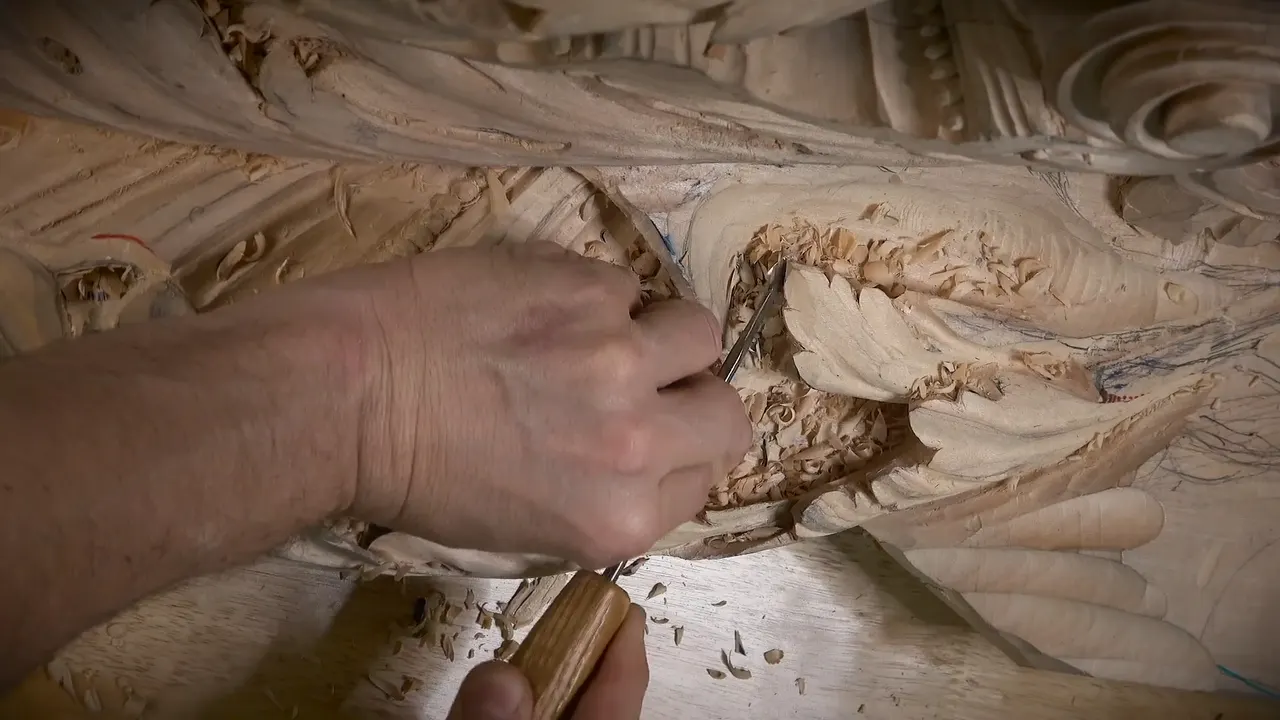

In part 5 of workshop 72 in the Venice Room I said two parts of the carving, one a little bigger than the other, would be pleasing even if nobody puts a ruler on them. The same word turns up in my other lessons, so below you get each line with its lesson and the thing I was placing when I said it.
Ever looked at a piece of wood carving and liked it without knowing why? Did a part ever sit wrong before you could say what was off? Come along through part 5, because that is where I say out loud what I was after.
What did I call pleasing in part 5 of workshop 72?
Part 5 starts on an undercut. "And I create beautiful undercut which no human being ever going to go in and see that." Next came "But oh no, it's looking good." And: "And if I know it, even if you don't see it, you still will feel it, that it's done with love." Soon after: "You should see it already. It's already taking form."

The tool came up next. If you ask me whether it would be authentic to the time period, I said, "of course, it's not." It was not used, "but they used knives, and this is a form of a knife anyway." And: "Knife is authentic."

Then a need: "And I need to attack that on inside a little bit, remove some what I don't need, and open up this area." "You already should see it takes shape," I said, and "Let me refine a little bit." The small areas would wait until the end, because I might change some stuff.
The next section got a plan. "So there's going to be a middle line somewhere and how I want to end this movement, probably go all the way that direction." A second thought followed: "Maybe I should actually end up right underneath of that movement." That, I said, "would give me ability to actually hide that shell." And: "That's exactly what I'm going to do."

So one main movement would go underneath, and I have to create extra divisions. The right position mattered to me, and I wanted to be sure of it. One would be a longer one: "I'm not sure if you're able to see that, able to catch that. I hope you are."
Then the bigger idea. Another division would repeat this part as a symmetrical part on the other side, "like a dynamic symmetry." It is not a static one, I said: "if you know the rule of the golden ratio of whatever, five parts out of eight, two parts out of three, and whatever."
A smaller detail on one side calls for a little bigger one on the other. To simplify the idea, I said, let's say it would be five inches (127 mm) across between two points. "Of course it's not," I added, but then "I have to make eight on this side." Which you don't see, "but you should understand."

A second case: "Let's say if this would be two centimeters wide, this one, I have to make this one three centimeters wide." In round numbers, 2 centimeters (about 0.8 in) against 3 centimeters (about 1.2 in), and I called it "a golden ratio or dynamic symmetry."
The word itself came next. "I know nobody's going to estimate that and put the ruler on that, but it's going to be pleasing to the eye." After it: "Somehow it works with the brain and everything, actually, pretty much in creation works that way."
How does a human body fit in?
I took the human body as my next example, and I put it this way: "Everything is symmetrical even on a human body." The list was a right eye, left eye, right ear, left ear, right hand and left hand, "but one is always a little bigger than another one." Then this: "It's never like the true symmetry."
I named the Fibonacci sequence as the kind of geometry the rule applies to, and I put it in numbers: "not like a one-to-one ratio," I said, but "like a two-to-three ratio or five-to-eight ratio." You can find it in workshop 72.
What was the plan for the part nobody sees?

"And that's kind of hard area for me to work, and especially you don't see a thing what I'm doing." The plan: "this part, which you don't see, I'm going to do off camera, but I can work on this side."
The last lines of part 5 are about the opening, and they start with a relief cut. "Got to be careful and create a relief cut, and I can probably create a little bigger opening." Next: "Slightly bigger opening." Last of all: "Create a really good separation cut."
Did part 6 say it again?
Part 6 of workshop 72 carries the same thought. "If I've got movement upward this way," I said, "symmetrical movement would be either go that way also, it would just repeat, but downhill." And: "So if this one goes up, so this one going to go down a little bit, not much, but a little."
And again nobody looks. "Nobody's going to apply ruler or look for that stuff. Well, maybe some people." Most of the people don't know "about those rules and the geometry in wood carving and everything else, like architecture and so on," I said. Even so, it would make something pleasing, and "a human brain going to read it."
The end of part 6 sets a limit. If it were a different style of canvas, I could do crazy stuff with it, "but I have to be, again, really true to the Venetian period."
Where else did the word turn up in the Venice Room?

The numbers came in workshop 73, part 4. "It's symmetrical but little different." This is a big eye, I said, and there would be "a lot smaller eye." Say the two spaces make "10 square inches, let's say, just example," or "10 square centimeters." One part would be "about 6 out of 10 centimeters." Then: "38%, and this would be 62% of 100." I called that "really pleasing" and said it has a name, the same one as in part 5.
A question came next: "But my question is, what do I really want to do?" One part could go underneath a line, with the other overlapping it, or the opposite. "I think it's more logical," I said. Also: "I have to live with that if there is a problem." I was using 3 millimeters (0.12 in), "number 11 and one-eighth of an inch veiner." The lesson is workshop 73.

Back in Venice Room 17, part 11: "please understand, I'm not trying to confuse anybody." I was developing an idea meant to be "pleasing" and also "logically accurate, because you have to look at that from different points of view." Right after that: "I want to create a deeper concave, just give that extra line look." That one is in workshop 17.

Venice Room 75, part 10, gave me a curl to think about. "I could actually just curl it upward like that, but then it would be off from another side. It's not going to look good. I have to be consistent." Then: "But I want to make sure it looks pleasing. It is looking pleasing, okay?" Then "I want to make it a little more pleasant for myself."
My changes there were plans. Of the original eyes I said, "I think they are a little too close," and I wanted to "just move those eyes farther like this." The reason was "just to give more movement," and the result would be "more catchy by the human eye." Another plan was to change which part overlaps which, as you can see in workshop 75.

In Venice Room 81, part 8, I had to make a decision about where my point would be, "because there is a couple options." One was to put it at one spot so the leaf looks like it rolls upward. My second option, "which I think is going to look more aesthetically pleasing," was my plan. See workshop 81.

Later, in Venice Room 100, part 7, the plan was to do it the same on all of them. Then came "a side second one," and I called it "pleasing." Yes, "of course, I can see myself, it's not consistent yet." Plus: "I got to check that and recheck." The lesson is workshop 100.
One more use sits in part 9 of workshop 72, and it is a different kind. It starts with "Let me show what I've done off camera." Working with the camera on was really hard for me, "because my head would stick always in the shot, and not really pleasing."
Which lines come from the Furniture Panel and design lessons?
In the Furniture Panel design course, lesson 1, part 3, I said my background is "like between Asian and Western." And: "I'm Russian." I wanted to develop an idea "pleasing for both worlds." One of my golden focal points should be somewhere if we follow the rule of thirds, and the goal, I said, "is to find the golden center first." My board there was 15 and a half inches (about 394 mm).

Lesson 2, part 2: "Believe you or not, somehow when you follow those rules, those laws, those principles you can say, your artwork is actually looking really good." Then: "I don't know how is it working. Inside of your brain, probably you're wired that way." The last line: "pleasing to your eye, appealing to your brain when you follow those rules." That one is Furniture Panel 2.

In lesson 7, part 1, I did not like how something would look. For that reason I did just six parts of 10. Off camera, I tried to find what looks pleasing. Then came a line of mine, "I want to carry this line all the way down." That line would become another molding, and I would reflect it on the opposite side. See Furniture Panel 7.
In workshop 16 of the Furniture Panel, part 1: "it's the designing stage," and I "spent a lot longer on designing it." Spend your time designing it, I said, and the result is "really, really pleasing." The carving "is not as complicated," as long as you stay consistent with how deep you carve. "If you're not overdoing it, you should be good." Find it in workshop 16.

Hashemi Flowers 5, part 5: looking at the final work, I said, it would look "organic" and "just more pleasing." "I know you can't explain to everyone about those laws of movements and rhythm and so on, but it's really important in the composition." Read it in Hashemi 5.

In Principles of Design in Wood Carving, lesson 2, I showed a picture. "Can you tell me who is the main guy right there? What is the main flower?" A golden ratio caliper, I said, would fall exactly on 1.62. That peony "is the main guy in overall design." It "sets in perfectly and just pleasing," I said, and then: "That is my golden spot," and my "main hero." See design principles 2.
How did the tray, the hazelnuts and the butterflies use it?

Tray of Blessing, lesson 6, part 1: "it's just like indication of the same movement" at a smaller scale. "Like again, golden ratio, 60 and" forty, I said. "You don't have to explain to people why you've done that way, but it's gonna be a lot more pleasing to human eye." Later: "It doesn't really show that curl well," and "it's gonna be more pleasing in my opinion." See Cabernet 6.

In Carving Hazelnuts, workshop 7, part 3, I was drawing a center line, and my plan was the golden ratio, with a 40 and a 60. "I don't want to do the line right in the center." That would "look more pleasing." About the line itself: "I usually don't," but "I really want to see how it actually connects overall motion." This course starts on its Hazelnuts page.

Carving Plate with Butterflies, lesson 4, part 1: I looked at two spaces. "That space gonna conquer approximately 62%." The second space: "38%." Next I said "go back and tell you you really don't have to stick to that rule in that type of carving." Further on: "if you go south like Greek culture and Roman culture, they really stick to those rules." Then: "It's still gonna look nice." Watch it in butterflies 4.
What do those lessons look like side by side in a table?
| Lesson | What I was weighing in that lesson | My words |
|---|---|---|
| This part, 72.5 | Two parts of the carving, one a little bigger | Two centimeters, then three |
| Venice 73.4 | A big eye and a smaller eye | Sixty-two and thirty-eight out of 100 |
| Venice 75.10 | The original eyes of an acanthus leaf | A little too close |
| Furniture 7.1 | A line carried down a panel | Tried to find what looks pleasing |
| Hashemi 5.5 | How the final work looks | Organic, and just more pleasing |
| Principles 2.1 | The main flower in a picture | Sets in perfectly |
| Cabernet 6.1 | A curl on a leaf | More pleasing in my opinion |
| Butterflies 4.1 | Two spaces on the butterfly plate | Approximately 62 percent against 38 |
Where can you watch each line in full?
Each line above sits in a course on this site. The Venice Room keeps this part inside workshop 72, and the Part 6 course holds the whole panel. More of my lines wait in Venice 17, 73, 75, 81 and 100. The Furniture Panel design course carries lesson 2, lesson 7 and lesson 16, and the rest sit at Hashemi 5, Principles of Design 2, Cabernet 6, Hazelnuts and Butterflies 4.
How it's done
- Make the opposite side bigger. Venice 72.5 says that when one detail is a little smaller, I make the one on the opposite side a little bigger.
- Put numbers on it. Two centimeters against three, or five against eight, in the same part.
- Nobody checks it with a ruler. No one measures it with a ruler, I said, and it still works with the brain.
- Find the center first. Lesson 1.3 of that course says the goal is to find the golden center first, on a board 15 and a half inches (about 394 mm) wide.
- Make a relief cut. Venice 72.5 ends on my plan for a careful relief cut, then the separation cut.
Frequently asked questions
By my numbers, how much bigger is the opposite part?
Part 5 gives two examples. If one part is two centimeters wide (close to 0.8 in), the one across from it is three centimeters (close to 1.2 in). Five inches (127 mm) across calls for eight on this side, and nobody will put a ruler on it, I said.
Which part of a carving did I say you still feel?
The first lines of part 5 say I create a beautiful undercut that no human being ever goes in to see. I added that if I know it, even if you don't see it, you still will feel it, that it's done with love.
Did I tell you to stick to the 62 and 38 rule on the butterflies plate?
In lesson 4 I said I have to probably go back and tell you that you really do not have to stick to that rule in that type of carving. Greek culture and Roman culture, I added, really stick to those rules.
What to carve next
- Venice Room workshop 72
- Venice Room Part 6 course
- Venice Room workshop 73
- Venice Room workshop 75
- Venice Room workshop 81
- Venice Room workshop 17
- Venice Room workshop 100
- Furniture Panel design course
- Furniture Panel, lesson 2
- Furniture Panel, lesson 7
- Furniture Panel, workshop 16
- Hashemi Flowers, lesson 5
- Principles of Design, lesson 2
- Tray of Blessing, lesson 6
- Carving Hazelnuts
- Plate with Butterflies, lesson 4