
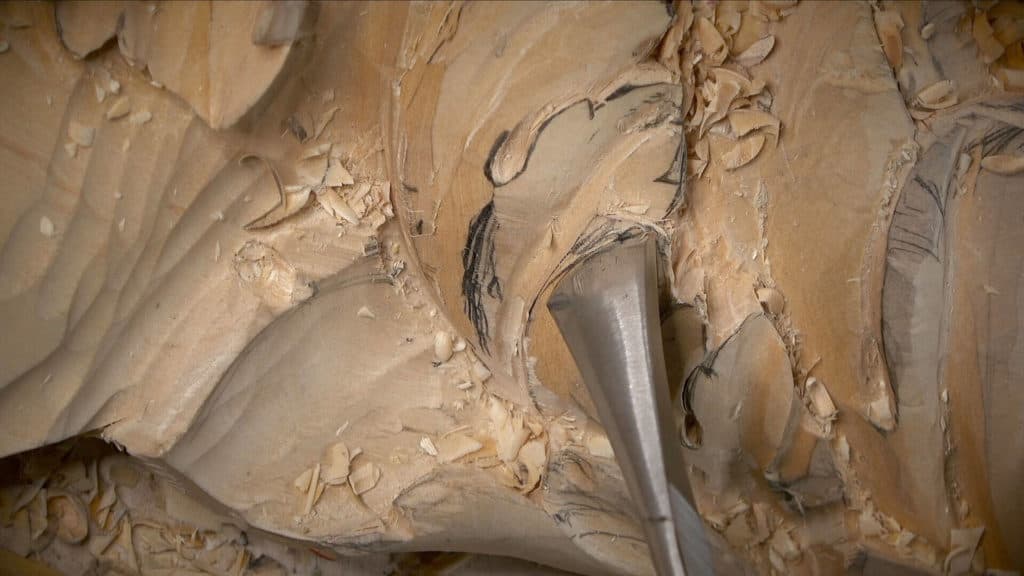
Alexander Grabovetskiy, woodcarver, School of Woodcarving · Published 2020
What does a wood carver mean by "straight tool"?
Quick answer: "Straight tool" is a phrase I said in Venice Room workshop 74, part 1, when I said I should probably take a spoon gouge instead. Other lessons of mine use it with back bends, goose necks, fishtails and the number nine, and each one tells you what I did next.
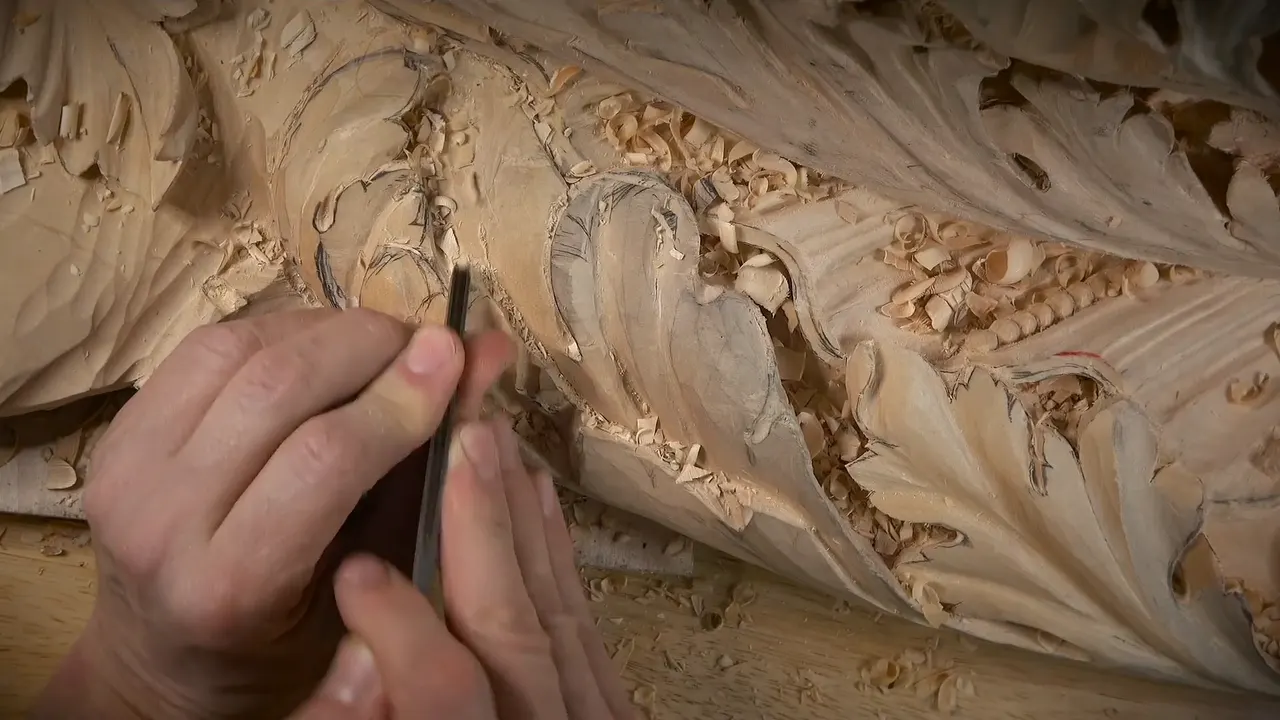

"Straight tool" is a phrase I said in Venice Room workshop 74, part 1, while I was choosing another tool: "I should probably take a spoon gouge because the straight tool doesn't cut it anymore." In other lessons the same two words sit beside back bends, goose necks, spoons, fishtails and the number nine.
Ever pushed a gouge at a spot and felt it stop helping? Did you push harder, or reach for another tool? Come through part 1 with me, then through the lessons where I said it about a spot, and see what I named next.
What was I saying right before the straight tool stopped working?
Part 1 of workshop 74 opens with a rule: "Just little by little, okay? Without rushing." Next came my plan, a spoon gouge, since the plain tool had stopped helping: "It is not working anymore."

The choice of tool carried a worry: "I don't want to see a U shape on inside."
Which tool did I name next?
"Let me think. Maybe I should use just the number nine and 10 millimeters." That is 0.39 in, and it was still a maybe. I wanted to see whether I could blend it nicely, I said, and the shape "really has to be just gradual."
Yes, three-dimensional, I said, "but gradual." And no extreme lines.
How did it look after I went in?
Before the result came "let me go in this way," and then it looked to me like I had achieved the result. Of course you don't see the details yet, I noted, "but at least I've got what I wanted to see. I've got a really nice movement going on."

The other side was the next question: "My question is how I want to see opposite side." Nor did I want the movement to extend that way.
A plan for the divisions came next: "So now I can probably start some of the divisions of this part, okay, of this movement." I was "Not sure" whether to go high like this and make "some micro division," and I said another division would follow.
How deep did I plan to go before the relief?
It would not be deep, I said, and a "too deep shadow in this area" would be "a little too distracting."
The next step I named was the relief: "But I need to relieve first this section." I planned "probably three millimeters" in a "number 11," and three millimeters is 0.12 in.

Which sweep closed part 1?
I wanted to "establish this curvature" and "find the right sweep." The one I named was "number five and about 20 millimeters," or 0.79 in. Hitting it came with a limit, and the limit was "but not too deep."

How did part 2 treat the back bend?
Next, part 2 picks up on "Not too deep." I planned the back bend for one purpose: "Because I don't want to lose a slope on inside." I added "Slope feel on inside, okay?" A smaller one came next, and I said I needed it to "attack this ridge."
Grain was a worry. "I am working against the grain, so that's why I have to be really careful how I do that," I said. "Sharp tools, that's the solution."
Later in part 2, one tool was no good: "That one doesn't work." I tried a number six in a quarter inch (6.35 mm), and it was "actually excellent." The size was "about six millimeters or so," or 0.24 in, and "That gave me beautiful movement."
Did I call a tool normal in part 3?
On the flower, yes. "Just a normal tool" was possible, but I had back bends, and the back bends "in this case, is going to help me a lot." A smooth transition "from inside out" was what I needed, and I would "just knock down that ridge."
Is there a straight tool in part 9?
In part 9, "upside down" gets an explanation. A straight tool could do it that way, I said, but the tool in my hand was a back bend, number five, half an inch (12.7 mm). "So it's not upside down," I said.

Now to the other lessons, where the same two words turn up again, each with its own page linked where I use it.
Why does a straight tool dig in at the wrong angle?
My video on back bent tools, in All about Tools for Wood Carving, starts from a high spot that I still had to reach. Then the angle: "with the straight tool, it's gonna dig in." The back bend is raised, and I showed it from the side: "I can safely attack this part."

Undercuts are its other job. "it's such a nice tool when you're just working your way right underneath," I said. A straight one was still possible, I said, but sometimes "there's a stuff right on the way."
Was a number nine a straight tool on a livestream?
In Livestream April 2020, in the questions and answers, someone asked about a hole and whether a two-millimeter (0.08 in) spoon dug it. My answer: "It is not." The tool was "actually number nine," a true half circle, "half a round."
The key line came next: "that's not the spoon, it's a straight." And, "So it's just a straight tool. It's just one of my favorite tools." Spoon, I said, would be "really hard to make a rotation," while with this one "I'm able to rotate and just dig deep, really deep if I wish to."

How does a fishtail differ from a straight tool?
Questions and Answers about Woodcarving has a lesson called What is better Straight Gouge or Fishtail. Inside holes, I said of the straight tool, "you can get inside, but you cannot rotate the tool, and you can't carve all around." The fishtail has a second plus: "I can use just the corner," to get "in some tiny spots where I can't get with a straight tool."
What is a straight tool sweep?
Venice Room 52, in part 6, has a back bend in my hand: "it was a back bend six millimeters, and the sweep was three." That "would be equal to straight tool sweep," and "a sweep is a curvature of a tool." Six millimeters is 0.24 in, and I called it "a quarter inch how wide that is" (6.35 mm).
Then came a spot the plain tool could not reach. Two pieces were in my way, and the straight one made it "almost impossible." The ceiling mattered too: "I hit the ceiling and my tool not even reaching right here." For that spot you need "a bent or short bent tool like that."
When was the straight tool not sufficient?
In Venice Room 15, part 12, I needed "longer cuts right there," and "Straight tool not going to cut it." The plan was a spoon gouge, number 11. Venice Room 2, part 2, has the same turn: the plain tool "would not be sufficient anymore because I'm hitting this side," so I needed "to switch my tool," and "let me get again big number seven."


Can a straight tool undercut?
Inside Venice Room 40, part 8, I said "probably the best tool would be number one back bend." Then I wondered whether a straight tool could do the job, and said "Yes, I am, actually." The limit came next: "I'm not going to be able to undercut." With the back bend, I would be able to. In that part I also said "I need to use back bend in this case."

What is the danger of a straight tool?
Over in Venice Room 57, part 5, comes a danger. "I think that's enough," I said, and "there is a danger" about the straight one. You have to stop at the right point, "otherwise, you're going to dig in," and then you clean a valley that is not consistent. So "that's why spoon gouge in this case would be probably the tool of choice."
Where was a straight tool fine?
Down in Venice Room 63, part 2: "it's okay to use a straight tool at this place, but it's not okay when it's going to go upward." A spoon was needed there, I said. Later, in part 4, I wanted to make sure I was "not undercutting," and said a straight one would probably do. The size was "7 millimeters, little bigger than a quarter," or 0.28 in.
What kept a straight tool out of the way?
Workshop 62, part 6, is Venice Room 62: "everything is in my way now. I can't use a straight tool." And, "So a back bend just helps me."

Part 4 of Venice Room 76: "So that is almost impossible to do with any straight tool." The back bend "allows me not to damage opposite side because it just rides above it."
The question in Venice Room 70, part 9, was this: "Let me see if the straight tool will be sufficient, or I should switch to a spoon." The hole was "about 25 millimeters or so" deep, 0.98 in, and I said "I think I need to switch to a spoon." Then came "Veiner, in this case, and maybe 7 millimeters" (0.28 in).
When is a back bent tool safer than a straight one?
Floral and Molding 8 starts with a plan in part 3: "I could start with just the straight tools, like number seven." Further on, the tool was a really short hook, and I could probably "get by" with straight tools. A feeling followed: I "just feel" it would be "safer just to use that back bent." My choice: "just a number 5 back bent."

Floral and Molding 11 went the other way in part 2. A "raised part" made it "not really convenient" for me to use the straight one, so I said I'd use the back bent, "number three." My words for it: "a straight tool would be in my way, but now because I do have that goose neck, so I'm not touching that point."
What does a goose neck do for a straight tool problem?
Lily Box 11, part 2, is Carving Lily Box 11: a straight tool was still an option, I said. Sometimes it is blocked by "some stuff on your way." My tool has a goose neck, and it gets me "in some areas" where the plain one would limit me.

In Lily Box 8, part 11, I said "with a straight tool, I really can't get to area like that. But with the backbend, I am able to." I explained why I worked with the number 11 first: "this area is really fragile," and I wanted "a relief cut."

Can the straight tools do most of the work?
Carving Hashemi Flowers 32, part 2: "I'm still using just straight tools," I said, and "I don't use any spoons right now because I don't really need it at this point." I was able "to do most of that work with just the straight tools." And, "At least now."

What did I reach for when the mess would not come out?
Venetian Flowers Rosette 2, part 3: "there is some mess on inside." The straight one could not get it out, I said, and "I'm going to need some kind of spoon gouge." My pick was "small spoon gouge, like number seven or so."

Do the numbers change from one course to the next?
Carving Modern Acanthus 5, part 1: "If you have a trouble with the straight tool just to grab a spoon gouge your case is going to be number nine. In my case, it's the number 11." I added "Don't ask me why I brought number 11, but not number nine." I did give a reason, though: "I like number 11 and it's harder to find number nine."

Carving Byzantine Acanthus 4, part 2: it will dig in, and "that's no bueno for me." The cause was a "limitation of the straight tool," and my answer was "better just to use the normal position."

Carving Roman Acanthus 9, part 6: "Be really careful when you're using just a straight tool, because everything is on your way, and you can always damage it if you're not controlling that."

Where does each straight tool sit next to the others?
Each lesson here, what I said in it and the next thing I named.
| Lesson | What I said | Next |
|---|---|---|
| This video, 74.1 | That plain tool had stopped helping me | Maybe nine |
| Lesson 2 of the Venice Room | Not sufficient anymore | Switch my tool, big number seven again |
| Workshop 62 | I can't use the plain tool | A back bend |
| All about Tools, the back bend video | Dig in | Back bend, and attack it safely |
| Venice 52 video | Sweep is a curvature of a tool | Back bend |
| Lesson 70 of the Venice Room | Need a spoon | Get a spoon, veiner in this case |
| Venice 63 | Fine in one spot, not upward | Spoon gouge instead |
| The Floral panel, lesson eleven, part 2 | Not convenient | Number three back bent, goose neck |
| Hashemi Flowers 32 | I don't use any spoons right now | Straight tools |
| The Modern Acanthus course, lesson 5 | Have a trouble | A spoon gouge, number 11 for me |
| Rosette 2 | Mess on the inside, I said | Small spoon gouge |
| The Floral panel, lesson 8, part 3 | Get by | A number five back bent, safer |
Where can you watch part 1 and the lessons on this page?
You can watch part 1 in Venice Room 74. The Venice Room Part 7 course holds workshops 74 to 85. Every other lesson on this page has its own page, linked above, and each is open to you with school access. A workshop number means the Venice Room, and every other lesson carries the name of its own course.
Want to hear me say it in my own voice? Start here.
How it's done
- Say what stopped. The plan was a spoon gouge, since the plain tool no longer did the job.
- Ask which tool. The choice of tool came with a worry about a U shape on the inside.
- Name the sizes. A number nine at 10 millimeters (0.39 in) was my maybe, a number 11 at three millimeters (0.12 in) was for the relief, and a number five at about 20 millimeters (0.79 in) was for the curve.
- Keep it gradual. I said the shape had to be gradual, three-dimensional but gradual, with no extreme lines.
Frequently asked questions
Where did the straight tool stop working in part 1?
I said a spoon gouge was my plan, then "It is not working anymore." My question was which tool, and I named, as a maybe, a number nine.
Which number did I call a straight tool?
On a livestream, the tool in my hand was "actually number nine," I said, and "it's a straight," not a spoon. In Modern Acanthus 5 a spoon gouge was "number nine" for you, and mine was the number 11.
When did I say a straight tool was fine?
The plain tool was fine "at this place" in Venice 63, but not once it goes upward. In Hashemi 32 I was "still using just straight tools." In Floral 8, "get by" was my phrase for the short hook.
What to carve next
- Venice Room 74
- Venice Room Part 7
- All about Tools for Wood Carving
- Livestream April 2020
- Questions and Answers about Woodcarving
- Venice Room 52
- Venice Room 15
- Venice Room 2
- Venice Room 40
- Venice Room 57
- Venice Room 63
- Venice Room 62
- Venice Room 76
- Venice Room 70
- Floral and Molding 8
- Floral and Molding 11
- Lily Box 11