
Alexander Grabovetskiy, woodcarver, School of Woodcarving · Published 2020
What does a wood carver mean by "on the fly"?
Quick answer: In Venice Room 74, part 12, I said the design changes on the fly, and that is why I held back from a deep dig and clean work at that stage. Other lessons of mine use those words for a line moved on the wood and for a camera switch. Each one is named and linked below.
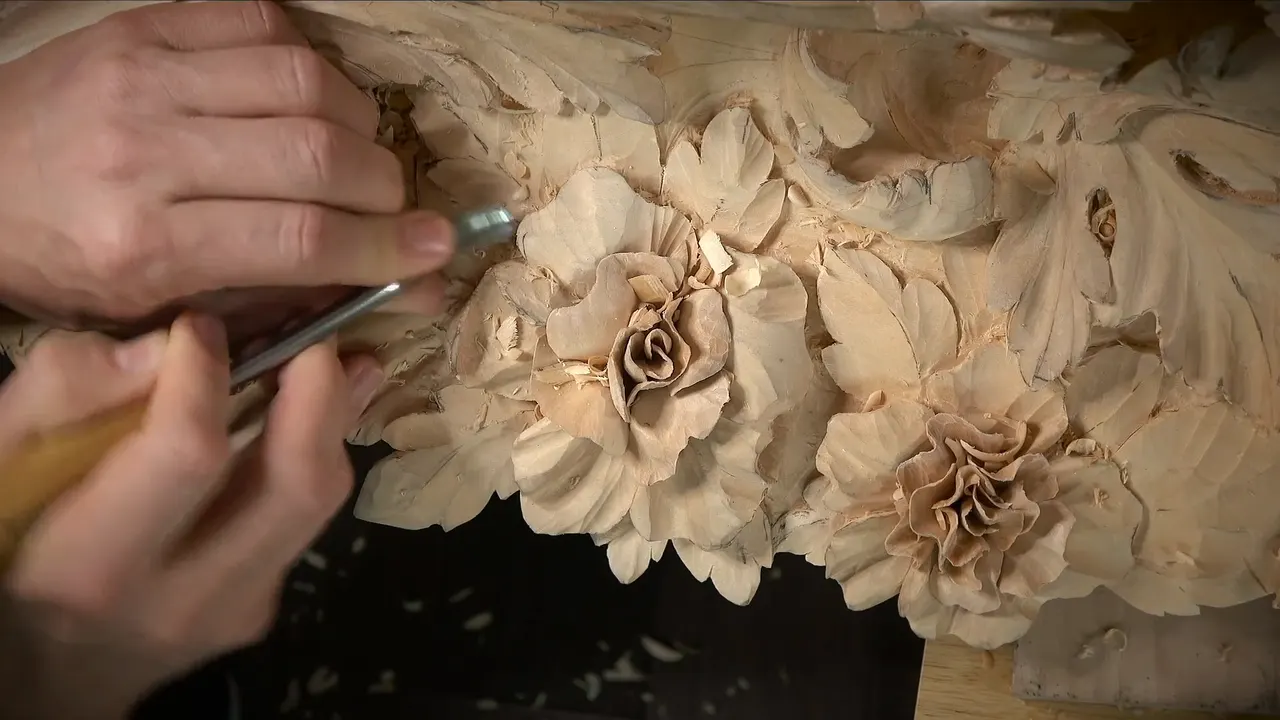
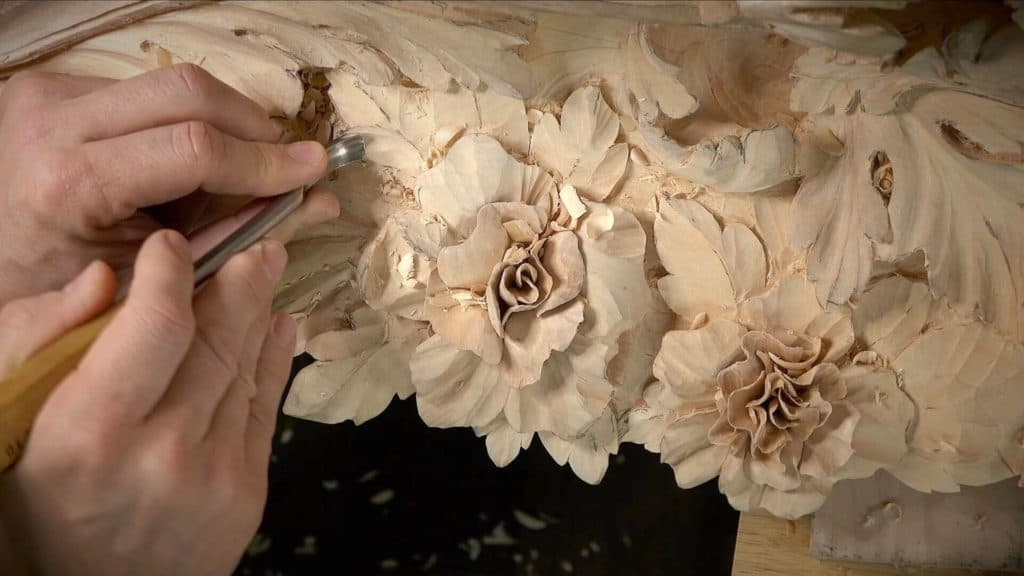
In Venice Room workshop 74, part 12, I gave the reason I did not dig deep and clean right away: a design that changes on the fly. My other lessons use those words for a line moved on the wood and for a camera switch. Every lesson is linked below.
Ever drawn a line on a board, looked at it a day later, and wanted it somewhere else? Did the paper ever tell you what the wood would do? First comes part 12, then the other lessons where I say it.

Where in part 12 do the words come?
The last lines of the captions hold the sentence. "I really didn't want to do right away really deep excavation and clean cuts because I found out I'm changing a design once in a while, or right on the fly."
A long stretch of digging and cleaning comes before it. One sentence holds a deep hole and a design that may change.
What was I carving before I said it?
The video opens on a plan. "Now I'm probably going to exaggerate some of the concaves." For that I would "need to use a spoon," and my first words about the size were "Maybe number nine spoon and seven millimeters" (7 mm is about 9/32 in).
The size changed. A number 11 would work too, I said, but I thought the nine was the better pick in this case. "I'll use 10 millimeters, not seven, okay?" Ten millimeters is about 0.4 in.

My next plan was "maybe a little deeper excavation right here. Just for extra shadow." After that, a verdict: "this concave looks perfect, almost." A second one on the side, I said, gave me "really, really nice shadow."
On cleaning I made a plan: "let me clean a little bit on inside because I don't need that extra ridge, extra facet." And one for movement: "I could probably use the same tool and excavate this way."

Two places needed more. "More interesting look right here and maybe right there. Just little notches if you wish to call that way." I named them, notch number one and notch number two, "which is hard to see, but it does make difference."
One more shadow spot got a plan of its own, "one and a half millimeters in another cut" (about 0.06 in). Not too deep, I said, "because they all mostly on each other. Those two leaves."

Why did I hold the tool back on a slope?
Here is how I put it. "I am working right on a transition, right on a slope." The grain was "a little challenging sometimes, just to catch the right direction of the grain." Sharp tools help a lot. And: "So those sharp tools, it's a must."
One patch I "left there somewhat rough, not clean," and I said I could "attack it and clean it a little bit just with the back bands." The tool came next. "I'll use number five back band and go in like that, but not digging too deep because otherwise I'm going to create another problem I don't want to deal with."

The reason for the care was a mark. "Too deep of a cut," I said, and "there is going to be a mark really deep inside of this cut." The paint came into it, and I said so out loud. "I know that is a paint grade and everything is going to be pretty much hidden, but like in other cases, it would be a big mistake. This one is a somewhat forgiving project, I would say."

What did the cleaning look like?
"All right, number 11 and smaller number 11, and clean it on inside. Get rid of that mark." And this: "I still have to clean, clean, clean, clean, and clean again. And sometimes cleaning actually takes longest."
Smaller tools followed. "Get one and a half millimeters. Get rid of that, whatever junk I don't need." And then "maybe even with the smaller tool, like one millimeter number 11" (about 0.04 in). "Let me see if I'll get it out with this one."

Two spots were still waiting. "I really need that deep excavation right here, and also this area, too." Then came a walk around the piece: "I will have to go all around this project and go in every eye I left, eye of Acanthus."

Why not dig deep and clean right away?
The reason sits in the last lines of the part, the sentence I quoted at the top. It carries its own reason, and I have nothing to add to it.
Part 10 shows change at work. "A result of my idea. Okay? So that is exactly what I was imagining." Then, "It's change, actually. Change from the main design, what I designed previously."
Part 11 has the same kind of moment. One section did not please me, though I liked the movement overall, and the fix I floated was, "Maybe I can just put extra separation right on this spot." It would give "a little more interesting look."

What did I change on the wood?
Venice Room 85, part 3, has me on a 3D computer design. "When you're doing it even on 3D computer design, it doesn't look the same in real life. And in real life, I have to make a lot of different choices and decisions." The example came with it: "if I don't like something, how it looks, I would rather change it pretty much right on the fly, pretty much. It has to move."

The Tray of Blessing, lesson 2 has me dropping a part lower, maybe. Next came what I do sometimes, and what follows is "on the fly, you know, just you think, oh, it's gonna look better this way now, but I have to be careful."
Further on in that video I said "just indication of overall movements. That's probably enough as of now." The leaf had no complete shape yet, "since we just designed on the fly pretty much."

Lily Box 10 is a flower. I planned to move a line from the edge a little inside, "because I want to make sure I have enough wideness." It was "sometimes the decision I have to make on the fly." Paper is two-dimensional, and wood is a three-dimensional world, I said.
Soon after, the flower "actually has a shape already," though one part was "too flat," and it needed some roundness.

Lily Box 13 is where I said it about a real project, and the way I put it was plain. "It's real life. Okay? So that's a real project." And I said I had to make "the decisions pretty much on the fly." You see the mistakes, I said, and how I fix them.
I also said "I wish I don't make any mistakes, but I'm not there yet." Small stuff, I said, "happens almost on every project."

Another eye and a leaf underneath come up in Venice Room 97: "I think it's going to look much better this way." "And yes, I do change on the fly, which I think it's okay," I said. And, "I'm glad that didn't excavate too deep. Otherwise, I would be screwed, I guess."
Here too a deep excavation and a changing design sit in the same breath. In a later part of Venice Room 97 I corrected a word, "I am making changes, not changes, but decisions," and about the dig there I said "approximately 10 millimeters deep" (about 0.4 in).

Is a redraw the same as an original design?
In Butterflies 10 we were going to redraw a part, and the change would be "more true to the overall design." I added, "I shouldn't say that we are designing on the fly because those butterflies used to be carved for centuries." And: "it's not like original design. It is historical, I'd say, design."
Next came a depth: "only about one millimeter deep." That is about 0.04 in.

Curly Kitchen Cutting Board 3 sits in a beginner course, and I was drawing lines around a board. I said we were going to design on the fly, "on a piece of wood." Then, "Please follow along." And, "Don't just watch."
The second part of that lesson comes back to it. "So like I said, we are doing on the fly, this design." It would stay "really accurate to the designs, actually, what they used to design in the ancient times." My next words were "a bird, like a paradise bird."

A pencil comes first in workshop 4 of that course. I said I would need it because "on the fly, I'm going to make some changes. There is a reason for that." One cut "would be really, really deep," and I said I would probably "add some small elements like that to eliminate that deepness."
Workshop 16 has a short one. "I'm just making my decisions on the fly how I want to do that." Straight at first, "but then I'll change my flow and go on angle a little bit."

The grape lessons carry the words too. In Grape Onlay 1, the pattern was not exactly like what we were carving, I said, since I change the look "on the fly, how it's gonna look." In part 3 of that lesson the words come with "you are making decisions," and with a way to practice: "you can take a block of wood" and "try to do those grapes before you carve the real piece."

Where does working from scratch come in?
In that same tray lesson I said, "I don't like the idea of replica." Copying is "not gonna teach your brain to think." For that I used driving: "you're gonna say, Hey, push brakes, turn right. And you have no idea why you have to push the brake and why you turning, right?"
What I found best was "when we carve together and you learn to see in three-dimensional world, it's much easier for you later on." My words after that: "like from scratch pretty much."

Does on the fly mean something else in my lessons?
It does. In Roman Acanthus 16 the words belong to the camera. "I'm actually using multi-camera setup, and when I'm recording everything and then I'm editing everything, it takes a lot of time." This time, I said, I upgraded my equipment and I was going to try to switch on the fly, "live switching." About mistakes I said, "please forgive me."
The next part of that lesson says "I am switching on the fly or live switching." Then, in Acanthus over Moldings 6 I explained a pause. "I'm not creating a cut." And: "I can just switch my cameras," which was "the fastest way for me."

Over in Venice Room 72 I said the equipment helps. "Sometimes, even that really expensive equipment fails. But it helps me a lot, actually, just to switch on the fly." So that way, I said, "I can create a lot more for you to watch, a lot more videos, and concentrate more on working than editing."
Editing is the subject in Venice Room 96. "I'm not re-watching all the videos, it will take me too long, even editing." All my editing, I said, was done on the fly.

Where do all these lines sit side by side?
Every lesson on this page, with the words I used and what I did beside them.
| Words | Beside them, in my lesson | I named |
|---|---|---|
| A deep dig held off | A design that may change, in Venice 74.12 | Spoon, back band |
| Change from the main design | A result of my idea, in Venice 74.10 | Overlapping acanthus movement |
| Choices and decisions | A movement that has to move, in Venice 85.3 | Another S curve |
| Redesign stuff | Maybe dropping one part lower, in Tray 2.2 | Cleaning a little |
| Designed on the fly | A leaf with no complete shape yet, in Tray 2.2 | Overall movements |
| A decision on the fly | A line to move from the edge, in Lily 10.9 | Two millimeters (0.08 in) |
| Decisions on the video | A real project with mistakes, in Lily 13.3 | Gouge, then glue |
| I do change | Another eye and a leaf under it, in Venice 97.1 | Not too deep |
| Decisions, not changes | A dig ten millimeters (0.39 in) deep, in Venice 97.8 | Number 11 V-carve |
| My decisions | A straight start, then an angle, in Cutting Board 16.3 | Cuts toward the center |
| Make some changes | Pencil first, then one deep spot, in Cutting Board 4.2 | A knife |
| On a piece of wood | Pencil lines around the board, in Cutting Board 3.1 | Knife, then gouge |
| How it looks | A pattern not exactly like the carving, in Grape 1.2 | A number five |
| You are making decisions | A good spot to try something, in Grape 1.3 | A block to practice |
| Designing on the fly | A butterfly part redrawn, in Butterflies 10.2 | A small gouge |
| Switching on the fly | Live switching of two cameras, in Roman 16.1 | New equipment |
| A pause I explained | Why I pause on screen, in Moldings 6.2 | Cameras |
| Just to switch | More to watch and less editing, in Venice 72.3 | Equipment |
| All my editing done | Too long to rewatch the videos, in Venice 96.1 | Editing |
Where can you watch part 12?
New to a word? A gouge is a chisel with a curved edge, and both are hand tools. A concave is the hollow side of a curve. In relief carving, shapes stand out from the wood behind them, and a shadow falls into every hollow. A multi-camera setup puts two or more cameras on one scene, and live switching is the switching between them.
You can watch part 12 in Venice Room 74, inside the Venice Room Part 7 course, which holds workshops 74 to 85. All of those lessons have their own pages. Sizes come in millimeters or inches as I said them, with the other system after it. The Beginner in Carving course holds the cutting board lessons, a gentle place to start on carving, a branch of woodworking.
Want to hear me say it in my own voice? Start here.
How it's done
- Name the plan. Probably going to exaggerate some concaves with a spoon, I said.
- Keep the dig shallow. For a small shadow spot I planned a shallow pass.
- Think about the mark. A pass that goes too deep leaves "a mark really deep inside of this cut," I said.
- Say why you wait. I held back from deep digging and clean work because I change the design as I go, on the fly.
- Come back around. Going all around the project and into every eye I left was my plan.
Frequently asked questions
Which lessons have these words besides part 12?
Look in Venice Room 72, 85, 96 and 97, the tray lesson 2, Lily Box 10 and 13, and Grape Onlay 1. Cutting board lessons 3, 4 and 16, Butterflies 10, Roman Acanthus 16 and Acanthus over Moldings 6 have them too.
Which tool did I plan for the concaves?
A spoon gouge, maybe a number nine, at 10 millimeters (0.39 in) instead of the seven (about 0.3 in) I first named. I wanted a little deeper excavation for extra shadow.
Do the words only mean a changed drawing?
Not in my lessons. Roman 16 and the Moldings lesson use them for switching cameras, and Venice Room 96 uses them for my editing.
What to carve next