

Alexander Grabovetskiy, woodcarver, School of Woodcarving · Published 2020
What does a wood carver mean by "essentially"?
Quick answer: "Essentially" is a word I said in part 2 of Venice Room workshop 74, right before I told you my plan for the inside. The same word turns up in other lessons of mine, and each one tells you what I said next.
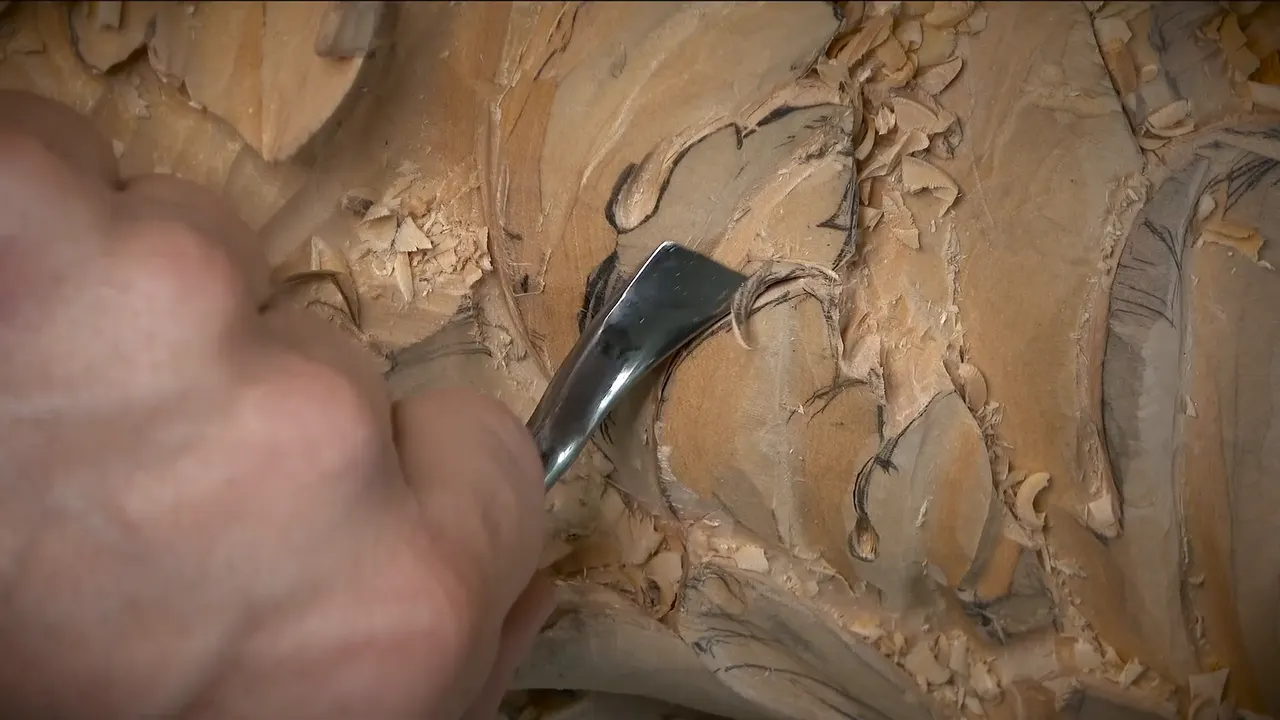

"Essentially" is a word I said in part 2 of Venice Room workshop 74, while I got ready to work on an area I could not show. In my other lessons it turns up beside tool names, thicknesses, shadows and cleanups, and what I said after it is on this page.
Ever tried to say your next carving step in one short line? Come through part 2 with me, then through the lessons where the word turns up.
What was I working on before I said "essentially" in part 2?
Workshop 74, part 2, opens with "Not too deep." My choice was the back bend, and my reason was the slope: "I don't want to lose a slope on inside." I needed "a little smaller back bend to attack this ridge," and I planned a number five, "just probably quarter inch." I repeated it as "quarter inch, number five, six millimeters" (0.24 in).

Grain worried me. "I am working against the grain, so that's why I have to be really careful how I do that." My answer was short: "Sharp tools, that's the solution." Right after that came "I've got some kind of mess right here."
How did I fit the curve in part 2 with a number five, before I said the word?
Next I wanted to relieve a spot, "this triangle right here," and I tripped over its name: "It's not a corner. What am I talking about?" To fit the curve I matched my gouge to it. "In my case, it was number five right now, about 12 millimeters or so, about half an inch, and I was able to fit this curvature." That is 0.47 in for the 12 millimeters, and the half inch is 12.7 mm.

I owned up: "I'm not really too happy with that section, okay?" A knife was one idea. "Some kind of gouge" was another. What I wanted was "really nice and smooth transitions, so it's not that harsh." Then: "let me think which one I should use."

One tool did not work: "That one doesn't work." My next try was a number six in the quarter inch, and my verdict was "number six is actually excellent." Its size came again as "about six millimeters or so" (just under a quarter inch), and it gave me "beautiful movement."

What came just before "essentially" in part 2?
I was happy with the movement, "although I can always hit and kind of refine right away." And "I don't want to do it too early, too deep." The job after it was one I could not show: "I need to work on this area and that area." Working there would be "like sticking my head in the camera again."

Which plan followed it?
"But essentially what I'm going to do, same idea pretty much." That is how my plan began. It would be "development like that," I said, but "on inside," with a division. "Everything's supposed to go to the point," I said, and the big subdivision would be waste, "all pretty much waste."

To explain it I offered to show it "from different perspective." I called that area "all waste," and I said "this going to become part of that movement, and that deep excavation."

I said "this one" would be "simple division," and I planned to "work on that off camera. Hope you understand why." The part closes on "I think it blends nicely."

Did "essentially" come up again in part 3, on the flowers?
Yes. Before that, about the main divisions of the flower, I said "it could be five, it could be eight, if you just follow the Fibonacci sequence and so on. But I'll make it just five." Near the end of the part I said I would "stop filming" and pointed you to Hashemi flowers: "if you really want to know how I do those flowers, just watch Hashemi flowers." It came after my reason, "take too long time of filming and editing": "essentially, it's going to be the same." After that I planned to carve around, like on Hashemi, and insert.
That covers my own lesson. The rest of the page goes through other courses, in the order of my words after it.
Which tool did I name beside "essentially"?
A back bend comes first in Venice Room 70, part 2: "sweep number 5 and 20 millimeters" (0.79 in). After that came "essentially, it's just number 5." A micro cut inside was my next plan. There were "a couple of ways I could attack it," but I "really want to show the shadow side because otherwise it just blends in."

The plug removal cut got "number 9 and 1/8 of an inch" (3.2 mm), and "I can go as deep as I wish." That came to "about 10 millimeters deep" (0.39 in), and "it gives me already what I'm after."
A grounding tool gets explained in Furniture Panel 21, part 1: "It is essentially just a number three." And "Number three in a London pattern." The shape, in my words, was "almost chisel." It had "almost no curvature, almost flat," but "it still has some curvature." Someone might ask "Do you have to buy those grounding tools?" and my answer was "it all depends."

How thick did I plan to leave the wood in Venice Room 66?
Venice Room 66 has it in part 12, where I said "it's already giving me a really dark shadow." With "essentially" came my goal: "the thickness from this point to my finger down, approximately six millimeters" (a little under a quarter inch). "That's what I'm leaving," and "Maybe even less, maybe about five millimeters, 3/16 of an inch" (0.2 in). Then: "I don't need to make it less than that because I really need some solid wood, otherwise it's going to be too fragile."

A connection point came to mind: "I could leave a connection point at this point." I wanted a way to keep it "without making it too obvious." For it I said "Let me use a mallet," "maybe number four," and "About 12 millimeters" (0.47 in).
Which shape was I after on the grape leaf vase?
Carving Vase with Grape Leaves 2, part 10, begins with "next, I'll take a flatter gouge and start blending." Then comes the word. I offered a picture: "let me show that to you maybe with the red marker." The shape was "just like a water drop," and the other side would match. Smaller tools came next: "smaller number 11," then "I'll use 1 millimeter, by the way" (0.04 in). My plan was to "get closer to the stem and excavate even little bit underneath."

What did I need room for in Venice Room 57?
Part 6 of Venice Room 57 has "I think that is enough," about the concaves I developed, "not too deep." Then: "But essentially what I need it's just a space for my beads." The openings were not wide, and I called it "about the same idea, but not too same, I should say."
I needed another back bend: "I have to use just a number three, I would say, back bend. In this case, I would use 13 millimeters and number three" (0.51 in). About the marking, "Don't pay attention to zero."
Where did "essentially" meet a shadow?
Carving Lily Box 11, part 11, is this lesson. There I talked about taking care of a shadow at a connection. What followed: "every little thing helps me to create the shadow point, okay? So that is essentially what it is. It's all about the shadows." Next up was "a half a millimeter" (0.02 in), "of course, number 11," and then "maybe I'll just get a better result with number one."
Chamomile and Bow Rosette 1, part 2, has five petals as my "divisions." Closer to the inner part I planned "much deeper cut and wider cut." Then: "So essentially, what I would like to do, create the shape," and a shadow would sit in it. For that, "I could probably do with the small, tiny gouge I used previously. Like one and a half millimeters" (0.06 in). "I'm after shadow, deep shadow."

How many cuts did I count on the Floral panel leaf?
Carving Floral and Molding for the Panel 7, part 1, has a leaf with "a bulging this way," also "convex and concave." The count came next: "Essentially, it's four cuts, okay? If you look straight to that leaf at that direction." From that point of view it would be "convex, concave, and a concave." As for "all of them," "the main idea" would stay the same.

Carving Lily Box 12, part 4, has "And essentially what it does, it creates a really nice grid." I added "Of course I'm not as accurate right now just because I'm just drawing."
What stage did I name in the cleanup lessons?
Cleanup is the stage in Venice Room 63, part 10, where "So essentially" led into "just the cleaning up," with "those sharp ridges" as my reason. Next, "let me give a separation cut right in this section also." "Now number five," I said, and then "this one is actually number six, and it's not going to work. I need number five."

Background work is the subject in Furniture Panel 15, part 8, where I said "I'm using a #11 veiner, three millimeters" (0.12 in). After it: "Essentially, what we're doing, we're just creating all the background all around first, before we're going to create all the details, because important to keep those high spots for the router plane to travel on." Next: "I am taking my time. I think it's important not to rush anything."

Carving Floral and Molding for the Panel 9, part 1: "What I have to do now is just pretty much just a cleanup." Next: "essentially, just blend it with the small tools, make it to the perfection." I planned a tool "like a spoon, but flat, really flat." For the cleaning itself, "let me clean that off camera, so you really don't have to watch all that cleaning process."
How did the subdivision and pipe lessons use the word?
An apology comes in Venice Room 49, part 9: "I apologize if you don't see everything because the camera position." After it, "essentially" and "I am just creating extra subdivisions right there," for "a really beautiful movement." Later in that part came a warning: "A lot of people making big mistakes when they just try to chop this without relief cut." I call it relief cut, I said, and "I usually use the same number 11."

Venice Room 60, part 4, has "But essentially, I'm just working on creating that long pipe, and I'm getting deeper and deeper. And again, my goal is to exaggerate." Then "Exaggeration of pipe." Later: "I'm keeping my gouge just really super sharp."

It returns in Venice Room 91, part 9, after "I need to create that deeper cut." Next came "just pretty much straight cuts like this just to create those droppings." I planned the number 11 with the "old way." Using the camera was "just not convenient" for now. For smooth movements I planned "somewhat aggressive rasps," and "I'll do it offline."
When did I call a step the same idea?
Small tools you can make are the subject in Furniture Panel 17, part 3: "you could buy multiple blades pretty much for this and just regrind them and make really, really small," and then "essentially it's exactly the same idea." The line after it was "You're doing exactly the same operation. Okay? So pretty much it's just a smaller version." Then came the big one, "I can reference much farther," and "I'm using a small one also all the time if I'm working on a small rosette."
Where does each "essentially" sit next to the others?
Each lesson here, my words, and what came next.
| Lesson | I said | What came right after it |
|---|---|---|
| This video, the second part of workshop 74 | Same idea | Work on the inside, and waste to clear in the big subdivision |
| Part 3 of this lesson | The flowers, the same | Carve around, then insert, as on Hashemi |
| Workshop 70, part 2 | Back bend, number 5 | A micro cut inside, then a plug removal cut, as deep as I wish |
| Part 1 of Furniture Panel 21 | Grounding tool | London pattern, almost flat, still some curvature |
| Workshop 66 | The thickness I leave | A connection point, maybe, to keep it solid, and a mallet |
| Grape Leaves Vase 2, part 10 | Show it, maybe | A water drop shape and a number 11 |
| Workshop 57, part 6 | A space for my beads | Number three back bend, and "don't pay attention to zero" |
| Lily Box 11, part 11 | Shadows | A tiny number 11, then maybe a number one |
| Chamomile and Bow Rosette 1, part 2 | Create the shape | A tiny gouge toward the center |
| The Floral panel, lesson 7, part 1 | Four cuts | Convex, concave and concave, seen from one direction |
| Part 10 of workshop 63 | Just the cleaning up | A separation cut, then number five, not six |
| Panel 15 of the Furniture course, part 8 | Creating all the background | A number 11 veiner, high spots kept for the router plane |
| The Floral panel, lesson 9, part 1 | Just blend it | A small tool, like a spoon but flat |
| Workshop 49, part 9 | Extra subdivisions | The relief cut first, with a number 11 |
| Part 4 of workshop 60 | Just working on creating that long pipe | Deeper and deeper |
| Part 9 of workshop 91 | Straight cuts | Number 11, the old way |
| The Furniture Panel, lesson 17, part 3 | A smaller version | Same operation, smaller blades |
Where can you watch part 2 and the lessons on this page?
You can watch part 2 in Venice Room 74. The Venice Room Part 7 course holds workshops 74 to 85. Every other lesson on this page has its own page, linked above, and each is open to you with school access. A workshop number means the Venice Room.
Want to hear me say it in my own voice? Start here.
How it's done
- Pick a tool for the slope. My reason for the back bend was the slope on the inside.
- Match the curve. Number five fit the curvature, and I was not really too happy with that section.
- Try another tool for a smooth transition. Number six, at a quarter inch (6.35 mm), was actually excellent and gave me beautiful movement.
- Say the plan for the inside. A division on the inside, the big subdivision as waste, and a simple division.
Frequently asked questions
Where did I use the word in the other parts of workshop 74?
In part 3, after I told you I would stop filming, "essentially" came again, and I told you the flowers would be done the same way as on Hashemi.
Which tool went with the word?
A number 5 in one Venice Room lesson, a number three on a grounding tool, a small flat tool for blending, and a number 11 for straight cuts.
How thick was the wood I said I was leaving in lesson 66?
Approximately six millimeters (0.24 in), maybe even less, and the limit was solid wood: "I really need some solid wood."
Which words went with shadows in the Lily Box lesson?
What to carve next
- Venice Room 74
- Venice Room Part 7
- Hashemi flowers
- Venice Room 70
- Furniture Panel 21
- Venice Room 66
- Carving Vase with Grape Leaves 2
- Venice Room 57
- Carving Lily Box 11
- Chamomile and Bow Rosette 1
- Carving Floral and Molding for the Panel 7
- Carving Lily Box 12
- Venice Room 63
- Furniture Panel 15
- Carving Floral and Molding for the Panel 9
- Venice Room 49