
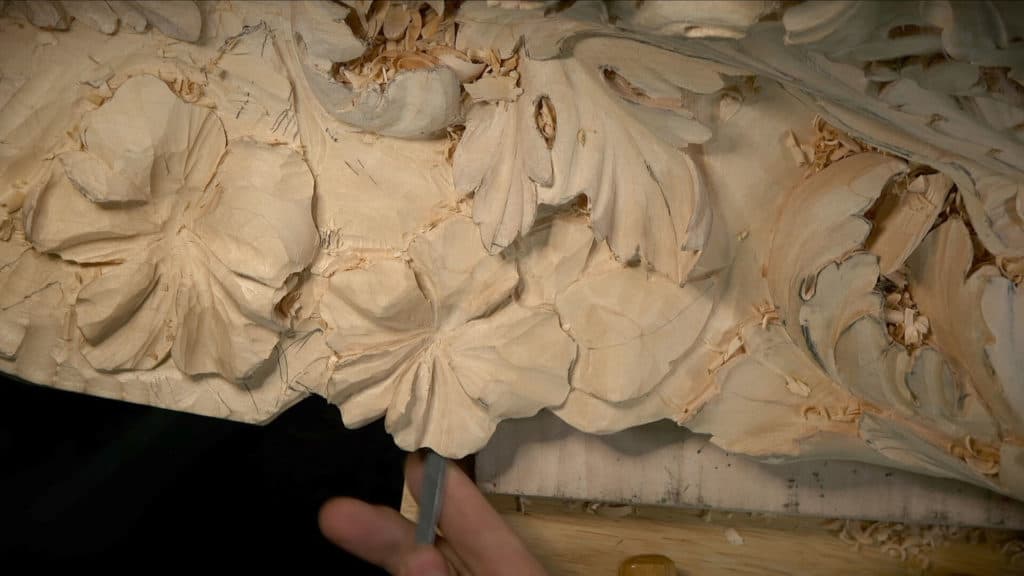
Alexander Grabovetskiy, woodcarver, School of Woodcarving · Published 2020
What does a wood carver mean by "socket"?
Quick answer: "Socket" is the word I used in part 3 of Venice Room workshop 74 for the hollow I dug into the first layer of a flower, to receive my middle part. In the Hashemi lessons I said I was not sure it was the better term.
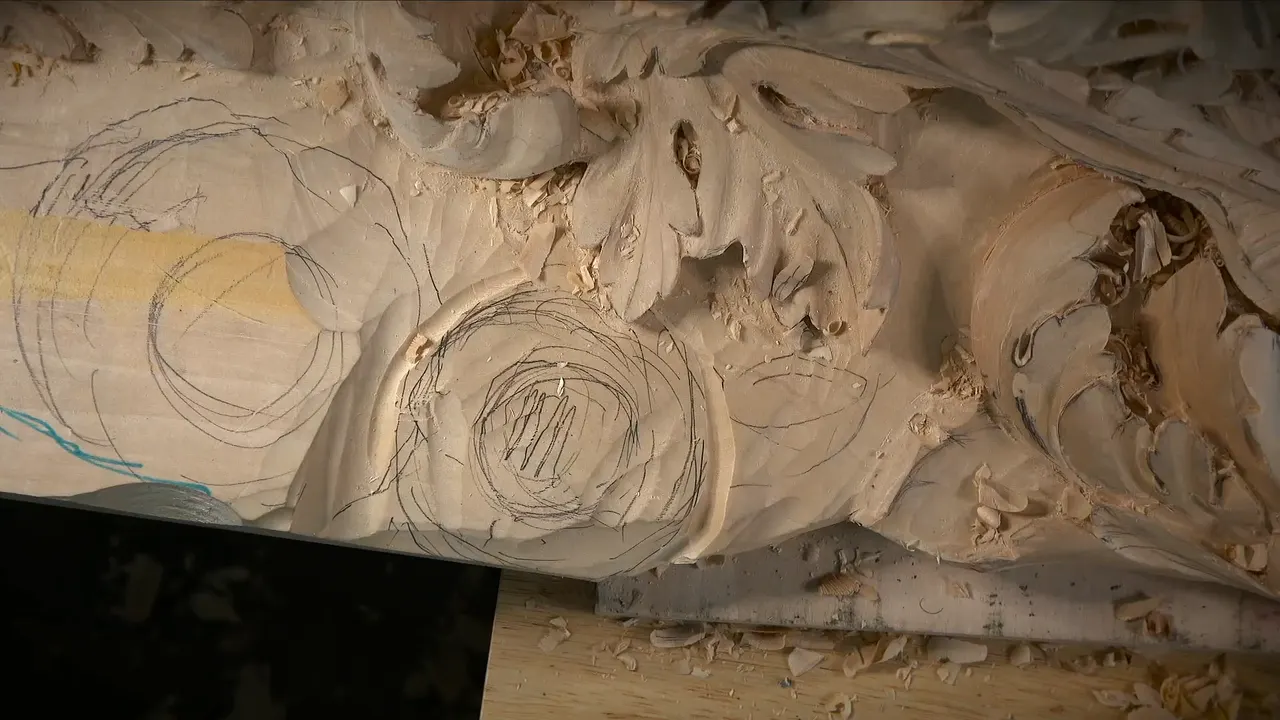

In part 3 of Venice Room workshop 74, "socket" was my word for the hollow in a flower's first layer. I had said it before, in the Hashemi flowers course, and told you then that I was unsure whether it was the better term.
Ever dug a hollow in a flower and then had to find a name for it? Come through part 3 with me, and then through the lessons where I said the word before.
What is a socket in wood carving, in workshop 74, part 3?
In part 3 the sockets sit inside the main lower parts of two flowers: "those are going to be the main lower parts and the sockets are inside of each of those." Inserts were the plan there, and the leaves around them were my job right then.
Part 3 opens with "Now it's the time to establish this part." The center part was going on, and then there would be an area with a couple of flowers. One of them could probably be big, I said, "around four inches, I would say." Four inches is 102 mm. The other flower would be "a little smaller." When I gave the sizes I said "this one is about maybe three inches, little less than three inches, and this one is about four inches." Three inches is 76 mm.

The lower layer is where the socket lives. I described the lower layer as one "with the socket, with just a hollow," and said it was almost a bowl carving. I would not show every step of the flower carving here, because I had already done it, pretty much one step after another, in the Hashemi flowers project, and the idea would be the same.
How did I dig the socket during part 3?
I named number 11, 10 millimeters (0.39 in), for the excavations and a big number 9 for the socket. "Here, let me get the number 11," I said. I liked how thick that part was, "kind of really thicker, really thick," but I wondered whether it would be good, because I really needed to reach the ceiling. Then: "I'm going to take number 11 and 10 millimeters." My plan was to "just go around first."

I also planned to take one of the petals "all the way to the ceiling," and I thought it would "look really awesome." "I do have to make the decision," I said. The question was where that middle part would sit. Right in the center was out, "because I want to kind of spread how it looks little bit." But the slope was already there, so it would be off-center "no matter what." I thought it would be okay.
The tool for the socket came next. The aim was to excavate it "to receive my middle part." Number seven came first. After it: "I could use number eight or number nine even." I came to number nine and said "I'll use 3/4 of an inch," which is 19 mm.

"I have to be really mindful how deep I'm going. There's not too much material left." Next I called it "my socket," and "I don't think I want to go deeper." After that came "I could go--" and "Let's exaggerate that flower and create a lot more shadows." The next line: "But I need some space to get my second layer because it's going to be doweled down on inside." I added that I did not want to get too excited about it.

Why did I knock down that ridge?
A smooth transition from inside out came next, I said, and "I really don't want to see that ridge. It doesn't look too appealing, doesn't look too good." A normal tool was an option, I said, but "I do have back bends, and the back bends, in this case, is going to help me a lot."

"I'll just knock down that ridge, just like that." And: "Just knock it down." Further on I said "And exactly the same all the way."

Is a socket round, like a donut?
It "looks almost like a donut shape," I said. "It is not, but you know." And: "I don't want to create perfect shape because it's never happens in nature, and it's not going to look good if you're going to create too perfect."
Counting the divisions of the flower came next. The Fibonacci sequence came up as one way to get five or eight, and then "I'll make it just five." They did not have to match: "Some of them could be wider, some of them could be smaller." One would be the widest, one "like a medium," and one "the smallest one." After the count I asked "Can you see a flower?" and answered "I know you can see the flower."

What goes into the socket?
Inserts. Near the end of part 3 I said "that is the first layer of a flower, and I created the socket, and I'm going to create my inserts." I created "a lot of different movements and so on, really roughly," I said, on that first layer, because "every facet, every tool mark makes big difference."
Part 4 puts it in plain words: the insert just goes in the socket. You saw, I said, that I carved just the outside ring, then the insert, and inserted it. I also told you I did not do those inserts on the camera, because they match what I did on the Hashemi flowers.

One more number from the end of part 3. "I've got approximately three millimeters undercut from the ceiling." Three millimeters is 0.12 in. A little shadow would remain, I said, and "that creates a really gradual movement, and I like it."

What did I call a socket in the Hashemi flowers lessons?
"I will carve sockets," I said in Hashemi Flowers 27, part 1, and then "I'm not sure what's the better term to use." I was setting up the second layer and I had laid out the ways to do it. One way was to "carve from the solid block and then attach that to the first layer." The second was to "carve separately all the leafage and all the flowers." The third was what I planned to take for that carving.
I explained the idea in a few lines. "Every flower has layers also, and the first layer usually goes backwards." It is like a ring of petals falling downward, I said, and then the rest of them falling upward. For the socket I said "I'll just take a gouge and carve this out, and then I'll drill through those sockets right in the middle." You can use a screw or a dowel, I said, "like they would use in 19th century and 18th century." The middle of the flower would be carved from a separate piece and inserted, so we can hide the connection points. Even the greatest of the greatest carvers, I added, used screws and had no problem with that.

My plan for the hollow came in the third part of that lesson: I said I indicated the direction and the centers of the flowers, and that I would dig "my hollow spot, or like a bowl-looking socket, if you wish to call it."

Did I stay sure about the word?
Not completely. My idea came up in Hashemi Flowers 28, part 1: "I hope you do understand my idea when I'm saying the socket." The leaves, I added, would sit at different levels, "for it would look true 3D, three-dimensional."
The next part of that lesson says it another way. "Like a bowl on the inside. So I call it a first ring of the flower." And: "There is such a thing as flower rings, or the first layer, if you wish to say." The first ring goes downward most of the time, I said, and the second one and the rest of them go upward.

Hashemi Flowers 29, part 2, has "Make it a better-looking donut," and later "semi donut." The socket came up again in the same part: "now I need to make this socket or this bowl a little bigger. I'll take number eight again and one inch." One inch is 25 mm.

The doubt came back in Hashemi Flowers 42, part 3: "Let's place it inside of the socket. I'm not sure if I should even say that this part called socket. But for me, it makes sense."
Why did I want a socket in the first place?
Part 2 of Hashemi Flowers 28 gives my reasons. A note first: "I have to make sure I'm not going to hit the screws from the backside." Then: "I'll repeat myself why I decided to go this route." Every single flower could be made separately and applied to the first layer, "or I could just carve solid."
My reason was the connection. A connection point was the job, with "a dowel or even screw," screwed to the first layer. Then came the glue: "glue, in a few years, is going to fail." But glue a dowel on the inside, I said, and "even if the glue is going to fail in 100 years, a dowel is going to hold that piece together."

How deep is a socket on the Hashemi panel?
About an inch, I said, or 25 mm. Hashemi Flowers 42, part 1, has the line: "remember, the socket is kind of deep, so we're talking about one inch, approximately one inch, going to go in." The same part says "just because we created this technique, we created the sockets, so I can easily use just the blocks of wood." That block was for a peony, in my words "the peony flower or peony, whatever you prefer to call it." It just sticks above a lot, I said. Above the flower, "we're going to have just that much, two and a half inches," which is 64 mm.

How do I fit a block to its socket?
To check the fit I said "I'll just place that inside. And remember what I did, I drew X mark and X mark, so that way I'll know exactly the direction of the grain." Then: "looks like I'm pretty close. Really, really close."

Part 2 of lesson 42 has me saying "I know I'm working against the grain," then "I'm not supposed to, but that's okay." That part would be "invisible anyway," and it only had to go in the socket. Without a big gouge, you can use smaller ones, "number seven and three-quarter of an inch," and then "this is number seven and 20 millimeters." Three-quarters of an inch is 19 mm, and 20 mm is 0.8 in. They take a little longer, "but that's okay."

The round comes from another lesson, Hashemi Flowers 43, where part 1 set the goal as "a semi-perfect ball." My oak block was "about an inch and three-quarter square" (44 mm), with a couple of screws in the middle. Further on I said "I could actually do opposite way. I could work, first of all, my round," and the sentence ends "in a socket." The rest: "It doesn't really matter what is your preference." Then "Just work your way from inside out," and "it doesn't have to be perfect round."

Does the word mean something else on a tool?
The word shows up on a tool too. I talked about how tools are built in different parts of the world in the April 2020 livestream. With a European tool, "you insert the tool inside of the handle," and "you have a long stem on inside." Then: "Chinese tools, the handle goes inside pretty much of the tool. It has some socket right on the tool part and you just get the handle and get inside."
Where does the word turn up, side by side?
Each lesson here, with my words and the thing they sat beside.
| Lesson | Words | Context |
|---|---|---|
| Venice 74, part 3 | Lower layer with the socket, with just a hollow | Number 9, 3/4 in (19 mm) |
| Venice 74, part 4 | Pretty much that insert just goes inside the socket | No inserts on the camera |
| Hashemi 27, part 1 | What I will do, I will carve sockets | Drill, then dowel or screw |
| Lesson 27, part 3 | My hollow spot, or like a bowl-looking socket | Centers indicated first |
| Hashemi 28, part 1 | My idea when I'm saying the socket | Leaves at different levels |
| Lesson 28, part 2 | So I call it a first ring of the flower | Bowl on the inside |
| Flowers 29, part 2 | Make this socket or this bowl a little bigger | Number 8, one inch (25 mm) |
| Panel lesson 42, part 1 | Remember, the socket is kind of deep, so we're talking about one inch | Just that much above |
| Course lesson 42, part 3 | Whether I should even say that the part is called socket | Placing the block inside |
| April 2020 livestream | It has some socket right on the tool part | Handle inside the tool |
Where can you watch part 3 and the lessons on this page?
You can watch part 3 in Venice Room 74. The Venice Room Part 7 course holds workshops 74 to 85, and Venice Room 75 comes next. The earlier workshops sit in Venice Room Part 6. The Hashemi lessons above come from the Carving Hashemi Flowers course, and every page here is open to you with school access.
Want to hear me say it in my own voice? Start here.
How it's done
- Size the flowers. One flower could be around four inches (102 mm) and the other a little smaller, about three inches (76 mm) or a little less.
- Dig around with a number 11. A number 11 at 10 mm (0.4 in) was for some excavations, and my plan was to go around first.
- Pick the gouge for the socket. I named number seven, then said number eight or nine could work, and I planned number nine at 3/4 in (19 mm).
- Watch the depth. I had to be really mindful how deep I was going, and I needed some space for my second layer.
- Ease the inside. A smooth transition was next, from the inside outward, and a back bend was going to help me knock down the ridge.
- Divide the first layer. I made five divisions, one to be the widest, one like a medium and one the smallest.
Frequently asked questions
What size gouge did I use to dig the socket in part 3?
Number 7 came up first. Then I said I could use number 8 or number 9, and I came to number 9 at 3/4 of an inch (19 mm). Earlier I had named a number 11 at 10 mm (0.4 in) for the excavations.
Was socket the right word, in my own opinion?
Not sure, I said in the Hashemi lessons: "what's the better term to use." In lesson 42 I added, about the socket, "But for me, it makes sense."
Why put a dowel or a screw through a socket?
Mine was to be "a connection point." My reason was the glue, which would fail in a few years. A dowel glued on the inside, I said, "is going to hold that piece together," even if the glue fails in 100 years.
What to carve next