
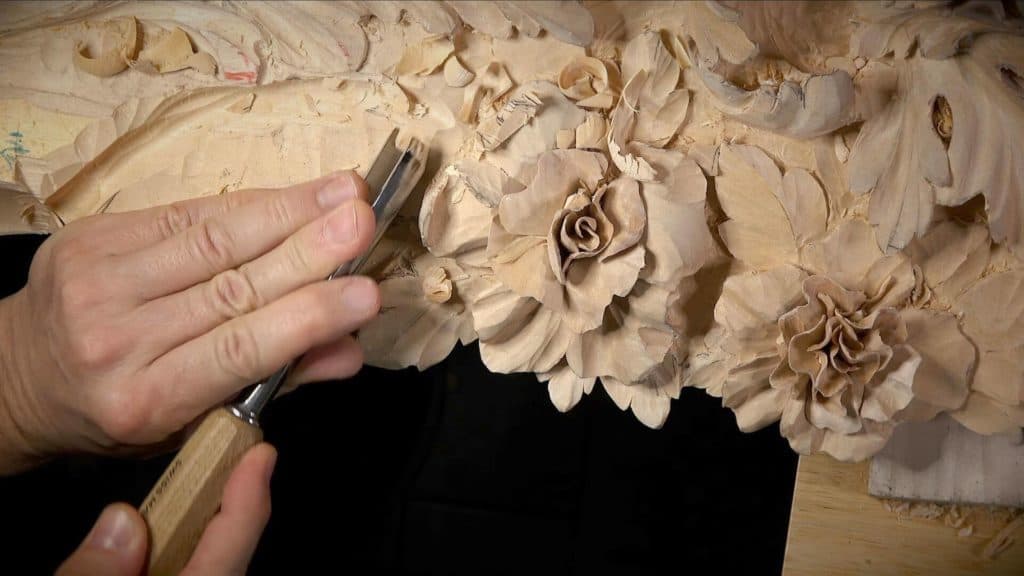
Alexander Grabovetskiy, woodcarver, School of Woodcarving · Published 2020
What does a wood carver mean by "final result"?
Quick answer: Workshop 74 of the Venice Room has me saying, in its fifth part, that I want the "final result" to look authentic to the Venetian period. In other lessons I said the same words when I promised to show a piece, when I held one up, and when I named the look I'm after while the wood still looked rough.
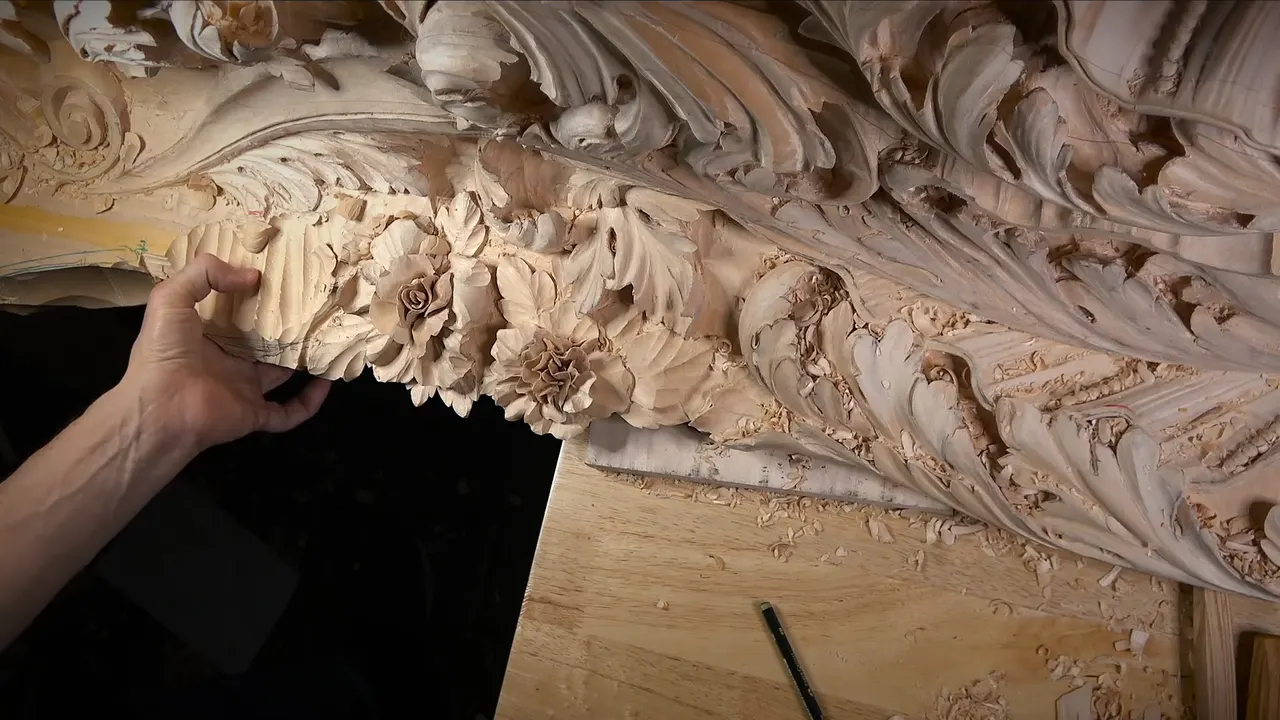

In part 5 of Venice Room workshop 74, I told you I want my final result "looking authentic," and I named the Venetian period. Other lessons use those two words when I promise a piece, when I hold one up and when the wood still looks rough.
Ever carved a leaf that looked unfinished and still knew where it was going? Did you ever put a gouge down because one more pass was too much? Part 5 is where this page begins, and the rest of it follows the same two words through other lessons of my wood carving school.
Which words came near the end of part 5 in workshop 74?
Near the end of part 5 I was using a number 11 at 15 millimeters, "like five-eighths of an inch" (15 mm is about 0.6 in). "That's mostly what I'm using on that project," I said. "I don't have to, by the way. But the reason why I'm doing it, I'm going to repeat, I told it multiple times, I really want to make my final result looking authentic to the Venetian period."

A visitor comes into it. "When expert would come and look at it, he could just check the tool marks," I said. Experts "do know what tools those people used." And "most what they used, it was gouges and veiners."
The way I told it, he looks and says "Oh, yes, that piece is definitely done authentically." Paint came last in that part. The paint, I said, would be more like a chalk paint, "also really true to the European culture," and "they paint it a lot with just a chalk paint."

What was I doing with the gouge before I said it?
A check on the wood that is left opens part 5. "Here, let me check." "I've got approximately, I would say, inch and a quarter left right in the middle." That is 32 mm.
My reason for "probably it's enough" came in my own words. "I still want to excavate kind of deep, and I still want to make sure it's not losing overall feel, gradually moving, and so on."
Cleaning called for a different tool. "I could use the same tool, of course, but if I have a better tool for cleaning, I would use a better tool." My pick was "just a large number seven, one of my favorite big tools."

One pass ended with "And I think that should do it." "And of course, I could take it to extreme and clean it even better if I wanted to." The question, as I put it, was "do I need to or not?" "I don't think I need it," I said.
A flatter tool came next in the part. "Somewhat flat tool, that's what I'm using, like number two and 50 millimeters, in this case." Fifty millimeters is about 2 in. I called it "more for sculpture," a "sculptor's tool," and "a really good tool also to have."

"Don't want to overdo it," I said, and an oops followed. "Oops, that is not bueno. If I would just continue to do that, I could break this part, and that would not be a good idea. And it would be really bad idea."
After that I said "Okay, wonderful. And now I can easily create the line again, recreate the movement." I could "take it a little closer to this part."

The shape got a name: "how I call it, fishing or fisher's boat shape." "Just the boundary," I added, "and that is going to be my middle movement."
What I was looking for, in my words: "a really, really 3D, just how it just gets overall movement." As for the leaf, I said "I want to try to repeat that movement on this leaf." And I said it would look "more organic."

The next tool was "number 11. And I can take probably 15 millimeters or so and outline a little bit." About 0.59 in. "I'm not going to develop the rest of it until I'm done with my corbels."
"We're going to lay that aside and wait and see how it's going to fit all together." "But now what I have to do, just preliminary." "I can actually take that leaf right underneath of that movement," I said, and "I think it would look really beautiful." It would "blend together," I said.

Do the other parts of lesson 74 explain it?
A reason for the movement sits in part 4. If you ask me why I am doing what I am doing, I said, my answer is the same as before. The words I wanted were "gradual movement," and it was "really important for me to show it's gradually moving to the ceiling."
A look at the same piece starts part 6. "I kind of like the overall feel of it." It also holds a worry, "I'm afraid it's going to just be too busy in this area," and a plan for "Three main movements."

When do I promise the final result?
Other workshops carry the two words as a promise. Over in Venice Room 76, part 5, I put it this way. "I'll spend a little more time a little later off camera, get a little closer with my eyes, for I would just see much better what I'm working." The promise came too: "And, of course, I'll show you the final result. Absolutely."

Take Venice Room 85, part 3, where the grain is the reason. "Let me please do it off-camera because, like I said, it's really inconvenient for the grain direction." I promised it in one line: "And I'll show you the final result."
A gluing job fills part 10 of Venice Room 78, and I said I would clean everything off camera and make it look more appealing. A promise of the final result closed that sentence.
For Venice Room 163, part 3, I said I would readjust my table, work on it and show the result when I was done. In Venice Room 102, part 7, I said "I am happy with that," planned a clean-up off camera and added "But it's not the end yet, okay?"

Venetian Flowers Rosette 6, part 2, has the plain version. "I'll just do all around," I said, and the final result would follow. In Furniture Panel 15, part 3, I said "Sorry if you can't see that" and asked you to wait for the result after my cut was done.
The Lily Box 13 part called Done has "So far, I am happy with my box, with the result." My plan after that was to "shake those fibers out" and show the final result.
What do I say when I hold the finished piece up?

In the rosette lesson the piece came out for you to look at. "I'm done with this beautiful composition," I said, and "Definitely, it is in my opinion, but I really like it."
I held it up and said "Here you go. That is the final result." "I hope you will do something like that," I added. "We started with just a simple drawing and finished with that composition."

Roman Acanthus 16, part 6, has the same turn, with "I will try to clean those pencil marks" and "I think that's it." Then came "And I will show to you the final result." And "here it is."
A drawing counts too. Over in Venice Room 92, part 8, I said "Let me double-check. And that's the final result of it." My plan for it was "I'm going to take it to my piece" and use carbon paper.

The Lily Box 13 lesson is on carving olives. In its part on blending color, "I know it doesn't make sense right now for some of you," I told you, "but once you're going to apply the final coat," and "blend nicely." And "Hopefully, you can see pretty much the final result of the carving."
Can I tell what the final result is while the wood still looks rough?
Take Carving Hazelnuts 7, part 2. "Even if I'm changing stuff, but still it looks somewhat appealing already." I went on, "I know it looks messy, but it depends how you look at it, because if you see the final result in your head, you're going to agree with me." That course carves hazelnuts.

A roughing stage fills Lily Box 6, part 11. "Don't pay attention yet to the details, okay?" I said. "I know it doesn't look too appealing sometimes, especially on a camera when you're looking really close. But the final result is always excellent, okay?" Then "I really don't worry about how it looks as of now."
In Venice Room 26, part 9, I was talking about "quarter inch eyes" (about 6 mm). "Even if it looks a little messy, that is okay. The final result will be awesome."

Grinling Gibbons, Maine class 14, part 3, has "Yeah, you don't really see the final result. But it is there." My next line was "The look I'm after."
Venice Room 50, part 10, has me talking about the moment "when you look at those lines and you don't know the final result, what you're after." On somebody else's design I said "It's not always possible for people if you did not design yourself, if you're trying to repeat somebody else's work."

Carving Grape Onlay 1, part 3, was an overall shape. "I'm working on just an overall shape of it," I said, without worrying about the final result, "because you can see obviously how choppy that one is." In Hashemi Flowers 10, part 11, I was working against the grain and said "what's the final goal, final result should look like."
How do I get closer to the final result?
Furniture Panel 22, part 1, has "I kept approximately one millimeter, maybe less than one millimeter away." One millimeter is 0.04 in. "I also don't want to do everything in one cut. I'm just going to carefully approach the final result by smaller cuts."

Venice Room 6, part 11, says it. "That would be a big mistake for me to press too hard. I can't do that. It's better to take time. And little by little, just approach to the final result."
Size mattered in Venice Room 35, part 4. "So got to be careful." Four millimeters (0.16 in) was "a little too big." Three millimeters (0.12 in) "still moves." Two millimeters (0.08 in) in a number 11 brought "And yes, it is much safer." Just before that I said "I need to get a little closer to the final result right here."

Carving Plate with Butterflies 8, part 1, was knife work. "Carefully carefully," I said, and it would take me multiple cuts to get to the final result I like.
What do I call a result that is not the last one?
Carving Vase with Grape Leaves 2, part 10, has it too. "I really don't worry about those ridges yet because we are going to be able to blend them later with the later steps." I would work on "all those pipes all around," and my words after that were "Not the final, final, but the result I'm after."

In Hashemi Flowers 44, part 1, I put it as "Hopefully you can see it's not the final results, but still." Chamomile and Bow Rosette 3, part 2, has me saying I forgot to show a bowl's "somewhat final result" before the beads.
One more version sits in Lily Box 10, part 5. "If I would just continue to do that, it would give me actually almost final result."

Where did I say it, side by side?
Each lesson here, with what I had in front of me.
| Lesson | What I had in front of me | How I said it |
|---|---|---|
| Workshop 74.5 | A leaf, and a 15 mm (0.6 in) number 11 | My aim |
| Workshop 85.3 | A part cleaned off camera because of the grain | A promise |
| Venetian Rosette 6.2 | A finished composition, and a drawing at the start | Held up |
| Roman Acanthus 16.6 | A leaf in the Roman style with pencil marks | Held up |
| Carving Hazelnuts 7.2 | Wood that looks messy while I keep changing it | Looking ahead |
| Lily Box 6.11 | A roughing stage, so no attention on details yet | Looking ahead |
| Furniture Panel 22.1 | Undercutting about one millimeter (0.04 in) from the background | Small cuts |
| Grape Vase 2.10 | Pipes all around, with ridges to blend later | Not final |
| Hashemi Flowers 44.1 | A planned separation between petals, going downhill | Not final |
Where can you watch part 5 and the lessons on this page?
Watch part 5 in Venice Room 74. The Venice Room Part 7 course holds workshops 74 to 85 of the Venice Room, and the other lessons come from the Carving Hashemi Flowers, Lily Box, Furniture Panel and Grape Vase courses. Every page here is open to you with school access.
Want to hear me say it in my own voice? Start here.
How it's done
- Check what wood is left. Approximately an inch and a quarter (32 mm) was left in the middle, I said, and probably enough.
- Switch tools to clean. A large number seven, one of my favorite big tools.
- Ask if you need to go further. Taking it to extreme was possible, and the question was "do I need to or not?" I did not think I needed it.
- Stop before you overdo it. Not wanting to overdo it was my line, and a slip that could break the part would be a really bad idea.
- Bring the line back. The movement was easy to recreate, in my words, and I wanted to repeat it on the leaf.
- Think about the old carvers' tools. Most of what the old carvers used was gouges and veiners, I said.
Frequently asked questions
Which look did I want in part 5?
Looking authentic, I said. I added that I had told you so multiple times, and I named chalk paint as "really true to the European culture."
Which tool was I using when I said it?
A number 11, 15 mm wide (about 0.6 inch), and I said it is mostly what I use on that project.
What did I say about wood that looks messy?
In Hazelnuts 7 I said it looks messy. In the Lily Box lesson on a roughing stage I do not worry about how it looks as of now, I said.
How do I move toward the final result?
What to carve next