
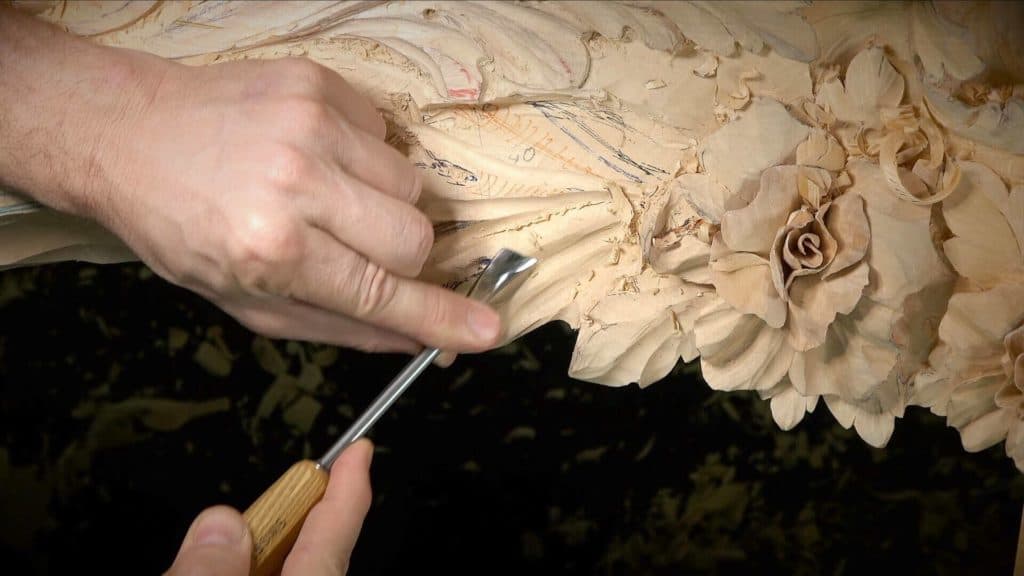
Alexander Grabovetskiy, woodcarver, School of Woodcarving · Published 2020
What does a wood carver mean by "you get the point"?
Quick answer: My Venice Room 74.8 part is where I exaggerated the big convexes, left one part unshown, and then used the line from the title question. Other lessons of mine close a loose word, a hidden angle or unfinished work in the same way, in the Lily Box and Furniture Panel lessons.
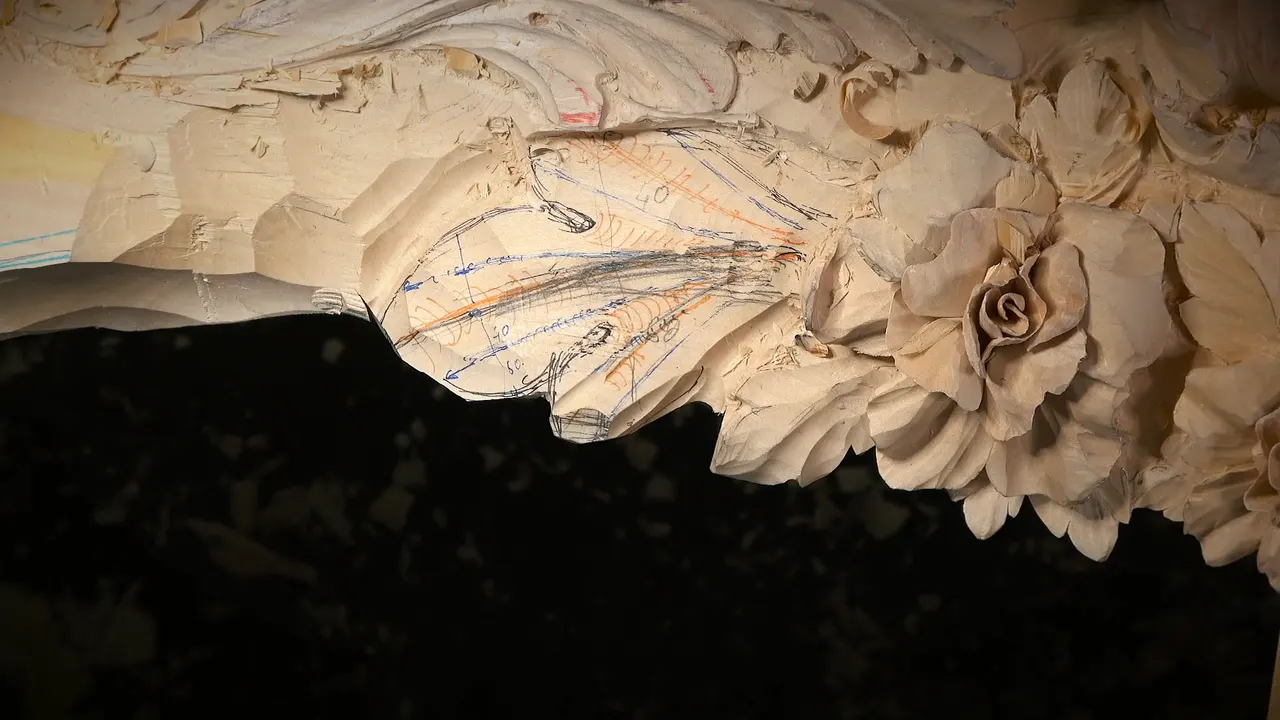

Venice Room workshop 74, part 8, is where I exaggerate the convexes and concaves around the eyes of an acanthus leaf. I stop short of showing one part, because I would "stick my head in the camera," and I tell you to "get that point." Other lessons of mine close a loose word, a hidden angle or work still half done on that same line.
Ever lost a move behind a hand? Ever read a drawing that was only close to what a carver meant? Those are the gaps this page sits in. Part 8 is the spine. Next comes part 9 of the same lesson, then lessons from the Venice Room, the Furniture Panel, the Lily Box and a few other courses, each with a gap of its own.
Where did part 8 begin?
The video opens on a plan: "Okay. And now it's time to exaggerate those convexes and concaves." The same tool might do, I said, and next I named the eyes as something to keep.

Maybe a "preliminary cut for the eyes," I said. For that I named "5 millimeters number 11" (3/16 in, the figure I gave). My plan was "to just indicate where's my eye going to be." And I added "not going to carve all the way yet because I might going to reconsider it. I mean, the position-wise. We'll see."
How did the concaves and the flower go?
The plan: create "those concaves," and another one "this way," "just to get the big chunk out of whatever that movement." I would "use a bigger one," I said. I could take it "all the way almost down like that," I said, and it would "create a beautiful movement."

More was possible. "Actually, I can exaggerate even more." On the middle: "to create my convex on inside right in the middle with no problem."
The exaggerations around the eyes were "a big thing," I said, and "I'm not afraid to lose the middle." I asked, "See how close I get to each other?" and said I could "actually create one cut right in the middle." Then the flower. "I don't want to hit my flower."

"And that's not really convenient for me." Next: "I could switch to 10 millimeters" (0.39 in), and "I think it should be okay." More notes to myself: "maybe I should change a little bit position how I'm cutting," and "maybe this side needs to be deepened little more." Then another concave.
What did I say about the part you could not see?
"And here you go. This part, if I going to work on it right now, I going to stick my head in the camera." That was not something I wanted to do. And I said the line itself: "So you get the point, what I'm working on and what I'm doing." And again: "Try to get that point, okay?"

The main idea came right after: "just exaggerate those big convexes around the eye." One more line followed: "here's going to be an eye, and there's an eye also."
Which tool did the convex ask for?
"I'll take a back bend, and I'm going to start creating my convex." In my case "number five pretty much is what I'm using. About half an inch" (13 millimeters).

Then: "Actually, I can knock down on the middle part of this movement. Doesn't look too appealing yet." One side needed care. There I did not think I could attack from the opposite direction, "which in my case would be the most logical."
"If I'm digging little bit on inside, creating that cut, I'm okay. I can always clean it. But really want to exaggerate that convex."
When was the convex already really nice, and what was left?
"That's beautiful and gradual," I said. "I don't need to do anything to it, okay? So it's already really nice." Then tool marks: "I don't have too many tool marks or facets." And sanding: "I don't need to sand it or use roughers or rasps."

One plan was left: "that is little too big. I need to use a little smaller tool, clean it on inside, whatever I created, that digging mark, digging tool mark."
Did part 9 carry the same line?
It opens on it, spoken about "what I've just done." A plan for the middle part followed: "let me also do this part, middle part, with the same tool." My aim was "a really nice convex," although "I need to change the position again and carve this way."

Further in came a plain admission: "a little hard area for me to show to you because I have to stay really far away just because of the camera position and so on." Again I said it, and then: "We've got three main divisions, and inside of those three main divisions, we also divide by three. One, two, three."
Was walking around the camera easy?
Floral and Molding 2, part 1, has me saying "I'll take number nine again and 10 millimeters" (0.39 in), and "I have to attack that from the right position." Then: "But for me, it's not always convenient just to walk around and so on." I did not want to cover the camera, and the line came next.

"And yes, I could probably go a little farther." My plan: take "number seven again and inch and a half" (38 mm), for "a cleanup. So just from above."
Did my hand ever block the work?
It did in Acanthus over Moldings 2, part 3. Looking from the side view, I said it "does not have a really gradual movement. So that is why I have to attack that and make it really gradual."

"My apologies that I'm covering with my hand," I said. The line came. After it: "I will exaggerate slightly." My verdict on the side: "Okay, that is good. As far as how it looks from the side." The top was another matter: "it is not good," and "I need to fix that movement."
Which detail could you not see on the stem?
Furniture Panel 26, part 2, shows me on a stem, where "my main focus is on the left hand side of the tool." I was "just trying to make the line more appealing to myself."

"Unfortunately, you don't see the full, you know, detail, but it's okay." That line was my next sentence, and later "I can probably just excavate a little deeper right here."
What can a drawing from one angle not show?
Lily Box 12, part 1, has me talking about waste: "it's going to create a really nice movement on the backside." Not everything "is possible to draw in two-dimensional world," I said.

"Well, it's possible if you create multiple, okay? Multiple drawings from different angles. Don't get me wrong. It's still possible, I shouldn't say it's impossible." With "just the one angle look from above," though, the line followed, and "it is almost impossible to create those little things."
How close was the line to the corbel?
In Venice Room 85, part 11, I said "I'm going to take number seven and 14 millimeters" (0.55 in) and "I can get a little closer to the final line." About the corbel, I said "I left approximately one millimeter to the line" (0.04 in).

A reference was set: "I've got my reference again, so I can always reference right now 90 degrees this way." I called it "a really good idea to get this done at the first step than just figure it out later." Then "at least I've got my drop outlined," followed by a correction, "Not really outlined yet, but" and then the line, and "of course, I can chop off this corner right away pretty much."
What is an outline that is not an outline?
Over in Venice Room 134, part 1: "Let me outline this side," I said, and "I could go this side maybe slightly lower. Don't have to, but I can do that probably." Then "number seven, big one," and "I think that is low enough."
Next I said "let me take again number 11 and 10 millimeters" (about 0.4 in) and that I would outline it this way. That sentence changed: "Not outline it, but" followed by the line, then "Clean it." Later: "I've got a little too close. It's okay."
Was that really a Shaker crown molding?
In Venice Room 58, part 7, the next job was "a really deep concave on inside between this line right here and that line." It would be "a deep excavation," I said.

"So it's almost like a crown molding. If you're in United States, you will understand what I mean, on inside." A fix: "It's not Shaker crown molding, but" with the line behind it, and "just a concave on inside." I added "Hope it makes sense, and I'm not confusing nobody."
What did I mean by waste?
Lily Box 11, part 6, has me saying I would use a knife to "remove some of the excess material right here with just a knife. It gives me really good slicing in this area."

A part got a name, "my waste. Not my waste, but" and the line again, before I said: "Going to chop out and create some shape. I'm not rounding yet anything, okay? Just like I mentioned that before, I am creating my canvas."
Was the wood really white?
In Lily Box 4, part 10, I said "with the grainy woods, sometimes you're losing overall picture." And: "So that's why I like to work with basswood because it doesn't have a lot of grain. Just a really nice canvas. Okay? Beautiful and white."

The fix: "Not really white, but" and the line after it. And: "that is the movement what I want to see. Really nice and smooth transition."
When did I call a shape not final?
In Furniture Panel 22, part 12, I said "I need to make it feel like it's growing from inside upward and downhill again. So it has to have a convex." My tool was "number three, by the way, and that's a quarter-inch" (6.35 mm).

"I need to make a little separation right here because I don't want to lose that movement." Next came the line. After it: "that is not the final form yet, okay? Because we still have to outline and undercut and make it absolutely beautiful." And: "Just giving the shape. That is the first step."
Were the long cuts good enough in the Rosette course?
In Venetian Flowers Rosette 4, part 3, I said I needed "the long bend, number seven," and "a few concaves right on inside," not deep ones, "but still a few of them."

"I'm still not too happy how those long cuts look. I could probably spend a little longer on those long cuts, but that's okay." Right after, the line from the title question. Then: "maybe I can actually get another one right inside, right here. That way, visually, it's going to just catch the eye and you can just follow the movement."
Where do the loose words and the closing line sit side by side?
Each lesson on this page, with what I had just done or said and what followed.
| Lesson | What I did or said that day | Next |
|---|---|---|
| Venice 74.8 | A part I did not want to work on right then, and my main idea | Big convexes |
| Next part | A hard area to show, because I had to stay really far away | Three divisions |
| Floral 2.1 | Whether to walk around and cover the camera | Farther, then a cleanup |
| Moldings 2.3 | Covering with my hand, and my apologies | A slight exaggeration |
| Panel 26.2 | You do not see the full detail, but it is okay | Deeper here |
| Lily 12.1 | Just the one angle look from above, in a drawing | Almost impossible |
| Venice 85.11 | The drop outlined only roughly, with the reference already set | Chopping off this corner |
| Room 134.1 | A line I said I would outline, then called a clean instead | Too close, but okay |
| Room 58.7 | A concave that is almost like a crown molding, but not quite one | Only a concave inside |
| Box 11.6 | A piece I called my waste, then fixed the word | A canvas |
| Box 4.10 | A surface I called white, then corrected | Smooth transition |
| Panel 22.12 | A shape I said was not final, only the first step | A little deeper |
| Rosette 4.3 | Long cuts I was not too happy with, though I said that was okay | One more inside |
Where can you watch part 8?
Part 8 sits in Venice Room 74, inside the Venice Room Part 7 course, which holds workshops 74 to 85. Each lesson named above has its own page on the site, and sizes come in millimeters first, as I said them, with inches after.
Want to hear me say it in my own voice? Start here.
How it's done
- Say what you plan to exaggerate. Open with the plan, and use the tool already in your hands.
- Indicate the eyes. Give a preliminary cut to the eyes with a number 11 of 5 millimeters (0.2 in), and hold off on the full carve.
- Clear the movement. Create the concaves and take the big chunk out of the movement, then reach for a bigger tool.
- Tell the viewer what you cannot show. Tell the viewer what you are working on, and say what the main idea is.
- Look at the convex. When it is gradual, with few tool marks or facets, leave it alone. Clean the digging mark inside with a smaller tool.
Frequently asked questions
Which tool did I name first in part 8 of workshop 74?
A number 11 of 5 millimeters (3/16 in) for the preliminary cut on the eyes. Later I mentioned 10 millimeters (about 0.4 in), and a number five of about half an inch (13 millimeters) for the convex.
Why did I not show one part of the convex?
I said my head would be in the camera if I worked on it right then. After that I named the main idea: exaggerate the big convexes around the eye.
What follows a word I got wrong?
A correction, then the line I use. Workshop 85 gave "not really outlined yet," Lily Box 11 gave "not my waste," and Lily Box 4 gave "not really white."
What to carve next