
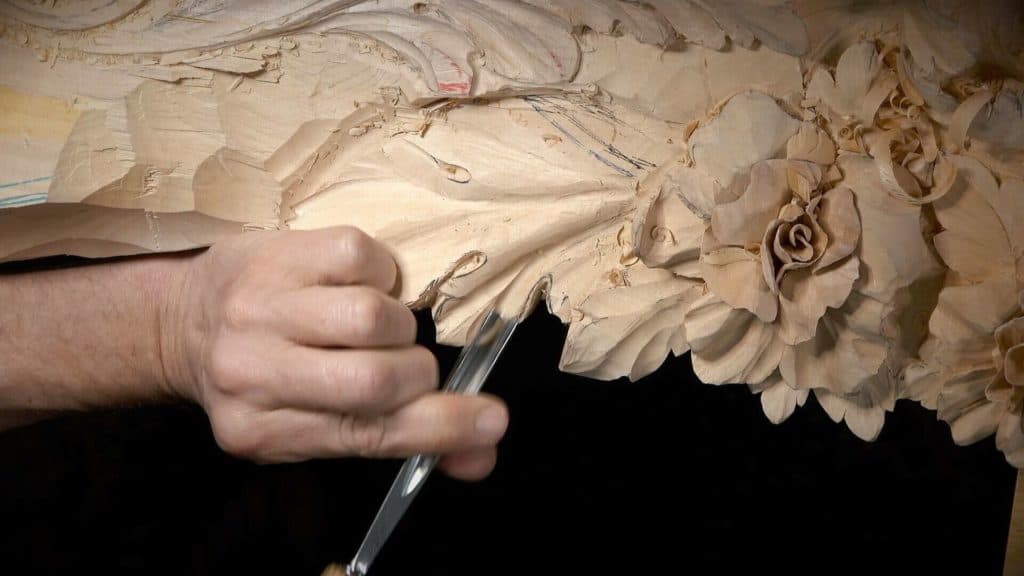
Alexander Grabovetskiy, woodcarver, School of Woodcarving · Published 2020
What does a wood carver mean by "the main ones"?
Quick answer: My Venice Room 74.9 part counted five convexes on one leaf, two of them out of the eyes. Other lessons of mine use the same words when I count divisions, movements, pipes and petals, on grape, Byzantine, Lily Box and Rosette pieces.
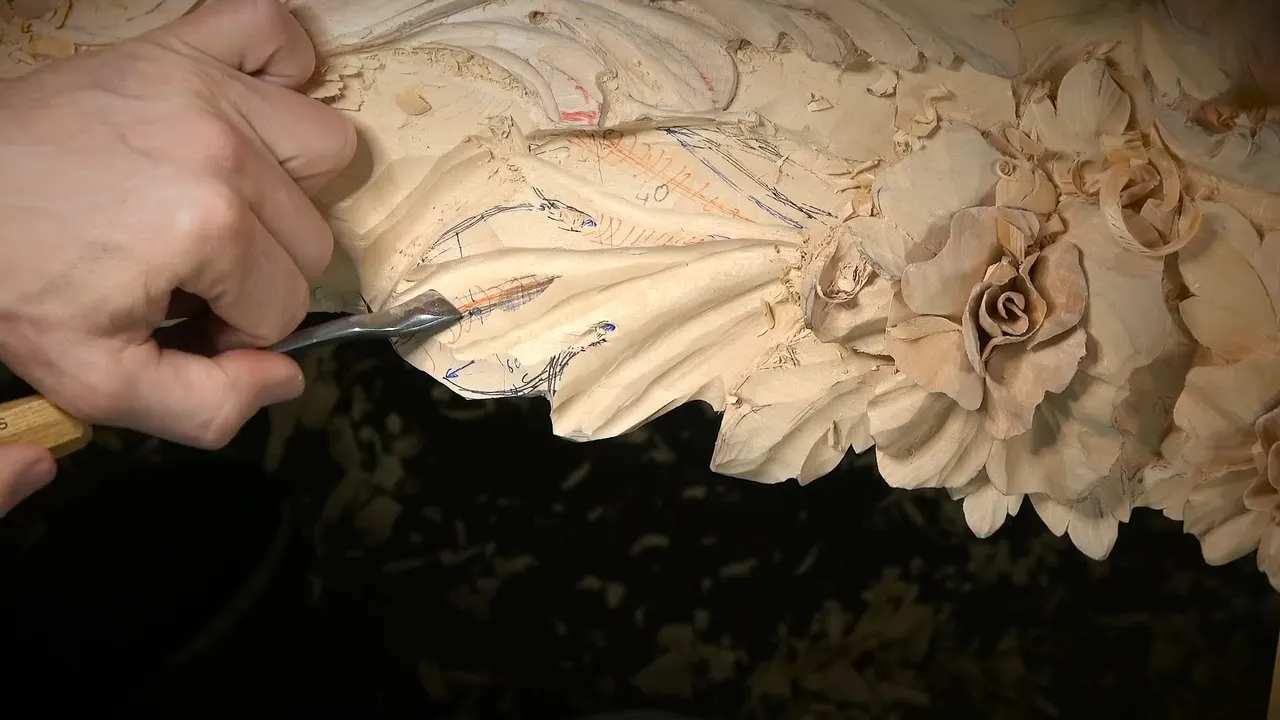

In Venice Room workshop 74, part 9, I count five convexes on one acanthus leaf, and two of them are what I call "main ones." They come from the eyes. Other lessons of mine use the same words when I set out a count, for a pipe, a movement or a petal, and then I say what follows.
Ever counted the parts of a leaf and lost track of which one matters most? Ever held a gouge over a line and not known which one to carve first? These gaps are where this page sits. Part 9 is the spine. The rest come from the Venice Room, the Byzantine Acanthus, the grape lessons, the Floral and Molding panel and the Lily Box, each with a count of its own.
Which convexes does part 9 call main?
Early in the part I turn to the middle of the leaf. The idea was to do it "with the same tool," and make "a really nice convex," though I had to change my position first and carve "this way." Plain enough. What was left, I said, was the divisions: three main divisions on this piece, each one divided in three, and each of those divided again.

I said I had shown you how I do them "previously, on the same piece actually pretty much." This time I planned to show "the beginning stage." One area was hard to show, because I had to stay "really far away" for the camera position.
Later in the part I gave the count. "Five total convexes. Two main ones out of the eyes and three secondary and inside of each division."
Do two eyes mean two convexes?
On this leaf they do, and I gave the reason as I talked. With three divisions, "it should be two eyes." And "if you have an eye, you always have a convex." I compared that convex to "the main vein, if you wish."
The tally: two eyes, two main convexes, and three divisions inside of those divisions. For Venetian style I added "convex, convex, and a convex." That makes "five total."
How did the closer look show the main convexes?
I showed an updated version. "That's what exactly I tried to explain to you," I said. There were two big pipes, "really thick and pronounced," and one more convex was "a lot less pronounced," right in one spot. And for the overall look: "that's how it looks in our overall composition." Then I said I had "to just create more divisions."

The closer look said it again. Those two pipes were "the main convexes." The weaker ones sat "on the side of the divisions itself."
Which tools did the hollows get?
"Let me excavate little," I said, "but I really need to relieve it." I first said number 5, then fixed it: "number 11 and 5 millimeters, 3/16 of an inch." That one was "little too big of a tool," so I needed a smaller tool, and I planned to take 3 millimeters, one-eighth of an inch.

I offered a mallet too: "probably I could use a mallet and excavate little by little," to "create beautiful separation." A little after that, "Got to be careful, of course."
Later the plan was a number 11 of 10 millimeters (3/8 in), to excavate a little deeper. Wood was running low: "I don't have too much material left."

What did I mean by upside down?
The word shows in the video while I excavate: "Just like that. Upside down." Later I said I really like to bring one edge up. Another convex between two points was an option, I said, and a weaker one. My wish stayed "a convex movement this way."

At first I said I could do it upside down, then I fixed myself: "Not upside down, but back bend number five and half an inch" (about 13 millimeters). By upside down, I said, I mean a straight tool used that way. A back bend is not that.
How much wood was left at the end of part 9?
The video closes on care: "mindful," then "more careful." My aim was still a convex feel in that section, though right then it was "just a concave," and "that's not good."

The last line is a plan: "Back bend will help me."
Did parts 7 and 10 of this lesson say it too?
In part 7 of this lesson, the main convex comes "around the eye," and a second one goes "right there." Those two are "the most exaggerated ones." On the sides I needed "a concave and a concave."
Part 10 returns to the middle. "I still do not want to lose middle part," I said. I wanted to see that convex there too, but what mattered most was "this movement the right way."
How many main ones does an acanthus get?
Venice Room 7, part 12, gives a count: "one, two, three main ones. Sometimes it's five, sometimes it's three. It all depends." A few more separations come after those. I planned to relieve them first with a number 11 of 7 millimeters (0.28 in), "just create little relieving cuts, preliminary ones."

Workshop 12 of the Venice Room, part 7, puts it at "three subdivisions, the main ones," with "at least in my opinion" after it. An eye sat on one side, so I had to add one on the other. Then: "Let me get number nine," and "couple cuts inside, straight down."

Did a Byzantine leaf count the same way?
Carving Byzantine Acanthus 8, part 2, gives a count. "We're going to have more," I said, but right now there are three of the main ones. I said to draw a middle line of that pipe. It goes "all the way to that central line."

On that center line I was going to use a marker, to mean "a high point." After it came the job of finding the center line of each division. And one more check: "Again, 60-40 rule."
Did the grape lessons count the main ones the same way?
Carving Vase with Grape Leaves 2, part 12, has five divisions, and inside each of them "three main divisions." The movement I placed from the middle was "like a vein." And: "If that is the main division, so that is going to be a subdivision."

Carving Grape Onlay 8, part 1, says every lobe should have subdivisions, "three main subdivisions," and "inside of those main ones, we also have to subdivide like in three or more."
Where did the panel count go beyond the main ones?
Over in Carving Floral and Molding for the Panel 12, part 1, I said "let me see what I've got, how many divisions." The panel had "multiple divisions, not just the main ones."

The plan was "three main ones," and then "I'm going to subdivide that." Further on, "I have to subdivide even more."
Which movements of a leaf are main?
Back in Venice Room 15, part 10, I call one thing "the main movement," with "a few separations" and "the main one like this." An extra concave would give "beautiful movement," I said, and I weighed a tool aloud: "Maybe number eight. Well, I'm sorry, number nine."
Venice Room 33, part 6, has the plan: "I need to establish my movements, the main movements of this leaf." More separations were still to come, but "those are the main ones." I was "really happy with the shape."

Take Venice Room 53, part 7, where "the main concaves and convexes" are main ones: a concave, convex, concave, with a down roll, and some of it gets raised later on. I added "the main shape, if you wish."

Look at Venice Room 94, part 1, where I had to make a decision on "my main movements." There were "already a couple of them." I also said what I mean by "smaller." With calipers set to a golden ratio, it means "62 percent" and "38 percent," or the "60-40 rule to be more simplified version."

What came after the main ones?
Lily Box 4, part 1, has me marking high spots. "We're not going to touch them now." Then: "as of now, those are the main ones, except maybe this one is not." The second layer: about 20 millimeters (0.79 in), "maybe even a little bigger."

The job was to identify "the main movements." The tool was to be "number nine, just besides of my high spots." For anyone worried: "if you are afraid to lose the details, don't be. Okay? That is the process."
Carving Flower Rosette 1, part 3, puts the main ones above the small petals, which are "second, right below." And: "I do have a small gouge, which is going to fit perfectly."
Which of the main ones was the biggest?
Go to Venice Room 162, part 3, for "my pipe number one." The next pipe would be "a little smaller." One more would follow, not as big. And: "this is the main one," and that one is "the biggest show."

For it I said "Let me actually get bigger tool," with "maybe 16 millimeters or 15 millimeters. Number 11. It's about 5/8 of an inch" (15.9 mm). I would "start concaving. From almost nothing, closer to the volute I get." Deeper and deeper followed, I said, as the tool went "little deeper, deeper, deeper, deeper."
Carving Hashemi Flowers 29, part 1, was plain. "Let me make a separation cut. This is the main one, the biggest one, I would say." I would take "number nine and about 5/8 of an inch" (about 16 mm), with "a little smaller mallet. 12 ounces mallet" (12 ounces is about 340 g).
Where does the main one sit?
In Venice Room 142, part 1, I laid out two options. One was a "double volute with some kind of acanthus moving this way." The other was "double acanthus head," so the second leaf is "secondary," and below the main one. That one, I said, is "probably, I would say, most logical." An opening in that area, I said, would "give some lighter feel," so the leaf would not look exactly like the opposite side.
Carving Grape Onlay 11, part 1, goes the other way. Going lower was possible, because part of it goes underneath a branch, but I wanted the look of that branch right. "I think I have to rethink." Then: "the main one gonna go even lower," with "two separations right here" as a "replication of this side."
A look at Venice Room 91, part 1: "one of the main one." The cut to make was "a concave cut going all the way." Then a view from the side: "Maybe I need to remove little more this way, because it doesn't look too fluent yet."
Where do the main ones sit side by side?
Each lesson on this page, with what I called main and what came next.
| Called | Where | Next |
|---|---|---|
| The pair at the eyes | Five convexes counted on the leaf, in Venice 74.9 | Three secondary |
| The convex around the eye | Another convex and a concave beside each, in Venice 74.7 | Concaves on the sides |
| Three, sometimes five | Sometimes five and sometimes three, it all depends, in Venice 7.12 | More separations |
| Three subdivisions | An eye on one side and one to add, in Venice 12.7 | One more eye |
| Three, and more later | Along the middle line of a pipe, in Byzantine 8.2 | A marker |
| Three in each division | Inside each of five divisions, in Vase with Grape Leaves 2.12 | Like a vein |
| Three main subdivisions | In every lobe of the piece, in Grape Onlay 8.1 | Three or more |
| Three of many | Multiple divisions, not just the main ones, in Floral 12.1 | More subdivisions |
| A main movement | A few separations and an extra concave, in Venice 15.10 | Number nine |
| Main movements | Other separations still to do, in Venice 33.6 | Happy with the shape |
| Main concaves and convexes | A concave, convex, concave with a down roll, in Venice 53.7 | The middle line |
| High spots, maybe | Spots I marked and would not touch yet, in Lily Box 4.1 | Number nine |
| Above the small petals | The small petals come second, in Flower Rosette 1.3 | A small gouge |
| The biggest pipe | Another pipe a little smaller, in Venice 162.3 | A bigger tool |
| The biggest cut | A separation cut made with number nine, in Hashemi 29.1 | A small mallet |
| The one below it | The leaf below the main one, in Venice 142.1 | A lighter feel |
| The one to go lower | Two separations as a replication of one side, in Grape Onlay 11.1 | A rethink |
Where can you watch part 9?
Find part 9 in Venice Room 74, inside the Venice Room Part 7 course, which holds workshops 74 to 85. Each lesson above has its own page. Sizes come in millimeters first, as I said them, with inches after. Those lessons are a fair place to start on wood carving in relief.
Want to hear me say it in my own voice? Start here.
How it's done
- Count the divisions. I counted three divisions on the piece, and each one was to be split in three.
- Match each eye to a convex. With three divisions, I said, there should be two eyes. Each eye brings a convex, and that convex is like the main vein.
- Name the five. In Venetian style the total was five convexes. Two belong to the eyes, and three are secondary ones inside the divisions.
- Excavate with a number 11, then a smaller tool. I named a number 11 first. Once it grew too big, a smaller one at 3 millimeters was named.
- Bring up the edge using a back bend. I planned a weaker convex between two points, and I named a back bend for it.
Frequently asked questions
Which convexes counted as main in workshop 74?
Part 9 totals five convexes. Two belong to the eyes. Three are secondary ones inside each division, and the big pair of pipes was really thick, with one weaker convex on the side of the divisions.
Which tools did part 9 name?
Number 11 at 5 millimeters (3/16 in) came first. Then 3 millimeters (1/8 in) was the plan once that one grew too big, plus a back bend number five at 13 millimeters (half an inch) for the edge. Last was a number 11 at 10 millimeters (3/8 in).
How many main ones did other lessons count?
A count of three came from Venice Room 7.12, with five possible and a note that it all depends. Workshop 12.7 put it at three subdivisions. The panel lesson in my Floral course gave three as well.
What to carve next
- Venice Room 74
- Venice Room Part 7
- Venice Room 7
- Venice Room 12
- Carving Byzantine Acanthus 8
- Carving Vase with Grape Leaves 2
- Carving Grape Onlay 8
- Carving Floral and Molding 12
- Venice Room 15
- Venice Room 33
- Venice Room 53
- Venice Room 94
- Lily Box 4
- Carving Flower Rosette 1
- Venice Room 162
- Carving Hashemi Flowers 29
- Venice Room 142