
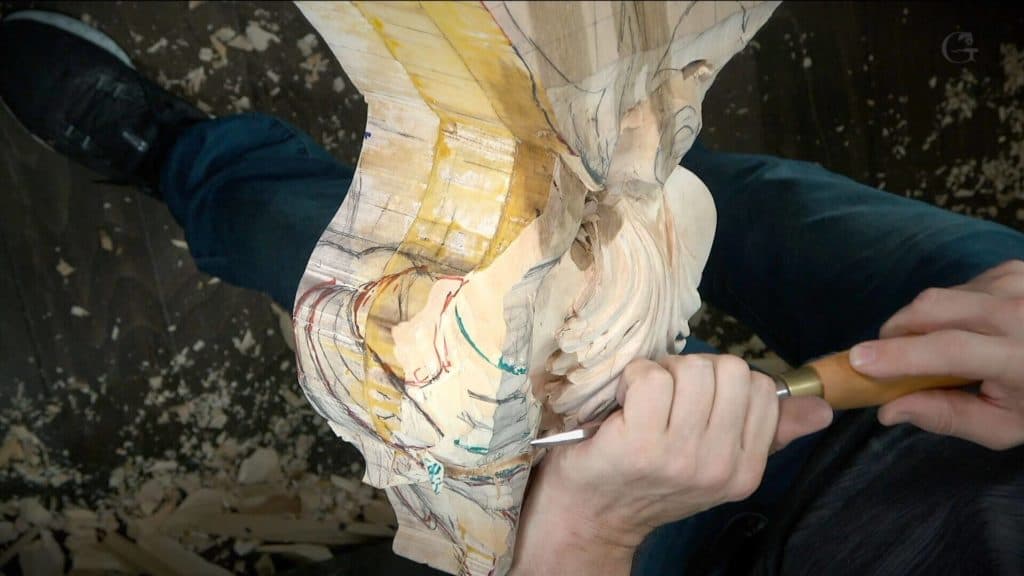
Alexander Grabovetskiy, woodcarver, School of Woodcarving · Published 2020
What does a wood carver mean by "unite"?
Quick answer: Unite is the word I used in workshop 83, part 12, for a triple movement on a corbel that I could make one chunk. In Furniture Panel drawing videos I used it for two lines, two details, two worlds, and divine and human.
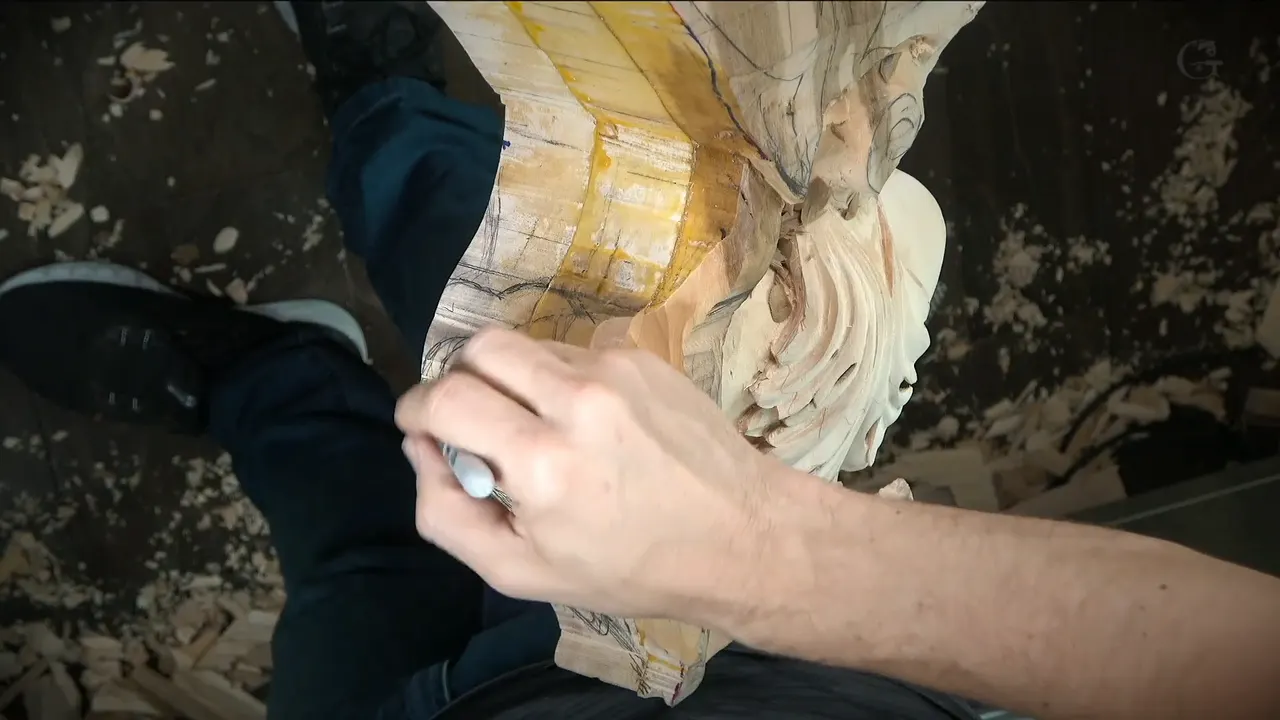

In workshop 83, part 12, I said I could unite a triple movement in one chunk, and I thought it would look much better. Other videos of mine use the same word for leaf lines, two details, two worlds, and the divine and the human.
Ever looked at three bumps in a row and wondered if they want to be one shape? Does a drawing feel wrong until two lines finally meet? Follow one word of mine across a corbel in wood and a furniture panel on paper, and see how often it came back.
Where I said unite, in six short lines
- Some spots and a big movement open part 12.
- One spot I had done did not please me, and maybe something had to change.
- A count came next.
- I could make it one chunk.
- Three big parts went down in marker, and teal marked the rest.
- Furniture Panel videos use the word for lines, flowers and two worlds.
Which words came right before unite?
The part opens mid-thought. "Just some spots," I say, and then comes my "big movement." One line, I said, "has to go all the way also to that line."
Then a verdict: "That is good." After it, "What I don't like, what I've done right here," and "Maybe I have to change something."
A count follows. "One, two, three, triple movement like that." What I could do sits right behind it: "what I can do, I can actually unite that in one chunk. I think it's going to look much better."
What was the marker for?
"Let me use marker for you to understand much better," I said, so a marker was my plan, and the frame below shows one in my hand. One section would "go all the way from here." Another one, I said, would be a "double layered section," with "one leaf on top of another one."
And a plain line: "I know it doesn't make any sense right now. It will."

An upper section came next. "But I also need to add something else right here. Otherwise, it's not going to look nice." Something else would be a third one, "one, two, and three right here." In my words these are "three main big parts," and "the rest of it" would be "smaller sections."
I planned to mark the small ones "with a different color." My plan was "probably just a teal color."

How did five sections come out of the count?
Next came a word of sorry. "I'm sorry for my mumbling today, but I really have to figure that out." And "I can also divide that."
One section, and a second one "right here." "Which means I've got total five sections, one, two, three, four, and five." The count was "accurate to the Fibonacci sequence," I said, and I added that this would be good.

For anyone who wants the row, it runs 1, 1, 2, 3, 5, 8, and each number is the two before it added together. A five sits in it. That row is my note, not a line from the video.
Why does a leaf like this look complicated?
Even I said so. "I know it's a little complicated looking one because we are working in not just a simple form, but it's in two dimensions." Then "this dimension and that dimension," and after that came three dimensions.
What was my first step in the wood?
"The step number one that I have to do, I have to probably make some separations between the lower section and the upper section." And then "That's what I'm going to do."
My tool plan was "again number 11," and "in this case, I probably should take 7 millimeters" (about 0.28 in). It came back as "7 millimeters, number 11."

A second idea followed. "This piece can just be little bit above of that movement, which is on the right-hand side of me right now." And a plan: "let me also outline this side."
How does a leaf with many parts still read as one leaf?
My logic covers all acanthus leaves "or any leaves." It is "like shape of the main leaf," and it is "still just a normal leaf, which you see every day and almost on all of the trees or plants." Another name, I said, is "shape of a boat, fisher's boat." Then "That makes it much easier."

The last words in the file are another plan. "So now I can take a skew and lower down a little bit this section right here."

Which lines came just before part 12?
In 83.11 I said "I think I can actually remove more." Then, "I'm going to leave just that point." The last lines of 83.11 hold "I also have to fill this space."
A request sits in part 10. "Since this project is big and for me, it's kind of hard to film and talk all the time." My question was "if it's okay, sometimes I'll just be quiet and keep carving." The whole lesson sits on the Venice Room 83 page.
Where else did I say unite?
You find it in the Furniture Panel design videos, where I draw on paper, and in Venice Room workshop 8. In each one the word sits next to a line or a detail I was working on.
What did I unite in workshop 8?
Workshop 8, part 3, has nearly the same sentence as my part 12: "I can actually unite those two." Right after it, "I really don't need to separate all of them."
Hard to see what I was doing, I admitted, but every ridge would make sense once you see the overall design. Later came "I still kind of don't like this ridge."

Where did I explain unite on the furniture panel?
Furniture Panel lesson 12 holds it in so many words, in part 3. One place, I said, was a "really, really good spot to unite those movements."
Then the explanation. "What I mean by unite, when I start my leaf, for example, it just repeats this line." At the finish of the leaf it repeats that line again. Overall, "it just kind of repeats and finishes that movement."
On the flowers I said "Maybe just a couple of them," "because I don't have too much space." I called them filler flowers, and "you fill kind of empty spaces with those flowers." You can find them, I added, "a lot of times on furniture, the period furniture."

Over in lesson 13, part 4: "I need to put some kind of leafage going downhill to repeat and unite." Next come "Follow this line first," and "I'll just do small ones." And "That's plenty of the details."

Which movement could not stop at a T?
In lesson 6, part 3, I said "there is not supposed to be any T-stops," and that this one would be "another T-stop although it's not a true 90 degrees T-stop." So "the movement cannot do that."
Then came "I have to unite vertical line and my diagonal line," and "my movement has to be that direction." "Or it could be this direction," I said. And "in my case, I would love to get this curl going like that."
A number came into it. "If you divide that space in 10 parts, it hits approximately 0.62." The figure is close to the golden ratio, which is my note, not his. Still, "I am not too happy how it looks."

What happens when a leaf makes its return?
The first part of lesson 8 talks about the "law of repetition," and the words "even on negative space" follow. The plan: "make my return this way."
The words: "I kind of unite this space and I unite the movement because visually, you're still going to be able to see this movement." And "Hope it does make sense."
I hit "that hidden line which is not going to be visible because it's just going to disappear." It "was the corner of this inner panel." Next, "I think I do like what I see except now I need to unite those two." The words "And how would I do that?" end the file.

Why did two worlds come into it?
In lesson 5, part 1, I drew a vehicle on a board and asked "what direction this car moves." With a Western mindset it "looks like it's going upward." With an Eastern one, "it's going downhill." And "that's just how our brains work."

Then the word. "I'm trying to unite two worlds." Right after it I named them: "Eastern and Western," and "or should I say Western and Eastern." Later, "your brain going to read it both directions," and "I'm trying to confuse brains and unite two worlds."

Which two things did I unite in lesson 8, part 2?
Part 2 of lesson 8 has "This type of carving when you are trying to unite divine and human." "I know it doesn't make sense to some of you," I added, and then I began to explain.
In nature, I said, "you can't find any straight lines." Everything "has an arc or a sweep or a curl," and you can find "lots of dots and lots of different curls or curves or arcs."
In art, "you add three more elements": "vertical line, horizontal line, and diagonal lines." "This part is a human part, this part is a divine part." The panel has "lots of straight lines and a lot of arches and dots," and "that's going to just represent a unity of human and divine."

When does a drawing unite only in part?
At lesson 9, part 2, I said "that is not 100% yet how I probably going to leave it, but at least for now it makes sense." Then "It makes sense for me. Okay? So it kind of unites." The next line was "Although not completely because I still have to do something like that too."
The wish comes again in part 3: "I still would like to unite the idea of the same acanthus movements in this area." Then "And first of all, I need to unite that." My plan: "we're going to repeat this movement on this side," with "little different detail." I'll make this one "like a curling behind of the molding." About the 17th century I said "they had a lot of those elements when one element just curls behind."

A harsher note sits in part 4: "Doesn't look too good to me." Then "Overall, the main idea I like, but I don't like the development of how it looks." I kind of wanted to unite this, and "get different pencil."

Which small details did I want to unite?
Something in lesson 10, part 4, is "going to kind of unite the overall idea." And "I think I do like this," and "I like it a lot, actually." One piece "can actually weave around right from behind."

Next, in lesson 11, part 4, I said "I think that is a good development, but I'm still not too happy." Then "I still would like to unite," and after "maybe like that," "those two details, this and that."
Where each video says the word
| Video | Doing | Words |
|---|---|---|
| 83.12 | Turning a triple movement on a corbel into one chunk | unite that in one chunk |
| Venice 8.3 | Two items that could become one | I really don't need to separate all of them |
| Design 5.1 | Reading a drawing both ways | I try to unite the Eastern and Western |
| Lesson 6.3 | A vertical line and a diagonal line | my movement has to be that direction |
| Course 8.1 | A return, a space and a movement | unite this space and I unite the movement |
| Panel 8.2 | Straight lines, arches and dots in one panel | a unity of human and divine |
| Video 9.2 | A detail that makes sense for now | it kind of unites |
| Sheet 9.3 | An idea carried into this area | unite the idea of the same acanthus movements |
| Drawing 9.4 | A development I did not like | get different pencil |
| Sketch 10.4 | Something I liked, and the overall idea | the overall idea |
| 11.4 here | Two details I still wanted together | those two details, this and that |
| Design 12.3 | A leaf that repeats a line at its start and end | when I start my leaf |
| Panel 13.4 | Leafage going downhill, in small ones | repeat and unite |
Where can you watch all of these videos yourself?
The corbel is in the Venice Room Part 7 course, and workshop 83 has its own lesson page. The ridges are in workshop 8. The drawings live in the Furniture Panel design course, lessons 5 through 13. A wood carving page on Wikipedia gives the long view, and the leaf page covers the plain shape I described.
Would you like to watch me draw three parts on a real corbel, and say out loud that it makes no sense yet? Would one chunk look better to you than three small bumps? The whole Venice Room is open on one tuition plan, and this leaf is waiting in it, with a pencil lying beside the gouge.
How it's done
- Count what you have. I counted a triple movement and said one spot did not please me.
- Think about one chunk. I said I could unite it in one chunk.
- Draw the big parts. The marker was for three main big parts, one of them a double layered section, with one leaf on top of another.
- Mark the small parts. A different color, probably teal, was for the smaller sections, and my count was five.
- Separate lower from upper. Step one, as I put it, was to make some separations between the lower section and the upper section, probably with a number 11.
Frequently asked questions
How many sections did I count in part 12?
Five is my count: "I've got total five sections." The plan was three big parts, then smaller ones in a different color, probably teal, and one section divided in two. Five, I added, was accurate to the Fibonacci sequence.
Which gouge did I plan to take?
A number 11 again, and I probably should take 7 millimeters (about 0.28 in). It was a plan. The file ends on a skew I could take, to lower a section a little bit.
Why did I mark the sections in two colors?
The marker was for the big parts, so you could understand much better. The rest, I said, I would indicate with a different color, and my plan was probably teal.
What to carve next