
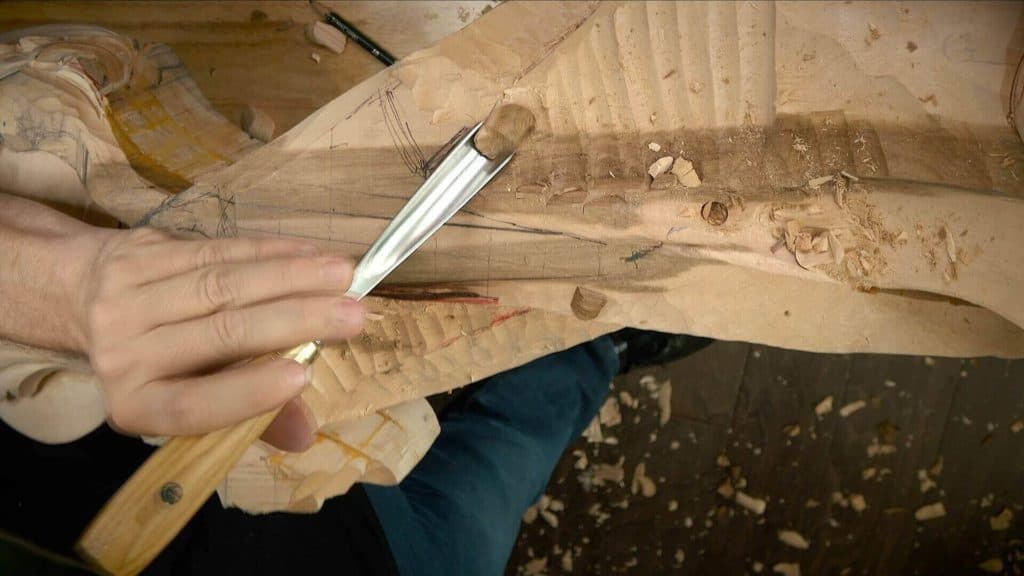
Alexander Grabovetskiy, woodcarver, School of Woodcarving · Published 2020
What does a wood carver mean by a "second way"?
Quick answer: A drill bit is my second way. In workshop 86, part 11, it goes a quarter inch (6.35 mm) down after the calipers gave a first reading. Other lessons use the same words beside color, undercuts, outlines, a knife grip, flowers and carbon paper.
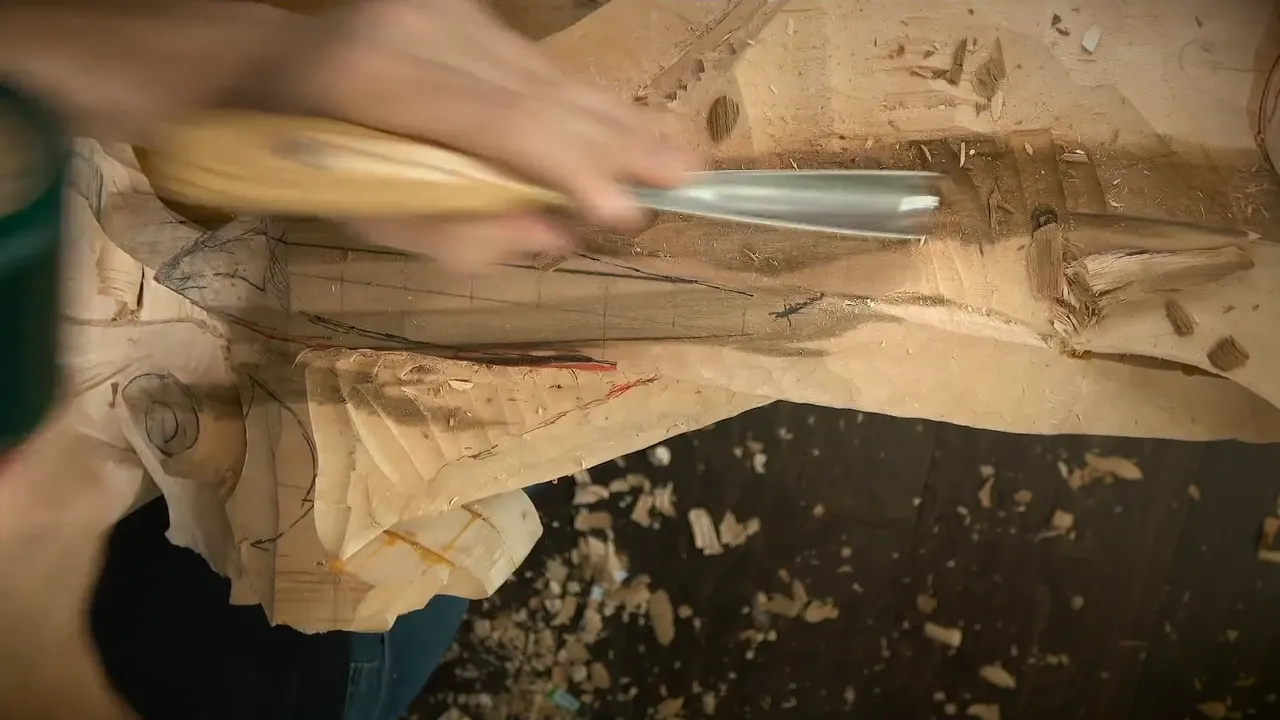

My drill bit is the second way in workshop 86, part 11, about a quarter inch (6.4 mm) down. Other lessons put the words beside color, undercuts, outlines, a knife grip and carbon paper.
Have you ever started a spot one way and then found a second way that fit it better? Would you like to hear what I say and do, lesson by lesson? Come through workshop 86 with me. Every lesson I borrow from is named and linked.
A short list for part 11
- A darker spot, and sharp tools for it.
- A depth to match.
- calipers first, then a drill bit.
- A check inside the hole, and a perfect result.
- grain, then the opposite side.
- A chop, in the last words.
What does part 11 say about the darker spot?
The video opens on a dark patch: "By the way, when you have a spot like this, a darker spot, watermark, your tools must be really sharp because this is the spot, a little mushy."

My next words: "I don't really worry about it, but just in case, if you do have a problem with a spot like that, you should know it's just because it's already starting to rot." Then "A little more mushy." My word for it is rot.
The direction changes after that: "Change the direction this way, though I really have to attack from this side."
Where does the second way come in, in part 11?
A depth comes first: "And I also need to make sure my deep spot right here is going to be equal at least to that spot." Then: "I'm not losing the line, but I'm going to create the cut right here." Two methods follow: "Well, a couple of ways. There is a second way, of course, I could do."
The first of them is the calipers: "So first of all, of course, I've got the calipers, and let me see how far."

The reading is "I'm raising a little bit higher on a side, and I'm just watching the distance right on the bottom, what it is, and looks like I'm about quarter inch." Then: "I need to go down a little bit on this side, about quarter inch." In metric that is 6.35 mm.
Here the second way is in my words: "And the way I could do, the second way, like I've done previously, just using drill bit." Next: "I can probably just go a quarter inch down." Then "Here we go".

My reason is plain: "The reason why, it is a little hard for me to get the calipers over that part."

A second check follows. "Now I'm going to place that inside and see how far am I." My need there is "about another eighth of an inch," about 3.2 mm. Later: "All right, I am right on the money. Perfect."

A note follows: "So that is going to be my reference right now."
What happens when the grain is against me?
Grain gets its own words in part 11: "I am cutting against the grain, which is not the best idea. Let me change the position." Then: "You know what? For me, it would be probably easier to attack from opposite side."

The pass is described this way: "And go across the grain. Perpendicular to the grain." Next comes "That is enough from the opposite side."

The last plan in the video is "And let me chop straight down like this."

How does part 12 treat the hole?
The next video goes back to the same spot: "I am at still the same spot. Here's the spot I drilled." Then: "See, that is the spot I drilled right here. Just looking from different point of view."
Near the end of that video a mark comes back: "Right here, see that mark? So that was my hole, and yes, I will little later measure the spot right here." My plan is to measure it later.

Part 12 also gives a reason for a clean surface: "I really don't need to clean at this point, but it's always easier to draw on a clean surface."
What is the second way for color on a vase?
Carving Vase with grape leaves, lesson 3, tenth video, mentions denatured alcohol: "because it's denatured alcohol, so it's still safe." A lavender color follows as a plan: "Okay, so let me apply a lavender color." The shade is lavender, as I name it.

Those words are "The second way I could actually apply the color, I really don't have to mix right inside of my cup. I can just use this, whatever the artistic approach. You just dip in a colorant." The brush is the tool there. About the shade: "It's called lavender, but it's much deeper. It's more like a real grape color."
Which second way do I take for an undercut?
Lesson 9 of Roman Acanthus Leaf, first video, has an undercut plan: "I will have to undercut under those parts of the leaf." Two ways come next: "The easy way, I still have the same tool in my hands, number five 1/4 inch." That is about 6 mm. The other is "I could use a back bent, and I really like back bents for undercutting".

Care is part of it in those words: "Make sure you're making sweep cut, okay? Like micro-rotation and little by little." And "Don't push too hard because right now the piece is becoming more fragile."
The back bent video has a second way of its own. A high spot is the setting: "with the straight tool, it's gonna dig in." My answer is "I can safely attack this part." Then comes "the second way, what I like to use" and the use named there is "for the undercutting."

Another line says why: "it's such a nice tool when you're just working your way right underneath." And "So it's a really, really good tool for the undercut."
How many ways do I count for setting in a leaf?
Corinthian Acanthus Leaf, lesson 2, first video, starts with "there's a couple ways to start working on this piece." My count changes in the next breath: "Well, actually, three ways. I'm sorry. It's not two ways, but three ways."

The V gouge comes first: "You can take a V gouge and just stay away maybe about 3/16 of an inch, about a quarter of an inch, and kind of outline your carving." In metric that is 4.8 mm and 6.4 mm.
Then the second way: "it's exactly the same, but instead of using a V tool, what you can use, you can use just a deeper gouge and kind of do exactly the same thing." A distance goes with it: "about five millimeters away, 3/16 of an inch," and an eighth of an inch (a bit over 3 mm) is okay too. After that: "So that is a second way. And also, there is another approach."
In the next video of that lesson, the second way comes again: "you can take a gouge, which you had before," A name follows: "Also, it's called setting in. Okay? So we actually set the main idea in." And "Just watch your grain."
In lesson 3 of that course, first video, a quick first way uses a knife: "So that way is actually a really quick way with the knife." Then: "A second way, you can find close sweep gouge, and you can just place it wherever you need to make a cut. And looks like this fits perfectly."

Over in the Greek Acanthus Leaf course, lesson 2, second video, a number seven comes first: "I could use, let's say number seven, or 14 millimeters," which is 0.55 inch. Then: "So that's one way."
Next: "The second way you could do, I would use still the same knife, what I used before, and I'll just stay away approximately five millimeters," about 0.2 inch. Its place on the wood is "make my outline cut toward the leaf itself."

The wood and the time come with it: "that is actually really one of the quickest ways to remove a lot of waste material." And "especially on a soft wood, it works really good." My offer to anyone: "if you feel more comfortable using a gouge, please, by no means, just use the gouge if you have. Any gouge pretty much will do."
Which grip is the second way for a knife?
Carving Plate with Butterflies, lesson 5, first video, puts a knife in my hand. The grip is in these words: "the second way just like a pencil." Then: "that is also a legit way to hold it."

The grip depends on the spot: "this area probably gonna hold it with a full hand." For smaller areas: "I don't have to excavate too deep." A pencil is named in the same video: "I could just hold it like, you know, like pencil or pen."
What changes with the second way on a flower?
Carving Furniture Panel, lesson 32, second video, goes to "this bunch small filler flowers area." The hollow comes first: "you can create a deeper shadow right in the center." The limit: "but it's not gonna give you too much details."

The second way is a dome, and in my words "you can actually do like a dome looking one." Next: "It's gonna go raised up just like this with the small spot, obviously in the center with the dark spot." And "it's gonna give you a little more details." My taste is in "like a dome idea, I kinda like it." A slope gets its own plan: "I'm gonna slope this one downhill".
Where does a second way go with drawings?
Livestream April 2020 has two videos with it. The April 5 video is on carbon paper: "There's two ways to use carbon paper." Paper is the first: "One of the ways how you use the carbon paper, you use just a piece of paper." Then: "But there is a second way how you can use carbon paper."
That second way sits on plastic: "I'm actually drawing the idea on plastic, just normal plastic, like a garden plastic." Plastic gives a view from both sides: "because you can see from both sides." Next: "I can also take that same detail, flip it over, and just transfer opposite direction on another end of the design."
The April 14 video speaks of time: "Saves you half of the time if you draw on the plastic." Then: "Second way what you can do." The sketches are "Just some sketches you've done." Also: "So there's a couple of ways I could use, again, simple plastic."
Which second way gets me to a class?
The Q and A on big tools and small has a plain example in a trip. My count is "Three different ways I could do, okay?" First: "just to buy airplane ticket, fly to closest city". Second: "I really wish to buy Sprinter van and just convert it and just to drive and enjoy the road." Third: "I could just enjoy the hike because there's a Appalachian Trail". The Appalachian Trail is that hike.
The times come next. "It took me about five hours and a half to get here by flight." For driving: "it would take me 30 hours". On foot: "Four months. It's what Appalachian Trail takes, about four months."
Where did each line come from, and what goes with it?
| Where I say it, by lesson and part | What goes with second way |
|---|---|
| Part 11 of workshop 86, with a drill and a darker spot | just using drill bit |
| Video 12 of that workshop, on a mark beside the hole | that was my hole |
| Grape Leaves Vase 3, the tenth video, with lavender | just dip in a colorant |
| Roman Acanthus 9, an undercut near a leaf | I could use a back bent |
| The back bent video, from the tools course, at a high spot | I can safely attack this part |
| Corinthian Acanthus 2, where two ways became three | a deeper gouge |
| Second video of that lesson, on setting a picture in | it's called setting in |
| Third lesson of that course, beside a knife | close sweep gouge |
| Greek Acanthus 2, an outline on soft wood | especially on a soft wood |
| Butterflies plate 5, a knife in my hand | like pencil or pen |
| Furniture Panel 32, a bunch of small filler flowers | a dome looking one |
| Livestream April 2020, on a double-sided drawing | flip it over |
| The Q and A on big tools and small, on a trip | enjoy the road |
Is there a spot on your own carving where one method stops working? Would you like to hear what I do next, one lesson at a time? You will find workshop 86 inside one tuition plan, with the rest of the Venice Room, Part 8.
How it's done
- Look at the darker spot. A spot like that needs tools that are really sharp, because it is a little mushy.
- Name the depth. My deep spot has to be equal at least to the other spot.
- Read the first way. I take my calipers and read a quarter inch (about 6 mm) on the side.
- Use the second way. I use a drill bit, and it takes me a quarter inch (a little over 6 mm) down.
- Check again. I place the calipers inside, and my need is about another 1/8 inch (3.2 mm).
- Confirm the reference. I say the result is perfect, and that spot is my reference for now.
- Change the side. I change sides, and my plan then is a chop straight down.
Frequently asked questions
Which tool do I use for the second way?
A drill bit. The calipers come first. After the drill, I check again, and the result is "Perfect." I go a quarter inch (a little over 6 mm) down.
Which tools does a darker spot ask for?
Sharp tools: "your tools must be really sharp." I call the spot "a little mushy," and later "a little more mushy." A problem there has a reason in my line "it's already starting to rot."
Why do I move to the opposite side in part 11?
Grain is the reason named there: "I am cutting against the grain, which is not the best idea." Then I say it would be "probably easier to attack from opposite side," across the grain.
What to carve next