
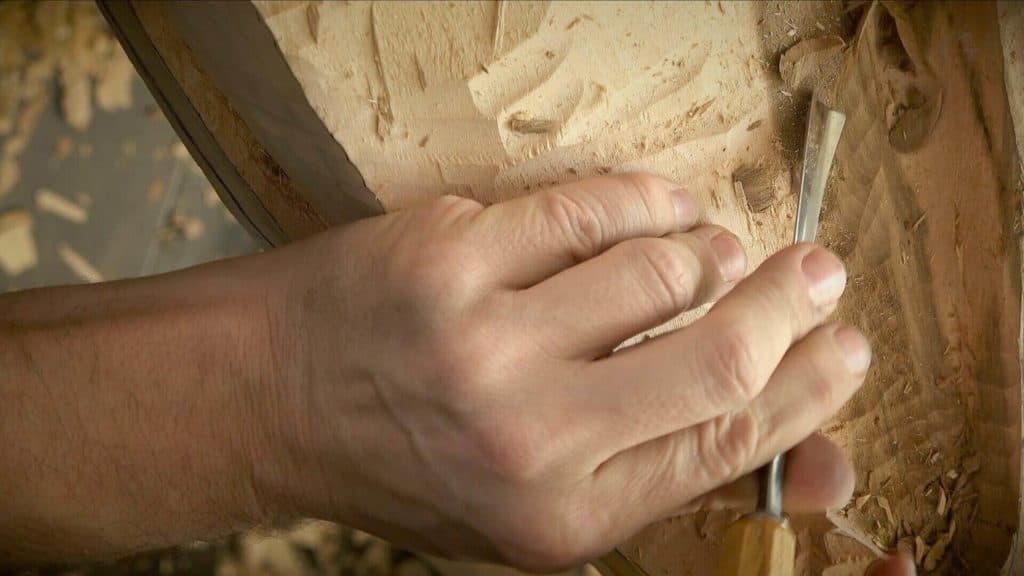
Alexander Grabovetskiy, woodcarver, School of Woodcarving · Published 2020
What does a wood carver mean by a "dot"?
Quick answer: Workshop 86, part 12, names a dot and a hole, and a mark beside the hole. Other lessons of mine use a dot at the crossing of lines, between beads, in dots of glue and beside a boat. Some lessons bring calipers or a marker too.
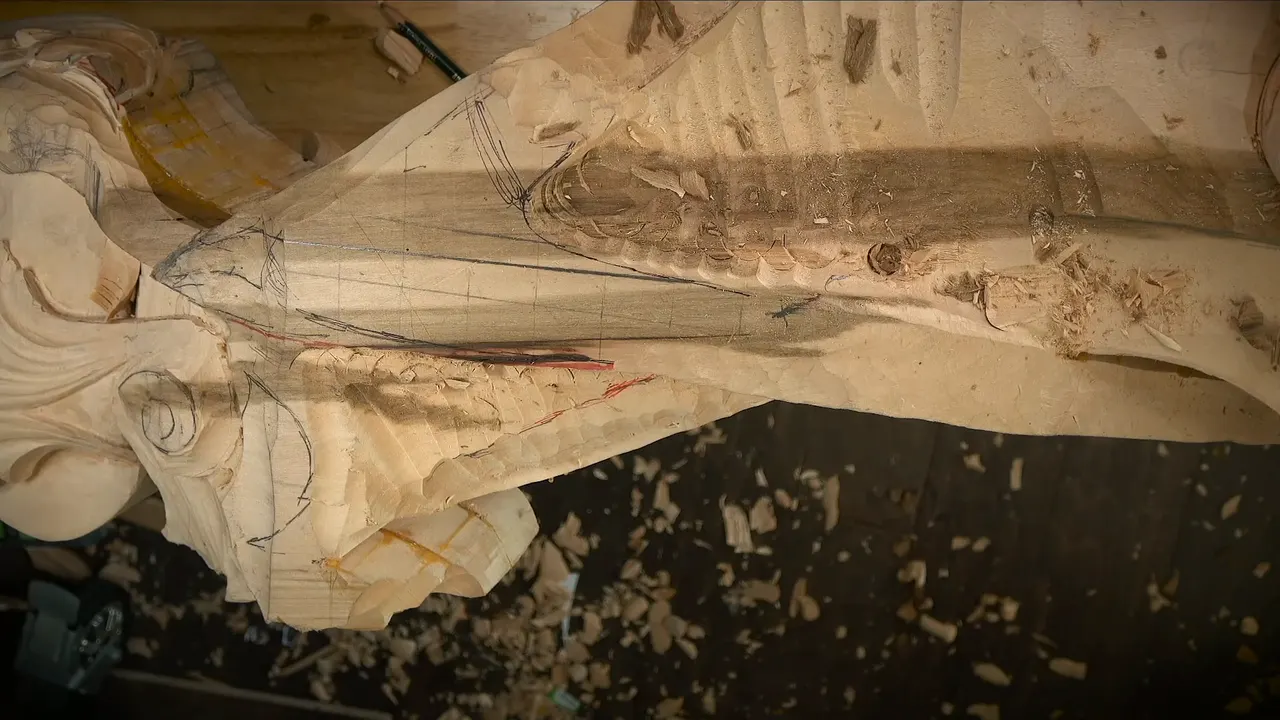

The words "that dot" and "that hole" are both in part 12 of workshop 86. Other lessons of mine use a dot for a golden point, a crossing of lines, beads, dots of super glue and a boat.
Have you ever marked a spot on a board and wondered what to call it? Would you like to hear where I use each word, lesson by lesson? Come through workshop 86 with me. Every lesson I borrow from is named and linked.
A short list for part 12
- The line, and how close I am.
- A number seven of 14 millimeters (0.55 in), in my hand.
- A surface made clean for drawing.
- A separated movement, with the line kept.
- A drilled spot, seen from a different point of view.
- A dark area.
- A dot, a hole and a mark.
Which line am I not passing?
The video opens on a line: "I want to make sure I'm not passing this line." Then: "it is right there, and I am pretty close."

A tool plan: "Let me get bigger gouge, number seven and three inches." In metric, about 76 mm. A smaller one comes next: "Although, probably a smaller tool will be better in this case." Then: "Let me get number seven and 14 millimeters, and clean everything." In inches, 14 mm is 0.55.
Another plan is a "could": "And I could use actually number two and about 50 millimeters, two inches, and clean that way."

The reason for cleaning is in my words: "I really don't need to clean at this point, but it's always easier to draw on a clean surface."
The outline follows: "And also with the same tool, I'll just outline this line right here." Later: "Wonderful. So all that is waste."
How do I treat a movement I have separated?
These are my words: "So I separated this movement from the main movement, but I still need to recreate the line. Not recreate, but make sure I'm not losing the line."

The tool changes: "I get again the bigger tool." Then: "Not too convenient for me."
What spot am I looking at, and from where do I see it?
"I am at still the same spot. Here's the spot I drilled. See, that is the spot I drilled right here. Just looking from different point of view."

Next: "But I repositioned the way it's going to be easier for me to clean everything up."
An apology follows: "And yes, I apologize again and again. I know I've done it multiple times, for it's wiggly a little bit. But that's the way most convenient for me to reposition quickly."

The gouge in my hand is named again, and the words are "Number seven, that's what I'm using."
Which area is really dark?
"And again, see that area, like really dark area? I don't want to throw that away."

Where in this video do I use the words dot and hole?
My words before that, a plan: "Now, let me clean this off camera, because it's kind of nothing special." Then: "I got my cut. It's pretty much the same what I've done before, just to get everything just to that dot or to that hole."

A mark gets its name next: "Right here, see that mark? So that was my hole, and yes, I will little later measure the spot right here." The plan after that is "All I need to do, just blend in little bit and recreate my line. So I need to recreate my line and continue to work on the rest of it."

Near the end, a spot gets named: "Here you go. That is another spot."
What do the videos next to this one say about a spot?
Part 11 has a plan about a deep spot and its depth: "equal at least to that spot." Next door, a mark: "and I've got this spot." Then: "Now I can lower down that whole section."
Workshop 86 has dots from a print in part 3: "I translated that from the edge to the dots, and then I connected that."
A plan with two of them is in part 8: "And I'm going to connect that dot and that dot."
What job does a dot have in the Furniture Panel design lessons?
Furniture Panel, lesson 3, first video, speaks of the whole board: "find the major, a golden point or golden center, okay? So I'm talking about the point or center. It's going to be just a dot, okay?"

A fourth video, in lesson 6, uses geometry: "And like I said, I'm just doing approximately, but if you want to be more accurate, you can just spend more time and just even use a ruler." Then: "So you just do corner to corner lines like this, and it's a pure geometry. And what you've got, you've got those dots, intersections." Next, a circle. A caution goes with it: "Although it's not really accurate how I did it, but you can see you can get really pretty accurate circle."

The second video of lesson 8 speaks of dots in nature: "In nature, in a creation, you can't find any straight lines. Everything has an arc or a sweep or a curl, and only two elements you can find in nature. You can find lots of dots and lots of different curls or curves or arcs."
Then in art: "But in art, you add three more elements. You still have dot, you still have arch." Next: "So you have vertical line, horizontal line, and diagonal lines."

About the panel there: "And in this panel, you can see lots of straight lines and a lot of arches and dots."
How do two dots give me a line or a center?
Venetian Flowers Rosette, lesson 1, first video, goes with calipers: "So let's say you've got one dot, go from opposite side. Here you go, you've got another dot, and you can eyeball the line between those two dots right there and right there."

Then: "If you want to be super, super perfect, you can always just get right on this line and try to attack that from opposite side, and looks like I'm right on the money. All right? So calipers worked."
Later: "Again, the old method, just calipers." Next: "Here we go. Dot number one and dot number two. And I've got pretty close in line between. So that is my center."

A rope gets a mention too: "I'm sure some of you already know that method, so you can just skip it." Next: "just using calipers and the old measuring device, just a twine or rope."
Rosette lesson 5 goes to the points of the calipers, in its third video: "I sharpen my points." Then: "So really, really sharp point, for I can just place it right on a small dot." Later: "I take another side, also this point."

Where does a dot start a pass?
In Venice Room 57, the tenth video names a possible number seven of about four millimeters (0.16 in): "But what I'll do, I'll place right in the middle where's my dot, and I create preliminary cut like that, okay?" Next: "And I can do everywhere right away. That way I'll save some time."

The next video has a corner done: "I've got the upper left corner done, so now I can do the opposite direction. Lower one. Again, from this same dot, I'll just go that way."
The hands get a line: "And that's little challenging for me not to cover with the hands because I still want to show to you what I'm doing." Then, about eyeballing: "And why I like the eyeballing, because I did the 6 millimeters apart right here, but I created little more narrow, and about 5 millimeters right here from this point." In inches, 0.24 and 0.20.
A different tool gets its words: "And when I was doing a big shell, I used different tool. And my point why I'm actually showing you a different tool right now, just to drive point home that there is a lot more ways to do exactly the same result."

In part 12 of workshop 57, another way is a plan: "Even, I could use a same quarter-inch backbend, start from the middle." In metric, 6.35 mm. Dots of another kind come next: "I do understand when I'm saying something, you have to see. See those black dots? Those are connection points between those beads."
Later, about placing the dots: "I'm not going to place them everywhere. I usually don't do that at all. I just eyeball it." Then: "And that way, you're getting almost perfect beads."

Carving Plate with Butterflies, lesson 9, third video, shows a plan for the lesson: "But whatever the round is, I'm going to put the dot, which I don't really have to, but just for the lesson's sake, on both sides."
Further on: "I could create the cut right between those cuts, but not from where I placed my dot, but from midpoint, or maybe about the golden ratio of that point, that point, and 60 % right here."
Then: "See the effect? Again, you don't have to do that if you have only one knife. But I think that gives you some more possibilities." And: "And that just gives extra dimension."

How else do I use dots, with a marker or with glue?
Venice Room 33, second video, brings a marker: "It doesn't matter what color marker you use."
Then, the dots: "I can just put-- Or even dots just like that. That way I see the direction much better." Later: "on some of the projects, I actually use a marker a lot. It makes sense."

Venice Room 1 uses super glue in its third video: "Maybe I should use just super glue, a couple dots."
The glue fails: "A couple dots is what I need. It did not stick." Also: "or maybe my glue is a little too old." Then: "Of course, there is a smarter way." Next: "just blue tape, and I think I should if it's not going to stick quickly."

How does one dot change a big thing?
A boat is in the third video of Venice Room 93: "But how do you know, maybe it's not that big, maybe it's not that small and you really don't know until you place another object right beside of it." Then: "Let's see if I going to put the small DOT just like this. Right, right on side of it."
The result is in my words: "Then this big boat becomes huge. Boat that becomes really, really big." And: "but you really can't tell a size until you place another object." One more: "if you place a small object like object number two, like a small object, then becomes big." Then: "But if you put a bigger object, besides that, it becomes small." And: "That is exactly what I'm trying to do in this section."
The Principles of Design, lesson 3, second video, returns to a boat: "Once I put the small dot, that becomes huge." Later: "fill the space with different idea, that boat becomes just like a small boat."
That video also shows Chinese fine art: "They just draw huge amount of mountains and nature everywhere. And they put tiny, tiny small house and a little guy."

Where did each line come from, and what goes with it?
| Where I say it, by lesson and part | What goes with dot |
|---|---|
| This video, a clean-up near a hole | that hole |
| Later in that video, at a mark beside the hole | that was my hole |
| A whole board, Furniture Panel 3 | just a dot |
| Lines crossing, Furniture Panel 6, the fourth video | those dots, intersections |
| Nature and art, Furniture Panel 8 | lots of dots |
| Calipers and lines, Rosette lesson 1, first video | dot number one |
| The points of the calipers, Rosette lesson 5 | right on a small dot |
| A pass in the middle, workshop 57, part 10 | my dot |
| A corner, in the next video | from this same dot |
| Between beads, the video after that one | those black dots |
| A round plate, Butterflies lesson 9, third video | where I placed my dot |
| A marker on a relief, Venice Room 33 | or even dots |
| A print and super glue, Venice Room 1, third video | dots of super glue |
| A boat beside another object, workshop 93 | right on side of it |
| A chalkboard boat, lesson 3 of the design course | that small dot |
Is there a spot on your own board that needs a name? Would you like to hear what I do next, one lesson at a time? You will find workshop 86 inside one tuition plan, with the rest of the Venice Room, Part 8.
How it's done
- Check the line. I make sure I am not passing the line, and it is right there.
- Name the tool. My tool is number seven, 14 millimeters (0.55 in), and I say "that's what I'm using."
- Clean the surface. Drawing on it is "much, much easier."
- Separate the movement. I separated this movement from the main one, and I make sure I am not losing the line.
- Reposition. I repositioned, so it is easier to clean everything up.
- Keep the dark area. I name the area really dark, and I keep it.
- Go to the dot or the hole. My plan is to blend in a little bit, and the spot is a dot or a hole.
Frequently asked questions
Which spot gets the clean-up?
Both words are in this video, and the mark gets a name too: "Right here, see that mark?"
Why do I clean before I draw?
The line is "it's always easier to draw on a clean surface," and I add "much, much easier."
What do I say about a dark area?
My words are about a "really dark area," and about what I do not want to throw away.
Which dots sit in workshop 57?
What to carve next