
Alexander Grabovetskiy, woodcarver, School of Woodcarving · Published 2020
What does a wood carver mean by "fake the eye"?
Quick answer: Lessons from other workshops and courses carry the word "fake" or "faking" with a rasp, a router bit, shadow color and an acanthus original. Venice Room workshop 87, part 11, holds the aim "much deeper than that area really is."
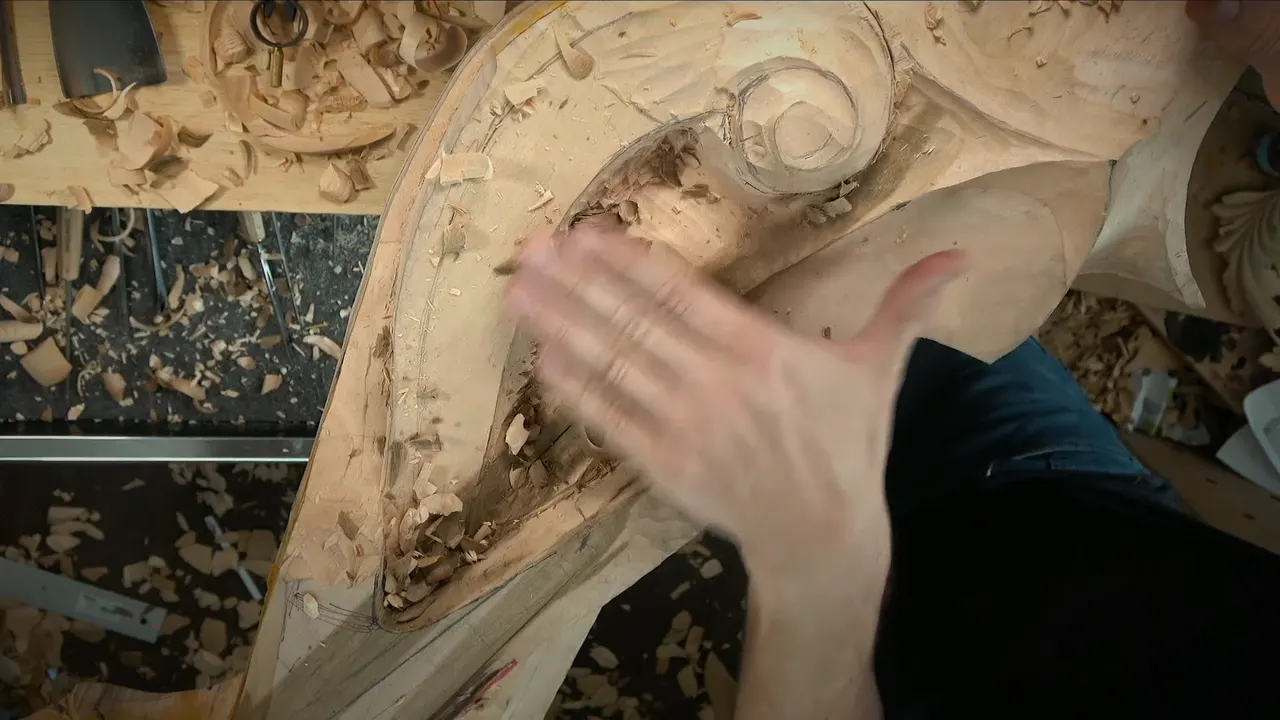

In Venice Room workshop 87, part 11, a flat-looking surface gets the word "fake." It is also in lessons from other courses, next to a rasp, a router bit, shadow color and an acanthus original.
Ever looked at a carved panel and felt a hollow was deeper than the board is thick? Ever wondered if a tool counts as honest carving? Both questions sit on one small word. This page starts in my own part, and after that it follows the word through other lessons, with each passage read together with the lines around it.
What do I say at the start of part 11?
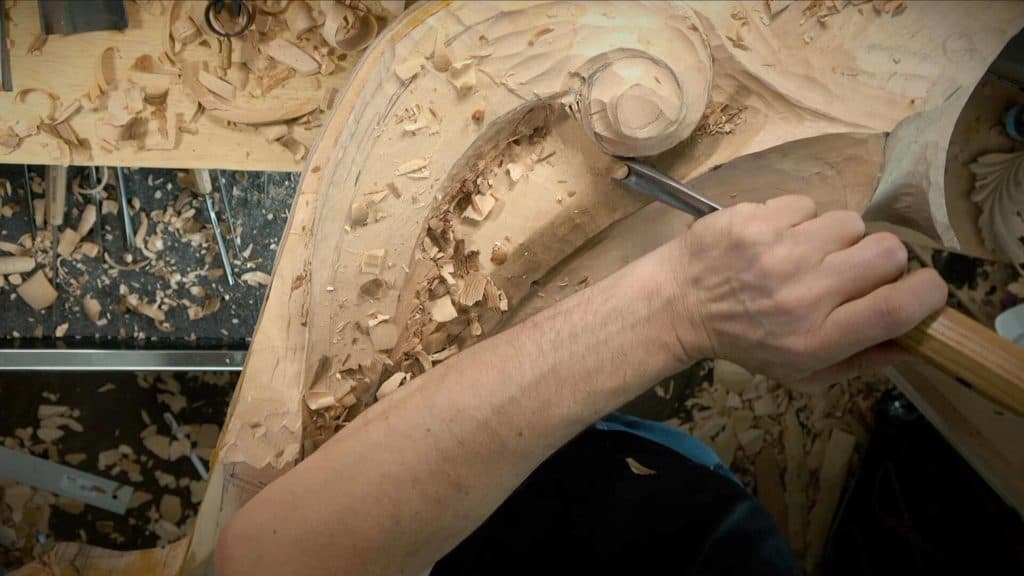
It opens on a remark. "By the way, what I'm doing right now, it was a common design trick to trick the eye." Next, the surface: "It's almost a flat surface, but the whole idea is a 3D, but some spots, it's a 2D relief carving, which pretty much that's what it is."
The aim reads: "So we are trying to fake the eye and make it look much deeper than that area really is."

How many sides does the piece show in part 11?
Here is my count. "So we're pretty much revealing multiple sides. It's already one side, two side, three side, and it's still going to be visible for four sides, wrapping around, almost 360, if you wish."
I add: "If you not agree with me, think about this part, which we're going to work little later." One short line closes the thought: "It just wraps around four sides pretty much."

Which tools and depth does part 11 name?
Tools arrive as plans: "And let me clean little more areas around," then "And I can probably use a big number seven," then "And go straight down, just like that."
The depth is "about an inch deep from this point down" (25 mm). I also say: "So, of course, it doesn't look clean, and it's time to clean up little bit."

A plan with number three comes next. The check reads like this: "So I am about one inch, I would say. We'll check that way I'll know exactly where I'm at." And right after it: "And yes, I am exactly one inch right there. Just one inch exactly." The part ends on "my final depth," which is one inch, or 25 mm.
Which lines does part 12 add?
It begins: "Now it's all about cleaning, which I could do off camera very much. But I know some of you really want to see the process."
The volute gets its plan in these words: "So now, I know the final depth, what I want to see right here." Next: "it's going to go much lower in this spot. Much lower."

Pencil comes next, in the words "let me draw a line." The distance is "about an inch from this point to the line I just drawn" (25 mm), and the words for that line are "the lowest spot." From the side, the words are "consistent movement on the side" and "really nice and consistent."

One detail waits on the inside. "So it's not going to stay flat like that." Beside it, "some movement also going from inside and wrapping like that." A short caution follows: "I can't make any mistake."
Where else do I say "fake" in my lessons?
Part 12 of Venice Room 88 carries the same idea in its own words. Here I say: "This area is slightly mushy, which is okay." Next comes "Again, that is just like a relief carving trick," and the mood stays plain: "I am somewhat happy. Not really super happy, but somewhat happy."
A condition rides with it: "I will be happy once I see the true result I'm after." The tool is "Number 7 at half an inch" (13 mm).

What is "somewhat faking it"?
In Venice Room 92, part 3, I say: "And I also have to make sure it looks organic." Next: "So which means I have to round this section and lower down a little bit right here." Right behind it sits the word: "But it's somewhat faking it." Then "you'll understand what I mean" closes the thought.
The illusion is named without fuss. "So I just have to create the illusion that it's just overlapping this way." I add that "I really don't have to do anything like a big notch." It closes on "So just indication of it, okay? So that is growing from the other side."
Later in the part there is a depth: "3/8 of an inch deep, so it would be 10 millimeters," and in metric terms 3/8 in is 9.5 mm.

Can a carving look fake when it is too uniform?
The word sits in a warning in Venice Room 98, part 6. The plan around it reads "let me start by establishing my convex and I'll see how it looks and maybe I'm going to like it." The warning has two halves. One is "I don't want to do too uniform, okay?" The other is "looking fake," with "a little too uniform" next to it.
The way out is a change of direction, in the words "Okay, may attack that from another direction." The plan for the other side: "Okay, one side. Let me do another side."

Is a rasp a fake?
Venice Room 5, part 11, holds a confession. "And lately, I really like the idea of using rasps." Then: "I should be honest with you, I really didn't use them before too much. I kind of thought it would be like a fake to the wood carving, but not really."
"To establish the main form, I could probably do that" names a use. Another line gives time: "And especially in production, I got to save time also." Rules enter too: "Yeah, the design is going to be authentic, but I already broke some of the rules, even when I used the machining, like when I used to plane my wood."
The rasp result sits here, in "but I kind of like the result, actually." After it: "Which it gives me almost perfect feel. This was not that bad at all."

In part 11 of Venice Room 26 the same tool is back, with "Because I have those rasps, why not to use them?" My next words are "I'm still trying to excuse myself, okay?" Right after it: "Still feels it's fake. But it's not really fake."
More lines: "Just because I didn't use them before, I have to probably use them and still call it a wood carving." And: "I really like how quickly I can get my job done. That's what I like about it." "See? It's just really nice overall shape. Beautiful overall shape." Then, at the end: "And I must admit, I like it. I actually like it."

When is a router bit faking it?
The Greek Acroterion course holds the word in part 1. I say: "Of course, I could go easier route and find router bit to make that base part or a plinth." Next: "But that would be faking it, okay."
The drawing is by hand too, and I say so: "I love to draw my designs by hand. That way, I can feel like it's human being done." Paper follows: "And what I did later, I printed, actually, to the scale of my design, and I glued that on top of lime wood or basswood. I waited about overnight until it's dried."
Before the carving: "I took it to my scroll saw and scrolled that all around, and now I'm ready to carve it."

Which low relief is "not fake"?
Panel talk in Furniture Panel 14, part 2, begins with "I am actually drawing just for carving." The panel gets its name next. "And as you remember, this one is a really, really low relief." The verdict on it is "So not fake," and then "absolutely true furniture style panel."
My plan for the drawing is short: "Let me kind of shade my background for I can see much better." A second verdict: "I like the overall movement, how it looks, the feel of it."

Can you fake a shadow with color?
The answer is yes in part 2 of Vase with Grape Leaves 4. "what I can do, I can get inside and create really deep shadow spots." Then: "We're just pretty much faking shadow."
The color is named: "We are faking shadow without losing the color." The next words are "I wouldn't use black because it would look unnatural," and "But raw umber is a good color to blend. Pretty much it blends with every color."

A warning sits in the same part, "So you can always overdo it. And you really don't want to overdo it. But a little bit." The look gets a name: "you're just creating an antiquing effect. Like that piece was done a long time ago." A tool is named too, "Maybe I can use some brush, which is a dry brush, and blend it like this."
The answer in Grape Onlay 5, part 2, takes another road, and it opens with a question to you: "Can you see that light penetrates right inside?" The reply is "That's exactly what it is. So you can't fake it with the color. I mean you could, but you know, you could just use the light. And a shadow is easier."

Right next to that sit a tool and a size. "Gotta get inside and excavate with the two millimeters" (0.08 inch), and "Number 11, go again from other side and hook this stuff out."
Which eye gets tricked?
In Furniture Panel 23, part 5, the words are "I can give another concave, which can go all the way in, in this direction." Then comes "just to trick the human eye and give extra dimension to the place where we don't have dimension at all."

Part 4 of the same lesson holds another plan. "So the second movement, what I want to do," and then "go like that inward." It goes on with "a feel like it's curling this direction." Short and flat, the next line reads "Okay, that is just to trick the eye."
Then a tool: "I need to use probably smaller number three, one-eighth of an inch, and blend everything nicely." One-eighth of an inch is 3 mm.

How thin is the slab in a lily flower?
Lily Box 11, part 1, gives a number: "this slab is only 5/8 of an inch thick, which is about 16 millimeters, I would say." The wish comes after it. "I still have to give a more three-dimensional look. I want to give a really true look of a lily flower." The rest is "make it look much deeper."

My plan reads "I'm going to create a lot deeper concave on inside of those petals everywhere and kind of get it really extreme right here." Next to it sits a limit: "I have to be really careful because I don't have much material left." The size is "one eighth of an inch" (3 mm).
Is the illusion real depth?
Furniture Panel 20, part 6, answers in plain words. "So now it just becomes even more three-dimensional. Okay. I should say it is, in my opinion, but there's not much depth." Then: "So you really didn't go all the way down. We just create the illusion. Okay? Just create that illusion that is really deep. And it's not. It is not."

Close by sits a mood line: "I'm kind of happy with this area. Doesn't look too bad at all."
What is a fake acanthus?
Grinling Gibbons class 4, part 3, holds "The middle part is always raised." Next: "But it also depends on the style." A warning sits beside it, "if you see concave inside so it's no good, it's just people don't know what they do." The test reads "original Acanthus versus fake," and then "they checking on those raised and low spots."
Which topics go with the word?
Here is the whole run in one place, row by row.
| Where | Topic named near it |
|---|---|
| 88, part 12 | a relief carving trick, and a number 7 at half an inch (13 mm) |
| Workshop 92, part 3 | an overlap and no big notch |
| 98, part 6 | a convex and "a little too uniform" |
| Workshop 26, part 11 | rasps |
| Workshop 5, part 11 | rasps, machining and the need to save time in production |
| Acroterion 1, part 1 | a router bit, a plinth and a scroll saw |
| Panel 14, part 2 | a really low relief and a true furniture style |
| Grape Leaves 4, part 2 | shadow made with a color, raw umber |
| Onlay 5, part 2 | light, shadow and a two millimeter tool (0.08 inch) |
| Panel 23, part 5 | the human eye and extra dimension |
| Lily Box | a slab 5/8 inch thick (16 mm) |
| Furniture Panel, lesson 20 | an illusion of depth |
| Grinling Gibbons class in Maine, lesson 4 | raised and low spots |
Watch part 11 and the lessons above inside one tuition plan, together with the Part 8 workshops and workshop 87. The Vase with Grape Leaves, Furniture Panel, Greek Acroterion, Lily Box, Grape Onlay and Grinling Gibbons courses carry the other lines.
How it's done
- Count the sides. "one side, two side, three side."
- Name the tool. "I can probably use a big number seven."
- Draw the low spot, then look from the side. "the lowest spot."
- Plan the detail on the inside. "some movement also going from inside."
- Check the depth. "my final depth" (25 mm).
Frequently asked questions
How deep does part 11 go?
At the check I say: "And yes, I am exactly one inch right there." That is 25 mm.
Which line in Grape Onlay 5 speaks of color?
Part 2: "So you can't fake it with the color. I mean you could, but you know, you could just use the light."
Which line in Venice Room 26 goes with a rasp?
Part 11: "Still feels it's fake. But it's not really fake."
Which course lesson names a router bit and a plinth?
What to carve next