
Alexander Grabovetskiy, woodcarver, School of Woodcarving · Published 2020
What does a wood carver mean by "planing"?
Quick answer: Workshop 87 of the Venice Room, in part 12, shows a number three whose shave is "really nice." Other lessons put the same word near a skew, a three-inch chisel and two kinds of plane, with a bump to remove, each read with the lines around it.

In Venice Room workshop 87, part 12, I name a number three and say I can "shave really nice." Lessons from other workshops and courses name a skew, a big chisel and two kinds of plane near the same word.
Ever laid a gouge almost flat on a surface and felt it skim instead of dig? Ever wondered when a carver should reach for a plane? Both questions sit near one word of mine. This page starts in my own part, and after that it follows the word through other lessons, each passage read with the lines around it.
What comes before the word planing in part 12?
I begin with "Now it's all about cleaning," and add that I could do it "off camera very much." Then: "But I know some of you really want to see the process."
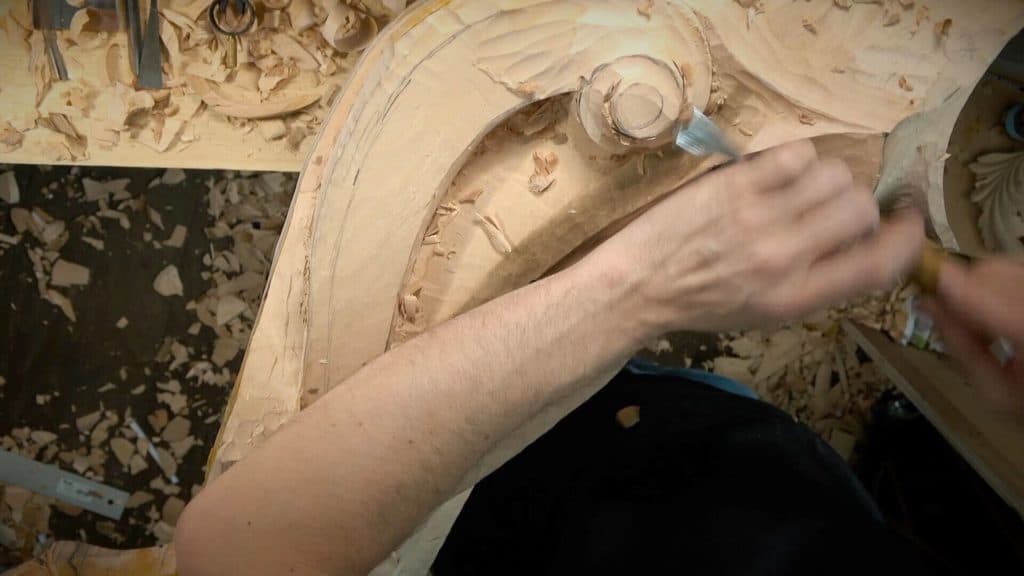
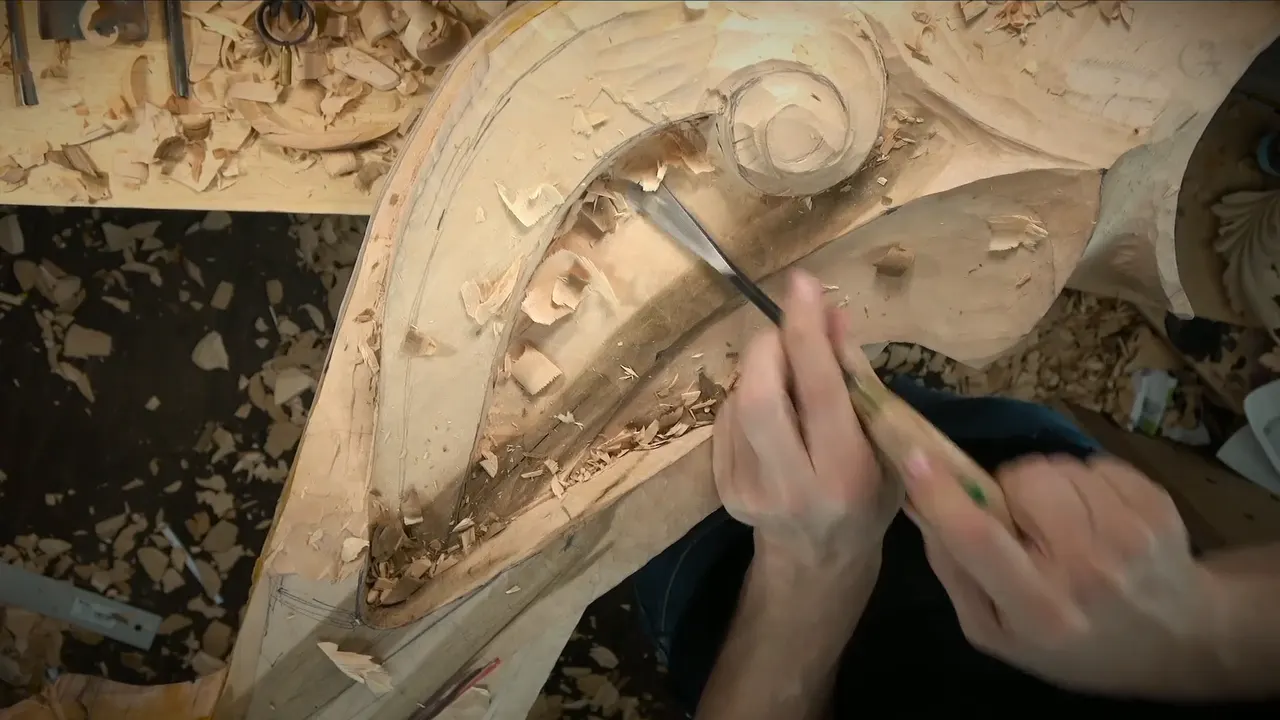
The tool comes next: "It's still number three, but a different brand." It has "a really big bevel on this one," and I can shave "really nice, almost like planing."

How does part 12 set the final depth?
I start with "I know the final depth, what I want to see right here." The volute gets "the high spot," and then "Much lower."
The pace gets one word, "gradual." The height is marked as "approximately the height" at one place, "but then it's going to go really low and up again."
Just before it, part 11 ends on one inch. "Just one inch exactly." Its last line reads "my final depth." That is 25 mm.

Then comes a pencil, with "let me draw a line," and the distance is "about an inch" (25 mm) "to the line I just drawn." That spot is "the lowest spot."

From the side I look for "consistent movement on the side." The shape, I say, "does not have to be wavy," and then "really nice and consistent."
What does a dull number nine do in part 12?
"Number nine, that's what I'm going to use first." That line is a plan. Later it gets a verdict: "my number nine needs to be sharpened now."
In plain words: "It is quite dull already. Yeah, it still cuts, but I have to create a lot of force to create my cut." And then "that is time to buff it or sharpen it."

Then I say "Here you go. I got to the final destination line," and then a plan follows in these words: "Okay, wonderful. And let me also do the same tool around here."
What waits on the inside, and why the chop?
A detail is planned for the inside, in the words "there are going to be a detail also inside of this. So it's not going to stay flat like that."

I plan "some movement also going from inside and wrapping like that," and say "that's coming a little later." A caution comes with it: "But now I can't make any mistake when I'm going to chop this way."
The plan for the chop is "downhill, straight, almost 90 degrees down." Another plan: "Number three, and little by little, I'll go around."

Where else do I use the word planing?
In Venice Room 92, part 1, I give a size: "it's about six millimeters. That's what I've left, about a quarter inch." A plan follows, "Let me just clean it." Before the skew I add "it's a good idea sometimes to just concentrate on different stuff. You really get tired of one area." Before the skew I add "it's a good idea sometimes to just concentrate on different stuff. You really get tired of one area."
Next, a skew. "And I'll use a skew." The skew is named for "a really, really sharp line." Then: "Just right on top. Almost like planing it." A second tool is named: "nothing stops me from using small scraper. So I've got a small card scraper, and that way I'll know exactly that is really straight and nice."

Which big tool catches the high spots?
Venice Room 24, part 11, has me on a big tool. "I can just ride pretty much, and control the height, how deep I go. And if I ride really almost flat to the bevel, I can catch the high spots, almost like a planing."
The surface gets "really nice cuts, really beautiful surfaces." A second comparison is named too: "it works just like a plane, or a planer I should say. Or hand plane." And then: "double-check that is good." One more line about the work: "let me fix overall movement, how it's supposed to look, which is very much not so bad at all."

Which tool takes off a bump?
In part 12 of Venice Room 17, the passage starts with "I'm not too happy about this side. Well, actually, I shouldn't worry about this side." The plan reads "I do have a small concave, but there's a bump. I need to use probably just the number five quarter inch and create, planing little bit right here. Just get rid of this bump." A quarter inch is about 6 mm.
A check follows: "Double-check. And yes, I am checking with the fingers because sometimes fingers give me a lot better idea what is going on." A verdict follows: "So I guess I'm kind of happy with this movement."

How does a three-inch chisel ride the high spots?
At workshop 105, part 3, I bring in a new tool, "I want to show you one more tool." Next come the words "I'll use just a big chisel." Then "it's just number one chisel, but this one is three inches," and "a really good solution." Three inches is 76 mm.
The riding is told this way: "just ride at the high spots," and "gradually remove" what it catches. The word comes with a condition: "planing, if you like woodworking planes. So it's actually doing exactly the same operation. And you can see it leaves really, really nice and beautiful shavings."
The hand tells me the result. "And now I can actually place my hand, and I don't feel any waviness, and almost no pressure." Then: "Gives me a really, really smooth and nice finish." Earlier in the part: "I'll just make it really smooth, pretty much with the same tool, this area and also this area, and then we'll just jump on another operation."

The edge matters: "The tool must be sharp to do that operation, and you can get really beautiful results, and quickly." Another line: "I just maintain my bevel, and it catches the high spots and just shaves off." A size choice follows, in the words "a good idea to use a bigger version versus small one on that surface because the bigger tool you have, a lot less chances you're going to dig with the edges."
Which tool goes with the word in the panel course?
Furniture Panel 18, part 2, names a tool size, "Number 11, and three millimeters, one-eighth of an inch." Then two choices. "I could take actually just a bigger gouge and kind of knock down those high ridges. Or I could take our router plane and just start planing. Which makes sense, okay."
A test comes next: "Check that is actually already final. That, let me see if it's going to be too aggressive or not. Looks like I'm okay." A limit shows too, "I'm probably going to need to remove a little more material in this area, because it's kind of tiny spot, and feels like my router plane little struggling."
Lesson 17, part 10, gives a reason for the tool. I'm "still a little above the final depth," and so "I really want to clean that with the router plane." The aim is "the same depth."
Later in that part comes a remark about dust, "just so satisfying to use a router plane. First of all, it does not create dust. Okay? So I really don't like dust in my shop."
Lesson 18, part 5, keeps the plan short, "Okay, let me use a router plane again." The result I name is "really consistent in the same depth."

When do I reach for a block plane?
In workshop 79, part 9, a plan starts it: "So now it's time for me to true it." Later: "So I've got that absolutely flat. I also could use a block plane just at the edge and get that absolutely straight line."

The next words are "looks like I am right on the money." And: "now I'm happy with this line. Really happy."
The hazelnuts course, in lesson 1, part 3, speaks of this tool for gluing. "I love it. Okay, let me plane slightly. And for this, I would use just a block plane. It doesn't have to be computer science."

The angle gets words too. "And by the way, if you're not familiar with the block planes or any planes, it is always better not to plane straight with the grain. I usually like to do it at the 45 degrees, like so. Same idea like with the chisel, and I'm kind of slicing it, okay? So that way you're getting really beautiful shavings. It's flat."
I name another option and what I need: "Like I said, I could take to the planer and plane it for this side also clean, but I don't need it. I want to really save the material. All I need is just a flat surface for gluing." A tool-mark remark closes the passage. "So like you see, I'm not going to worry about some of the tool marks."

Flower Rosette 1, part 2, has a block plane after a machine. "I already planed. I've got through the planer, my blocks, and I'm ready to glue the paper, actually, on the top." Next, "my planer has some marks on the knife, and you can see there is trail marks."
The hand tool follows, "it's not necessary step," and then "I usually like to use my block plane and just take those plane marks. Just clean little bit." Of the result I say "It's not much, but still, you can see."

Which line about a hand plane sits in the Greek course?
The Carving Greek Acroterion course opens part 3 of lesson 1 on a line about it, "So I can't say that when I'm using my hand plane, I am cheating." A short plan follows, "And just go little by little." Near its end I add a preference: "I actually do like to use my hand planes a lot."
Which planer do I name for the boards?
Venice Room 1, part 1, speaks of a machine. "I do have some machines involved, of course, because it's a huge and I have a big planer which can take about 25 inches wide boards." That is 635 mm. Next: "The first layer, it's about two inches thick, first layer." Two inches is 51 mm.
A livestream answer in April 2020 puts the machine in its place. "I did use machines at the beginning stage." Of the planer I say "I have a huge planer, 25 inches, a really big one," and "I can just pass my boards right there."
Then: "So I use machines just in preparation of wood for the lamination, for gluing, okay?" And last: "But as far as the carving goes, no, I did not use machines at all. All I used is just the authentic tools."
Which topics go with the word?
Here is the whole run in one place, row by row.
| Where | Tool and spot named near the word |
|---|---|
| Part 12 of workshop 87 | a number three with a bevel, and a shave |
| Lesson 92, part 1 | a skew first, then a small card scraper for a straight line |
| Workshop 24, part 11 | a big tool riding on its bevel |
| Lesson 17, part 12 | the number five at a quarter inch (6 mm), and a bump to remove |
| Part 3, workshop 105 | a wide chisel, three inches (76 mm), riding the high spots |
| Furniture Panel 18, part 2 | a router plane, or a bigger gouge for the high ridges |
| Panel 17, part 10 | the router plane for the same depth, and a shop with no dust |
| Lesson 18, part 5 | a consistent background from router plane work |
| In workshop 79, part 9 | a block plane, for a straight edge on the piece |
| Third part of Hazelnuts 1 | the block plane at 45 degrees, and a flat surface for gluing |
| Flower Rosette 1, part 2 | marks of a machine planer, and a block plane to clean them |
| First part of Venice Room 1 | a big planer for boards 25 inches (635 mm) wide |
| Third part of Greek Acroterion 1 | a hand plane, with a plain preference |
Watch part 12 and the lessons above inside one tuition plan, together with the Part 8 workshops and workshop 87. The second Venice Room course, Furniture Panel, Hazelnuts and Flower Rosette courses carry the other lines.
How it's done
- Set the final depth. "I know the final depth."
- Draw a pencil line where the lowest spot goes. "let me draw a line," then "about an inch" (25 mm).
- Check the movement. "I'm looking from the side," and then "consistent movement on the side."
- Sharpen when the edge is dull. "It is quite dull already," and "that is time to buff it or sharpen it."
- Slice at an angle with a block plane. "the 45 degrees, like so."
Frequently asked questions
What tool does part 12 name?
A number three. The bevel gets the words "a really big bevel on this one," and the shave gets "really nice."
How far is the lowest spot in part 12?
The spot is "the lowest spot," and the distance is 25 mm, one inch in the cue.
Which words describe the dull number nine?
The cue says "my number nine needs to be sharpened now." I add that I "have to create a lot of force to create my cut."
What is named for the bump in workshop 17?
What to carve next