
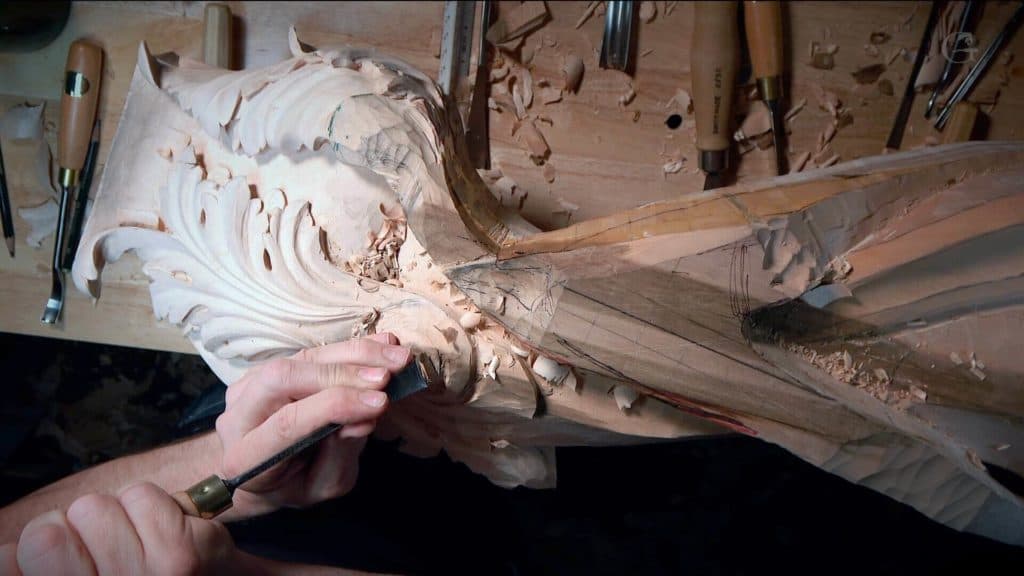
Alexander Grabovetskiy, woodcarver, School of Woodcarving · Published 2020
What does a wood carver mean by "sphere" when the shape is not a ball?
Quick answer: In Venice Room 88.11 the word "sphere-looking" follows the tool change to a number three. Elsewhere it is a hedge: a depth near a millimeter in one Furniture Panel lesson, an off-center ring in Hashemi Flowers, and a center that must go underneath.
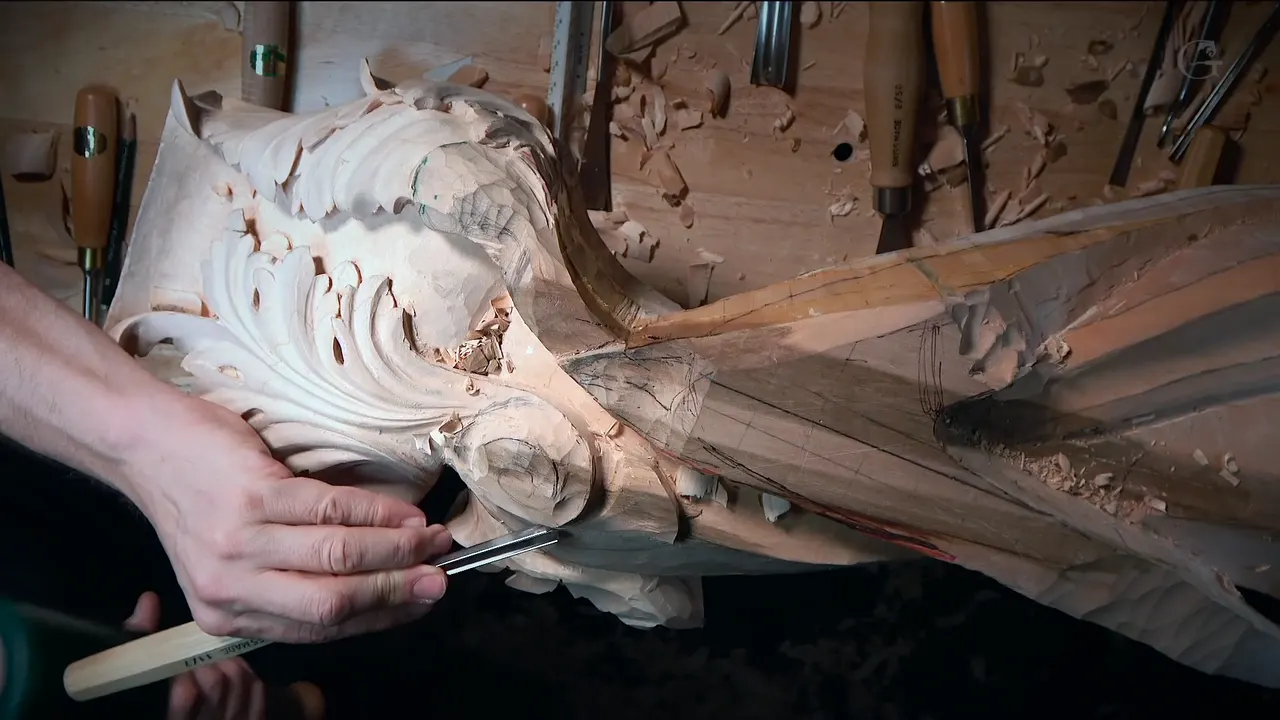

Sphere, in Venice Room 88.11, sits inside one word, "sphere-looking," right after the tool change to a number three. In other lessons the same word is hedged: "not really a sphere," "half dome," "a small sphere." Every lesson below gets its own lines.
Ever looked at a round shape in a carving and wondered if it had to be a true ball? Stay with this video, and then with the lessons where the word shows up again.
Which lines sit around the word sphere in 88.11?
The slope is first. "So that is good, except I still have to create the slope, which is going to repeat this slope." A note follows: "yes, you will see the development of it, okay?" Next, "Maybe I need to slope this one a little more, too."
Depth takes over from there. "So now what I have to do, all of that has to be lowered down, okay?" It starts with "let me start with just removing some excess material."

The outline plan reads "I'm going to outline now the whole thing with number 11 and 7 millimeters" (0.28 in).
The wall of the inner detail is next: "If this is sloping this way, I still have to see the wall of that inner detail. The idea is the same what I have right here. Okay? Like a rib almost." And "So that's why I'm actually laying right on the side, on the left side of my tool."

Direction is stated here: "pretty much I have to cut inward on inside." Underneath, "it's going to be almost like undercutting in this section," and near the next side "it has to have a slope again."
Its tool change reads "I need to change the tool and create that slope." Next, "I'm using number three right now." The word follows: "So pretty much it's just almost like a sphere-looking."

A look sits right behind it: "And that's going to give me a really beautiful look." The depth follows: "since it's a little different movement from what we had in our upper area, so I have to create much, much deeper excavation right here."
The barrel gets a line too: "I still want to keep the barrel look. That's what I call it." The last lines of the part hold a doubt: "I'm still not sure if I'm doing the right thing or not, but that's too late anyway, so I've got to do it this way."

What do 88.10 and 88.12 add to the shape?
Part 88.10 names a form: "that is exactly the form I'm after, so that has to be just from in, up, and down again." Meanwhile 88.12 keeps the tool: "Number 3, that's what I'm using. And you should be able to see I'm establishing that sloping movement on this side."
In 88.12 one part is headed "straight down," and the next line is "Same right there," while sharpness has its own line: "It feels like my number 11 needs to be sharpened."
A smaller tool follows: "So let me get a smaller number 11. I'll take probably three millimeters, and I'll start" (0.12 in). A trick is named: "that is just like a relief carving trick, just to fake the eye."
The mood is plain: "I am somewhat happy. Not really super happy, but somewhat happy." Then "I will be happy once I see the true result I'm after." The whole workshop sits on the workshop 88 page.

Is a sphere in his lessons always a ball?
In Furniture Panel 23, part 10, the line is "It's not really a sphere because we're talking about only one millimeter deep, or maybe one and a half millimeters the most." That is 0.04 in and 0.06 in. A rule sits beside it: "Just make sure you slice it."

Over in Furniture Panel 24, part 1, a flower center gets a hedge: "But there is a few different ways it's possible to do." The plan for the center reads "half dome, half a sphere."
The size is "only about 10 millimeters, about three-eighths of an inch point to point." A warning sits beside it: "if I'm going to push too hard, I can snap out that middle part, and it's not going to look good."

For Hashemi Flowers 43, part 2, the word is tied to a center point: "that is not perfect sphere because my center point is right here. That means my ring's going to go that direction." Its gouge is "a number seven, I remind you," at "about 5/8 of an inch" (16 mm). A mallet is weighed too: "with the mallet, you create too much shakiness."

In Venice Room 5, part 12, a line about a half sphere look takes the word back: "Not the sphere, I'm sorry, just the true half a pipe, I should say."
A gap is allowed in Venice Room 43, part 11: "almost perfect sphere. Almost, because it's not perfect and I don't need to."
What does a half sphere mean on a flower center?
Next, Furniture Panel 25, part 3, adds a limit: "just like the center of the flower." Then "I would like to get some kind of undercut." And "But later on not now."

Part 2 of that lesson sets the order of work. "I'm gonna start rounding that sphere." Later, "I created that sphere," followed by "really nicely rounded sphere." Right behind it, "I have to excavate the whole right inside of this area."
Part 1 of that lesson holds the plan for the center: "More like a 3D looking one." Also "I will have some kind of opening inside."

A wood gets a word in part 2: "what I like about Walnut it's somewhat forgiving sometimes you could go against the grain." Then "keep an eye what the grain of the wood does." walnut is the wood named there, and the grain is named too.
In Acanthus over Moldings 6, part 2, the center is a half sphere for now, and depth is added: "but it has to go underneath." After that, "that's how the center gonna develop," and "just the edge of the tool."
Then comes Carving Floral and Molding for the Panel 7, part 1, with a size: "this center part is about half an inch. About, I would say maybe not exactly half an inch, but about maybe 12 millimeters or so." Next, "now I need to reestablish my hole in the middle."
The hole has its own tool: "1/8 of an inch, number nine, and dig the hole inside" (3.2 mm).
Venice Room 18, part 1, aims at almost the same half sphere, and its first tool is "number eight" at "10 millimeters, three-eighths of an inch." Then "too deep of a cut, so I can't do that." The swap is "number three and six millimeters" (0.24 in).

A dome is the goal in Venice Room 117, part 1: "create a dome, like a half a sphere." A big gouge is named: "Number seven and three inches" (76 mm), "And use that upside down." Just before it, an undercut is only an "indication": "I can probably indicate that I can do undercut with the number 11 and 12 millimeters or so" (0.47 in), and "bigger tool and just blend it together."
Where does a sphere go inside a carving?
Hashemi Flowers 10, part 8, has the inner sphere as the part to remove: "All I have to do just to remove a sphere on inside. Okay." Its gouge is "a number nine and three-quarter of an inch" (19 mm). Then "kind of hard, but not impossible."
The same part holds the method: "the trick is just to make those rotation moves." And "bigger tool you have, quicker you can achieve that result." And "don't pry your tool, okay?"
Hashemi Flowers 28, part 3, makes a separate piece. "I'll take a block of wood, maybe that one, maybe different one," and then "remove a ball. Not a ball, but it's going to make a sphere on the outside and insert that inside of that ball or inside of this cavity."

A little later: "It doesn't have to be perfectly rounded." Number eight is picked, at "one inch" (25.4 mm). In that same Hashemi lesson, part 2 gives the word a direction: "my sphere going to go inside right here."
Part 3 of lesson 43 holds the plan: "the next step would be to make it exactly the same what we did from the upper point downhill to make it like a sphere." Behind it sit "take those ridges out and make it a little more roundsy on inside."

Part 4 of that lesson sets two sides: "more sphere right here and a sharper cut on this side."
When does he call a sphere true?
In Hashemi Flowers 19, part 5, the word is "a true sphere": "Get that around until it looks like it's a true sphere." The allowance follows: "you don't have to make it look absolutely perfect without any ridges, because those small ridges, they do create beauty."
A picture of light and a shadow goes with the ridges: "They look like small diamonds or precious stones. When the light hits every little small ridge, casts a shadow."
Over in Roman Acanthus 16, part 6, the goal is "My goal is to make it like true bead or true round sphere." The way is "one side, then we're going to turn," and "exactly the same, but we're going to approach it from the opposite side." A worry sits earlier: "I don't want to break it, especially at this stage when we almost done with that."

Carving Grape Onlay 1, part 2, has "So no outlining, it's gonna be a sphere." The lines after it: "you're gonna damage the side and it's gonna be impossible for you to clean later." A line about triangles follows: "try to avoid square connections." Then "It's not always possible."
Later in that part: "once I'm gonna establish my triangles, then I'm gonna go from outside inward." Then "the true sphere shape again." The end of it reads "We've got the full sphere and I still have that paper as indicator."

A method sits in Carving Grape Onlay 3, part 2: "Attack from different positions, from different angles and you just keep slicing, keep slicing." Then "I'm happy with the shape, with the roundness of it." Paper stays for now: "I am leaving some of the paper for now for I can see this is the highest guy."
A head gets the word in Carving Plate with Butterflies 9, part 1: "That head so it's gotta have" and the word sphere finishes the line. Then "And just rounded head like this."

Is sphere sometimes just a name he picks?
Part 7 of Venice Room 49 has "It's just a ball, sphere shape or dome shape." Its sixth part has "like a dome shape or sphere if you wish to call that way," and later "really good bowl or sphere."
In Carving Modern Acanthus 6, part 1, a motion gets the word: "what I'm creating just the motion like overall" and, after the word sphere, "if you want to put that way, okay." Then "see what I've done I created overall shape."
How does he make a small sphere?
Venice Room 93, part 4, plans a pair: "There's going to be a tiny sphere, which is going to happen also in this area." Then "There is the two spheres, like interconnecting spheres, and a small stem going inside on the sides."
Part 7 of lesson 93 reads "a small sphere. I don't want to lose it." A tool follows: "a knife is actually an excellent tool for operation like that for the small details."
Part 9 swaps a name inside one line, "my small circle part," and lands on "the sphere." Then "right away outline it." And "I can create that sphere also with just a knife very much."
Part 11 closes it: "that small detail, small sphere, I can probably take care of and make it even more round with a small tool like that. Just whatever fits."
Which lesson holds which line?
Each row below names a lesson, so you can find the line on that lesson's page and read the lines around it.
| Lesson and part | Another line from the same part | Its subject |
|---|---|---|
| Workshop 88, part 11 | that's why I'm actually laying right on the side | a rib |
| Panel lesson 23 | we're talking about only one millimeter deep, or maybe one and a half millimeters the most | slice it |
| Panel lesson 24 | I have to be careful no matter what I do | half dome |
| Hashemi, lesson 43 | that is not perfect sphere because my center point is right here | a ring |
| Venice 5, part 12 | Not the sphere, I'm sorry, just the true half a pipe, I should say. | a pipe |
| Venice 93, part 4 | There is the two spheres, like interconnecting spheres, and a small stem going inside on the sides. | a stem |
| Hashemi 28, part 3 | make a sphere on the outside and insert that | a cavity |
| Molding for the Panel 7 | I can't probably go deeper than that. | a hole |
| Hashemi 19, part 5 | They look like small diamonds or precious stones. | a shadow |
| Roman 16, part 6 | I almost did it at one spot, and that would be a mistake. | a bead |
Which round shape in your own piece needs a hedge before you pick a tool? This video waits inside one tuition plan, with the rest of Part 8 of the Venice Room.
How it's done
- Swap tools first. "I need to change the tool and create that slope."
- Name the gouge you have in hand. "number three right now."
- Look at the shape the tool leaves. "sphere-looking."
- Dig deeper. "much, much deeper excavation right here."
- Barrel look. "keep the barrel look."
Frequently asked questions
Which line in 88.11 holds the word sphere?
It ends a run about the slope. The sentence before it names the gouge, and the sentence after it speaks of "a really beautiful look."
Is a sphere always a round ball?
Lesson 23.10 of the panel course puts it at a depth near a millimeter (0.04 in). Hashemi 43.2 ties it to a center point.
Where does a half sphere go next on a flower center?
The molding course, part 7.1, follows it with a hole to dig in the middle. Moldings 6.2 follows it with a turn underneath.
Can a knife make a small sphere?
What to carve next