
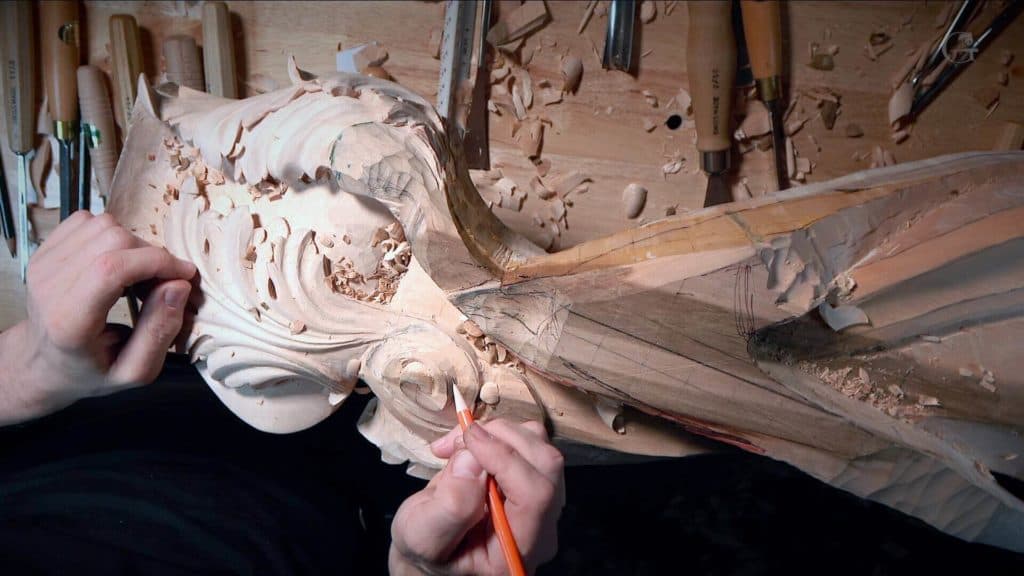
Alexander Grabovetskiy, woodcarver, School of Woodcarving · Published 2020
What does a wood carver mean by "super happy"?
Quick answer: In Venice Room 88.12 "super happy" sits in a line that also holds "somewhat happy," and "the true result I'm after" comes next. In other lessons the words sit beside a flower, a detail or a movement, with a petal gap, a small leftover on a side, or an edge named next to them.
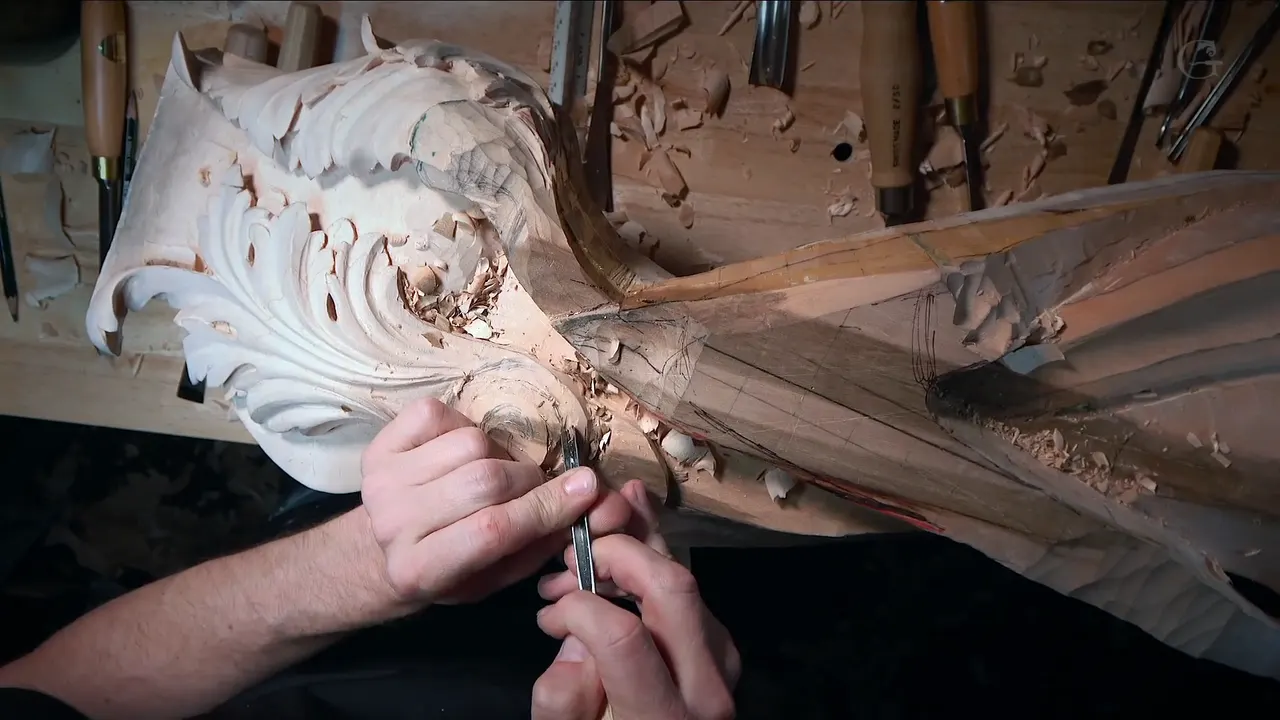

Venice Room 88.12 holds the words in one line: "I am somewhat happy. Not really super happy, but somewhat happy." Other courses carry "super happy" too, and every lesson below gets its own lines.
Ever tried to say how pleased you are with a spot in your wood carving, and found that "fine" was too small a word? Stay with this part first. The lessons where those words are said come right behind it.
What does 88.12 say before the happy lines?
The part opens on a tool and a plan: "That is what I'm using, and I'm going to go around this like that." A note on the tool is next, "It feels like my number 11 needs to be sharpened," and then a direction, "And yes, this part is going to be straight down. Same right there."
A number three takes over: "Number 3." You get a line too, "And you should be able to see I'm establishing that sloping movement on this side. You should be able to catch it." Right after that comes "All right. And I'm going to do exactly the same right here."

One condition is stated: "But I need to make sure I'm happy with my movement." One plan too: "And that part is actually going to go all around like that."

Which smaller tool is planned before the happy lines?
The plan names a smaller number 11: "So let me get a smaller number 11. I'll take probably three millimeters, and I'll start." Three millimeters is 0.12 inches.

The wood gets a remark of its own: "This area is slightly mushy, which is okay." Close to it sits a note on relief carving, "Again, that is just like a relief carving trick, just to fake the eye." The last words of that run are "Yes, to try to fake the eye."

Which lines in 88.12 talk about being happy?
Right after the top line comes "I will be happy once I see the true result I'm after." Tool talk comes next, "Number 7 at half an inch." That size is 12.7 mm.

More lines about the work itself follow in the same part: "Okay. That part I'm okay. So that part I'm kind of happy. So it's going around." And "I'm still not so happy the distance what I left right here." The plan reads "So let me clean it a little bit."

A second spot gets its own line, "And also right here, it's a little too much," and a tool need follows: "Going to need some kind of flatter gouge, maybe a number 3 or so."

Its last lines start with a pause. "Let me think, because right now it does not look too appealing. It does not look too appealing at all." A split verdict follows. "I'm happy. But right here, I'm not too happy." The closing words are a need, "make sure it's logically looking good."

What do 88.10 and 88.11 add around those lines?
Tools open 88.10: "Number 7, that's what I need next. Number 7 or number 5 will work." A change of mind follows, "Well, actually, you know what? I can just do it with the big one." Then a size remark, "And that would be a little too big."
A view is named there as well: "I am looking from the side view, and I want to make sure this line is actually flowing in 3D also really nice."
A form is named there too: "that is exactly the form I'm after, so that has to be just from in, up, and down again." A light plan sits close by, "let me reposition my lights again," and later "Right now, just a little too dark" with "Okay, so I've got extra lighting on, so it should be much better."
A hedge shows up too: "this is going to be challenging for me a little bit because I want to excavate a much deeper cut in this area." And "It's hard for me to explain, but you'll see."
A verdict of its own sits in 88.11, "So that is somewhat right movement," and a look: "And that's going to give me a really beautiful look." Its closing lines hold a doubt, "I'm still not sure if I'm doing the right thing or not, but that's too late anyway, so I've got to do it this way."
Where else are the words "super happy" said?
"Now I'm super happy, actually." That is the line in workshop 64, part 12. It continues: "So that is exactly what I was trying to achieve, except one of the spots and maybe it just still bugs me a little bit."
Shadow is the next subject: "Okay, but it's better. Now it is much better." A wish is stated: "And I want to do even deeper shadow in this area." A plan follows, "just excavate this area," and a tool: "the same tool, number nine, quarter inch, six millimeters."
A warning is attached to the dig: "But I have to be really careful attacking from multiple positions, from multiple angles. Because I don't want to destroy the edge of this leaf." The grain gets a line too: "I have to be careful because I am working along the grain. So grain runs that direction."

In part 12 of workshop 98, the words sit in the future: "So now I need to blend it and establish the final form, and I'll be super happy." Before that, "All of them actually, the same idea, pretty much."
A tool follows: "And I'm using number five. It's a sweep number five." A need is stated too, "Though I need to attack that from the right position." A grain note comes next, "good idea to always work with the grain if it's possible." And a flaw: "looks like I made mistake right here in this section, so I got to be really careful how I approach it." A size plan closes it: "let me take 10 millimeters" (0.39 in).

In workshop 128, part 2, a blend is still waiting: "A little blending needs to be done. But overall, I should say I'm super happy." A second line points at "that detail."
You get a line next: "Okay, I want to show you from above how it looks, and I think it's a really nice-looking one. Personal opinion, of course." The undercut plan reads "let me undercut," with a number 11 named and "start with 7 millimeters" (0.28 in). A direction note comes too, "I need to attack that from opposite side." Then "Final, final undercut. But a little bit."

Workshop 155, part 3, holds "That is what I'm after, and I'm really, really happy with that." Then comes "I am super happy with that." A short word of approval follows: "Okay, perfecto."
The eyes get an option: "Obviously, inside of those eyes, I can always excavate, pointing on inside like this, and create shadow with number 11 and one millimeter" (0.04 in) "or something like that." Then "some dark shadow."

Over in workshop 156, part 3, a limit comes first, in the words "And that's it. I don't want to take it too much from this point." Then "So I am happy, I would say. I am super happy with this."
The acanthus point gets a plan, with a volute named: "I want to create a little longer point," and "the number 11 and 2 millimeters" (0.08 in).
A depth limit is stated in that part: "Maybe about two, three millimeters deep, no more than that." That is 0.08 to 0.12 in.

Carving Floral and Molding for the Panel 11 has, in part 3, a movement first: "But in overall movement, it should look like this. So it's actually just going all the way down. Almost all the way down."
A leftover is named next: "I still have about two millimeters right on the side that I have to just remove." Two millimeters is 0.08 in. The next words are "But in overall," and the pair "super happy" ends it.

Carving Hashemi Flowers 44, part 7, "Maybe not with the edge, but overall," leads into "super happy."
A limit is stated: "I do have to control myself not to overdo it." The reason follows, "I can break it."

In part 2 of Chamomile and Bow Rosette 3, a tool is named before the words: "I'll use number 11," then "let me try three millimeters" (0.12 in). Then "And again, that is my tool." After that, "I guess today" and "super happy, super excited."
More work is listed next: "And we've got pretty much the second side. Yes, obviously, I need to clean." And "I also going to slope slightly more maybe this side. Or maybe I can just create some kind of concave, little more concave on inside like this. It's going to give me some more shadow."

Grinling Gibbons class in Maine, lesson 11, part 3, reads "And excavate them inside. Until until it's a really clean." Then "Yeah, I don't worry about all that fuss." A line then pairs "It looks like" with "super happy" and "this movement."
The edge is next: "Now I have to just refine" it, and "I'll use my knife upside down." The aim is stated, "Until I'm happy with the edge." Later, "looks like my edges good."

In Lily Box 12, part 3, the two words stand beside a flower. The sentence starts "And I should say that I am," then the pair, then "with this flower, except I still need to make a separation between those two petals."
Its tool is named: "I'll use just number one, really tiny number one, and create a separation cut just like that." And "another one right here." Later in that part, "my flower is almost done." Another line sits further on: "I'm happy because it really goes underneath this one like I planned to, and this goes upward."

Which other happy lines sit in these lessons?
These lines hold "happy" alone. They are listed as said, and nothing here ranks them. Over in workshop 38, part 11, one reads "I am really, really happy." It is followed by "I could probably start giving better details." Then "a letter S to this movement."

Lily Box 7, part 5, has "overall, I'm happy," and then a spot is named: "But I still not too happy. The region right beside that."

Before its happy line, workshop 17, part 11, sets a limit: "without making it too weak. And that's not too weak." The happy line ends on "this movement."

In Furniture Panel 21, part 13, a happy line sits between "Clean it, clean it" and "Beautiful." It ends on "this curvature." In Floral and Molding 10, part 3, one follows "let me try to excavate even deeper." Then "It does feel like that part of a canvas laying right on top of the layer below."
Workshop 34, part 4, ends its happy line on "the movements." It sits after "even more natural feel." That lesson also holds "later on, I could add the extra subdivisions."
Two lines say "pretty happy." In Roman Acanthus 16, part 5: "But I'm pretty happy actually how it looks right now." Before it, "there is no end. You can just work and work and work on it." And workshop 57, part 8, has "pretty happy actually with the overall curvature." After that, "Even if it looks on your camera like a straight line, it's not. It actually curves."
Which lesson holds which line?
Each row below names a lesson, so you can find the line on that lesson's page and read the lines around it.
| Lesson and part | A line said in that part | What it names |
|---|---|---|
| In workshop 64, part 12 | "I really need to do a plug cut again." | a plug |
| Part 12 of workshop 98 | "All of them actually, the same idea, pretty much." | the form |
| Venice Room 128, part 2 | "And I'll take again number 11" | an undercut |
| From workshop 155, part 3 | "Obviously, inside of those eyes, I can always excavate" | the eyes |
| Part 3 of workshop 156 | "I can probably outline it right away pretty much" | a volute |
| Molding for the Panel 11, part 3 | "I still have about two millimeters right on the side" | a side |
| Hashemi Flowers 44, part 7 | "And I do have to control myself not to overdo it" | a limit |
| Chamomile and Bow Rosette 3, part 2 | "Yes, obviously, I need to clean" | a clean-up |
| Gibbons class in Maine, lesson 11 | "Yeah, I don't worry about all that fuss" | a movement |
| Lily Box 12, part 3 | "I'm happy because it really goes underneath this one like I planned to" | two petals |
Which spot in your own piece would you call "somewhat happy" today, and what would make it the one you are after? This video waits inside one tuition plan, with the rest of Part 8 of the Venice Room and the workshop 88 page.
How it's done
- Name the tool. "Number 3, that's what I'm using."
- Say, in plain words, how you feel about it. "I am somewhat happy."
- Plan the clean-up. "let me clean it a little bit."
- Next tool. "Number 7 at half an inch" (12.7 mm).
- Make sure of the look. "make sure it's logically looking good."
Frequently asked questions
Which line in 88.12 holds the words "super happy"?
It sits in the second of two sentences that both end on "somewhat happy."
Is a job still left near the words anywhere?
Yes. A gap between two petals is named in lesson 12 of the Lily Box course. The molding course has a small leftover on a side in lesson 11.
Where do the words sit near a limit on breaking?
In Carving Hashemi Flowers, the seventh part of lesson 44, a limit on overdoing is followed by "I can break it."
How deep does 156.3 go near the words?
What to carve next