
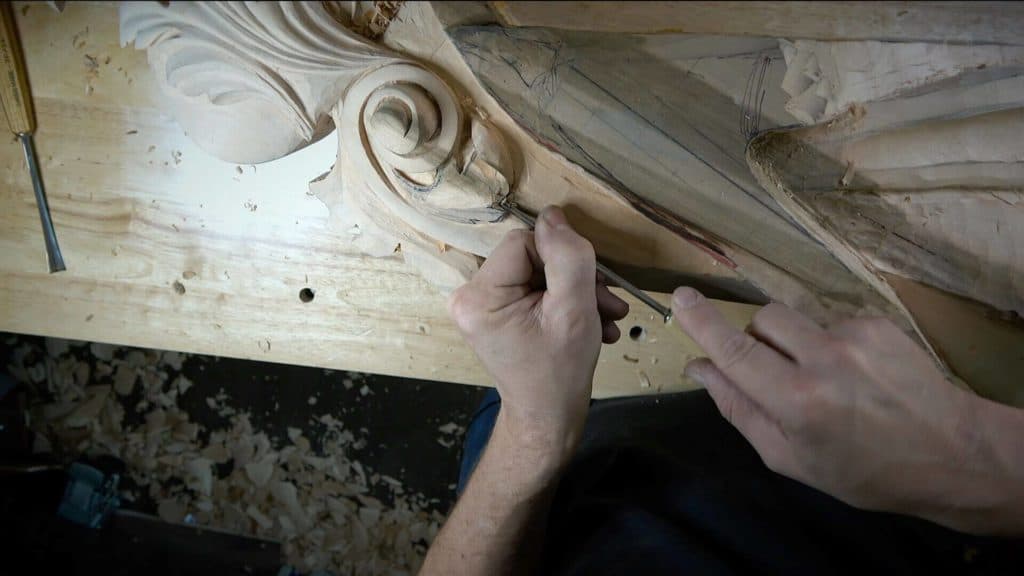
Alexander Grabovetskiy, woodcarver, School of Woodcarving · Published 2020
What does a wood carver mean by "tiny tools"?
Quick answer: The phrase "tiny tools" is how Venice Room 89.11 ends, after a limit on depth and a reason to be careful. In my other lessons it sits beside a number 11, a veiner, a joint with no glue under it and a mallet.
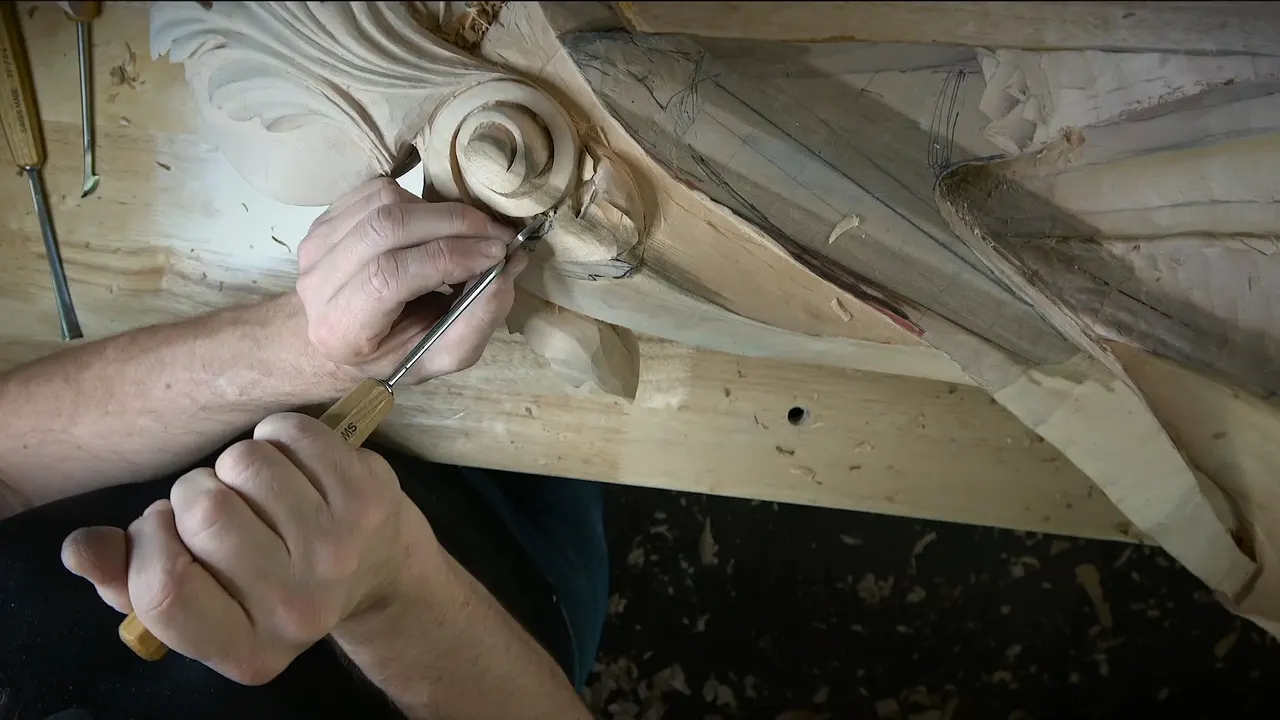

In Venice Room 89.11 my words are "I'm using really tiny tools," and they follow "I cannot go deeper than that." In my other lessons the same two words sit beside a number 11, a veiner, an eighth of an inch gouge and even a mallet.
Ever picked up a tool so small it nearly vanishes in your fingers? Did a spot ever stop you because one more pass would be too deep? Then walk through part 11 with me, and through the lessons where I use the same two words.
What happens in part 11 before the tiny tools?
It opens on the shadows: "It's all about the shadows." One line says "nobody's going to see how deep I got my undercut," and the next turns it around: "But somehow it's going to be a lot more pleasant to the eye."

Next comes a plan, with a size: "let me use one millimeter" (about 0.04 in) "and let me create a really nice marriage line between that volute and the background." Right behind it: "Maybe even slightly undercut. Not much, but little bit undercut."
A job comes next: "just take care of whatever I've got left right here." It needs "a small spoon," a "Spoon gouge, like number three maybe, and three millimeters or so" (about 0.12 in). A little stropping is planned too.

How did the strop save the spoon gouge?
The next words are "And that is not enough," and then "I need to strop it a little better." A short verdict, "It's much better," sits beside a line on the machine: "I just took it to my machine, stropping."
The bevel was next: "I changed a little bit bevel because it's already too rounded," and then "I gave a better bevel on the backside, and that took care of it." After that, words on the wood: "Now I can actually attack that even against the grain. Even if it's mushy like this. So it's still going to be removed really cleanly."

Which tools came next in part 11?
A different sweep: "I'll use number seven, and just use one side of it and get little better cut." A tool for the ground comes next: "There is also really good tools for that operation." My words for it are "background or grounding tools," and "it has a little bit of curvature, little bit of bend."

A bigger one is an option: "I even could use a little bigger one, maybe about quarter inch, six millimeters" (a quarter inch is 6.35 mm). A mixed verdict follows: "It gives me really good, clean cut, but not here," and then "Right here is still kind of working against the grain." Later: "And now it is looking really good."

Where do tiny tools show in part 11?
Next, a plan reaches down in size: "I could go right now with even smaller background removing tool or grounding tool, like a 16th of an inch" (about 1.6 mm), "and get inside of this area." Before that, a veiner is planned: "a half a millimeter veiner, number 11" (about 0.02 in), for "a channel cut all the way."
On the view: "I can't change the position. It just takes so much time to change the position of the camera." Then "Just get an idea," and "I'm actually doing both sides on this side."

After the veiner, the grounding tool is planned: "And then I'll attack that with the grounding tool" "between those two cuts." The words that follow: "really clean and nice transition point." And "Beautiful transition point."

"I'm ready to do concaves and convexes" comes next, followed by a plan for a tool: "Let me take this tool back. I don't want to create mess again on my workbench." The plan for the size: "just the number 11 and two millimeters" (about 0.08 in), to "attack that transition."

The last lines: "I do not want to lose the feel of this whatever surface. I cannot go deeper than that. That's why I have to be really careful not to mess up, and I'm using really tiny tools to do that."

Do parts 10 and 12 name the same sizes?
In part 10 the lines run "I could go even deeper undercut. And I think I should." Then a plan names one millimeter (0.039 in) in the same number 11: "I can excavate even deeper." Part 12 keeps the two millimeters: "I'm still using the same two millimeters," and "It's little bigger than a 16th of an inch" (1/16 in is 1.59 mm).
The same part gives a clock position for the flute: "with my flute about 3:00, almost on a flat. Pretty much on a flat, 3:00." For a concave: "Starting point 10:00," and a finish planned "with almost 9:00." And a warning about a deep concave: "No, I don't want to do it," followed by "I think it would be a big mistake." The shape wanted is "Just the main shape, okay?"
How small is tiny in my lessons?
Workshop 65, part 12, has a hope about a piece first: "I think I'll be able to actually stick that piece underneath of this detail. I hope so." Then a size for the word: "Let me use a small, tiny tool. Go around. And when I'm saying tiny, it's number 11 and 3 millimeters" (0.118 in). In workshop 31, part 2, I can "fix the movement" with "just a small, tiny tool, one-eighth of an inch, number three" (about 3.2 mm).

Maine class 12, part 2, has a plan with a different choice: "I'll use just a small not tiny tool number four." And workshop 95, part 10, plans a tool "to get rid of this left over," to "just hook this out like this."

How do I sharpen tiny tools?
The Techniques Q and A lesson on carving with the grain has a question on sharpening: "it's about sharpening." Then: "I showed you yesterday how to sharpen huge tools. But what about if it's tiny tools?" Next, the size, "Half a millimeter, number 11" (0.5 mm is about 0.02 in).
What do I say about tiny tools when a spot is fragile?
In Maine class 13, part 1, a plan starts it: "I'm gonna create that opening. It's completely airborne." Then: "Like I said, it becomes more fragile gotta be careful." And an earlier piece of advice is set beside it: "If in the beginning I encourage you not to use tiny tools. From this stage on you're gonna use a lot of teeny tiny tools." Its course is the Grinling Gibbons class in Maine.

A spot with no glue under it sits in Lily Box 9, part 1: "remember there is no glue underneath." Then: "so got to be careful and just use really small tiny tools to develop it. Okay. Otherwise, I'm going to break it."
In Roman Acanthus 11, part 5, a warning opens it, "Just be careful with that thing," Next: "Especially tiny tools like this. They are not designed for the heavy duty." And the way through: "if you're careful and if you're patient, you shouldn't have any problem with that."
Does a mallet belong on tiny tools?
A rule about the mallet sits in Lily Box 5, part 9: "When you're using mallet on a really tiny, small tools, you're really not supposed to use a mallet, actually." The turn is next: "But if you're really careful, even if you're not supposed to, sometimes it's helpful, actually, to use a mallet. You can gain a lot better control."
Do you have to own tiny tools?
Over in Roman Acanthus 7, part 5, the words are "You don't have to have tiny tools like I do. Any small tools will work, especially in this stage. This is not micro carving. On the micro carving, yes, definitely, I would use just micro tools. But not in this case."

Floral and Molding 13, part 3, is about a flower that sits beneath a petal: "you really don't have to worry too much," and "some of the details you're going to leave out." With the tool: "I can get in the tiniest spots, and I can create my cut with no problem."
An undercut is planned in Lily Box 2, part 13: "I probably can do it right away," and then "you don't really have to do that undercutting, especially if you don't have those tiny tools." Advice follows: "But I would advise you that if you really want to do carving for furniture, let's say, that makes big difference." The next two lines are "The shadow and light, how it casts, and so on," and "The small, tiny cut, but that makes huge difference."
Can you make a tiny tool yourself?
In Lily Box 3, part 7, a solution comes by the way when a number 11 is out of reach: "There's a solution." The example is a sewing machine needle. Then: "some of them, not all of them, but some of them, they do have a groove on inside," and "you can actually use a needle, create a handle for the needle, and that way you can create micro tool."

My own history is in the next lines: "And I've done it. I actually had that needle tool when I used to live in Russia exactly for the same operations." Then: "You can create beautiful movements with tiny tools."
How far does a tiny tool reach where a bigger one does not?
Greek Acanthus 14, part 1, has "start removing material what I don't need," and then goes below a pipe: "I can go underneath of a pipe really easily, even undercut underneath of the pipe." More: "I've got smaller than that, of course, too. I could use even smaller."
Workshop 82, part 8, has a surface that is "a little rough underneath," and I'm "just after really smooth form." The flatter tool will "clean that surface," and "Clean and nice right underneath." Then: "in a case like that, I can do only with the really small, tiny tools." A little later: "let me also create a small concave. I'm not sure should I or should not."

And in workshop 20, part 1, the words are about the kind of tool: "they're excellent tools. Really good tools to have." A plan follows: "Let me just carefully excavate that inside a little."
When do the tiny tools come into my hands?
In Hashemi Flowers 30, part 1, I talk about days when "you're trying to get as much as possible in one day," with setting in and final detail. The words: "I have a tendency to make little more mistakes because with the big tools, you're trying to rush everything, make quick movements and so on."

Then the tools change: "And then you're taking tiny tools in your hands. But your hands already done the big stuff." The course sits on its pillar page.
In Furniture Panel 15, part 9, a plan is "I'm going to need just the tiny tools." Sizes follow: "I'll use probably three millimeters and two millimeters" (0.118 in and 0.079 in), then "carefully," and a plan to "get pretty close to the final depth."

A thinner tool than a regular size shows in Lily Box 7, part 10: "it would be much thicker in this point. So right now it's really thin, and that metal really holds the edge. I really like it." And "that's really nice to get in some of the areas," my words about the thin tool.
Where does every tiny tools line sit?
Each row below names a lesson, so you can find the line on its page.
| Lesson | Where | Beside |
|---|---|---|
| Venice Room 65.12 | The word tiny gets a size here, given as a sweep number and a measure. | Number 11 |
| Lily Box 2.13 | An undercut for the shadow and light on a piece for furniture. | Casting |
| Lily Box 9.1 | Thin spot, no glue underneath it, so care comes first. | Careful |
| Furniture Panel 15.9 | A plan to work around one area at a slow pace, with two sizes. | Depth |
| Maine class 13.1 | An opening hanging in the air, where the work gets fragile. | Teeny |
| Roman Acanthus 11.5 | A warning that tools this small are not made for heavy duty. | Breaking |
| Greek Acanthus 14.1 | A way to reach below a pipe and even undercut there. | Smaller |
| Venice Room 82.8 | A rough surface underneath, cleaned with a flatter tool. | Smooth form |
| Hashemi Flowers 30.1 | Big tools do the first work, and the small ones come into the hands later. | Final detail |
| Techniques Q and A | A question about sharpening, with a number 11 as the example. | Number 11 |

Which spot on your carving is too deep to go lower, and which tool in your drawer would reach it? Inside one tuition plan, part 11 waits with the rest of Part 8 of the Venice Room, and the rest of workshop 89.
How it's done
- Note the limit. The surface has a depth that cannot be passed, so it keeps its feel.
- Pick the size. The number 11, two millimeters (0.079 in), for the transition.
- Take the tiny tools. Really tiny ones, to be careful not to mess up.
- Work the channel. A number 11 veiner for the channel on both sides, then the grounding tool between them.
Frequently asked questions
Which lines sit just before the last words of part 11?
Two lines sit right before them: a wish not to lose the feel of the surface, and a depth that cannot be passed. A reason to be careful sits in between.
How small is a tiny tool in workshop 65?
In part 12 of workshop 65 the word tiny comes with a number 11 of 3 millimeters (about 0.12 in). A fix in workshop 31 gets a number three at one-eighth of an inch.
Do I have to own tiny tools?
Roman Acanthus 7 says any small tools will work at that stage. The same words add that it is not micro carving, where micro tools are the choice.
What to carve next