
Alexander Grabovetskiy, woodcarver, School of Woodcarving · Published 2020
What does a wood carver mean by "tremendous"?
Quick answer: In workshop 90, part 12, the word is part of "tremendous undercutting" for one area, and a big undercutting is named in this section. In my other lessons the word sits beside a side I can round, a clean pass, a long tool list and a skill that helped me, each with a link below.
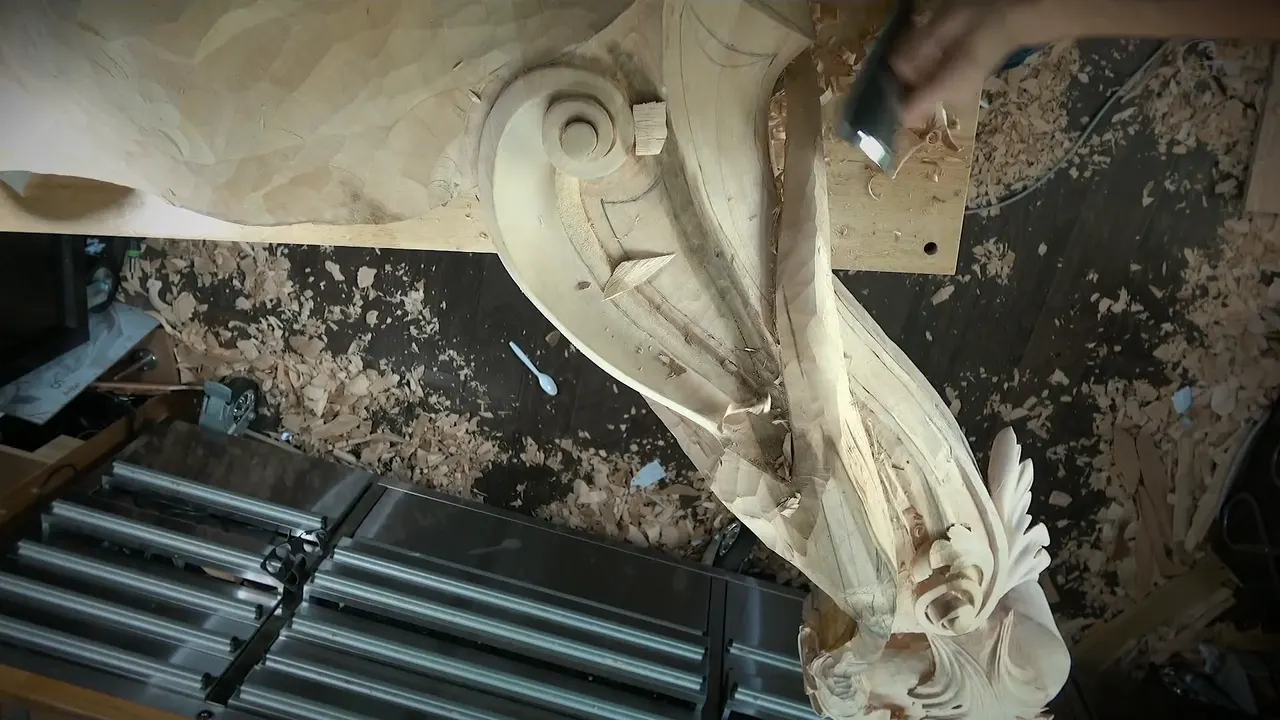

In part 12 of workshop 90, I say "tremendous undercutting" about one area of a wood carving. In other lessons the same word sits beside a side I can round, a clean pass, a long tool list and a skill that helped me. Each has a line below, my own words first.
Ever stood at a corbel and wondered how much wood can come out from underneath a leaf? Do you keep your gouge sharp enough to feel when it stops working? Then these lessons will hit home. I start in Venice Room 90. After it I visit the Part 7 and Part 12 Venice Room courses, the Roman Acanthus Leaf course, Flower Rosette and a few more. Sizes come in both systems, inches and millimeters, with my own figure first.
What is my plan before the word in part 12?
Part 12 opens with a need to watch both sides: "So what I have to keep an eye, both sides" and then "inside how it's going to look." The order of work comes next: "But again, I'm going to create a round look first, and I'll work on details little later."
Then comes "All right. So that is good." After that, a need: "What I have to do now, I have to completely get rid of whatever the raw wood I have left." About the tool, the line is "with the same tool upside down, but it doesn't work that way, so I have to change the position." One more need follows, and it is short: "And attack that from this side."

Where does "tremendous" sit in part 12 of workshop 90?
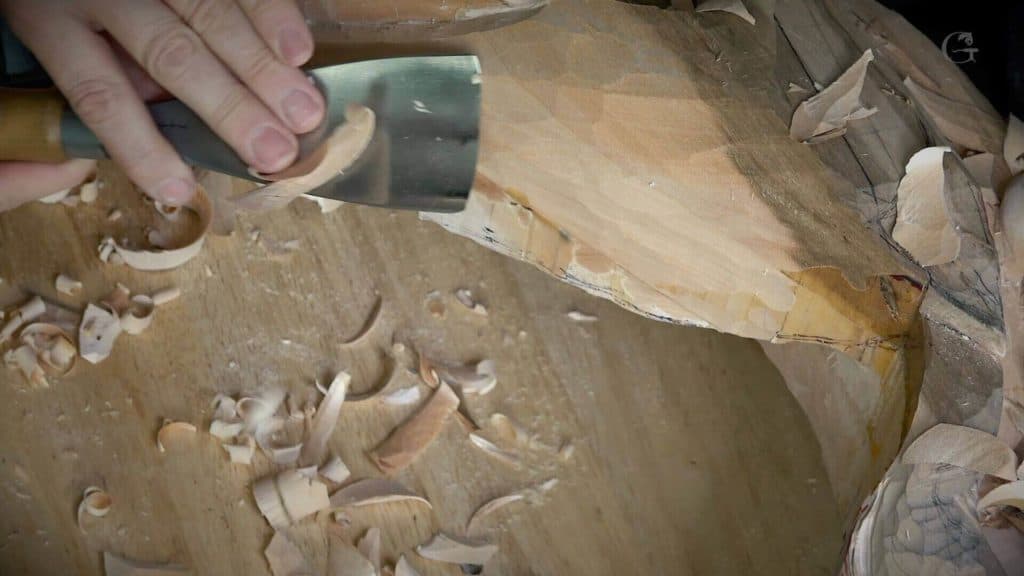
For this spot I say "And same idea. I have to be really nice and close to the main body." A figure comes next: "So you're going to leave approximately six millimeters in this case because it's kind of" and there the caption stops. Six millimeters is about 0.24 in.

In the next stretch sits the word: "but that's not going to be tremendous undercutting in this area, at least." Then a turn: "a big undercutting in this section because I really want to get a really deep shadow underneath".
More lines sit in the same stretch, among them "this part could be airborne." Also "I don't really need to do that, but it's possible." Then "Kind of blend everything."

What does the end of part 12 say?
The side gets named: "And now I have to round this side also." A short offer follows, "Well, maybe I'll be able to show that to you." Then the feel I am after: "Just create natural movement, like it's supposed to feel like it's really dropping around."

A mallet comes as a maybe: "Maybe it's a good idea for me to use a mallet." Next, "Maybe yes, maybe no." A note on the tool follows: "It feels like I need to sharpen my gouge a little bit." After it, "There you go. Much better." Last comes "Okay, let me double-check."


What came right before, in parts 11 and 10?
The drop is the subject of part 11. The movement "starts from all the way backside, wraps around, and goes all the way this way." The need is "a really smooth transition," and the tool I plan to take is "a really big gouge, number seven." The size I name is "Three inches" (76 mm).

The shape I want is "a little more bulkier on the bottom of that drop and a lot less at the top." It stays "really close, actually, to the main body" and "much thicker right here at the end of it." For depth, I have "approximately half an inch" (12.7 mm) at one line, and "maybe about 10 millimeters" (0.39 in) is the plan. The look I name is "a real material."

Care is in the part too, with a reason about messing up: a mistake would not be fixable. And thin is a worry. A plan closes the part: "So let me use my gouge upside down."

A lighter touch sits in part 10. "So not really deep. I don't want to make it too stripey." Then "All I need is just pretty much an indication of the movement." One idea gets dropped: "I wanted to do a deeper cut right there, but do I really want to do it or not? I don't think so." The replacement is "a concave cut, but not as deep as I wanted to before."

The mood turns, with "Right now, it just looks all bulky. Not good." Bigger tools come next: "I need bigger tools. I use a number seven." A doubt follows: "Maybe I just overcomplicate it. Which sometimes happens." And an idea, with a rasp: "I can try my new addition and get those ridges out". A last wish is "Like I said, I want to see it a little more smoother."

How far can I round a side when I have an inch?
In Venice Room 84, part 1, the word comes with a measurement. I plan to outline a side with the number 11, and "I'll take seven millimeters" (0.28 in). Then, "By the way, I do have approximately one inch to the main form right here." That is 25.4 mm. The same line goes on, "so I can actually round this side also tremendously."

About a leaf that will lay on the main form, I talk of "illusion it's laying right here." And "So I can chop slightly, too, with no problem."
Reaching the spot is a different matter: "So this is a kind of challenging area for me to reach." A possibility is "take probably just number nine and use a mallet and work from a back side." And "Yes, I am kneeling down, by the way." I also plan to change how I fasten it, and the line says "It's not really convenient for me."

Later in that part I say "that is the line of the main body of the element" and "it has to also be about quarter inch above that line" (about 6 mm), with an undercut planned there. Then "It's actually wrapping around going this direction."
How much can a small detail change in Venice Room 93?
In Venice Room 93, part 6, I say "And right here, I don't really like how it looks." A different number seven is the plan, and the aim is "Just give some roundness." A maybe follows, about changing the part, because "I kind of still don't like how it looks right here."
Then the word closes the thought: "And if you're going to do that, so you will see that those small details, you really do have to change sometimes tremendously." Another plan is "Let me clean that with the skewed gouge number seven in 10 millimeters" (0.39 in). Then "I'll just create a small concave." And "Okay. That looks better."


Earlier in that part there is a size check: "It's actually a little smaller than one-eighth of an inch." Then "Just like 3/32nds." And "It's two and a half millimeters, I'd say, approximately." In metric, the eighth is 3.2 mm, the 3/32 is 2.4 mm, and 2.5 mm is about 0.1 in. A plan sits there too: "I'll make that concave a little bigger."
How does the word fit a side I plan to lower?
Venice Room 132, part 2, begins with a thickness of "about one-eighth of an inch" (3.2 mm) from above, and then "So it's only three millimeters" (0.12 in). There I plan a "preliminary undercut underneath of this leaf", and "maybe you'll see what is going on."

The tool is "Number 11, and I am using five millimeters" (0.2 in). Then "I can go about two millimeters" (0.08 in) "and get little deeper excavation underneath." A wall stays: "But I'm still leaving some wall right here, the thickness to the highest spot, because I still have to establish concaves and convexes." And "So those undercuts are preliminary."
In a hedge, the word shows up. "the final line I have to hit, it's this line. So I'm going to lower down tremendously, I guess, this side." Then "Maybe not tremendously, but somewhat." And "that part's going to go right underneath."
One more line sits near it: "I know when it's too close, you almost don't see what I'm doing, okay?" Then "So it's almost impossible sometimes to get an idea even what am I doing." Earlier in that part I plan number 11 at "12 millimeters, about half an inch or so", and "somewhat like a 3D" is how I describe the leaves.
What is a bigger gouge worth in the Roman Acanthus lesson?
In Roman Acanthus 11, part 1, I plan to take "probably 10 millimeters, number nine" (about 0.4 in), and "I'll create concave cuts on both sides." The care is in "I don't want to take the material on a single cut because I want to be really accurate."

The method is "if I'm just taking little by little, I can control much better what is taken out." My "clean side in this case is on the right-hand side, and this left side is more rough." The last line there is "I can always attack from the opposite direction".
Here is the word: "if you would have a bigger number nine, or number eight will work also, it would help tremendously, actually, to make a cut really clean because you can take multiple ridges, which you don't have to have." A figure comes with it: "about 5/8 of an inch" (16 mm).

Does a tool list get tremendously long?
In Flower Rosette 5, part 1, one of you asks me about tool listing. I say "it would be probably a nice idea to list the tools", and "although on simple projects like this one, yes, it would be easier for me to list all the tools." On a bigger project, "like Grinling Gibbons course, it's almost impossible to create a list", and "the list is going to be tremendously long."

Another line is "some of the tools I use you don't have to buy because same results you could actually achieve just by using the tools you have." Also "the number one tool which you have to really buy to carve is a knife." On wood I say "if you're using basswood or limewood, same like I'm doing right now, it should not be any problem."
Does hand carving have a limit?
In Furniture Panel 38, part 1, the caption line that holds the word is garbled, so I leave it out. The lines around it are clear. "What I like about wood carving and especially hand tools, there's no limit what you can do." And "one of the beautiful things about wood carving by hand that you can do whatever you imagine." Then "Limitation is just inside of your head."

Just before those lines: "But be careful not to go too deep." A depth check follows: "I'm about the same level right now with this, but I have to double check."
Does the word leave the bench?
It does. During my April 2020 livestream, I talk about how people watch my videos: "my videos are also watched after live, and that is interesting." The retention line is "Without any talking and without any music, retention was absolutely tremendous. People just kept watching and watching." It ends on "I think it's just like a hypnosis or something like this."
A harder place for the word is Let me introduce myself. I talk about jail and prison: "just imagine how hard it was inside." Here is how I go on: "I just tried to figure out, how can I survive?" Here are the words: "I had my skills already, woodcarving skills, and those skills helped me, okay, and helped me tremendously."
Which lesson holds which line, and what sits beside it?
| Where | Next to the word |
|---|---|
| Workshop 90, part 12 | A big undercutting named for this section. |
| Lesson 84, part 1 | About one inch to the main form, and a leaf that is going to lay on it. |
| Lesson 93, part 6 | Small details that need a change, and a concave in the wrong place. |
| Workshop 132 | A side to lower, a hedge on it, and a wall left standing. |
| Acanthus lesson 11 | A clean side against a rough one, and a bigger gouge. |
| Flower Rosette 5, part 1 | One of you asking about listing tools, and Grinling Gibbons. |
| Furniture Panel 38, part 1 | No limit on what you can do with hand tools. |
| April 2020 livestream | Videos without talking or music, and how long people kept watching. |
| Let me introduce myself | How to survive inside, and the skills I already had. |
Is there a side of your own woodworking where a chisel will let you take a lot, or a spot where it will not? Everything in workshop 90 sits inside one tuition plan. Other workshops wait on the Part 8 course page, and more Venice Room lessons carry on from there.
How it's done
- Plan the order. My plan in part 12 is a round look first, with the details a little later.
- Name the need. I have to completely get rid of whatever raw wood I have left, and the position has to change before I attack from this side.
- Stay near the main body. The need is to be really nice and close to the main body.
- Say how big the undercutting is. Some undercutting is coming, but not tremendous in this area, and a big undercutting is named for this section.
- Round the side I name. The side I name needs rounding, and the movement should feel like "it's really dropping around."
- Check the tool. It feels like I need to sharpen my gouge a little bit, and the part ends on "Okay, let me double-check."
Frequently asked questions
Where in workshop 90 do I say "tremendous undercutting"?
In part 12, in a line about one area, with "at least" at its end. A big one in this section is named in the next line, with a deep shadow underneath as the reason.
What figure sits next to the word in part 12?
Approximately six millimeters (about 0.24 in), left in this case. Before it comes a line about the main body, and the caption stops at "because it's kind of".
How much wood sits behind the side I round in Venice Room 84?
The measure is "approximately one inch" (25.4 mm) "to the main form". A leaf will lay on that form, and my words for the look are "illusion it's laying right here". The word follows in the same line, as "tremendously".
What to carve next