
Alexander Grabovetskiy, woodcarver, School of Woodcarving · Published 2020
What does a wood carver mean by "nicely"?
Quick answer: Nicely is a word in Venice Room 91, part 1, said about a carving that wraps and falls. Other lessons of mine put it beside blend, transition, fit, flow and curl, in Venice Room, Furniture Panel and Hashemi Flowers lessons, each linked below with its own words.
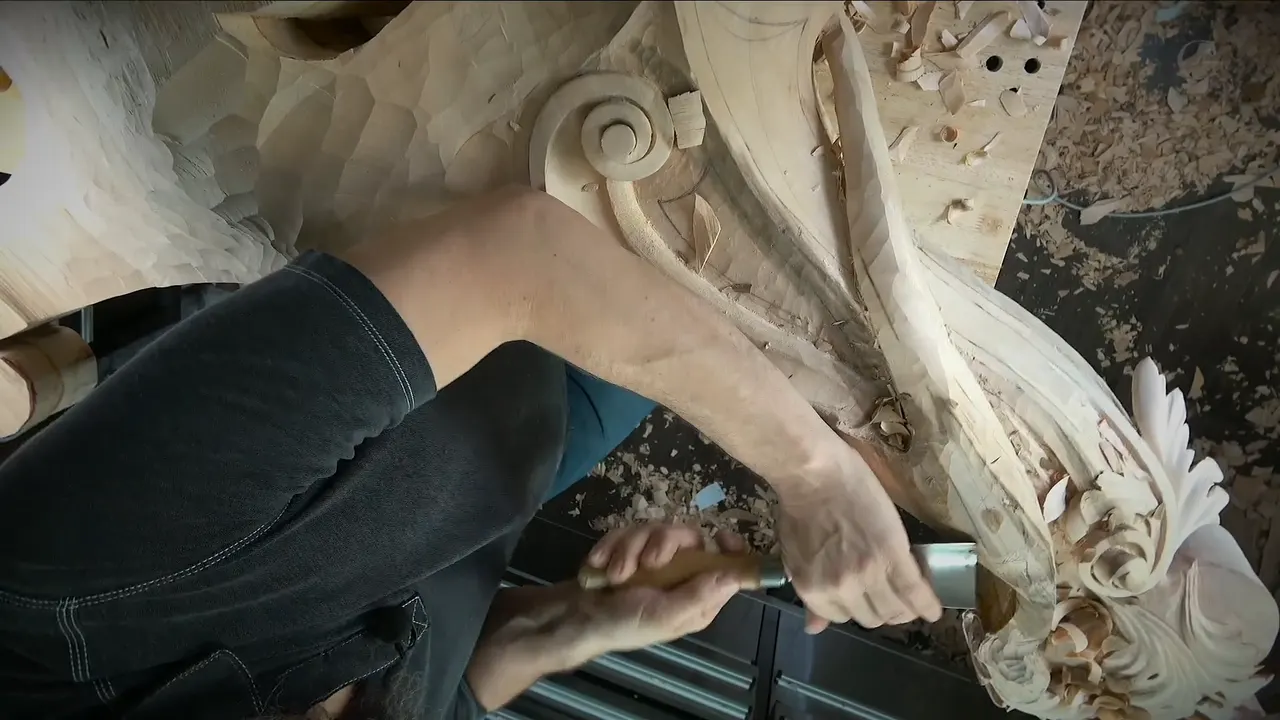

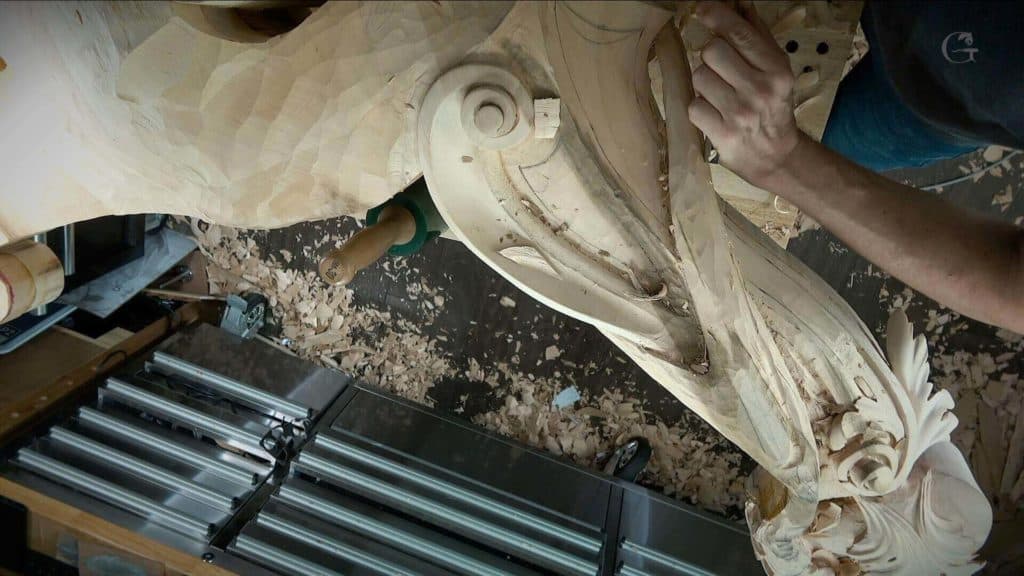
"It actually looks really good. It just wraps around nicely." Those words are in workshop 91, part 1, near the start, and the adverb turns up again in lessons about blend, transition, fit, flow and curl. This page reads part 1 first and then the wood carving lessons that carry the word, each with its link.
Ever turned a carved piece in your hands to see if the shape runs on into the wood beside it? Then you already know the question behind part 1.
What are the plans in 91.1?
- A verdict on the wrap.
- A decision ahead on how the piece will really look, with the shapes still to carve.
- A transition, planned for a number one.
- A fall, and a smaller number seven that might get the shape closer.
- One main concave, somewhat deep, for a number 11 or a bigger tool.
- A wish to exaggerate, and a plan to walk around.

Where does the carving wrap around nicely?
The decision is stated before any tool is named: "Well, now I'm ready actually to create my concaves and convexes and make that decision how it's going to really look." One area gets its own verdict, "This area is not too nice yet."

Distance gets a line too, about a part that "is going to be much closer to the body than this part." The line goes on with "So I can actually get even closer little bit," and a short check closes it, "Okay, that is good."
How does a shape fall really nicely?
Tools come into the lines here: "I think I don't need any more the big gouge." Then "So I'm going to take probably just a number one right now and going to create that transition right here."

The verdict is plain: "So that is really, really good, so it actually falls really nicely, really nicely."
Another tool is only a maybe: "Maybe it's a good idea for me to get a number seven, the smaller one, and get little closer to the final shape I'm after." The size is "like a half an inch, number seven," and an inch is 25.4 mm, which is 12.7 millimeters.

Then: "Here you go, and now I am ready to just work around, just work around."
What is the plan for the main concave?
Thinking is in the lines, "I have to think little bit." A look from the side is in the plan: "And let me take a look actually from the side how it looks." A remedy follows with a maybe, "Maybe I need to remove little more this way," and then "So maybe I'll just get that bump out." Then a short verdict, "All right, that is good."
The main concave gets its words: "there's going to be actually a couple, but I want to make sure it looks like it's really falling down and then it just wraps."

One of them is planned for "right here." The plan is to "carry that concave all the way like this," and it is "somewhat deep, I would say, concave."
The sizes are plans too. "I'll do that probably with that number 11 and 10 millimeters," which is 0.39 in. A bigger tool is only a possibility, "I can start with the bigger one, maybe about five-eighths of an inch first, like 15 millimeters or so," and 15 millimeters comes to about 0.59 in.
How do I reach the far side of the wrap?
"I want to exaggerate that one, really exaggerate that one." Position gets a line, "I need to attack from different positions, walk around," and an apology goes with it, "My apologies if I'm going to stick my head in the camera."

The part ends on a plan, "And I need to attack that from this side."

Can a part wrap nicely before it looks good?
Venice Room 84, part 5, holds back an amount with a plan to leave "approximately quarter inch for the below movement," roughly 6.35 millimeters. "Unfortunately, you don't see it, but that's my plan." Another line holds back more: "But not much, like I said, because I want to keep some of that material."
Tools are planned next, "some kind of spoon" first, with "about number three or number five." Soon after: "I'll take number five."

Beside a doubt sits the word: "So that is actually wrapping really good. Even if it doesn't look too good right now, it will wrap really nicely. Let me try to show you from different point of view."
What tool makes a smooth concave transition nicely?
The same workshop, part 11, has a plan: "Maybe I can actually create a little more pronounced concave right here. Number 7." A reason follows, "since I have some stuff I have to remove right here, so I can actually create a really nice and smooth concave on this side."
Next line: "It's going to transition nicely." Later: "I'm happy with this side. Of course, it's not the end yet because I still have to do more movements going like this," which "I can leave as a concave." And: "maybe it's time to shape this movement a little better."
Then: "Number 7, that's what I'm using. Fourteen millimeters, same number 7," and 14 millimeters is 0.55 in. About the blade: "A really long bevel."
What comes before blends nicely in Venice Room 74?
Over in Venice Room 74, part 2, the lines run "Again, I have to stick my head in the camera to show that to you, but I don't want to do that."

Part of it is left for later: a plan to "just work on that off camera," and "Hope you understand why." Closing the stretch is "But we've done all that, and it blends... I think it blends nicely."
How slow can a blend be and still blend nicely?
Part 4 of Venice Room 65 has these lines, "But I have to control. Don't want to break anything." And a size: "half a millimeter makes big difference," about 0.02 in.
The facets get their words, "What I'm doing, I'm taking care of those facets." Then "It's much quicker in real life. And I'm really controlling." Then: "Of course, there's a lot of junk. But that is okay." The verdict that follows is short: "Okay. But it blends nicely. Blends really nicely."

Can you detect the movement when a shape just blends in?
Venice Room 71, in part 2, has a remark on a tool: "like I need to sharpen my skew. But that's okay." The passage turns on a question, "can you detect the movement? How nicely it just blends in?" and then "I think it's really beautiful."
A maybe sits at the end of it: "And yes, I could use number seven or number six and give even better roundness if I need to."

Why does a section need knocking down before it blends nicely?
Look at part 6 of Venice Room 83: "Deeper and nicer." Then "I also need to knock down a little bit this section, because it has to blend nicely."
A tool and a size follow, "Let me take number 11 and 7 millimeters and get rid of whatever I just created fast," about 0.28 in. The next verdict is plain: "And it does not look too bad." Then: "Something doesn't make sense, but I'll figure this out a little later."

What makes a flowing line curl underneath?
Hashemi Flowers 12 gives its goal in part 1: "the goal is to show that that curls underneath, okay?" Then: "It's supposed to be really nicely flowing all the way this way."
The passage closes on an attack, "And I'll attack that from all the directions until I'm happy with what I see."

Does a movement flow in more than two dimensions?
Furniture Panel 21, part 9, has this line: "the movement has to be like a flowing, not just in two-dimensional world." Then the curvature: "What I mean by that, I mean that curvature, for example, it's just a really nice and it's flowing really nicely."
Then: "But it also has to go downhill nicely, same way right here. So it cannot be choppy."

Which tool fits a tight inside nicely?
Floral and Molding for the Panel 5 says, in part 1, "on the inside, it just doesn't work." The plan is to "use a different tool."
The choice is "Number six." The size is "in this case, it's about, I would say maybe 12 millimeters," around 0.47 in. A test comes next, "That should work. Let me check," and then "it fits really, really nicely."

What if the shape does not fit the overall design yet?
The same Furniture Panel lesson, part 6, has a doubt: "But overall, it looks wonderful. Okay, let's attack this section. Okay, I think it just doesn't look too good as of now because I want to make sure in overall design, it just fits nicely."
The way forward is plain: "But what I can do, I can actually take this line," and "little by little, combine that right inside like that."

Where does a smoother transition raise an edge?
Venetian Flowers Rosette 3 says, in part 4, "And blend it nicer. More smoother transition, I should say. But again, at the area of edge, I can make this edge raised up slightly."
A small gouge is a maybe, "And maybe I can use a small gouge and create little deeper movement in this section. Just for the shadow's sake."

Further on in the same part, the words are "That's good. And that actually goes really nicely downhill, goes around." Then: "Just need to undercut slightly."

Can a shallow undercut cast a shadow nicely?
Furniture Panel 23, part 11, has "Not really deep undercut," then "And that's already giving me some shadow. Okay. See how nicely it casts its shadow?"
The next move is "And I can do exactly the same on the opposite side also. Go a little bit in, right to half a millimeter," near 0.02 in. And: "It's not really undercut, but still, every little bit helps." Then more concaves are planned: "I'll just create some more concaves on that part." On the tool: "I could use any tool pretty much," and a number 11 of "3 millimeters" (0.12 in) is one choice.

Does an undercut flip nicely?
In Furniture Panel 20, part 8, the tool is "number seven right here" and the push is "Go a little deeper." Then: "So initially what I did, I undercut under this side, and it just looks like it's flipping nicely and still creates the shadow underneath."
A limit is stated, "And yes, I could go to extreme and do even more than that," and the next side is a plan: "Okay, let me attack opposite side." That side calls for an undercut, "I'll kind of undercut a little bit," with the wish "I really want to see a really nice transition from this point."

How does a wider concave get blended?
Chamomile and Bow Rosette 4, part 2, has a plan: "now, I need to get from this concave to much wider concave." A range of tools is offered, "And you could use any gouge, like maybe number five, number seven will work."
Then the word: "Okay? So it has to be blended really nicely." A wish sits beside it, "But still, I really want to see in the middle some kind of concave."
How do sharp lines turn into a nice blend?
Floral and Molding for the Panel 9, part 1, has "And yes, I don't need those sharp lines, so all I have to do is just blend them nicely." Next: "And let me excavate a little section right here. Clean that from this side."
A doubt ends the stretch: "And that curl is not too nice. I kind of have to change that."
Does it curl nicely when concaves build a convex?
Venetian Flowers Rosette 4, part 2, reads "And now it looks, in my opinion, much better," and then "Now it looks like it curls really nicely."
Next: "But to create that convex, I need to create a couple of concaves."

What numbers sat beside the word?
| Spot | Number named near the word |
|---|---|
| This part | one, seven and 11, all as plans |
| Rough wrap | three or five, then five |
| Smooth concave | 7, for a pronounced concave in part 11 of the same workshop |
| Roundness | seven or six, if needed, in Venice Room 71 |
| Knocked section | 11 at 7 millimeters (0.28 in), in Venice Room 83 |
| Tight inside | six, at about 12 millimeters (0.47 in), in the lesson with the tight inside |
| Wider concave | five or seven, in a Chamomile lesson |
| Flip | seven, in Furniture Panel 20, with the undercut under one side |
Is there a spot on your own carving where the shape runs into the wood beside it? Could you say, in millimeters or in inches, how deep the next hollow goes? Workshop 91 sits inside one tuition plan with the other Part 8 workshops. This page ends where part 1 ends.
How it's done
- Look at the wrap. Part 1 begins with a verdict on a shape that wraps around.
- Name the decision. The decision ahead is how the piece will really look.
- Plan the transition. A number one is the probable tool, since the big gouge is no longer needed.
- Check the fall. The shape falls really nicely, and a smaller number seven is only a maybe.
- Plan the main concave. One concave carried through, somewhat deep, with a number 11 as the probable tool.
- Walk around. Position gets its own line, with an apology for the camera.
Frequently asked questions
Which words sit beside nicely in part 1?
Wraps and falls. Both words belong to this one part. The wrap sits near the start, the fall follows a number one planned for the transition, and a decision about the next shapes sits between them, with the main concave still ahead.
Which sizes did part 1 name?
Plans only: a number one for the transition, and a number seven of a half an inch (12.7 mm) as a maybe. For the main concave, a number 11 at 10 millimeters (0.39 in) is the probable choice, with a bigger one, about five-eighths of an inch or like 15 millimeters or so (0.59 in), to start with.
Was the wrap finished when the word showed up in Venice Room 84?
A wrap that does not look good yet is the setting, and the line stays a will: "it will wrap really nicely." Earlier in that part I name number three or number five as the probable tool, and then "I'll take number five."
What to carve next
- Venice Room 91
- Venice Room Part 8
- Venice Room Part 7
- Venice Room 84
- Venice Room 74
- Venice Room 65
- Venice Room 71
- Venice Room 83
- Hashemi Flowers 12
- Furniture Panel 21
- Floral and Molding 5
- Floral and Molding 9
- Chamomile and Bow Rosette 4
- Venetian Flowers Rosette 3
- Venetian Flowers Rosette 4
- Furniture Panel 23
- Furniture Panel 20