

Alexander Grabovetskiy, woodcarver, School of Woodcarving · Published 2020
What does a wood carver mean by the "main surface"?
Quick answer: In Venice Room 91, part 2, a fold lays on the main surface. My Lily Box lessons put the same two words beside a lid, a ridge and a slope, and beside glue or a small gap. A Venice Room lesson and a Furniture Panel lesson carry them too, each linked below.
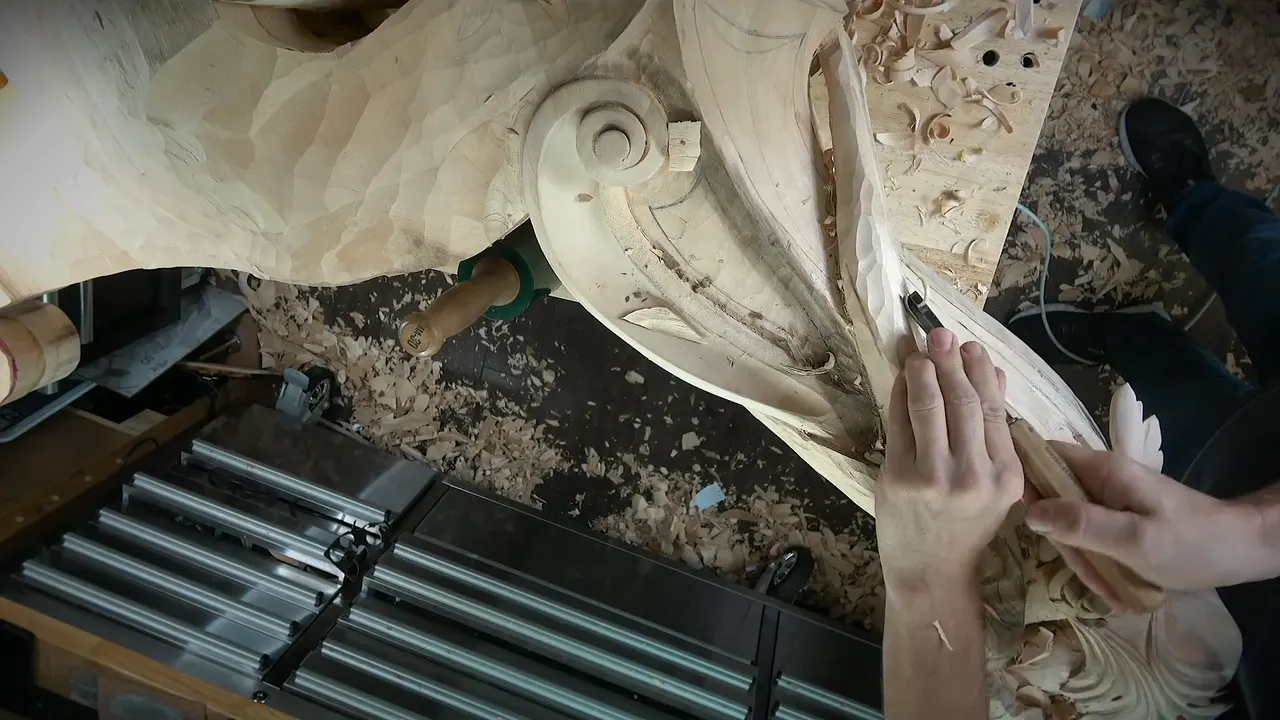

"I mean, that fold laying right on top of the main surface." That line is in workshop 91, part 2 of the Venice Room. The same two words, main surface, are in my Lily Box, Furniture Panel and other Venice Room lessons, each with its own distance, tool or glue. This page reads part 2 first, then those wood carving lessons, each with its link.
Ever set a small carved shape over a bigger one and wondered how far down it should sit? If so, part 2 is your spot.
What are the plans and verdicts in 91.2?
- Grain direction.
- One side to blend, and a look that is natural.
- Second, a deeper concave, only a maybe with a small tool.
- Shadow, and an exaggerated fold.
- Maybe another concave beside it, on the side.
- Undercut of one millimeter in this area, "not as much," for later.
- Ridges to blend, and a clean up.

Why keep an eye on the grain when a shape wraps around?
The grain opens the part: "And yes, I do have to keep an eye the grain direction because it does change." The next line gives the reason in the next breath, "It changes because it wraps around and the grain does all kinds of weird stuff." The subject is grain.

What is planned for the side first?
"All right, so that is a preliminary cut. And on the side of it, I'm going to do a smaller cut." The first step comes right after: "First of all, I need to blend one of the sides, which is going to be this side."
A caption line follows: "hard ridge. I don't need it. Otherwise, it's not going to look natural." After that: "So that is good," then "Get a little deeper cut."
Can a concave get softer without losing its feel?
Number three is next: "And let me also take number three. And round that little bit more." The softening is a plan, "And again, I'm going to make it a little softer."
One thing stays put: "But I still don't want to lose the feel of the concave, but a little softer movement."

What goes inside the first concave?
"That's concave number one, and right inside of it I want to create a deeper concave. Maybe with the seven millimeters," which is 0.28 in. Grain comes back as a plan, "Then I have to change the position because of the grain. And go that direction."
How does an exaggerated fold make a shadow?
"So what I'm doing right now, I'm actually creating a shadow. I am creating a shadow. I'm actually exaggerating." Then: "I'm not sure if I should say that way or not, but I am actually exaggerating that fold." The tool is "the smaller even tool, with the five millimeters," and that is 0.20 in.

Where could another concave go on the side?
A possibility: "So I think that is good, except I can probably create another concave with the five millimeters just right on the side of here." Direction shifts once more, "Just on the side. Again, I have to change the direction and cut one more time this direction. And take a look."
Which line sits between a view and a verdict?
Between "You don't see that probably. That creates beautiful transition" and the verdict "Really good" sits the line that opens this page, about the fold and the main surface. The picture in that line is a fold on the surface.
How deep is the undercut under the fold?
"So it's going to give me a chance to undercut, but not as much. I really don't need to undercut in this area really deep." The depth is "one millimeter undercut later on," and the tool is "number 11." One millimeter is 0.04 in.

Why add a shallow concave on the side?
A plan: "right on the side of this section, I could create either convex or concave, but a shallow concave. Let me use number three, and I'll just create a shallow concave." Another turn of the tool follows.
On why it is needed: "just for the shadow's sake." Ridges are to be blended too. The last plan is "Get a little clean up," with "five millimeters or even four millimeters to clean up inside of here," which is 0.2 in or 0.16 in.
Is the exaggerated fold how it looks in life?
Part 4 of workshop 91 says more about it. With "the smaller tool, number 11 tool," the line says life will not look exactly like that. The other version is "exaggerated version of it, okay? Like a fold, just because of the shadows we're going to create."
The underside gets a wish in that part as well: "feel like it's folding from underneath." One more line states it, "Just changing the overall feel, how it feels." A plan sits beside it, to "blend this side a little better."

Where else does this fold grow from underneath?
Workshop 91 has more of it. Part 4 says "So now it looks like that section is actually growing from underneath right here." Seven brings a worry and a plan: "I'm still not too happy about this section because I want to make it feel like it does fold like this, okay?" A ridge is next, "first of all, I need to blend this ridge so that's going to be more soft."
In part 8 the light source gets a line. "You see only with the light source from one point," and the move is "to another side," then "let me check." Next: "So now it gets in a different direction, and it feels like it does fold." Mixed feelings sit here. "I am happy overall," goes beside "I'm not too happy yet with this section."
Over in six, a shadow stays in view: "I still see that shadow, which is I'm after." Another concave is planned there too, a "transitional concave" that goes "folding in." Back in seven, a plan sits "right between those two concaves," for "a folding motion," after a plan to "carry this one all the way." In six, the line is "fold that closer to the body."

Can the main body lay on a folded leaf?
Venice Room 42, part 4, has a plan for a smaller side: "This side is little too bulky, and I can take that, make this part a little more tinier, like that, and bring that on inside." It is going to look as if the main body "lays on top of this folded leaf." Another idea is to "start undercutting all the way up." See Venice Room 42 for that lesson.
The side also needs "have to undercut much deeper," and a plain note ends the stretch, "Just have to be careful."

When does an undercut wait for the main surface?
Venice Room 126, part 3, has the plan, "I'm not going to undercut yet," and the reason is "I need to establish concaves and convexes on the main surface." Later on, an undercut is planned "underneath right there."
Showing it matters: "make sure you see what I'm doing." The camera gets a plan too: "Maybe I have to turn my table." The view gets its verdict, "And yes, I think it's much better for you to see." After that comes a plan to "check with my iPad drawing and see if I'm not making mistake how I want to do it." Then: "And yes, I do make mistake."

How high can a detail stand above the lid?
The lid is named in Lily Box 4, part 1: "I'm using number nine, six millimeters, and I'm leaving about 10 millimeters from my main surface, from the lid surface." Six millimeters come to 0.24 in, and 10 millimeters to 0.39 in.
Earlier in that part: "I'm okay with the longer process," and "I still like to use the bigger tools, especially at the beginning stage." A small leaf comes next, "Looks like I don't have any glue underneath of this small leaf." The wood gets a remark, "Look at the grain. Isn't that gorgeous?" The warning is "Got to be really careful how I attack this side."

Why start with the weak spots near the main surface?
Ten, in the same workshop, has its reason: "it's easy to catch that grain and break it. So that's why I'm carefully taking care first of those weak spots."
The plan leaves "approximately one-eighth of an inch above the main surface." That is 3.2 millimeters. Height gets a note, "And overall, it has to be lower also because right now just too high."

How much stays between the main surface and a ridge?
Thirteen has a ridge, with a gap of its own between the main surface and that ridge. The line adds "Exactly the same idea like we did before. I take care of it." Next comes just "Three millimeters," or 0.12 in.

Can small details sit really close to the main lid?
Twelve has a plan for small details. First, "Approach this side like this." Then: "those small details, this one and that one" sit "really close to the main surface, to the main lid." The caution is "But still, be careful, they are really small and fragile."

How low does a part go toward the main surface?
Lily Box 5, part 1, starts from a rough area, "at least I've got an idea what I have to do right now," and "So that has to be lowered down." The aim is to take it down toward "our main surface."

Eight has "that's a separate detail, by the way." Then comes the gap, "maybe about eighth of an inch, 3 millimeters from the main surface" (3.2 mm and 0.12 in). A view: "So now I can see exactly what's going on." And a plan: "I can take number nine now and start digging even more."

Where does a slope end near the main lid?
In Lily Box 7, part 4, the choice is "number 11 now, and 3 millimeters" (0.118 in), for undercutting. A warning is plain: "I have to be really careful in this area because that thing doesn't have any glue underneath."
Then number seven is for a slope. The wish is to "bring that really low to the main surface, to the main lid, to this surface," and the aim is a look of growing "from underneath."

Can a dowel hold a detail to the main surface?
Lily Box 10, part 1, splits a piece in two, one to carve separately and then "glue that in." The space is needed "later on to drill through and connect that with some kind of dowel to the main surface, okay, if it makes sense."
A cover is planned over it: "And then we can cover that dowel with this development." Before that, a second set has one piece "a little below" and another "a little above."

Does the main surface get a different glue?
In Lily Box 13, part 4, a plan opens the stretch: "I probably should use the same glue, super glue." Then "Maybe I put the spot right in the middle. That's going to hold." Afterward the glue gets time: "let it then dry. Wait until it's dry."
Why it is fine is said in one line: this piece is "glued to the main surface anyway." The surface itself gets "a different type of glue."

What if a tiny element ends up below the main surface?
Furniture Panel 16, part 5, gives the size: "about maybe 16th of an inch, and some spots" go "even less than that." The 16th is 1.6 millimeters.
A caution goes with it, "I don't want to create any micro cracks on inside of this element. So it's better not to rush it and get that slowly to that point, okay." For the tool, "a number five and a quarter inch to get closer," or 6.4 millimeters.
A slip below it is not a big deal there: "you can always shave an extra 1/64 of an inch or 1/32 of an inch." That is 0.4 mm or 0.8 mm, the shave sizes.

Which tools sat beside the main surface?
| Where | Tool beside the words |
|---|---|
| Fold, 91.2 | number 11 for an undercut, as a plan |
| Slope near the lid | number 11 first, then number seven for the slope itself |
| The lid surface, where the details stand | number nine |
| A tiny element | a number five and a quarter inch (6.4 mm) |
Is there a spot on your own carving where a small shape sits on a bigger one, and could you say, in millimeters or in inches, how far it stands above the wood? Workshop 91 sits inside one tuition plan, with the other Part 8 workshops. This page ends where the part ends.
How it's done
- Watch the grain. Part 2 opens on the grain direction.
- Plan the blend. A blend for one side comes first.
- Plan the deeper concave. Inside it goes a deeper concave, as a maybe with a small tool.
- Make the shadow. A shadow comes with the exaggerated fold, and a smaller tool is named next.
- Lay the fold. The fold sits on the main surface, with an undercut of one millimeter for later.
- Blend and clean up. Ridges get a blend, then a small tool cleans up the inside.
Frequently asked questions
Which tool sizes does part 2 name?
Seven millimeters (0.28 in) for a deeper concave in the first one, as a maybe. Five millimeters (0.20 in) in the line after the fold, and for a possible concave beside it. Number three to round, and for a shallow concave. A number 11 for the one millimeter (0.04 in) undercut, then five or even four millimeters (0.16 in) to clean up.
What is said right before the fold lays on the main surface?
"You don't see that probably. That creates beautiful transition." The line after the fold is "Really good."
How far above the main surface does a Lily Box detail stand?
In the lid workshop, about 10 millimeters (0.39 in) from the lid surface. Two other parts say 3 millimeters (about 0.118 in), once beside a ridge and once "from the main surface."
What to carve next