
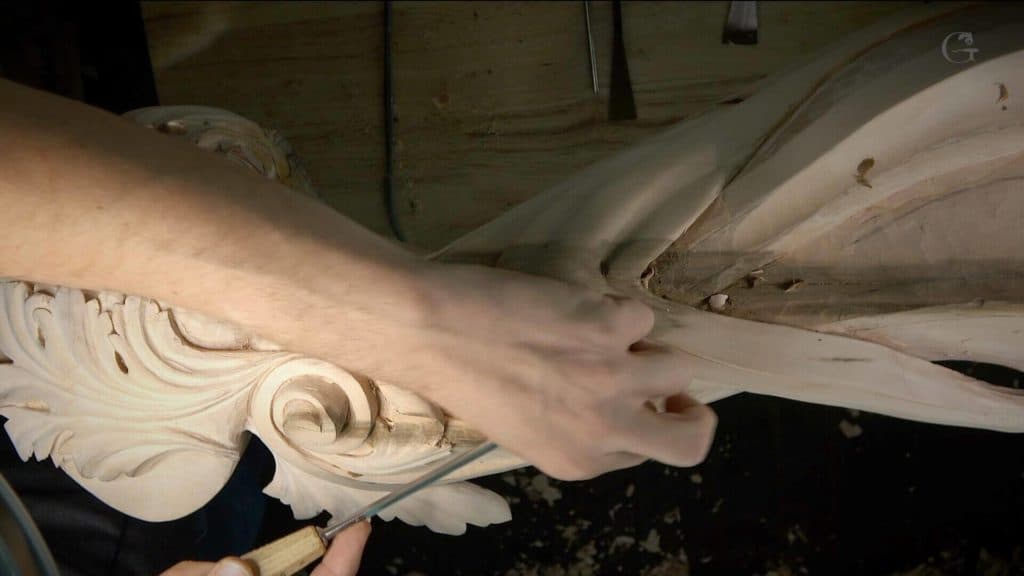
Alexander Grabovetskiy, woodcarver, School of Woodcarving · Published 2020
What does a wood carver mean by "straight down cuts"?
Quick answer: In workshop 12, part 2, of the beginner Curly Kitchen Cutting Board course, the meaning is stated: "When I'm saying straight down, that means it's without any bevel or maybe slight bevel. But straight down, it's a 90 degrees down cut." Part 9 of workshop 91 plans the words with a number 11.
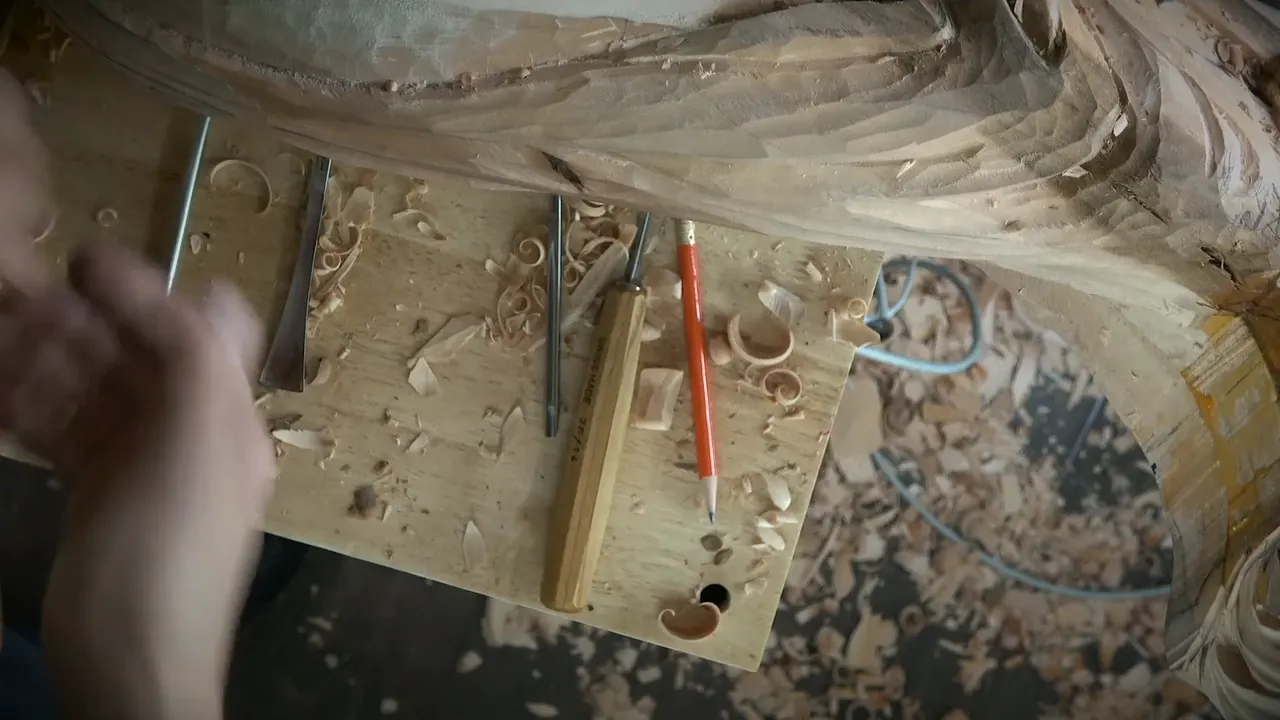

"Just straight down cuts." That line sits in workshop 91, part 9, of the Venice Room, right after a tool is named. Ever set a gouge on a drawn line and worried the wood past it might tear away? That makes the first stroke along that line matter to you. Part 9 gives a tool and a plan, and other lessons of mine fill in the rest.
What is the plan for the straight passes in part 9?
A plan, said aloud: "just pretty much straight cuts like this just to create those droppings." A tool follows in "So with the number 11", then comes the phrase that names this page. All three lines are plans. A short section is to be shown first, in "show you a section right here in this spot". Part 9 gives no definition of straight down, so the lessons below supply one.

Why are the straight passes planned off camera?
Many are planned for off camera, in "create that off-camera, those multiple cuts". A reason follows in "it's just not convenient to get with the camera", and a promise comes after it, "a lot better job" and a look at the final result. One view is shown anyway. "So that is how it looks if you would look right straight to it."

The first line of the part is "And I can make them a little wavy", and an apology follows, "I apologize if you can't see what I'm doing, but later on you'll see it". A need comes next, "Once I develop this side, I have to reposition completely", and then "That way you'll be able to see".

What comes after the straight passes in part 9?
Rasps. "And yes, I will use probably rasps" starts it, and "somewhat aggressive rasps" names them. Their job is "really nice and smooth movements". A limit is stated too: "I'm not going to create any more concave-convexes. It's exactly what you see."

Details stay few, for a stated reason. "I really don't worry about creating too many details in this case because that is going to be a paint job." The part ends on "I'm pretty much done with this section," then "a couple more details probably," then "Not more than that." Last of all, "So just enjoy."
Part 9 never says what straight down means. The lessons below do, one passage at a time, and the first is a knife lesson for beginners.
What does "straight down" mean in the beginner course?
Workshop 12, part 2, of that course spells it out. "When I'm saying straight down, that means it's without any bevel or maybe slight bevel. But straight down, it's a 90 degrees down cut." Earlier in the same part come "Remember, everything has to go to the center line" and "Just straight down".

A little bevel is fine too: "If you want to do a little bevel cut, just slightly beveled, it's going to be fine also." The grip gets a name, "I'm actually just using the grip like I would use a pencil when I'm writing". And the eyes stay on the blade, in "I'm keeping an eye on my edge, how deep my edge digs in".
What is a straight down pass for?
Following the drawing. Workshop 8, part 1, of the cutting board course overlaps leaves, with one running "underneath of this big leaf", and then the job is named, "just to follow the design". A little later comes "I'll cut away from myself, just helping with my finger".

Workshop 16, part 4, has "And on the side of those, I'll make another cut like this". Then the talk turns to you: "there is absolutely no limit to what you could do". And "it's up to you what you really want to see".

A reason is named outright in Roman Acanthus 4, part 3, "it would be much easier for me later on to find the original design". The tool line reads "Probably should use the same number 3 what I used before", and the next line names "number 7, the same half an inch" (about 13 mm).

Why does 90 degrees matter on a line?
In Lily Box 4, part 10, the aim and the angle come in one breath. "I don't want to lose my edge of the design," and then "like perfect 90 degrees. That way, I'm not going to lose it." The next lines name "the same number seven", and then "Make sure you don't undercut it".

Workshop 106, part 1, adds a cost: "I want to make sure it's at 90 degrees. I don't want to go in and undercut." Then "If I'm going to undercut, I'm going to lose this line and mess up overall picture, or overall design, I should say". "Number one" is the tool named.

A check with a square is named, then set aside. "Take a small square and check if you do have a 90 degrees this way or not. But I'll just eyeball it and carefully with number one and single bevel, I'll use in this case." There is also "You could use a double bevel. It's actually also excellent tool."
Fewer words carry the same reason in Venetian Flowers Rosette 2, part 1, "That's what I have to do for I wouldn't lose a boundary, right?" The plan there is "to place my number nine right on the line and start chopping". With a knife, Chamomile and Bow Rosette 4, part 1, says "Without angling. Toward the center."

How does workshop 130 describe an edge pass?
Workshop 130, part 1, names edge passes. "So nothing special, just chop around those future leaves," and then "what I'm talking about by edge cut, just to get number nine and remove some of the material close to the edge". The right angle comes as "Straight down, 90 degrees," and as "Straight down, 90-degree cuts, just like that."

A bigger tool is a maybe, "I could actually get even bigger, maybe three-quarters of an inch" (about 19 mm). Soon after, "And hit that little harder". Later in the same part, "And because I have that cut, so now it's a lot easier for me to see", and then "A straight down cut, what I'm talking about".
How close to the line does a straight down chop go?
Close, and not final. Over in Venetian Flowers Rosette 1, part 2, "That way I can get really close, not final on the line, but sometimes even pretty close on the line, but somewhat close to my design". Behind it sits "a lot easier to clean it". A tool line follows, "Same tool, number nine", and then "Like I said, I could use number 11 and get exactly the same result".

A mark can set the limit. Floral and Molding 1, part 3, says "I can remove some of that material with the straight down cut, but not beyond that point". Behind that point sits "it's going to rise up like that". For the job, "number seven", at "one inch and one-eighth of an inch, or 28 millimeters and a half".
The second part of Furniture Panel 21 holds depth back on purpose, with "right now" and "one-eighth of an inch" (about 3 mm) as the limit, and "I need some space for cleaning" as the stated need.

Another limit sits in workshop 120, part 1, where the plan names "number 11, and in this case would be 4 millimeters" (about 0.16 in). "But right here, I cannot go deeper than what you see on the opposite side. So it has to be about the same." Then "Maybe a little bit deeper than that area because there is a high spot and it goes downhill this way".

How hard do you push when you go straight down?
The panel lesson says no pushing: "I'm not pushing it. Okay? So I'm not pressing on my tool." A turn is named, "What I do, I still create a rotation movement", and "I still create the slicing cut, if you wish". Then "a lot less resistance".

Force has a downside with the grain. In Chamomile and Bow Rosette 2, part 1, "Just be careful because my grain goes this direction", then "chop too hard, I can knock down completely the whole thing".
In Furniture Panel 16, part 4, the grain is the warning. "See what just happened", then "It's not mistake. I'm not as deep, but keep an eye what the grain does." Then "if it splits like that, it can go inside of the finished part, which is supposed to be finished part", and "Just be careful, okay? Be really careful." The same part names "number eight or number nine", with "much easier to get to the final detail" as the reason.

Which tools take the straight passes?
Many do: a number 3, a 5, a 7, a 9, an 11 and a 1. Workshop 22, part 4, of the Venice Room, says "I'll use number three and a quarter inch" (about 6 mm). In workshop 145, part 1, it is "I'll take three millimeters. Number 11" (about 0.12 in).

Small tools pair with a clean view. In Lily Box 7, part 11, the pick is "a one and a half millimeter" (about 0.06 in). Next comes "let me clean a little bit my surface for those lines not distracting my view", and then "that way I can see exactly how I need to approach it". A plan sits in Furniture Panel 17, part 6, beside "number seven": "maybe I can right away hit with the number one, the straight line".
How does a straight pass help lower a section?
Workshop 154, part 2, needs a section down: "it has to be at the same level, whatever I have right there". The aim is "just chop little by little. About quarter inch deep at the beginning" (just over 6 mm). A check follows in the middle of that stretch, "The molding going to go below, so I'm actually safe to bring the whole section down".

Two more lines sit in that stretch, "I'm just double checking, people" and "I'm working on a live project, and I can't redo that". Part 3 of lesson 16 in the furniture panel course says "take a gouge, get a little closer to the design", and after it "make a relief, so it just pops right out".

When does a pass tilt?
A few lines say otherwise, right where a plan is spoken. Workshop 28, part 9, corrects itself: "Not straight down, but little undercut this way." A limit follows, "not much because, see, it's already moving".
In Chamomile 3, part 3, a knife is planned on an angle, "angle it slightly", and then "and I don't have to force it". And workshop 37, part 2, has a maybe for the edge of a future shell, "preliminary" passes, and then "Yes, I will undercut later on, but at least you should be able to see some of the results, what I've got".
Is a straight down pass a step on its own?
It leads into the next move, in the lines below. "Okay. And now I can clean inside" is workshop 22, part 4, right after "And exactly the same". Over in workshop 115, part 3, a tool is named, "Let me take number five, same tool I used before", and "approximate movement" is what it is going to give.
Workshop 120, part 2, goes "I've got an idea" and then "continue development", with "Number two, in this case, I've got 10 millimeters" (about 0.4 in) as the tool.
Workshop 135, part 3, puts "Doesn't have to be perfect, okay?" ahead of "So let me use number seven now". Then a swerve, "this side going to go underneath of that long leaf".
And workshop 145, part 1, says "I also need to relieve it", later in the stretch that names the number 11.

Which lessons say it, in one table?
Each row names the lesson and part, and what the lines there are about. Rows with only numbers are Venice Room workshops. Workshop 91 is the first row.
| Lesson and part | What the lines in that part are about |
|---|---|
| 91.9 | number 11 planned, with the many passes off camera |
| Cutting Board 12.2 | straight down with a knife, no bevel, 90 degrees |
| Cutting Board 8.1 | following the design, with leaves going underneath |
| Roman Acanthus 4.3 | number 3 first, then number 7, for finding the design |
| Lily Box 4.10 | number seven, 90 degrees, and no undercut |
| Lily Box 7.11 | a small tool, then a clean surface for a clear view |
| Furniture Panel 16.4 | numbers eight or nine, and the grain watched |
| Furniture Panel 21.2 | a depth held back, to leave room to clean |
| Venetian Flowers 2.1 | a nine on the line, to keep a boundary |
| Floral and Molding 1.3 | a stop at a mark, with no pushing |
| Chamomile 3.3 | a slight angle on a knife pass |
| Venice 106.1 | number one, a small square, and no undercut |
| Venice 130.1 | edge passes with a number nine, 90 degrees |
| Venice 154.2 | a nine, little by little, to lower a section |
| Venice 120.1 | an 11 of 4 mm, and no deeper than the other side |
| Venice 28.9 | a first idea of straight down, then a little undercut |
Is there a line on your own board that you would hate to lose? All of workshop 91 sits inside one tuition plan, with the other Part 8 workshops from Venice. Part 9 plans the passes, a round of rasps after them and a paint job, and ends on "So just enjoy". The corbel sits in the same wood carving lesson.
How it's done
- Keep the line. One Lily Box lesson puts the aim first, a line that must not be lost.
- Go straight down. The beginner course spells it out as no bevel, or a slight one, in a 90-degree pass.
- Stop short of the final depth. A panel lesson holds back from a set depth, to leave room to clean.
- Skip the push. A molding lesson turns the tool, and "a lot less resistance" follows.
- Watch the grain. Another panel lesson says to keep an eye on what the grain does, and to be really careful.
- Clean for a clear view. The Lily Box lesson cleans the surface so the lines do not distract the view.
Frequently asked questions
Where does part 9 plan the straight passes?
After the number 11 is named. The plan is for many passes off camera, with one section shown first. No angle is given for them in that part, and the lessons in the table below supply the rest.
Which lesson says what straight down means?
The beginner course, in its twelfth workshop. A pass straight down has no bevel, or only a slight one, and goes down at 90 degrees. A knife is the tool there, and a little bevel is called fine too.
Why keep a pass straight down on a line?
One lesson names the aim, "my edge of the design". Workshop 106 says an undercut would "lose this line and mess up overall picture", and it names a small square as one way to check the angle.
What to carve next
- Venice Room 91
- Venice Room Part 8
- Roman Acanthus 4
- Lily Box 4
- Lily Box 7
- Venice Room 106
- Venetian Flowers Rosette 1
- Venetian Flowers Rosette 2
- Chamomile and Bow Rosette 4
- Chamomile and Bow Rosette 2
- Venice Room 130
- Floral and Molding 1
- Furniture Panel 21
- Venice Room 120
- Furniture Panel 16
- Furniture Panel 17
- Venice Room 22