
Alexander Grabovetskiy, woodcarver, School of Woodcarving · Published 2020
What does a wood carver mean by "arc"?
Quick answer: In workshop 94, part 10, I say "let me explain S curvature" and then "if I have a movement like this and that arcs this way." Other lessons use it too, among them part 4 of Hashemi lesson 43, with "don't create just a really true" and "arc. Just as much as possible waviness."
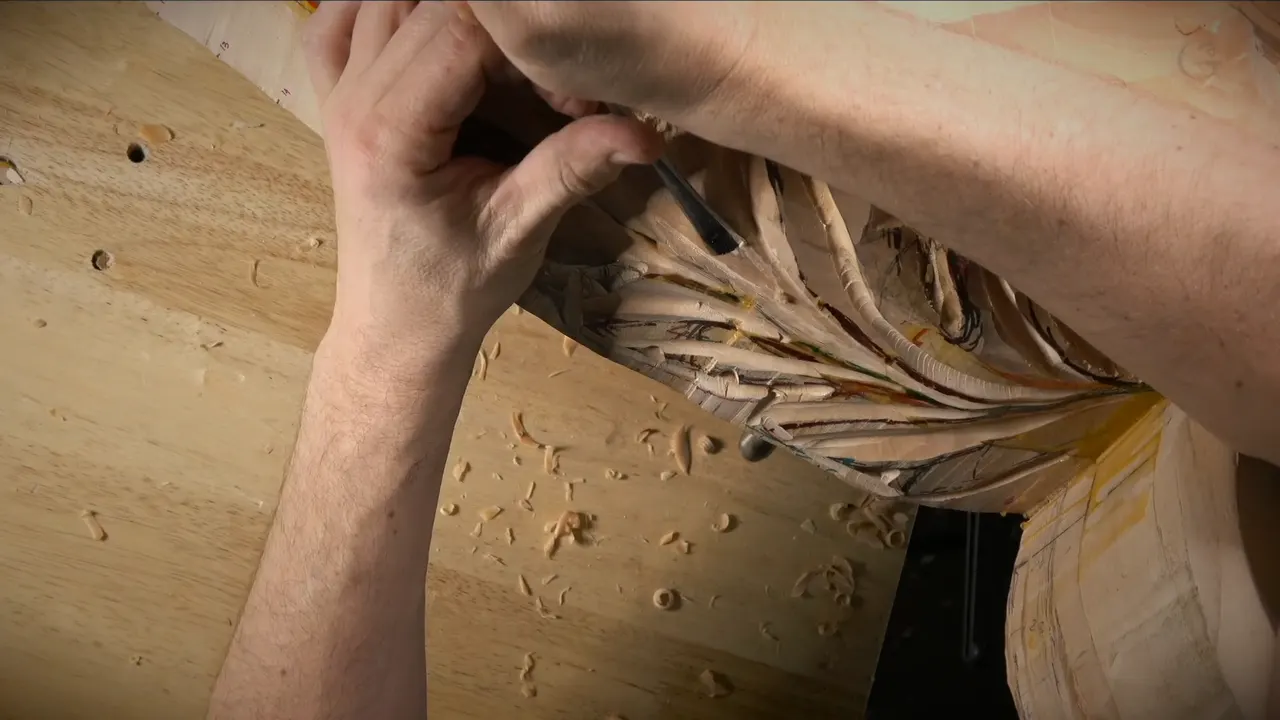

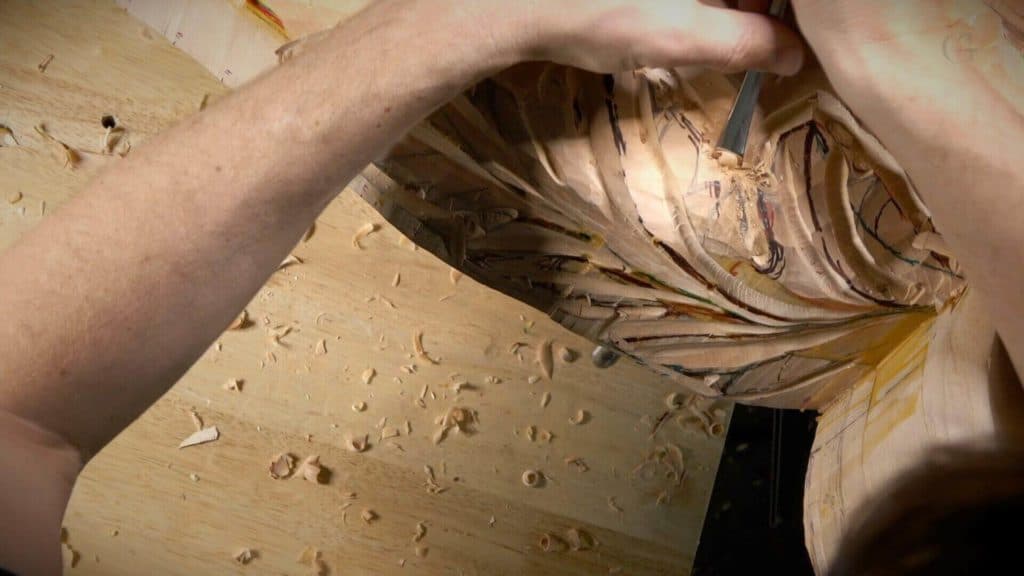
One stretch of part 10 in workshop 94 holds the word "arc", and several of my other wood carving lessons use it too. This page reads part 10 first and then each of those lessons, line by line, with the work around the word.
Ever look at a curve and wonder which way a second curve should bend beside it? That is what part 10 shows with its S curvature. The lessons after it show the same word with other work around it. Every size is given in millimeters and inches, my own figure first. The arc has its own Wikipedia page.
What comes before the arc talk in part 10?
Tools come first in part 10. The opening plan is "use probably just the Back-bent", then "and clean up" and "the movements and so on, that would be really nice." Another plan is "I could use just probably the number seven". Next is "and some of the areas I can make it really nice and smooth."

The divisions follow. "So there was one division I almost lost already and there was a second division" is the line, and "right, and there is going to be another one" comes after it. Further on I say "movement this way and this is going to go that way" and "And now I can actually make it nicer." Small divisions are named too: "then I still going to have small divisions and inside" and "it's still going to have some small divisions on inside."

Where does part 10 use the word arc?
A short talk on the S curvature holds the word. "let me explain S curvature" starts it, and "if I have a movement like this and that arcs this way" is the next but one. The line after that is "So the curvature supposed to follow."
I go on with "So I'm talking about if you have an arc". The talk then reaches "on this small section, you know, it's arches just this way" and "which means that S curvature supposed to be that way." The section stays open: "I don't know yet, but definitely I think I want to do right here."

Which tools and sizes follow the arc talk?
A size comes next: "let me use a smaller number, 11 five millimeters" (about 0.2 in), with "and create a little nicer outline" and "in this direction." A number 11 Veiner shows up in "number 11 Veiner and five millimeters and create one more cut" (0.2 in) and "And that is good."

More plans wait in the part: "I can probably chop with the same tool in this area too" and "And let me also create a nicer outline in this area." I say "I am going to use the number seven and 14 millimeters" (about 0.55 in), then "I'm going to create cut just like that."

A result is named in "So it's going to give me a really nice" and "beautiful curvature." The waste comes next: "let's get rid of some of the waste." A last plan is "may also use the same number seven in this section and I can rotate my tool" and "opposite direction and create the S-curvature also in this section." There is also a curvature page on Wikipedia, if you want to read more.

Which Venice Room workshops use the word arc?
In part 1 of workshop 94 there is more. "and that's going to create like almost like an S curvature" comes first, then "so it's not going to be" and "just a single arc". After them come "But even in an s curvature" and "I have to make the decision where the movement going to change the direction." Then "So one arc going this direction and another one in this direction" follows. A little later I say "Here's my arc" and "Well, arc number one."

"And of course, I need to blend" and "now, the middle part and all that glue has to be gone" sit in part 7, ahead of the word. The word shows in "I don't want to destroy my middle line because it has a really nice arch or arc". The phrase in part 9 is "like arc movement or arch."
The lines in part 2 of workshop 95 are "this line the middle line and the curvature of a leaf or this part" and "its actual arc, just like that, Ok just like this." After it come "to repeat that movement so it cannot go on the opposite side" and "So it has to repeat this side." Its size line reads "number seven and 14 millimeters, half an inch."

In part 5 of that workshop I say "Though it's not convenient for me" and "to draw that, but I also want to give some kind of arc" and "and may begin to change the point, where is that going to end?"
For workshop 45, part 7, the word comes before a change. "Okay, so in the flow" and "even the position of the point" and "makes the big difference in my opinion" come first, then "it's just like an invisible arc,". The plan is "I'm going to chop this out,".

Over in workshop 56, part 12, the word sits beside an end point. "But I also have to be logical how far this is going to extend" and "from this point, I'll find some middle spot and just" lead to "try to draw invisible arc." The stretch closes with "And right there, it falls right here."

A shadow starts the word in workshop 59, part 11: "but it casts" and "a wrong shadow." "Now I fix that shadow. Let me think" comes next. A size follows: "14 millimeters I'll try first and just" (14 mm is about 0.55 in), followed by "get a little more pronounced arc."

The size in workshop 105, part 2, is "about 20 millimeters" (a little under 0.8 in). After the size come "And I don't want to make it straight cut" and "It has to be gradual movement, more like" and "arc, if you" with "wish to say that. Just really smooth and nice" and "transition, not just a straight down cut."

In workshop 149, part 2, there is "gradual. So it's going to go all the way down this way." Next is "So if you look from the side, it's also going to arch" and "Okay? Or arc, whatever you say" and "arc or arch. But anyway, so I need to start" and "lowering that down." A tool plan is "maybe number" and "three."

Which lessons of the Principles of Design course use an arc?
Design principles lesson 4 has the word in a talk about movement. "See that arc" and "See that movement" come first, and "That movement continue the main movement" follows. In the same stretch I say "I call that movement as a letter S" and "It still supports overall idea,".
"Now, in my case, overall movement goes that direction" is the next line. Further lines are "There's also another rule, we call it Law of Repetition" and "We repeat the movement on a different scale" and "I've got the main arc going that direction on the Baroque diagonal." The Baroque style has its own Wikipedia page. The stretch ends with "In this case, it's also arc, but look what happens."
Later in the lesson come "That is the letter S because it supports the main movement" and "So should I put my arc right here or should it be on this side" and "Absolutely on the bottom" follows it. After them come "And why do we do that letter S" and "To support the big idea."
Another talk in that lesson has "See, that arc, that curvature, that movement is a long one" and "This one is a smaller one" and "That one, even smaller one." Before them are "let's say even just when we're talking about the Arc" and "Curvature, it's supposed to repeat."

What do the Furniture Panel lessons say about an arc?
Furniture Panel 8, part 2, speaks of nature. "In nature, in a creation" and "you can't find any straight lines" come first. Then "Everything has an arc or a sweep or" and "a curl" and "or curves or arcs."

How do the Hashemi and Floral and Molding lessons use arc?
Hashemi Flowers 43, part 4, puts the word beside a drawing line. "please do as wavy as possible" comes first. Then "but even when you draw, don't create just a really true" and "arc. Just as much as possible waviness." The tool is "And I'll use number 16 V tool,".

Further on in that part the word is about height: "What I'm saying lower, for example, if my arc is kind of high right" and "half of this arc." Another line is "I shouldn't even say it's arc because" and "some of them not even" and "looking like arc."

Floral and Molding 7, part 2, reads "But again, right now it looks like a straight line" and "and it doesn't look good." The advice is "just try to avoid" and "Straight lines. Okay" with "arc or whatever, the arabesque,". molding has a Wikipedia page too.

In lesson 13 of that course, part 2, a number 11 is named in "to use number 11, just because when you look from the side,". Next come "movement, not just a straight line, if you wish, if you would just use a straight" and "down cut."
After those come "It still has to kind of movement like arc" and "if you wish. Exactly the same arc what is on inside" and "you're recreating on outside. And with the number 11, just".
Where do the Lily Box and Grape Onlay lessons use arc?
Lily Box 3, part 6, starts with "don't like overall movement of this side." Ways follow in "A couple ways I could do, of course, I could find, again" and "a bigger gouge" and "and just create the perfect" and "the perfect arc." The line after them is "I can just eyeball it and just use my judgment."

A check follows in part 6: "Little better" and "Although a marker, in this case, doesn't help because it penetrates." Later still comes a corner: "this corner. Well, it should not be a corner, by the way" and "It should be, again, like an arc transition."
Elsewhere, Lily Box 4, part 11, has the word: "Again, I am looking at the" and "three-dimensional" and "tangency, from this point all the way to" and "that point. I have to see the real nice arc." Then "Let me give a" and "first cut."

In Lily Box 5, part 7, the line is "arc this way." After it come "But it's not necessarily going to stay there" and "We'll see how we're going to develop it."
Over in Lily Box 7, part 7, "Now it just blends nicely. And all I have is" leads in. Then come "I don't know if you can say that arc blend" and "of course, it's three-dimensional arc, but there is" and "smooth arc." It ends with "I should say, if you look at the three dimensions, it has a nice" and "curvature. Okay."

Grape Onlay 4, part 1, has "Now, like I said" and "before, I don't like to see any straight lines" and "and this motion looks like little too straight for me." The plan is "Okay? So I'll create some kind of arc, okay" and "I'll just go right underneath of those two guys" with "and excavate somewhere like right like this."

In Grape Onlay 9, part 1, I find "the main line and the main line of this leaf" and "I would like to just, uh, create the same movement" and "going downhill." The following lines are "so this arc" and "gonna go that direction again, doesn't really have to" and "to follow those rules if you feel like that's too much." The last line is "Just get the overall motion. Okay?"

Chamomile and Bow Rosette 2, part 3, carries the word beside a line on a leaf: "Although I did not keep that line like a straight" and "arc. I did some waviness" and "looking a lot more natural." Then "Just a slight waviness."
Lesson by lesson, what sits beside the word?
| Lesson | What sits beside the word |
|---|---|
| Venice Room 94-10 | A short talk about the S curvature |
| Venice Room 94-1 | A single arc and an S curvature |
| Part 7, workshop 94 | A middle line with a nice arch |
| 95-2 in workshop 95 | The curvature of a leaf, its arc |
| 95-5 of workshop 95 | Not convenient to draw, but an arc |
| 45-7 in workshop 45 | An invisible arc and a point's position |
| Part 12, workshop 56 | An invisible arc drawn from a point |
| Workshop 59, part 11 | A number seven for a pronounced arc |
| Workshop 105, part 2 | A gradual movement, smooth and nice transition |
| 149-2, from Part 13 | Going up, then down, and an arch |
| Design Principles 4 | A main arc and a letter S |
| Furniture Panel 8 | An arc, a sweep or a curl |
| Hashemi Flowers 43 | A high arc beside a low arc |
| Lily Box 3-6 | A bigger gouge, or just eyeball it |
| Grape Onlay 4-1 | And excavate somewhere like right like this |
Is there a curve on your own piece that has no second curve beside it yet? Everything in this lesson sits inside one tuition plan, and more Venice Room workshops wait on the Part 8 course page. For furniture work, start with the Furniture Panel course. For acanthus with a gouge, chisel and mallet, start with workshop 94.
How it's done
- Give an example. "again, I know I already tried, but for example, let's see" comes before the example in part 10.
- Keep the section open. "I don't know yet, but definitely I think I want to do right here." is the line for the section.
- Pick a number 11 for the outline. "and create a little nicer outline" follows that plan, with "in this direction."
- Pick a number seven for the curve. "beautiful curvature." follows the number seven plan.
- Turn the tool for the last section. "I can rotate my tool" is the plan for the last section of part 10.
Frequently asked questions
Where does part 10 name the divisions?
"So there was one division I almost lost already and there was a second division." is the line. Later comes "And now I can actually make it nicer."
How does the Hashemi lesson treat a high arc?
"What I'm saying lower, for example, if my arc is kind of high right" comes first, and "half of this arc." follows. The same part has "I shouldn't even say it's arc because".
Which line in Chamomile and Bow Rosette 2, part 3, mentions waviness?
Part 3 has "arc. I did some waviness," and then "looking a lot more natural." The same part has "Just a slight waviness."
What to carve next