
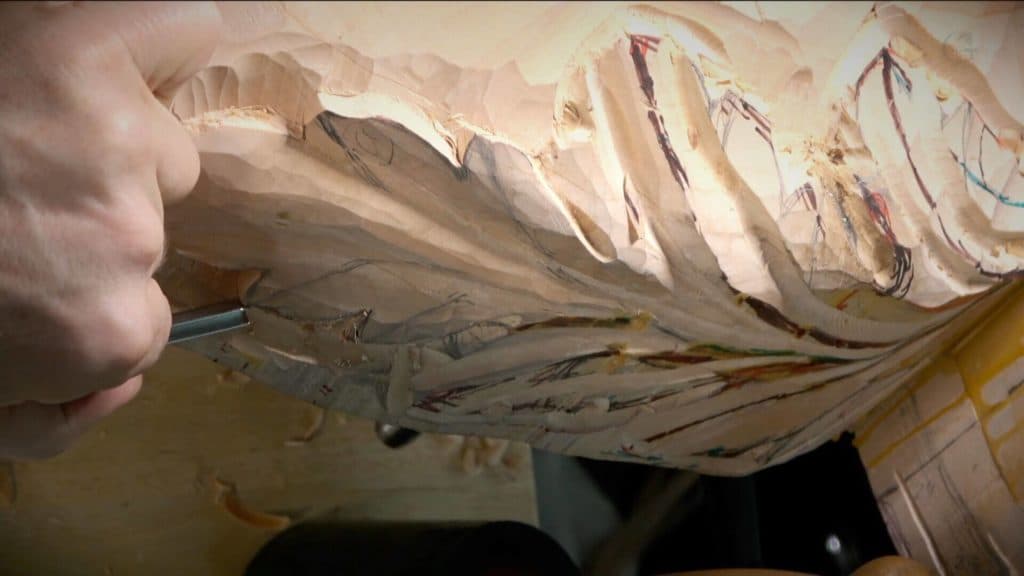
Alexander Grabovetskiy, woodcarver, School of Woodcarving · Published 2020
What does a wood carver mean by "the wall"?
Quick answer: A wall is the side of a carved shape that I work toward. In workshop 94, part 11, my line is "Again, I'm still working with the wall." The second Greek lesson, part 4, adds the cue "exactly 90 degrees". Other lessons use the word for a side I leave for later, or for a section I plan to remove.
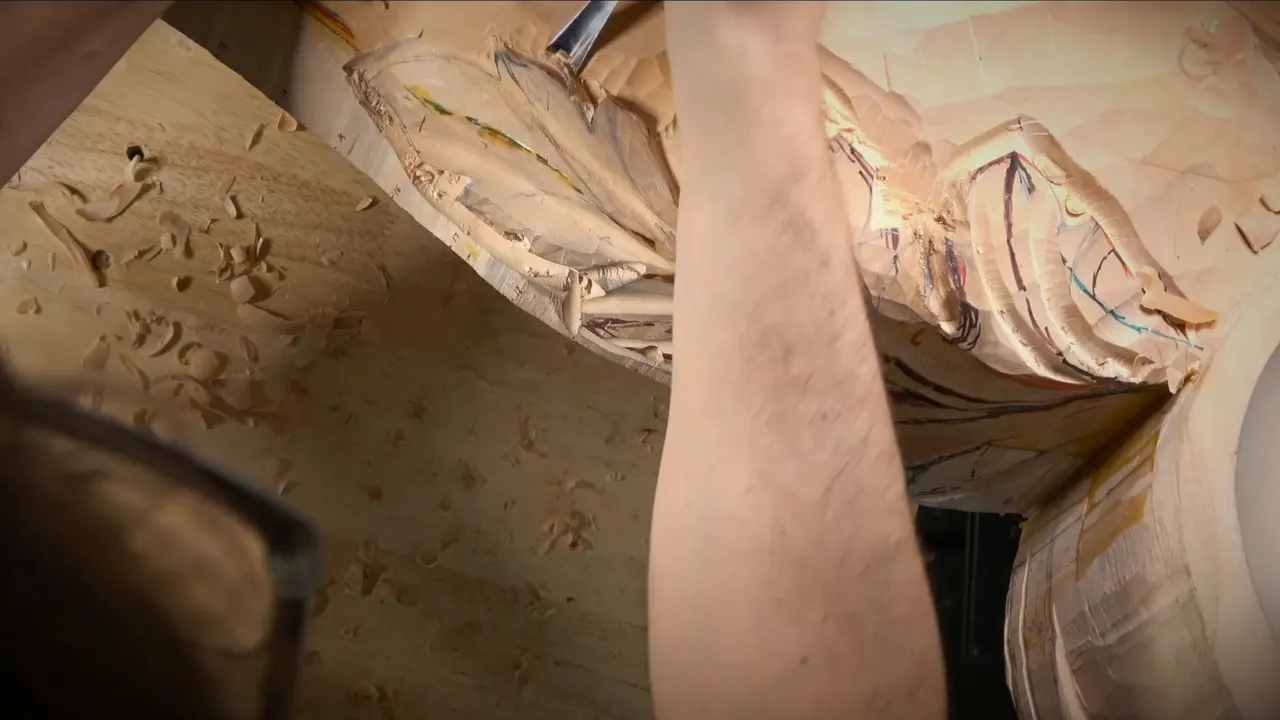

My word wall, in workshop 94 part 11 and in many other wood carving lessons, means the side of a carved shape. This page reads part 11 first. Then it goes lesson by lesson through the places where the same word turns up, with the line and the work around it.
Ever stood over a hollow you dug and wondered what its side should do next? That is the spot where part 11 starts, before any undercut. Sizes are given in millimeters and inches, my own figure first. Wikipedia has pages on the 90 degree angle and on the gouge, which are worth a look.
What comes before the wall in part 11?
Depth opens the part. "And yes, like I said," opens it, and "10 millimeters down," (0.4 in) finishes the thought. Next comes a second figure in the very next cue, "the final depth right now, I've got about six millimeters," (0.24 in). After that comes "so I'm safe actually can dig a little deeper if I wanted to." The stretch ends flat with "But as of now, it's just straight down."

Next comes a plan for another pass. "I will add some more micro" is the start, and "concaves and convexes in those sections" completes it. Two short lines sit between that plan and the next, "Just slightly later" and "before I undercut,". A tool plan arrives after them: "in this case, I could use a bigger like number 4, I would say" and "and maybe even five."

Where does part 11 use the word wall?
Three places. One is "Again, I'm still working with the wall" with "I'm not undercutting yet" right behind it, plus a reason: "because I still have to establish micro-movements on the inside." A forecast rounds off the group, "But as of now, I'm getting an idea what's going to happen later."

Another is a size. "the quarter inch, create the wall, but quarter inch," is the cue, and "later on, they're going to blend everything soon" is the next (a quarter inch is about 6 mm, my own pair). Tools were named earlier, "Also, use number seven and 14 mm" (0.55 in), and a few lines later comes a plan: "I'm going to use number 11 for undercutting." The lean is "I'm going to lean in little inward" and the size is "it's going to give me about a 4 mm cut" (0.16 in).

The last turns up later in the part. "And I'll go right now about six mm about quarter each" is the cue, and the cues "in the final depth" and "10 millimeters" follow. My plan for getting there is "I am going to draw a line perfect line on this side." After it comes "And bunch cuts like I did previously, creating the form all the way to the wall." Then the part says "I can achieve that final look."

How do the numbers in part 11 fit together?
Two figures stay in view. Ten millimeters (0.39 in) is the final depth, and six millimeters (0.24 in) is where the part stands at the start. One more pair is "full Three-eighths of an inch 10mm" (3/8 in is about 9.5 mm, so the 10 is my rounding).
Tool sizes ride along with those depths. "Maybe number five" and "and thirty-five millimeters" (1.4 in) are the big pair. A different number five plan reads "but about Seven-eighths of an inch or so" (22 mm), and "Create S-curvature" follows. A number three gets its own size: "I'll use number three, but a little smaller" is the plan, with "Like maybe about" and "Three-quarters of an inch" (19 mm) after it.

What else sits near the wall in part 11?
A bump does. "I do have a little hump in this section," is the line, "so which is somewhat Ok but not too appealing" follows, and my plan is "I can take the same number seven" with "and maybe just right on top and get rid of." The cue "That hump" ends the thought.
Glue gets a line of its own: "upside down and get rid of that glue" and then "because I didn't want to save on glue." Grain gets one too, "working against the grain" and "do anything, you know, with the grain right now." My verdict is "And that is absolutely Okey with me" and the next cue is "if your tools really sharp You shouldn't have any problem." Read about grain or glue on Wikipedia.

Feel gets a few lines. "OK, so I kind of like overall feel" is first, then "even I don't have 100 percent like a smoothness, which is Ok at this point,". Two cues that sound alike come next, "And it does look good, in my opinion" and "it does look good." "So make it really nice and curly" belongs to a number seven of 14 millimeters (0.55 in).

An outline gets named as well. "That's good. that gave an outline," is the first cue, and "they know exactly" comes a little later. Right after it, "The boundary. They can check out some of that" closes the thought, and the tool for the plan just before it is a number five of 35 millimeters (1.4 in).

Which lessons call the wall a straight-down side?
Greek Acanthus 2, part 4, has the plainest definition. One line is "undercut everything. So we're going to establish the straight down cut." Soon after, "It's called a cut" and "The wall is going to be", followed by the cue "exactly 90 degrees". Two tool cues come next, "number seven" and "20 millimeters, and I can see" (0.8 in). Later in the part, "that's called a wall cut" repeats the name.

The same part gives a second look. "degrees wall left. You can see that is a 90 degrees right" is one cue, and "here, and there is a wall, straight down cut" is the cue after it. Its final line is a plan: "So later on, we're going to undercut it and establish more details".

In Greek Acanthus 3, part 4, the wall meets a second piece. "So my 90-degree wall" opens the stretch, and "overlapping" closes that sentence. Two more cues follow, "a wall, like I said before" and "like a straight-down wall. So and that wall will".

For Furniture Panel 18, part 6, the line is a check: "I really want to see if this wall has a 90 degrees." One tool is named, "number 23", and a way to use it follows, "And create your 90 degrees wall that way" plus "if it needs to be little higher."

Part 4 of workshop 90 has a slope beside my wall: "slope, so my cut, my wall is going to be 90 degrees" and "go in, 90 degrees inside like this." Over in workshop 97, part 10, the lines are "What I'm after, I'm just establishing wall" and "that surface versus my wall, about 90 degrees." The same part adds "But for now, I'm just establishing boundaries."


In workshop 88, part 1, the wall comes with a plan. "But I can get really close to the design" comes before "and create really nice wall without undercutting." Then "later on, I will undercut" and "But not much" end it.
The Dining Table Apron course gives a reason in workshop 8. "And the reason why I'm using just a single beveled" is first, and "chisel in this case, because I need to establish" continues, and "a wall, how I call it" ends it. Anyone curious about a bevel can read that page too.

Where does a wall stay standing for later?
Corinthian Acanthus 5 opens with a plain definition of the word. "the wall. That part is actually called wall right now because" starts it. The next is "the cut, what we did, it actually was straight down" and the word that completes the thought is "undercut." Wikipedia explains acanthus well.
Plain words sit in workshop 9, part 9: "I'm not going to work this wall yet. Okay" and next "So if you know what I mean, that thing is called wall". A reason follows, "I'm happy with the overall development, okay,".

Grape Onlay 6, part 1, leaves a wall beside a leaf. "I am not gonna touch my left hand side leaf" is first, and "but it has a curl, it just curls back" is later. The reason is "So that is why I am leaving a wall" and the result is "So I'm not doing anything to this side yet."

Old work shows up in workshop 47, part 12. The stretch starts with "stone carvers and wood carvers, especially stone carvers" and a few seconds later come "they left the wall. And that's what I call" and then "wall right here." Beside those sit "So that space right here" and a plain verdict, "They did not undercut. Okay?" Then comes "They did maybe little bit, but not much."
Over in workshop 52, part 10, a kind of undercut has a name. "Lots of people, they just do almost a straight cut" leads, then "We call it wall undercut. It's almost straight down" and "almost 90 degree, just a slightly angled little bit, okay?" A benefit is listed too, "really strong, but it's much faster".
In furniture work, Furniture Panel 16, part 5, has "I mean, the wall I'm talking about. I want to keep the wall." Just before it comes "We want to keep it." Just after it come "And approaching the corner" and "but got to be careful."

When is the wall something to remove?
Blunt words show up in workshop 73, part 6. "good. I really don't want to see this wall, and that is actually" is one cue, and "this section called wall" follows. A little later, "I'll try to remove" is the plan. Another stretch has "this wall on the inside" and "so I don't want to mess up" and "So it's supposed to be really clean undercut."

The Roman Acanthus course names it in lesson 16, part 5. A small gouge opens the stretch, "small gouge. This is number five again" and a complaint follows, "how my sides,". After that, "right on the wall. So that is the wall, what I'm" and "talking about. This is a wall." The fix is "And I'm creating just a slight concave in it."

Floral and Molding 7, part 3, gives an amount. "how much wall I'm leaving," is the question, and "it's about maybe just no more than 1 millimeter" is the figure (1 mm is 0.04 in). Later "one millimeter wall" appears again.

What happens when you dig into a wall?
Digging into a wall earns a warning in Furniture Panel 17, part 2. "when you dig inside the wall, you create a" starts it, and "scratch or tool mark or cut inside. Okay" ends that sentence. Two consequences are listed, "It's not going to look as a solid wall" and "So it's going to have that cut line." A conclusion closes it: "So that's why it's not my preferred".
The idea returns in workshop 105, part 2, with a size. "Because when you carve, you dig inside of the wall," opens the line, "and I have approximately three millimeters from" (0.12 in) is the next, and "to my cut, so which means I just have a safe zone" wraps it.

The kitchen board gets a line in the beginner course, workshop 7, part 2. "that this side, this wall, I would call it," is the cue, and "3/32nds" (2.4 mm) is the next. "down. Okay? Approximately 3/32nds" wraps it up.

Walls can lean, too. In Furniture Panel 38, part 2, the cues are "and my stabbing cut is slightly, uh, angled" and "I really wanna see some kind a wall right there,". The third is "which is the angled wall." The last two are "but slightly, slightly angle it that way" and "It's gonna give me a wall. Okay?"

Lesson by lesson, what stands next to the word?
| Lesson | The words around the wall |
|---|---|
| This part, 94-11 | Working the wall, with no undercut yet |
| Greek Acanthus 2 | The name "wall cut" for a straight-down side |
| Third Greek lesson | A wall against the piece overlapping it |
| Furniture Panel 18 | Looking to see if this wall has 90 degrees |
| Workshop 90, part 4 | A slope inside, with my wall at 90 degrees |
| Part 10 of 97 | Establishing wall and boundaries for now |
| Venice Room 88 | Really nice wall without undercutting yet |
| Venice Room 9 | Not working this wall until the overall development |
| Grape Onlay 6 | Leaving a wall beside a leaf I have not shaped |
| Forty-seventh workshop | Walls left by old carvers |
| Fifty-second workshop | Wall undercut, almost straight down |
| Part 6, workshop 73 | Plan to remove a wall, and a really clean undercut |
| Floral and Molding 7 | Leaving about one millimeter of wall |
| Furniture Panel 17 | A scratch or tool mark left in the solid wall |
| 105-2 in Part 9 | About three millimeters from the edge, a safe zone |
| Beginner course 7 | This side, this wall, about 3/32nds down |
Is there a hollow on your own piece with a side you have not touched yet? Everything in this lesson sits inside one tuition plan, and more Venice Room workshops wait on the Part 8 course page. For relief work with a chisel and a mallet, start with workshop 94. Wikipedia also explains shadow, and the first Venice Room course opens at its own page.
How it's done
- Name the depth. "10 millimeters down," comes first in part 11, and "so I'm safe actually can dig a little deeper if I wanted to." follows.
- Hold off on the undercut. "I'm not undercutting yet" follows the wall line, and "micro-movements on the inside." comes after it.
- Plan the undercut with a number 11. The plan for part 11 reads "number 11 for undercutting."
- The hump gets a number seven, as a plan. "I can take the same number seven" is the plan for the hump in part 11.
- Plan a line to the wall. "I am going to draw a line perfect line on this side." comes before "all the way to the wall."
Frequently asked questions
How deep is the final depth in part 11?
Ten millimeters (about 0.4 in) is the figure, in the cue "10 millimeters." that follows "in the final depth". Earlier in the part comes "I've got about six millimeters," as the starting point.
Which Greek lesson puts a wall against another piece?
Lesson 3, part 4, where the cue "overlapping." comes six seconds before "The idea is to create" in the same stretch.
What does workshop 73, part 6, add about a wall?
The cue "this section called wall." comes first, and the plan after it reads "I'll try to remove".
Where did old carvers leave a wall?
What to carve next