
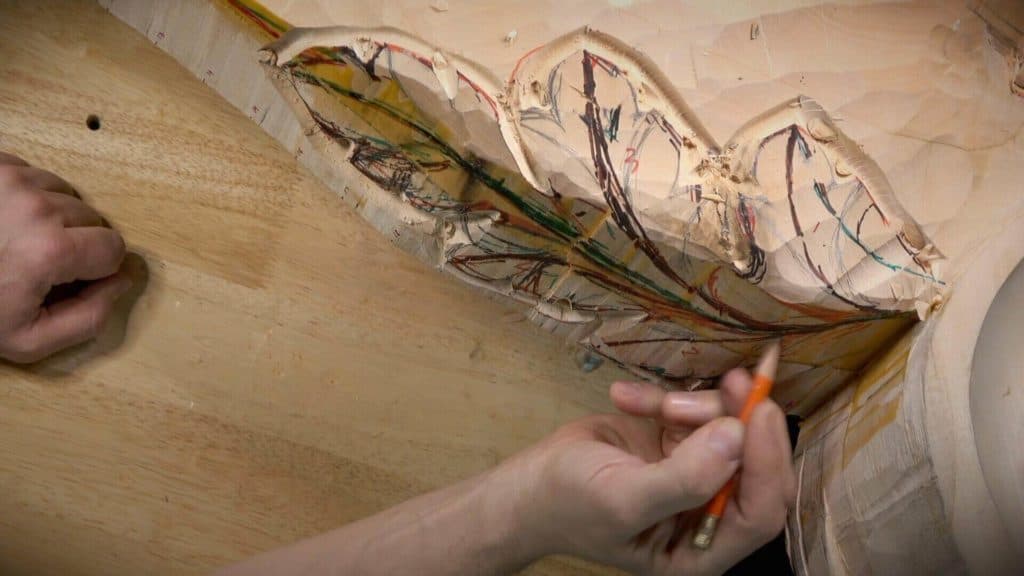
Alexander Grabovetskiy, woodcarver, School of Woodcarving · Published 2020
What does a wood carver mean by "a smaller scale"?
Quick answer: In part 5 of workshop 94 the phrase ends a line on curls. In my other lessons the same words sit beside a repeated detail, another leaf, a smaller tool and a small skew. Each stop has a link, and the table at the end sets them side by side.
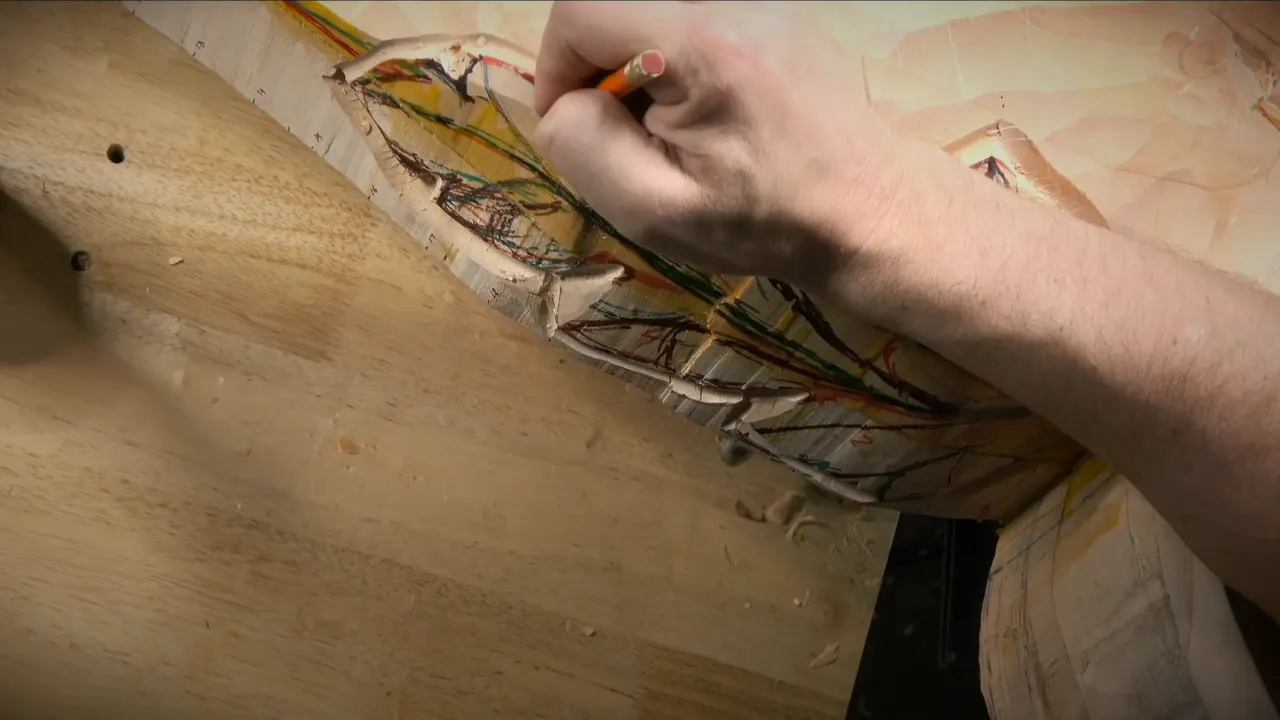

Part 5 of workshop 94 ends a line on curls with the words "on a smaller scale". My other wood carving lessons use the same words beside a repeated detail, another leaf, a smaller tool and a small skew, with a line of mine at each stop.
Ever drawn one curl with a pencil and then had to draw its twin to fit a tighter space? Can you tell, with your eyes shut, what a change of scale does to a shape? This page will feel familiar either way. It starts in Venice Room 94 and visits fourteen more lessons. Every size here comes in millimeters and inch, my own figure first.
What leads into the phrase in part 5?
Curls come first, ending with "it's going to give me that curliness". Then the line closes: "But it's going to be on a smaller scale, I should say."
Which words in part 5 name the grain and the two planes?
The part opens with a warning on grain: "careful because the grain direction is all over." Then "We're talking about two planes." Right behind it, "Again, this is one plane and that is another plane."
Here is a plan: "what I'm going to do just because that's a huge piece and I really want to establish curly movements, in each of those main five divisions". Later comes "I'm happy with this part."

Which lines plan the triangles?
The plan opens with "Let me jump right now, right here,". A need sits beside it: "I need to create middle lines of the main separations".
Another plan names the tool: "And I'll take again, number 11-10mm and relief those triangles just like that." Ten millimeters (0.39 in) is the size. One more plan reads "I'm going to make it curly".

Which kind of acanthus is this?
Elsewhere in part 5 sits "And again, what I'm doing, it does not apply to all of acanthus in history there is lots of different acanthus." Right behind it, "This is just more like Italian Venetian style." See acanthus for the ornament itself.
One spot gets its own remark: "But I do have like a weird looking area, which means I can give an extra movement this direction." Beside it sits "And that's gonna look really good, at least on this side looks really good." Another side stays alone: "And I'm not going to touch this side, although I could I could use just the skew and land that little bit nicer."
How does part 5 place a point by eye?
It begins with "And right here, the same idea." After a plan, "let me. Do one of them," comes "and again, of how I determine the point". Then "that points should fall about that, the golden ratio." Also "And yes, I just eyeballed that." And "it's not that complicated". It ends with "If you used to golden ratio, it just comes naturally to you." The golden ratio is the ratio that line points to.

The other side gets "same idea, and the symmetrical counterpart". Before long, "This side doesn't look like it's falling anywhere," and a plan, "maybe going to skip one of the sides". Next, "if you know the fibonacci sequence." Its count runs "one, one, two, three, five, eight and so on." See Fibonacci for the sequence.
What do the pipes get at the end of part 5?
Late in the part: "I like the main shape." A need follows: "now what I have to do, just want to concentrate on exaggerating my pipes whenever I see an eye, I have a pipe."

Part 6 of the same workshop holds "So that's going to give me that three dimensional look. It just like opens up." The same part warns "I have to be careful not to hit my middle line," and adds "so important not to lose" and "not to lose it." One more line there: "just like really nicely tapering."
Where does the phrase sit in Venice Room 41?
In the Venice Room 41 lesson, part 6, it sits beside columns. The line starts "And I love that element, what I'm using right now because, in the future on the corbels,". It goes on, "on a little smaller scale, not on the corbels, but below the corbels," and plans columns there: "they're going to have about the same movement."

Next, "And by the law of design, you have to repeat. There's one of the laws, like law of repetition." A figure follows in "Number 11 in four millimeters, that's what I'm using." That is 0.16 in.
Soon the talk turns to repeating: "If you've got one part, some idea, you have to repeat that somewhere else." Then on who looks: "And most of the people are not going to catch it, but in my case, there's going to be some professional people looking at it." And "I'm talking about architects and designers who are involved in the project."
What goes beside the phrase in Furniture Panel 14?
Spoken aloud in the Furniture Panel lesson 14, part 4: "Maybe I could, and I think I should, repeat the same detail," and next "on a smaller scale right here." Behind it sits a note on the ornament: "Again, that is just acanthus overlap." Then "I know it's a really small detail. No, that's not the volute, okay?"

The spot gets "maybe that way a little bit just to fill the space." Also "maybe couple movements right here to make some curliness." "Wonderful." closes the stretch.
What sits with the phrase in Butterflies 10?
The Butterflies lesson 10, part 3, reads "We're going to do exactly the same what we've done on the previous one," followed by "on a smaller scale." After it: "And the idea is I want to create the same effect, the bigger cut and a smaller cut."

"But those guys are bigger in case with the first butterfly and much smaller on the second one." Two doubts sit together: "Maybe this one is actually a little too big." And "Maybe not, maybe it's all right." The curl reads "I also going to create multiple cuts right inside my previous cut just to give some curl in this."
A look at the board: "So yes, what you see right now, just a mess, my pencil mess."
Which leaf joins the phrase in Butterflies 4?
Over in the Butterflies lesson 4, part 3, the first line is "I'm looking for a tapering effect." Then "some kind of tapering. Okay. So which means this part is wider than here."

Then the phrase: "And on a smaller scale we're gonna have another Leaf right here." Last, "Curly details which is gonna repeat on its own once it's done. It's gonna look nice."
How small is a step in Grape Onlay 8?
The Grape Onlay lesson 8, part 2, gives the size as "just approximately, you know, one mil, one millimeter at a time." One millimeter, 0.04 in, is the step. Next, "I don't wanna break what I worked on before, carefully".

Here the phrase reads "on a smaller scale, I'll just attack, you know, those subdivisions parts." A size is named a little earlier, "two and a half millimeters" (0.1 in). Right after, "Number 11, it's still number 11."
What is the same idea in Gibbons Maine 18?
The Gibbons Maine lesson 18, part 2, has "Just on a smaller scale." Then a wish: "and I would like to probably create another cut." Also "another paddle."

A sister line sits in part 1 of that lesson: "if you gonna get the idea of this one you will get All of them obviously in a smaller scale." Close by, "It's gonna be a lot less petals." A figure sits in the same stretch: "about 10 millimeters" (about 0.4 in).
What goes with the phrase in Acanthus over Moldings 6?
The Acanthus over Moldings lesson 6 opens part 3 with "Again, those are just the preliminary shapes." Also "I've got too much mess going on." Right after it comes a look at the whole: "But you should be able to detect overall. You know, how it looks that's what I'm after."

The run: "Concave convex concave and then it goes." The run goes on: "Downhill exactly like what I showed right here." Later, "So we're just gonna be right there on the bigger scale. It's gonna happen on a smaller scale all around."
Next: "Okay, and yes, I mean now I can just have some fun with them." Later, "But overall I'm gonna try to stick with the same idea." Inside the shape: "Obviously going to need much smaller tool." The figure is "1/8 of an inch three millimeters", and an eighth of an inch works out to 3.2 mm.
Which tool goes with a smaller scale in Venice Room 101?
The Venice Room 101 lesson, part 9, starts with a plan, "just a small skew like this and create my initial cut." Ahead of it, "And again, I'm just eyeballing." On drawing the marks first: "I don't need to draw that. It just takes too much time,"

Here is the phrase: "And pretty much exactly the same what I've done in this area," with "on a smaller scale." Then "And it looks like I really have to get closer because I can't see." And "That's just too tiny."
Once more: "But again, the idea would be the same." And "And you go all the way, all the way, then flip and just attack that from opposite side."
How small is the work in Furniture Panel 37?
The Furniture Panel lesson 37 opens its part 3 with "To create that convex, I need to create the concave on both sides." For it, "I'll take just the number eight." A width follows in "about four millimeters or so" (0.16 in), right after the number.

Next, "The scale is kind of small." Then "But on that small scale, I mean every little detail helps." A last line on the stroke: "I am kind of slicing almost, almost no material is removed, but that's all I need in this case."
What sits near a convex in Venice Room 52?
Inside the Venice Room 52 lesson, part 6: "But anyway, can you see that? It's just created roundness. And yes, even on a smaller scale, I can create that also right here. It's not that deep pipes."

On the way, a tool gets named: "it was a back bend six millimeters, and the sweep was three." Later, "And a six millimeters, it's a quarter inch how wide that is." Six millimeters is 0.24 in. A quarter inch is 6.35 mm.
What does a small scale ask in Flower Rosette 4?
The Flower Rosette lesson 4, part 3, sets the two scales next to each other: "on a small scale carving as on a big scale carving." Then "It's just smaller, and you just have to be really careful, or more careful, actually, on a smaller one."
Next, "Because every cut, every ridge makes a big difference on a small one," And "Just one small mistake on a smaller scale work, and that's it. You can't fix it." A line on the work: "So that's why sometimes, actually, to do the smaller carving is a lot more harder than to do the big scale carving." It ends well: "But it's a really good practice piece to polish the skills."
Where else does the phrase sit, in the big picture?
Also in the Venice Room 6 lesson, part 9, the words reach past one leaf. Just before: "because it's huge. You can't really Follow me on this one. This is more just that you get overall idea." After it comes "And there's so many details, so many different elements you can use on different types of wood carving you do on a smaller scale or on a big scale, too."
A bench line opens part 7 of the Venice Room 49 lesson: "if you want to save your back, your carving bench supposed to be by the elbow". Then "On a smaller scale, when I'm working on another pieces, I'm using a carver's vice."
A plan in part 3 of the Venice Room 48 lesson names it too: "There is a double layer, which I planning to do in another lesson on a smaller scale acanthus". Just ahead: "There is different approaches, actually, to developing the head of acanthus." For a gouge size at this scale, the lessons above give figures in millimeters.
Which lesson holds which line, and what sits beside it?
| Lesson and part | Words that sit beside the phrase |
|---|---|
| Workshop 94-5 | Curls, and then the phrase that closes the line. |
| Lesson 41, part 6 | Columns below the corbels, with about the same movement on a little smaller scale. |
| Panel 14-4 | One really small detail, an acanthus overlap. |
| Butterflies lesson 10, part 3 | The same effect, bigger and smaller, with the second butterfly much smaller. |
| Butterflies 4-3 | Another leaf, tapering. |
| Grape Onlay lesson 8, part 2 | Steps of about one millimeter at a time. |
| Gibbons 18-2 | Another paddle, going right underneath the first. |
| Moldings 6-3 | Concave, convex, concave, and the inside of the shape. |
| Venice 101-9 | A small skew, tiny squares, and the same idea. |
| Lesson 49, part 7 | A carver's vice, for working on another piece. |
| Room 52-6 | A back bend, roundness and pipes that are not that deep. |
| Rosette 4-3 | Small and big scale, the same principles. |
| Panel 37-3 | A number eight, and every little detail. |
Is there a shape of yours that came out better at two sizes? Everything in workshop 94 sits inside one tuition plan. More Venice Room workshops wait on the Part 8 course page, and every course named above sits in the same school.
How it's done
- Set the curls. Part 5 plans "to establish curly movements, in each of those main five divisions".
- Mark the middle lines. Beside the plan sits the line about "middle lines of the main separations".
- Plan the tool and its size. The plan names "number 11-10mm" (about 0.4 in) for the triangles.
- Place the point by eye. "And yes, I just eyeballed that." is the line.
- Repeat the detail at a smaller size. Panel lesson 14 plans "repeat the same detail, but on a smaller scale right here."
- Reach for a smaller tool inside. Moldings lesson 6 reads "Obviously going to need much smaller tool." (1/8 of an inch, three millimeters).
Frequently asked questions
Which line sits just ahead of the phrase in part 5?
The curls, ending on "that curliness".
Which words in part 5 name the two planes?
"We're talking about two planes." comes first, then "Again, this is one plane and that is another plane."
What tool size is named in part 5?
A plan in part 5 names "number 11-10mm" for the triangles, and 10 mm works out to 0.39 in.
Where is the golden ratio named in part 5?
What to carve next