
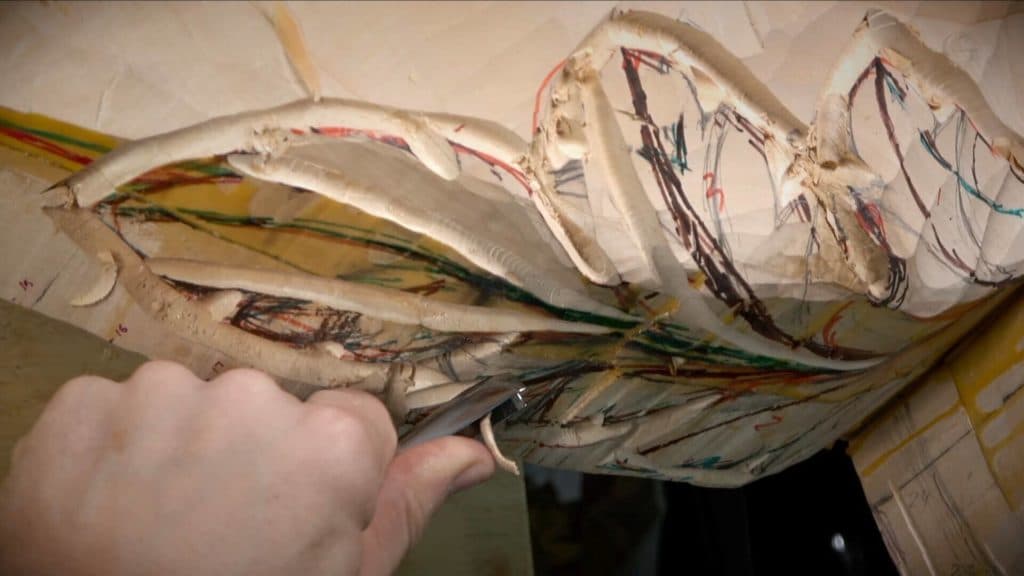
Alexander Grabovetskiy, woodcarver, School of Woodcarving · Published 2020
What does a wood carver mean by "a different color"?
Quick answer: In part 6 of workshop 94 the words follow a ridge and name a blue color. In my other lessons the same words sit beside a new division, smaller sections, a high spot, a concave and a depth map. Each stop has a link, and the table at the end sets them side by side.
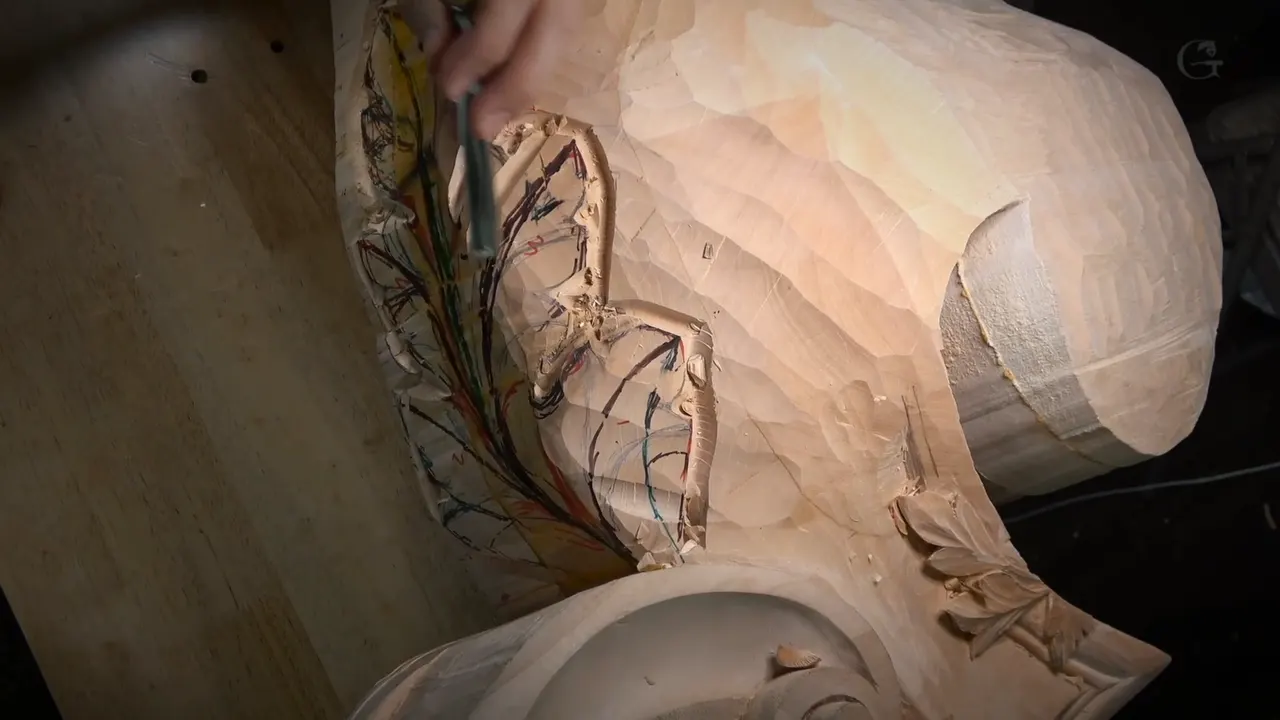

Workshop 94, part 6, holds the words "a different color" beside a blue color and a pipe. My other wood carving lessons use the same words next to a new division, smaller sections, a high spot, a concave and a depth map, with a line of mine at each stop.
Ever stood over a drawing with one pencil and wished for a second? Can you tell from a color alone which line is the hollow and which is the high spot? This page will feel familiar either way. It starts in Venice Room 94 and visits eleven more lessons. Every size here comes in millimeters and inches, my own figure first.
What comes before the color line in part 6?
Pipes open the talk, with "to establish the movement in those pipes." Why the hollows? "The pipe is going to be convex, which means I have to do concaves". The run is planned from "the middle point", and the concaves "run that concave all the way to this point."
Two lines cover the point. "And how I determine this point, again, if you follow the golden ratio rule," is one. "And again, how I determine this point, of course, I just eyeballed" is the other. Measuring gets a remark of its own: "But if I will measure it's not really convenient for me how to measure it." A question follows: "How do I do that? I don't know, just like that". More on the ratio sits in the golden ratio entry.

Which words describe the second hollow?
The line begins "And this concave, I have to run all the way somewhere right here." Why so long a run? "because that pipe, it's going to be pretty much that wide."
The look has a name in "So that's going to give me that three dimensional look. It just like opens up." After that, "So there's two areas." One more word on the point, "but it just still falls in this section". Then "I hope it makes sense."
Which tool starts the digging in part 6?
A plan names the tool as "the same number 11 and 10mm", and the work as "start excavating my concaves". Ten millimeters (0.39 in) is the size. Next up is a second hollow, "Now I'm going to do a second one." A note on order sits with it, "I'll do it in sections."

A warning sits in the work: "I have to be careful not to hit my middle line, so important not to lose". A pipe closes the stretch with "So that would be pipe number one." Blending gets two lines, "And yes, I can probably blend that right away" and "supposed to be like a convex I'll just blend that".
How does the other side start in part 6?
Next comes the opposite side, in "and let me do it on the opposite side, exactly the same idea." Then "Same idea." One shape is named, "a ridge".

Then comes the color line, "So which means let me use a different color, just the use, like blue color." A pipe follows in "one of the pipes". Right behind comes a quick repair, "Not the pipes, concaves - I'm sorry." The line after it ends on "this direction."

Tapering gets a word of its own: "So, again, just like really nicely tapering." Care gets a line too, "Here, I have to be careful", and "also a gradual movement" follows. The part ends on "the second one".

Where does Venice Room 62 put a different color in its first part?
Venice Room 62, part 1, puts the words beside a division. The need comes first. "Now I need to create my concaves and convexes." Next, "So, the main movement going uphill, and logically, I supposed to have another division somewhere right here."
The plan is "Let me get a little different color or maybe even smaller marker." Then the hollow, "So I'm going to take a main concave and remove all that." A short plan sits there too, "So my point is, what I will do, I want to raise here."

The want is plain. "And I want to make it really massive concave because I really, really, really want to see some movement, some shadows." The size is a plan, not a pass: "I will use the number 11, 18 millimeters veiner. Maybe actually bigger. I'll use 30 millimeters right here." Eighteen millimeters (0.71 in) and 30 millimeters (1.18 in) are the figures. The reason is "because I really want to exaggerate everything." Then "And carefully approach."
What is the blue color of lesson 74?
Lesson 74, part 7, has "on the opposite of middle line also, I have to create another concave".

The color is named in "concave, which is a blue color in my case." After it come "a lot more easier for you to understand" and "Hope it makes sense." Looking first is a plan, "Let me see how it looks".
Digging follows: "Now, I can start my digging, wood digging." A care line comes next, "Like I said, I do not want to lose the momentum or movement, if you wish." The tool is a plan, "take seven millimeters" with the note "I think it should be sufficient". Seven millimeters (0.28 in) is the size.
Which color goes on the high spot in Venice Room 75?
Venice Room 75, part 5, carries the plan "I can actually use a red color." The spot is "my high spot, at least for now."

Then "which means that line going to go somewhere underneath, so it's invisible." Another line has "And I'm using red marker. I shouldn't probably use that red marker because it penetrates deeply." Then a second thought, "But maybe I just should to switch pencils."
Which colors does lesson 75, part 6, write down?
Here the talk starts with "whenever I have a convex, I have to create concaves." Then "I promise I'm not going to use marker right now." Next, "I'll use just a blue pencil." The shade gets a plan too, "teal or teal-ish." Shades of teal and a colored pencil have entries of their own.

Next, a repair: "Number one convex and number two convex. I'm sorry, concave. The blue would be concave." A plan to write it follows, "So let me write that down. Blue would be concave and red will be convex."
Which sections get teal in Venice Room 83?
Over in Venice Room 83, part 12, the plan names "marker for you to understand much better." Two layers are named too: "double layered section" and "one leaf on top of another one."

"I know it doesn't make any sense right now. It will." A count follows, "So one, two, and three right here. Okay. Three main big parts." The rest is "smaller sections", and the plan is to "indicate it with a different color." The shade is a plan, "Let me take probably just a teal color."
Another remark: "Double check. I'm sorry for my mumbling today, but I really have to figure that out." The total comes next. "So which means I've got total five sections, one, two, three, four, and five." It is "accurate to the Fibonacci sequence." The Fibonacci entry covers that count. A last line says "I know it's a little complicated looking one because we are working in not just a simple form, but it's in two dimensions."
How does Venice Room 84 name the second concave?
Next is lesson 84, part 8, with "And I need second concave." Behind it the plan reads "for you would understand, blue color, if I'll find it, which I don't know where I did. Right here. Got the blue color."

The plan repeats the word concave and names an end point. For the tool, "use 7 millimeters to continue this concave. I need deeper concave here." Seven millimeters (9/32 in) is the size. The reason is "Okay. So because I need to make that middle part of acanthus convex."
Two limits sit nearby, in "But please understand, it's not always the case." and "It's just particular Venetian style." The leaf in general gets "It's more convex inside of the middle part." For the leaf itself, acanthus has a page.
What went wrong with the blue marker in Venice Room 72?
Part 3 of Venice Room 72 has "What I don't like, I don't like that I have a blue marker, which is okay in this case". Paint is the reason. For other cases, "that would be a huge mistake."
Softer words follow: "Not huge, huge. I mean, I'm still able to clean it." The lesson follows, "it is a lesson for me not to use that color, although I use different colors, but this one looked like it penetrated much deeper." A marker is the tool in question.

After it, a blend: "See, it's a beautiful tool to use. I can blend really, really nicely from deep concave to a much more shallow concave."
Which two colors does Grape Leaves 2 name?
Grape Leaves lesson 2, part 5, opens with "two different colors, the blue for deep cuts for the concaves, and the red for the upper convexes, so it's the high spots."

A note on the pencil sits beside it. "And yes, I can continue with the pencil right on top of whatever I cut." Then "a flowing line, beautifully flowing line, so without too much wiggling." Another stretch has "Also, what I want to see from the golden ratio point, from this point,". Its figure is "So 62%, to be exact."
Where does a different color sit in Furniture Panel 3?
Furniture Panel lesson 3, part 2, has "Although I know there's a lot of lines and maybe I should probably just get the different color." Behind it, "And while I can actually put just a cross." The cross gets a label of its own, "So that is my major, major, minor, minor."

Right after, "So I think I am ready to start to develop some movements."
What do the colors mean in Furniture Panel 20?
Furniture Panel lesson 20, part 1, ties the colors to depths. "I uploaded a depth map. Okay? And I indicated that by different colors at different depth, how deep I went with the background." See the depth map entry for the term.
The key comes in three colors. "The blue, light blue color, it's one sixteenth of an inch deep" opens the key, about 1.6 mm. "A yellow color, it's one eighth of an inch deep, or three millimeters deep" comes second. "Really bright red, it would be a three sixteenths of an inch deep" comes third, with "five millimeters" beside it. Three millimeters is 0.12 in, and five millimeters is 0.2 in.
Where the map lives: "So you can find that in the beginning of this course, in the downloads section, in downloads workshop." The yellow and color entries cover the names. Another line sits near it, "So I just want to make sure we're not losing the details." The stretch ends on a plan, "So let me get a marker and I'll just refine details."
Where else does a color mark a high spot?
Floral and Molding lesson 9, part 3, has the plan "different colors for you just to understand the concept." The key follows with "a red color" for the convex and "blue color" for the concave, then "Just to think about that red as sunshine and the blue is like ocean."
Modern Acanthus lesson 1, part 1, starts with a search for "different colors". Two colors are named, "use the two colors. Okay in my case, it would be orange and a blue." Next, "Orange it's gonna be just like a sunshine in the morning. Okay, so that means it's gonna be high spot blue gonna be like a ocean."
Which lesson holds which color, and what sits beside it?
| Lesson and part | What the color sits beside |
|---|---|
| Workshop 94-6 | Blue color after a ridge, then pipes and concaves. |
| Division in 62-1 | Another division, with a smaller marker as the other choice, and a big veiner for the hollow. |
| Concave in 74-7 | A concave on the opposite of the middle line, a blue color. |
| Red color in 75-5 | A red color for a high spot, and a red marker that penetrates deeply. |
| Blue pencil in 75-6 | A pencil in blue, a teal or teal-ish shade, and blue for the concave. |
| Sections in 83-12 | Smaller sections marked in teal, five sections in all, and the Fibonacci sequence. |
| Second concave in 84-8 | A second concave, a blue color, and 7 mm (0.28 in) to continue it. |
| Marker trouble in 72-3 | A blue marker, a painted piece, and the words penetrated much deeper. |
| Grape Leaves 2-5 | Two different colors, with blue on the concaves and red on the high spots. |
| Floral and Molding 9-3 | Different colors for the concept, with red as sunshine and blue as ocean. |
| Modern Acanthus 1-1 | Two colors, with orange as sunshine for the high spot and blue as ocean. |
| Panel 3-2 | A lot of lines, a different color, and a cross for major and minor. |
| Panel 20-1 | Colors for depth, with a depth map. |
Is there a drawing of yours that needs a second color? Everything in workshop 94 sits inside one tuition plan. More Venice Room workshops wait on the Part 8 course page, and a ridge between two hollows has its own page in Venice Room 87.
How it's done
- Plan the hollows. Concaves on the sides of a convex pipe are planned in part 6.
- Plan the tool. A 10 mm (0.39 in) number 11 is the tool for the concaves.
- Watch the middle line. The warning is about the middle line.
- Plan a second color. A second color opens the other side.
- Find the key. Lesson 75 writes down a key for blue and red.
Frequently asked questions
Which shape is named just before the color in part 6?
"ridge" is the word.
Which words follow the color line in part 6?
The next line starts "one of the pipes", with "Like this." beside it.
What does lesson 75 say a blue color is?
In those lines blue marks the concave and red marks the convex.
How deep is the light blue in Furniture Panel 20?
What to carve next