
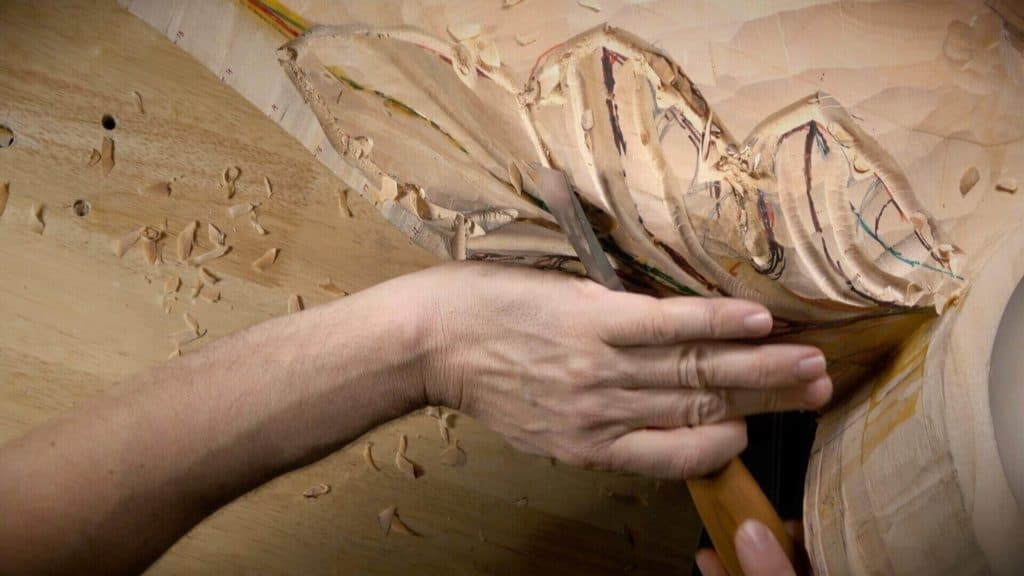
Alexander Grabovetskiy, woodcarver, School of Woodcarving · Published 2020
What does a wood carver mean by "a rough shape"?
Quick answer: "Rough shape" is a first stage with the shaping and cleaning still to come. In workshop 94, part 8, the words "rough shape" mark where the work stands. In my other lessons the same stage sits beside a smaller gouge, a plan to clean later, or a note that the work is "not finished yet."
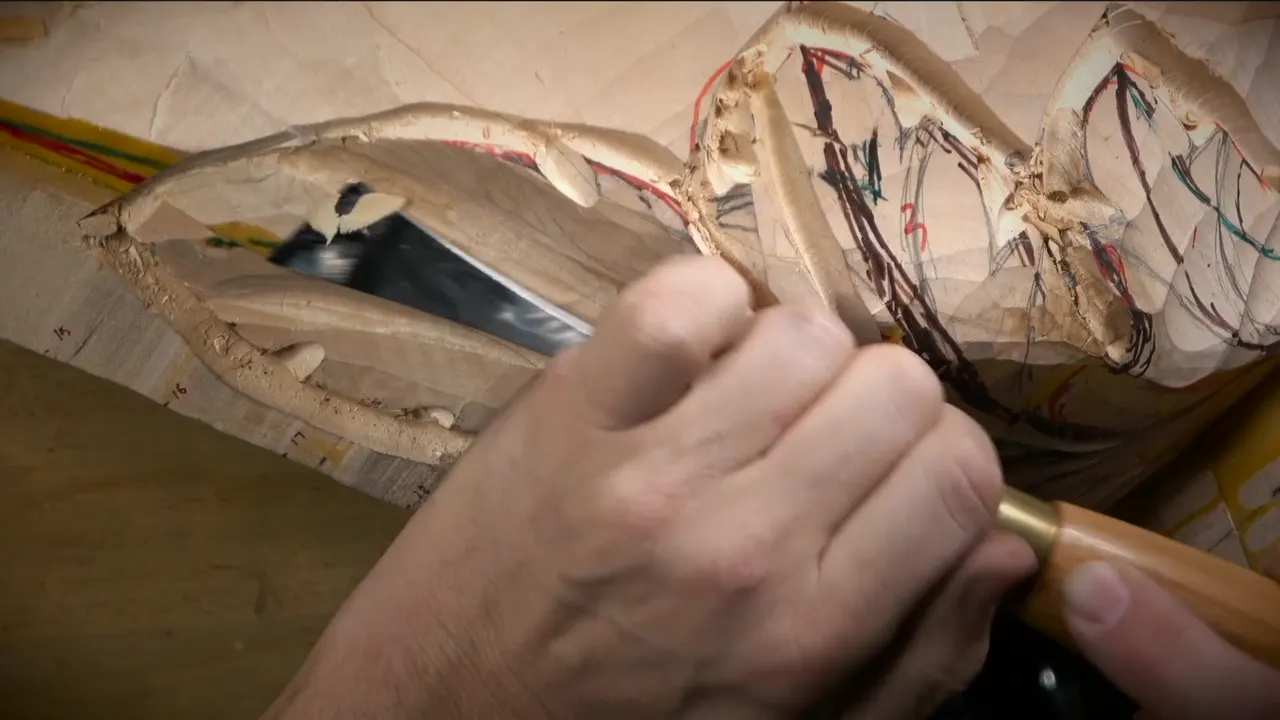

Workshop 94, part 8, holds the words "rough shape" in a short clip. My other wood carving lessons carry rough forms and rough stages too, each one beside a plan to finish it later.
Ever stopped at a half-carved piece and wondered if it is done or only roughed in? This page starts in Venice Room 94 and visits more than a dozen other lessons, with each size given in millimeters and inches, my own figure first.
Where does Venice Room 94-8 mark the rough stage?
The first clear line reads "and again, as I said, I'm just eyeballing right now at this point, I need to use the Mallet." A mallet is a need there, and no step is done yet. Next comes "OK, let me see." Then a longer thought: "Got to do this one. It's kinda not too convenient for me."

The words themselves sit a little later: "And that's it, I mean, as far as rough shape. OK, so that is only a rough shape yet." Direction follows: "Attack from the right side."
Which tool comes next?
The next tool is a skew, and the line reads "And I'll take on just a skew chisel." For the tool itself, start with the chisel page.

Grain gets a say. "Yes, I am working against the grain." Then "I have absolutely no problem with that." My trust sits in "That's OK, I can do that against the grain again, as long as I have my tool super sharp, I shouldn't have any problem." Close by, "It's just not convenient for me to attack from opposite side" and "just because of that camera position." Wikipedia has more on grain.
How does part 8 end?
With a few plans and one last check from another side. "And maybe I can roll slightly this section this way to the right just a little bit." A forecast: "It's going to give me a lot nicer, smoother look."

Another line: "And I can bring a little, you know, farther on inside this part." A check follows: "I need to check from a different point of view." The clip then stops on "Oh, it looks."
Do the neighbors, parts 7 and 9, add anything to this?
In part 7, "I could use a skew again." A middle line gets guarded: "it has a really nice arch or arc and I don't want to lose it."

Over in part 9 the start is "I'm happy with this part, except I still have to create a smaller concave" and "five millimeters." Five millimeters is 0.2 in. The tool: "Number 11." and the mallet gets a reason: "I'll use Mallet because it's going to give me a lot more control."
The blending goal reads "But my goal is to blend that really nicely." Right after it, "It would look, no matter from what position you look at, it still has to have a flow." A wish for the movement follows: "So I really want the gradual movement, really gradual".
One check is done by touch: "And I'm feeling with the hand, because sometimes you don't really see what is going on and you really have to use your hand".
How does the Lily Box olive lesson start?
Part 1 of lesson 13 in the Lily Box course works on olive shapes. Plan: "So again, now, I'm going to do a rough shape." Level comes first: "And to do rough shape, let's make it a little lower." The depth is "approximately maybe a 16th of an inch down to this green line," which is 1.6 mm.

The plan names a "number eight gouge", at 1/8 in (3.2 mm). The work is described as "I am just establishing the rough shape."
A knife takes the next piece, and an easy part gets a warning: "And usually those easiest parts give you a lot more trouble just because it looks easy." "I'm using a knife, and I'm digging inside of this block of wood, but I'm not afraid because that is just what was left over from another project." The knife earns its place with "because it's just much quicker for me." Result: "I can give a really nice quick shape."

Further on, the order is spelled out: "And once you're going to establish the rough form, we're going to take a gouge and shape even better." A warning follows: "Like I said, don't be fooled." and "It looks simple, but once you're going to carve it, you'll see it's not as simple as it looks".
Can a gouge do that job instead of a knife?
The same lesson, in part 4, offers it as an option: "But also what I could do, I really don't have to use just a knife.". The gouge page lists the family. The way is "Just a small gouge, just a normal way, and give a rough shape at first," then "and then take care of those facets also." Verdict: "That's possible."

Later, the idea returns as a plan: "Maybe I could use the same approach and use the gouge normal way. I think it's probably the best way right now, and create the rough shape." Before that, a plan for roundness: "But let me see if I'll be able to get the roundness I want to."
When is a form only somewhat rough in workshop 80?
Venice Room 80, part 2 opens with a concave that is not ready: "It's not concave yet." Plan: "Later on, I'll just attack and create the concave." Then comes the need: "But now I need just a somewhat rough form". A measure follows, of "this spot right here." The payoff is "And then I'll know exactly how to blend, and I'll create a hole right there."

Next door, part 3 of that workshop has "Again, that is somewhat rough." and then "But it will do for now." Tool plan: "Let me use a number nine and a quarter inch," which is 6.35 mm.

What does workshop 88 call this stage?
Workshop 88, part 7, shows the whole piece: "that is how it looks overall. Of course, it's rough yet. We're still in the roughing stage."

A change of plan is on the table now. "There's going to be a drop, and I probably have to redo this part." A cause is given: "which means I have to change the design, original design, what I intended to."
How do workshops 63 and 58 phrase rough yet?
Back in Venice Room 63, part 2 gives the need: "get rid of some of this." Then "It is looking rough yet, so it's not finished yet." One more word for it: "preliminary."

For Venice Room 58, part 2 has close words: "but it's not completely done. If you look closer, it's somewhat rough yet, and I'm going to leave it for now like that, okay?"

Where does rough that out show in Venice Room 8?
Part 2 of workshop 8 sits in the first Venice Room course. The line before the tool is "just at least some of the material I don't really need, and which is on my way". Its tool reads "Okay. And now I'll just use a number nine, kind of rough that out." Then "Just excavate a little deeper."

Is clean carving different from rough carving?
The Dining Table Apron course, workshop 17, begins with a small tool: "And once again, I'm using a V tool number 16, and it's only one millimeter." Converted, 0.04 in. Next, "Really tiny one." and "But it's really, really good for cleaning up."

Both terms arrive together: "There is such a thing as, we call it clean carving or rough carving." Then "And clean carving, so you really spend your time and clean to the perfection."
History comes in: "So the number one type of wood carver in England, it used to be wood carvers who used to carve for boats, for big ships. It's ship carving. They didn't pay attention too much to the detail. It's a more rough carving." One more line: "So it was a rougher style wood carving."
House carvers get their own words: "House carvers, well, they were really more careful, but still, a lot of stuff people don't see close to the eyes. It's somewhere above, like crown molding, with some architectural details." The crown molding page on Wikipedia has the term, if you want a picture. Next, a line on mistakes: "So they could make some mistakes. They could leave some spots rough." Furniture is the other case: "And with the furniture carving, it's not the case. So you really have to check all the details."
Why leave the work rough in Furniture Panel 34 and 20?
Furniture Panel lesson 34, part 2, has a width of "two millimeters" (0.08 in) and a side: "I have to attack that from the opposite side." The stage reads "it's just rough stage and I wanna make sure that flow is really nice." Then "Okay? I don't wanna see any straight lines." A fix is on the list: "Now I can see a few straight lines and at the end I can always fix that, you know, just to make it really, really flowing." Verdict: "Okay? So for now it's good."

Lesson 20, part 7, has a timing note: "But now it's too early because I have those petals in my way," and then "And yes, sometimes I am leaving rough until the end, and then just look at everything and just clean." A petal has its own page.

How rough is left somewhat rough, in Byzantine Acanthus 7?
In Byzantine Acanthus lesson 7, part 1, the piece comes with "but pretty much I left it somewhat rough, but take a look around, okay?" Read about the Byzantine style on Wikipedia.
A look in part 1: "See that? So that side is kind of undercut a little bit." Later, part 2 repeats the rough note with a plan: "So I left it rough. We're going to finish it nicely." Then "But let me actually take little more out."

Has Roman Acanthus 2 reached the rough background?
Roman Acanthus lesson 2, part 4, names a tool: "I'm using number seven, half an inch, 13 millimeters, to get to my preliminary background." Then "Although it's not even the rough background yet." The stage is described as "I'm still establishing the main form, the main movement."

Lines are not final: "So those lines are not the final lines, and this background is not the final background." The acanthus page has the plant.
What is a rough idea in Hazelnuts 2?
Hazelnuts lesson 2, part 3, has the plan: "I don't want to do too much at this stage," with the aim of a "rough idea of those guys." Care is asked for: "Somewhat careful." A second need follows: "And I also want to make sure I'm not losing the centers of those two guys." A warning closes it: "And it is challenging because the grain direction goes this way." See the hazelnut page for the nut.

How rough is too rough in Hashemi Flowers?
Hashemi Flowers lesson 48, part 3, starts with "Right now the shape is too rough. I like the overall movement of this petal." Then "Overall movement is good, but not too clean." The plan is "So I'll just try to blend all those moves together."

In lesson 1, part 4, of the Hashemi Flowers course, an edge is "still kind of rough". The gap is "about maybe eighth of an inch for now, okay?" (3.2 mm).

Lesson by lesson, what sits beside the rough stage?
| Lesson and part | What sits beside the rough stage |
|---|---|
| 94-8 (Venice Room) | A first stage, then a skew. |
| Olives, Lily Box lesson 13-1 | A lower level first, then a number eight gouge. |
| Olives, Lily Box lesson 13-4 | A small gouge, the normal way, as an option. |
| 80-2 (Venice Room) | A somewhat rough form, with the concave later. |
| 80-3 (Venice Room) | Somewhat rough, and a refining chance ahead. |
| 88-7 (Venice Room) | Roughing, and a change of the design. |
| 63-2 (Venice Room) | Rough yet, and some of it to get rid of. |
| 58-2 (Venice Room) | Somewhat rough yet, left like that for now. |
| 8-2 (Venice Room) | Roughing out material that is in the way. |
| Apron, workshop 17 | Clean carving, rough carving, and who left spots rough. |
| Panel 34-2 | Kept rough for the flow. |
| Panel 20-7 | A too-early undercut, and rough kept for the end. |
| Byzantine 7-1 and 7-2 | Left somewhat rough, to be finished nicely. |
| Roman Acanthus 2-4 | Not final yet: lines and background. |
| Hazelnuts 2-3 | A first idea, and a caution on the centers. |
| Hashemi 48-3 and 1-4 | A petal shape still rough, and an edge to leave for now. |
Is there a piece of yours still at the first stage? Everything in workshop 94 sits inside one tuition plan, and more Venice Room workshops wait on the Part 8 course page. For furniture work, start with the Furniture Panel course.
How it's done
- Name the stage. Part 8 marks the work as a rough shape, with more to do.
- Pick the tool for the side. The tool is a skew, with "Attack from the right side." beside it.
- Keep the edge sharp. Sharpness is the condition in part 8 for a pass in that direction.
- Look from another side. The part asks for a check from "a different point of view."
- Leave the clean-up for later. Workshop 63, part 2, calls the work a "preliminary."
Frequently asked questions
Which tool is announced after the rough shape?
A skew chisel: "And I'll take on just a skew chisel."
What edge does this work need?
One that is "super sharp", so there is no problem.
Which gouge does the Lily Box olive lesson name?
A number eight.
Which stage does workshop 88, part 7, mention?
What to carve next