
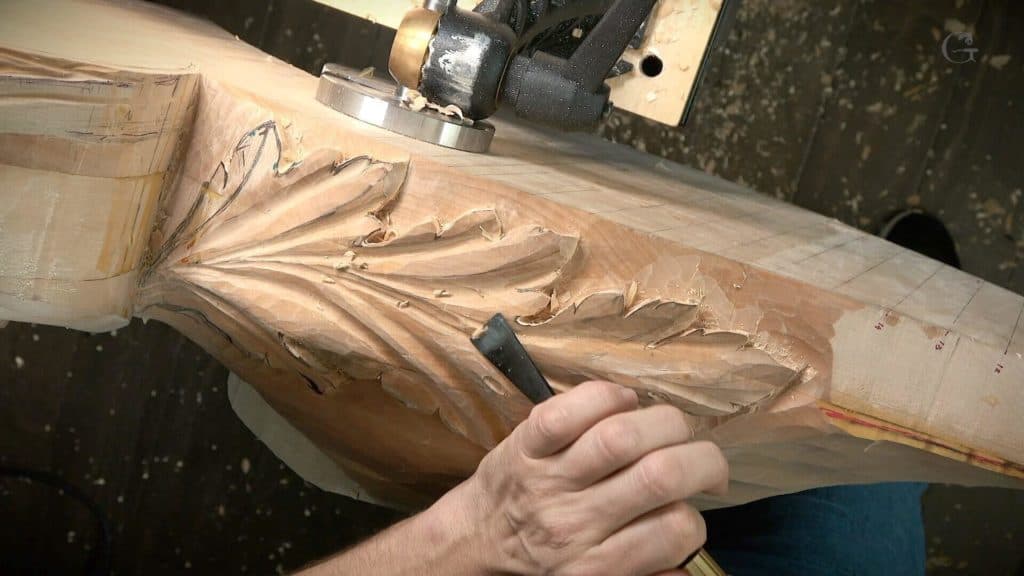
Alexander Grabovetskiy, woodcarver, School of Woodcarving · Published 2020
What does a wood carver mean by "a rasp job"?
Quick answer: The rasp job ends video 10 of workshop 95, after a thought about leaving a side alone and a line about a cleanup job. Other lessons of mine carry the word "job" beside a number 3, a number 11, a knife or a rasp, and each one is linked below.
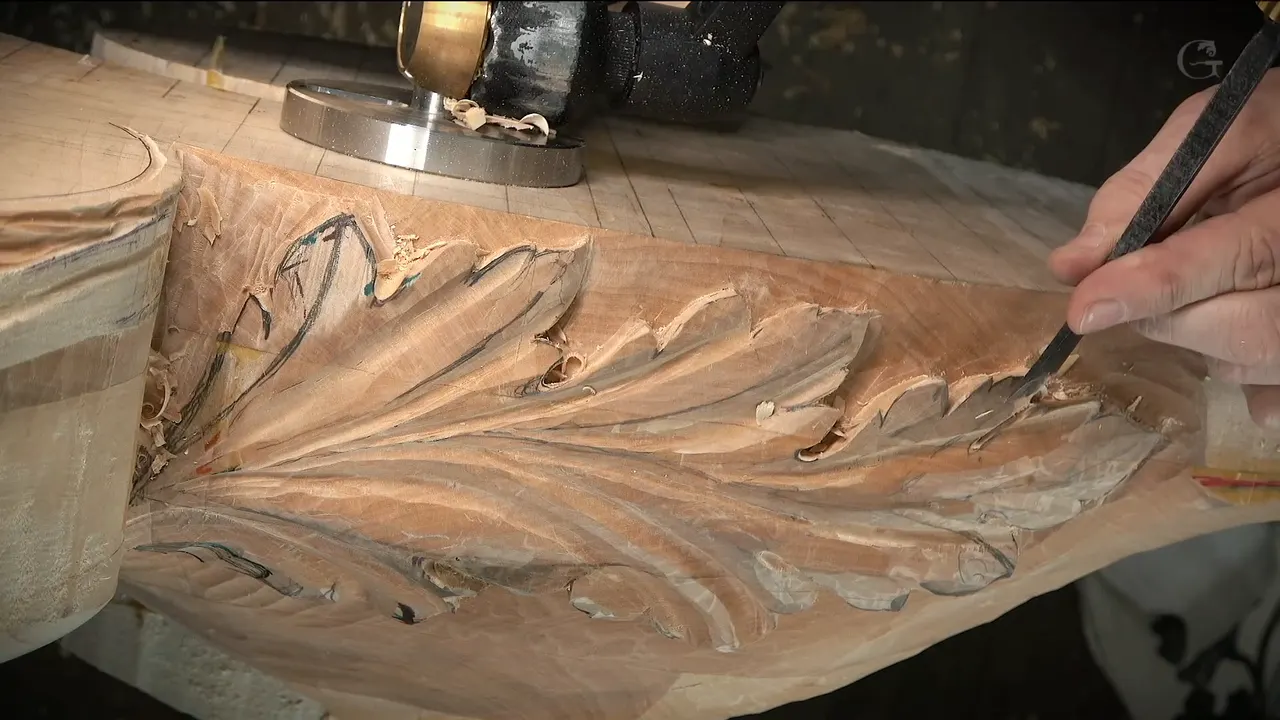

In part 10 of workshop 95, near 00:06:44, I say "Maybe I'll just give a rasp job to it so we'll see." A minute earlier come the words about rasps, and then a cleanup job. Lessons from other courses of mine carry the word "job" beside a gouge, a knife or a rasp, and each one is linked below.
Have you ever looked over one side of a carving and wondered if it needed another round with the gouge? The words sit in workshop 95, and the rest of this page is where my other lessons say them.
Where does the rasp job sit in part 10?
At the end of the part. "And I think I could leave this side alone" is the cue near 00:05:24, and six seconds later comes "although, maybe it's a good idea" with "for me, not to spend too much time" right behind it. "may be I could use" comes next, and one word follows by itself, "rasps".

Three cues in a row give the job its name: "And just to give a", then "little bit of a", then "cleanup job". Next to them sit "Maybe" and "let me double-check from all the sides". The next line is "And I see some of the areas I need to address", and I point with "Like right here" and "And right here".
The last cue of the video is the line this page opened with. It is a maybe that waits to see, so here it stays a plan.

What small tools come before the rasp in part 10?
Near 00:00:28 the cue is "Give a little twist in this direction". Soon I say "carefully I need to remove this side" and "with the smaller tool". "I need to work on this edge right now" comes next, with "and don't worry about this section" and a clean that waits: "I'll clean a little later" and "Just a little later".

Names follow. "I will use" and "number seven" make the first pair, and "Create much better curvature" sits a few lines on. A second plan reads "And maybe number five, but small one". Then "Get inside of that triangle and move it carefully".
A tiny tool is next: "I will use a small, tiny tool to get rid of this left over". I name "half a millimeter" (about 0.02 in) and "just hook this out like this". A few cues on I say "with the 1/2 mm tool, what I can do, I can prolong a little bit" and "go in slightly, although it's not easy", and then "on the end grain".

Which cleaning lines sit before part 10 in workshop 95?
The two videos just ahead of it carry cleaning of their own. The eighth video carries "Clean up with that number 11" and "Follow with the number three", then "2mm," as a size. The ninth video gives "I need to use the small one" and, near the end, "OK, let me clean that with the one millimeter" (1 mm is about 0.04 in).

What does a cleanup job mean in my other lessons?
Chamomile and Bow Rosette 3, video 2, gives the plainest case. "I can take" and "a small tool" are followed by "like number three" and then "give a slight" with "cleanup job to those two guys".

Acanthus over Moldings 8 puts a size beside the job. "number three" comes first, then "And one eighths of an inch three millimeters" (about 0.12 in), "Gonna give a clean cut" and "Clean up job".
A clean comes before the next step in Venice Room 45, video 3: "But to do that, I have to clean it" and "first". After it come "I need cleanup job", then "I need to give a cleanup job". Then "I do not want to force it, but this will be" with "undercut underneath of this".

In video 11, Venice 59 puts a plain label on it. "It's going to slow me down, and all it is just a" leads into "cleanup job", "That's what it is, okay" and "Nothing special", and then "Just cleanup job". A few lines on, the cue is "because of the grain, I got to be careful how I attack it".

The number 11 sits in Venice 57, video 1: "cleaning job done again with the number 11", "I could use number nine" and "but number 11 will fit good". The size I give is "Seven millimeters" and "Quarter inch" (7 millimeters is about 0.28 in). Further on the cue is "cleanup job done".

Which gouge or knife gives a cleanup job?
Floral and Molding for the Panel 12, video 3, is short. "now it's time" and "to give some" and "clean-up job" are followed by "The same number seven".
In Grinling Gibbons Maine 7, video 1, I say "I gonna get again number 11 and 3" and "millimeters and give us some kind of cleanup job" (3 mm is close to 1/8 in). Then come "Well preliminary cleanup" and "cleanup but just like that. Okay, so exactly".

A knife does the job in Venice Room 102, video 12: "And I can probably just give it some clean-up job with knife" and "a small, tiny knife". A flatter gouge does it in Venice Room 119, video 3, with "cleaning job" and "Let me get just a flatter" and "gauge, like number three".
A bigger tool opens video 12 of Venice Room 86: "Let me get bigger gouge, number seven and". Then "a little better" and "clean-up job". It closes the thought with "Although, probably a smaller tool will be".

Does a cleanup job wait for a later step?
Moldings 9, video 1, carries "I have to do some cleanup job" ahead of "happy but I still have to clean". Then Moldings 6, video 1, gives "to make cleanup job undercutting" and "and so on but I'll do it" and "after the final".
Blunter lines sit in workshop 35. In video 2 the cue is "Maybe just a little better cleanup job right here", "because right now it just looks all choppy" and "and that's not nice". And in workshop 34, video 7, I say "Is it nice or not nice, I should say" and "Give it a little bit cleanup job".

And the cue in Furniture Panel 31, video 2, is "Careful just to get, uh, uh" with "the cleanup job right on inside".
How did I feel about rasps?
The long view comes from workshop 14, video 10: "I just stayed for many years" and "away from those rasps" and "I really did not believe in them". Next is "I would look at them like not authentic to the woodcarving world". Another cue says "my teacher never used them".

Later in that video comes "Maybe I got too excited about" and "those rasps, but I think it's" and "a good tool now". One more line sits near 00:07:46: "Just wonder myself, sometimes asking myself why I didn't use that" and "before?"
From workshop 24, video 6, come "And to be honest with you, I stayed" and "For a long time, I tried not to use" and "rasps or even buy them". Then "those because I thought it would not be authentic to the wood carving world" and "but it's not true". I add "carvers, they're using those tools".

In Venice Room 50, video 8, I say "I did not use" with "rasps before this year, before this project, because". After it come "I think I lost a lot of time" and "not using it and just doing everything out of chisel", and then "I could save a lot more time just by using rasps".
That video also gives grids: "10" with "grid, that would be really rough, and 14 would" and "be really" and "nice". And "And mine are, I believe what I have, it's about 13". A cue before them says "paint grade".

Does a rasp leave abrasive in the wood?
The fourth video of workshop 24 starts with "My rasps" and "I'm going to soften everything" and "make my transition nice". Later come "they don't leave any" and "abrasive inside of the fibers, inside of the wood". For who knows the tool, I say "antique furniture reproduction people" and "Gorgeous Chippendale style and so on".
Wikipedia has pages on abrasive, on Chippendale and on antiques. Then Venice Room 10, video 6, gives "it doesn't leave any" and "abrasive on inside". Next come "So I can always go back with the tool, and I know it's not going to dull" and "my tool".

Furniture Panel 19, video 8, has "really stayed away from rasps" and "But now I'm okay with that" with "And actually, I really like the result of it". Then "sandpaper because there's no abrasive left in" and "the wood, so it's not going to harm your tool".
The video ends the thought with "And of course, after rasp, I can always" and "touch it with the" and "gouge". Their order is the rasp first and then a gouge. Sandpaper is named in the line before that, together with the abrasive idea.

When does a rasp job fit the spot?
A rasp on one edge is in Venice Room 46, video 5, where I say "maybe it's not bad idea at all, just use a rasp" and "just on that edge", then "And I create really nice and gradual movement". Next, Venice Room 84, video 9, reads "need to clean up this area because right now it doesn't" and "flow", with "do it with a rasp" after them.

Later in 84 comes "rasp a little bit, this section" and "just to get really smooth transition". A hedge shows in workshop 82, video 10: "I'm not the biggest fan of rasps, but in this" and "case, like I said previously, I think it makes" and "sense", then "I can create and refine the shapes really quickly".

One more line for the same tool sits in the sixth video of Venice Room 10: "Okay. And I'm also going to hit with the rasp," and "this middle part". Then "Just kind of create" and "overall movement".

The second video of workshop 145 reads "I'll take some" and "rasps" and "and I'm going to rasp it". Then "I think it's just going to expedite my process" and "At least I hope".

Then Venice Room 146, video 2, gives "I'll just rasp majority of it" and "and create the shape I'm after", then "I hope it's going to save me some time because sometimes after rasp" and "you have to really" and "also just do something else. But we'll see". Near 00:01:06 the cue is "small rasps to give some rasp job and so", and a little later "many times, maybe too many times, there's going to be paint".

Paint grade is the cue in workshop 163, video 2: "By the way, I could" and "just rasp it if I wanted to", then "Like I said, that's just paint grade". Two more cues say "so I can probably just get rid of those" and "ridges pretty much right away". Paint is named again.

When do I hold the rasp back?
The ninth video of Venice Room 41 reads "Maybe I should just go back to normal way" and "without using any sandpaper" and "or any" and "rasps. So we'll see".
Another hedge shows in Venice 19, video 5: "I don't have to use a rasp, but since I have it" and "why not?" Then comes Floral and Molding for the Panel 6, video 1, with "I know especially furniture makers, they really like to" and "sand that stuff. And I'm okay with that". After them: "whatever, the rasps, like a small rasps and so on, you can" and "make it to the perfection", then "I don't need to because that project is going to" and "going to be covered with paint".

Which lines did I borrow?
| The lesson and the video where I say the line | What sits beside the words |
|---|---|
| Part 10, workshop 95 | A side to leave alone, rasps as a maybe, and a cleanup job |
| Workshop 14, video 10 | Years away from rasps, then a question about why |
| Workshop 24, video 4 | Softening everything, and no abrasive left in the fibers |
| Lesson 24, video 6 | A habit of staying away, and other master carvers |
| Lesson 19, video 5 | One rasp I do not have to use, but have |
| Venice 10, video 6 | No abrasive inside, so my tool does not dull |
| Venice 50, video 8 | Time lost with chisels only, and a grid of 13 |
| Furniture Panel 19, video 8 | Rasp over sandpaper, then a touch with the gouge |
| Room 46, video 5 | One edge, a rasp, and a gradual movement |
| Room 84, video 9 | An area that did not flow, and a smooth transition |
| Venice Room 82, video 10 | A tool I am not a fan of, used here |
| Venice Room 146, video 2 | Small rasps for a rasp job, and paint to come |
| Chamomile Rosette 3, video 2 | A small number 3 for a slight cleanup job |
| Moldings 8, video 2 | Number 3, a size, and a clean-up job |
| Floral Panel 12, video 3 | The same number seven for a clean-up job |
| Gibbons Maine 7, video 1 | A number 11 at 3 mm for a preliminary cleanup |
Is there a side of your own carving that you could leave alone for now? You will find workshop 95 inside one tuition plan, with the rest of the Venice Room, Part 8, in the Venetian style. Before it sits workshop 94, and workshop 96 follows.
How it's done
- Leave a side alone. Near the end I say "I could leave this side alone".
- Weigh a shortcut. "may be I could use" comes first, and the next cue is one word, "rasps".
- Name the cleanup job. Near 00:06:03 the cue is "bit of cleanup job".
- Look from all the sides. A plan to double-check comes first, and then the cue "And I see some of the areas I need to address".
- Point at the spots. I point with "Like right here" and "And right here".
- Offer the rasp job. The last cue of the video is a maybe with a rasp job in it.
Frequently asked questions
Where does the rasp job sit in part 10?
At the very end of the video. Before it sit a maybe about rasps and a line about a cleanup job, and a look at the other sides comes right after.
Which small tools come before it in part 10?
Number seven comes first, then "maybe number five, but small one". A tiny tool is named next, with "half a millimeter" (about 0.02 in) near 00:03:07.
Where else do I say "cleanup job"?
Chamomile 3 has it beside a number three, and Moldings 8 has it beside a size. The twelfth Floral lesson pairs it with a number seven, and Maine 7 pairs it with a number 11 at 3 mm (about 0.12 in).
What to carve next
- Venice Room 95
- Venice Room Part 8
- Venice Room 94
- Venice Room 96
- Chamomile and Bow Rosette 3
- Acanthus over Moldings 8
- Venice Room 45
- Venice Room 59
- Venice Room 57
- Floral and Molding for the Panel 12
- Gibbons Maine 7
- Venice Room 102
- Venice Room 119
- Venice Room 86
- Acanthus over Moldings 9
- Acanthus over Moldings 6
- Venice Room 35