
Alexander Grabovetskiy, woodcarver, School of Woodcarving · Published 2020
What does a wood carver mean by "helps me"?
Quick answer: In workshop 96, part 2, "helps me" sits right after a verdict on a compass, and green tape follows. Other lessons put the same words beside a small knife, a v-tool, sunshine and a magnifier lamp, each with its own cues nearby.

In workshop 96, part 2, "helps me" comes right after "the simple stuff", and the same words sit beside very different aids in other wood carving lessons. This page reads each of them with the cues around it.
Ever try to draw a smooth curve on a carving and find that no template or compass will help? Workshop 96 reaches for green tape. The lessons below name a knife and a lamp, and sunshine too. Every size is given in millimeters and inches, and the lesson's own figure comes first.
Where does "helps me" sit in part 2 of workshop 96?
It sits at 00:04:10 in the line "I usually find the simple stuff helps me a lot." Earlier, at 00:03:22, the part says: "What I mean by help there are different ways you can make" and "some curvatures, a real nice and smooth".
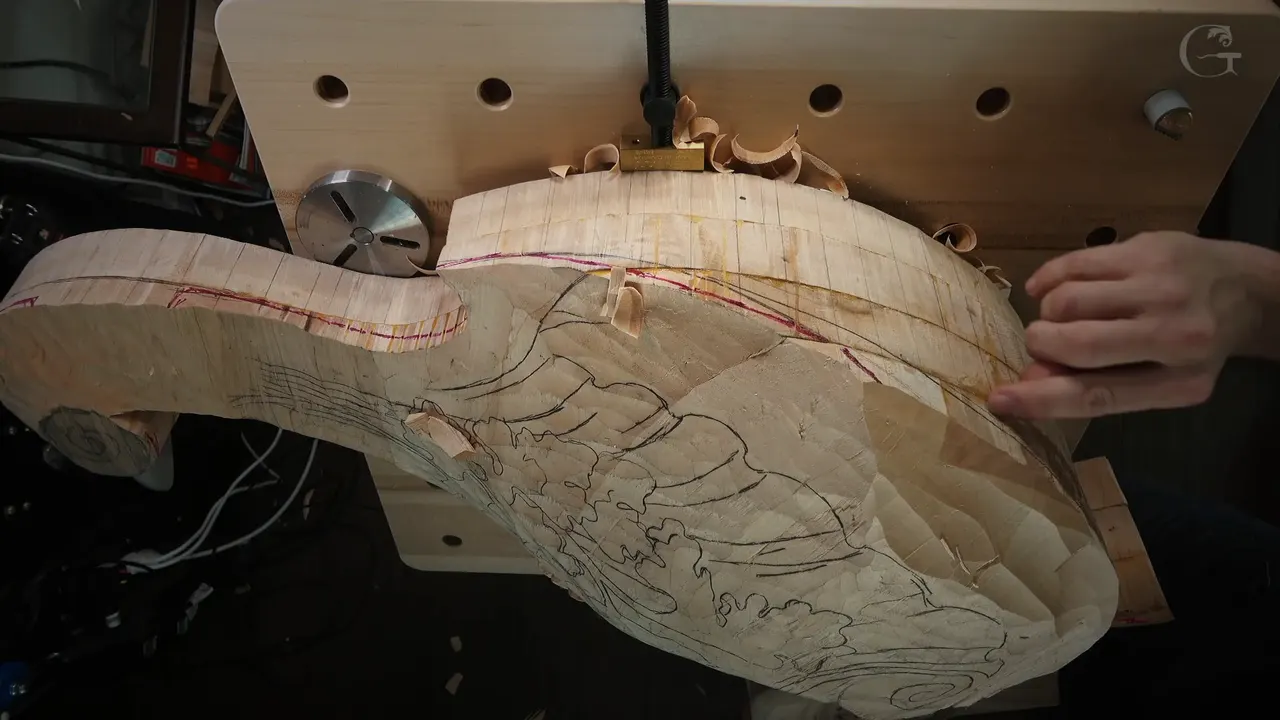
The tape follows. Its words are "And this case is just the roll of green tape" and "and this green tape going to give me a really nice, beautiful curvature." After that, "That is what I'm after."

How does part 2 begin?
The first cues are Near the start, "I've got the line and you don't see that," is followed by "right here. So see, that is the movement." The target is "that has to go all the way down to this line."
Then a high spot gets a name. "So what they have to do, I have to expose" leads to "this section is going to be the high spot" and "So that's why I have to walk around."
Care follows: "how much material removing" and "from this section" with "because it has to be also flowing this way." The movement is "Really nice movement uphill." Its limit is "So I don't want to overdo." Two more cues follow, "I'm still safe" and "but I got to be careful."
One question gets a flat answer. "And if you would ask me if I'm afraid of losing outlines" is answered by "Absolutely not" and "I am not."

What movement is the part after?
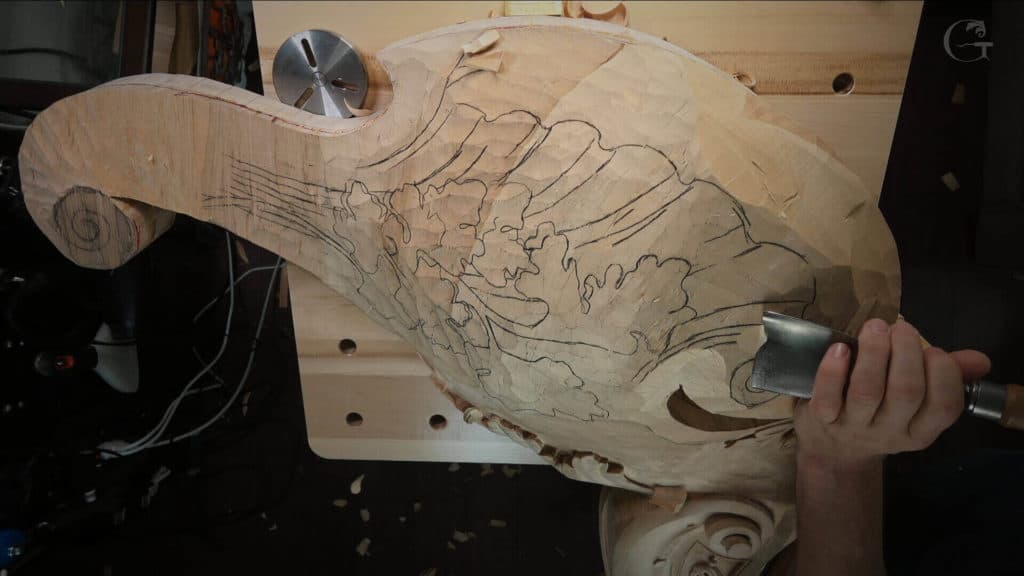
A look at the piece sets it up: "logically, when you look at this piece" and "it looks like it's supposed to go this way right here and followed that direction" with "I mean, follow this movement, but that's not the case." "Ok, it is not the case" comes after it.
The real route is stated at 00:02:46: "So actually, this movement going to wrap out and go all the way this way" with "movement which is going to go this way, that direction." A secondary movement is planned for the other side. The task is "So which means I have to create really, really, really nice movement." Smoothness is the last order: "Make it real smooth."

What does part 2 say about French curves and a compass?
French curves come first: "you can use French curves if you don't know what the French curves are." They are described as "It's really cheap but you can" with "find the right movement and just to try to follow that." Then the verdict, "But I found it is limited", and a wish, "I wish there is a lot more options in this case."

A compass is the other aid. "What I found, what I need, I can't use" leads into "a compass Ok because really there is no reference point that is obviously", and "I mean, the center is going to fall somewhere right in this hole" follows. "So, it is not good" closes the compass cues, and the line from the top of this page comes right after it.
What follows the green tape in part 2?
"And yes, that is going to go round just like that" follows the tape talk. "And this becomes molding, which is I worked previously" comes next, then "And this part" and "is going to wrap on inside like this". More on molding sits on Wikipedia.

A low spot is the need: "I still have to make this part much lower so that this is not" and "good. Yet." And "So I need to make it much lower." The tool is a plan: "So let me use number 8" and "So that would be number eight and I'll use one inch" (25.4 mm) After it, "let me find the right position."

The close has a warning and an option. "I do have to keep an eye how deep I'm going" and "So it's important for me not to overdo it," lead to "but I still have to create a really good wall." The option is "I can leave a little bit" with "like this side angled slightly." The cue after it ends "but not as much." The last cue is a plan: "OK, let me move on to this section."
Do the other parts of workshop 96 name a help?
Part 1 of this lesson voices a hope: "But I hope, is going to be helpful" with "just if you can get the certain parts like tips and tricks, there's a lot of Acanthus" and "movements, lots of different volutes and so on." The site gets a feature too: "added a visual browser if you go to a course itself?"
Its tool comes with two figures: "favorite Gouge is a three inches" and "It's 80 millimeters Gouge and they're going to need big Mallet." Three inches is 76.2 mm, and 80 millimeters is about 3.15 in. A mallet has its own Wikipedia entry.
The third video carries a grain warning. "So, by the way, that is not the safest way" comes first, and "The best way is actually just to go across the grain, just in that direction" and "that is why across the grain is always safer." A number three is the idea near the end, "I think it is a good idea to get a number three" with "Three-quarters of an inch deeper right now," (19 mm) earlier in the part.
Which tools help in other lessons?
Hashemi Flowers 7 has a rough patch in part 5: "Make a mistake after another mistake" and "Too many mistakes." A knife is named next: "this small knife" with "helps me actually a lot right now" and "I can have much more control."

Over in Hashemi Flowers 16, part 2, a handle is the help. The cues are "small and I need to attack from" and "the bottom going uphill, if I would use a different big one" with "I would not be able to place it that low." Then "Just because it's a really small handle" and "that actually helps me."

The v-tool is named in Hashemi Flowers 5, part 2: "reason why I'm using actually a v-tool" and "because in some areas," lead to "the wood is weaker, and I can" and "break, actually, also." The line is "So the v-tool helps me to make" and "a relief cut."

A bent tool is the help in Venice Room 62, part 6. "Because everything is in my way now" is followed by "I can't use a straight tool" and "convenient for me to use a straight tool." "So a back bend just helps me" is the cue after them.
A back bend remark sits in part 8 of Venice Room 12. "But that side, I could actually do even with just a straight tool" is followed by "But it helps me not to damage this edge, because" with "when I'm using back bend, it's staying above this edge" and "so it's safer." The lesson page is Venice Room 12.
Another sits in workshop 58, part 4: "And also it helps me right here because I see" and "I've got really high detail right on the left-hand" with "side, and the straight tool would not let me carve that" and "direction. But long bend tool is."

A plain gouge comes into Roman Acanthus 7, part 1: "You don't have to have that" and "still be able to use just a normal straight" with "gouge" then "but I kind of like that idea." After it, "So my side helps me actually to carve."
A curve is the help in Plate with Butterflies 10, part 2. "I'm going to hold almost flat" is the plan, and "And just because it has that curvature," leads to "it helps me to attack without damaging the edge." The depth is "Only one millimeter deep" (0.04 in)

In Floral and Molding 3, part 1, a tool can be placed flat: "Yes, I do have the right position. I can just take" and "and place it flat." The question is "how that tool helps me" with "The highest spot of the shell" after it.
A scaler turns up in Flower Rosette 2, part 2: "architectural one that's aluminum" and "I use that a lot actually." Then "this aluminum just really good because I can actually put" and "my pencil marks on it, and it helps me sometimes just" with "to mark it." A pencil has a Wikipedia entry too.

Lily Box 3, part 4, names a heel side: "I could use only my heel side" and "that notch. Okay?" Then "Just like that, especially if I'm working against the grain, it" with "helps me. And then I can flip it and clean that way."
Do a setup, a light or a lamp help too?
In Venice Room 76, part 10, a vise and a bit of leather are named: "place it right in the vice" and "leather right there, so it helps me" goes on into "damage it. But it's still solid. Okay? Solid." The verdict is "I think it's a good setup."

A lamp is the topic in Furniture Panel 20, part 1. A noise comes first: "And that squeaky sound, that's actually from my" and "magnifier lamp" with "So please forgive me" and "if it bugs your ear." "It just helps me" is a cue that ends with "that magnifier lamp." Then, "And I can actually go even deeper right here." A magnifier has a Wikipedia entry.

Paper is the help in part 7 of that lesson. The tool is "Okay. I'll use number seven" with "quarter inch" (6.35 mm) Later "And my paper helps me" carries on to "to see the edge" and "which is a good thing."

Sunshine is the help in Venice Room 44, part 11: "Okay. And now I have to blend this ridge" and "and sunshine helps me a lot, actually." After it come "I can see" and "how the light hits" with "and I can see clearly what I have to do." Last come "It's almost" and "sunset."

An island is named in Furniture Panel 16, part 3: "I don't really have to go really close to my final" and "detail, because I can always go back and" with "finalize it." The line is "See how the island helps me?" The warning that follows is "Okay, got to be careful not" with "to get too close to the design."

A grid is the help in Roman Acanthus 3, part 1. "And keep an eye" is the call, and "That grid we created actually helps me" goes on to "to see." Soon after, "For example, this leaf, you can see the point of this".

Can a pause or a small move help as well?
A pause is the topic in Venice Room 69, part 12: "and taking a moment, it helps me" then "to visualize better what's going on." Then "And I step away and just look how it looks" and "from different points of view, just like stepping and" with "looking from different positions." The close is "That is actually good practice."

Back in lesson 20 of the panel course, part 4, a small wiggle is named: "And little wiggling helps me little bit." Then "oops, should not slip" and "Sometimes it helps just" with "controlling little better,". After that, "Also, what I could do, I could use a" and "mallet. That's going to give me even better control. Okay?"

Over in Venice Room 11, part 12, a plan appears: "number 11 and 7 millimeters" (0.28 in) with "and excavate." The wiggle line is "Again, I am wiggling because it helps me." Later "looks a little too big" and "maybe for this separation. We'll see."

Small things are the topic in Lily Box 11, part 11: "When I'm saying taking care of the shadow, every little thing" is followed by a cue that ends "the shadow point, okay" and starts "helps me". Later "So that is essentially what it is. It's all about the shadows" and "Okay, let me use a half a millimeter" (0.02 in)

Lesson by lesson, what sits beside the words?
| Lesson | What sits beside the words |
|---|---|
| Workshop 96, video 2 | Green tape that gives a really nice, beautiful curvature |
| Hashemi Flowers 7, video 5 | Knife |
| Venice Room 76, video 10 | Leather right there, so the piece is not damaged |
| Furniture Panel 20, video 1 | Magnifier lamp |
| Roman Acanthus 3, video 1 | A grid created earlier, so the leaf points can be seen |
| Venice Room 44, video 11 | Sunshine |
| Floral and Molding 3, video 1 | A tool laid flat, then the highest spot of the shell |
| Furniture Panel 16, video 3 | Island |
| Plate with Butterflies 10, video 2 | A curve, so the attack does not damage the edge |
| Flower Rosette 2, video 2 | Scaler |
Which small helper sits on your own bench: green tape, a lamp, a window? Everything in this lesson sits inside one tuition plan, and more Venice Room workshops wait on the Part 8 course page. For a smaller start, try the Hashemi Flowers course.
How it's done
- Find the line. Open part 2 of workshop 96 and listen for the simple stuff, right after the compass verdict.
- Read what comes before it. French curves and a compass get verdicts first, and the word for French curves is "limited".
- Look at the tape. The tape is shown as the guide for the curve.
- Read the close of the part. The part ends on a plan: "OK, let me move on to this section."
- Compare other lessons. Each lesson in the table names its own helper by the same words.
Frequently asked questions
Which cue comes right before the simple-stuff line?
"So, it is not good." ends the compass cues, and the simple-stuff line follows it.
What is the problem with French curves in that part?
The cue is "But I found it is limited", followed by a wish for a lot more options.
What size is planned beside the number eight?
The plan is "I'll use one inch." (25.4 mm)
Which video names sunshine?
What to carve next
- Workshop 96
- Hashemi Flowers 7
- Hashemi Flowers 16
- Hashemi Flowers 5
- Venice Room workshop 62
- Venice Room workshop 58
- Venice Room workshop 12
- Roman Acanthus 7
- Plate with Butterflies 10
- Floral and Molding 3
- Flower Rosette 2
- Lily Box 3
- Venice Room workshop 76
- Furniture Panel 20
- Venice Room workshop 44
- Furniture Panel 16
- Roman Acanthus 3