
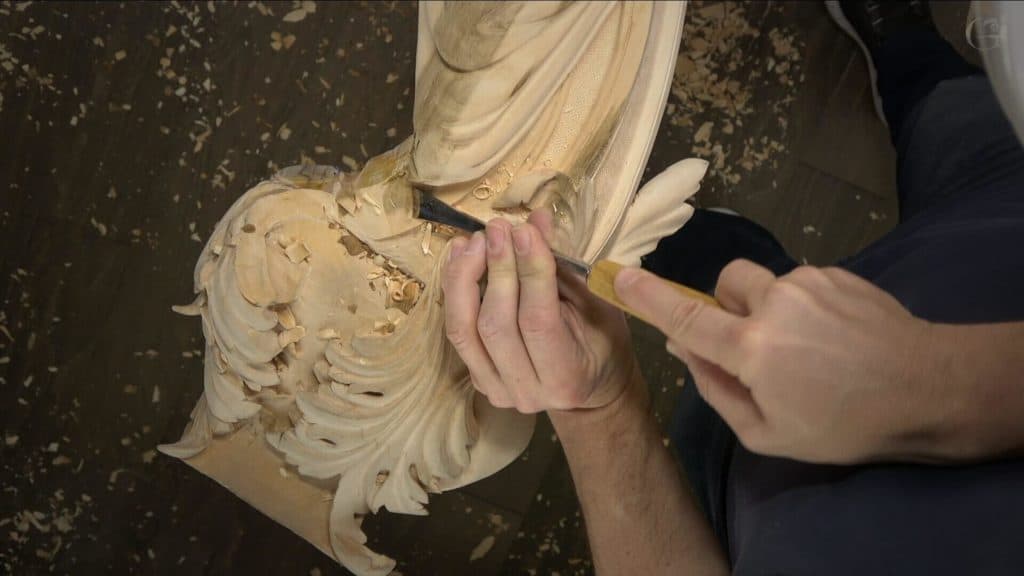
Alexander Grabovetskiy, woodcarver, School of Woodcarving · Published 2021
What does a wood carver mean by "clean again"?
Quick answer: In part 12 of workshop 101, once the veiner is enough, I pick up a number three, 20 millimeters (0.79 in), for a cleaning pass. Elsewhere in my courses a line like it comes with a tool of its own, such as a number 11, a back bend or a knife.
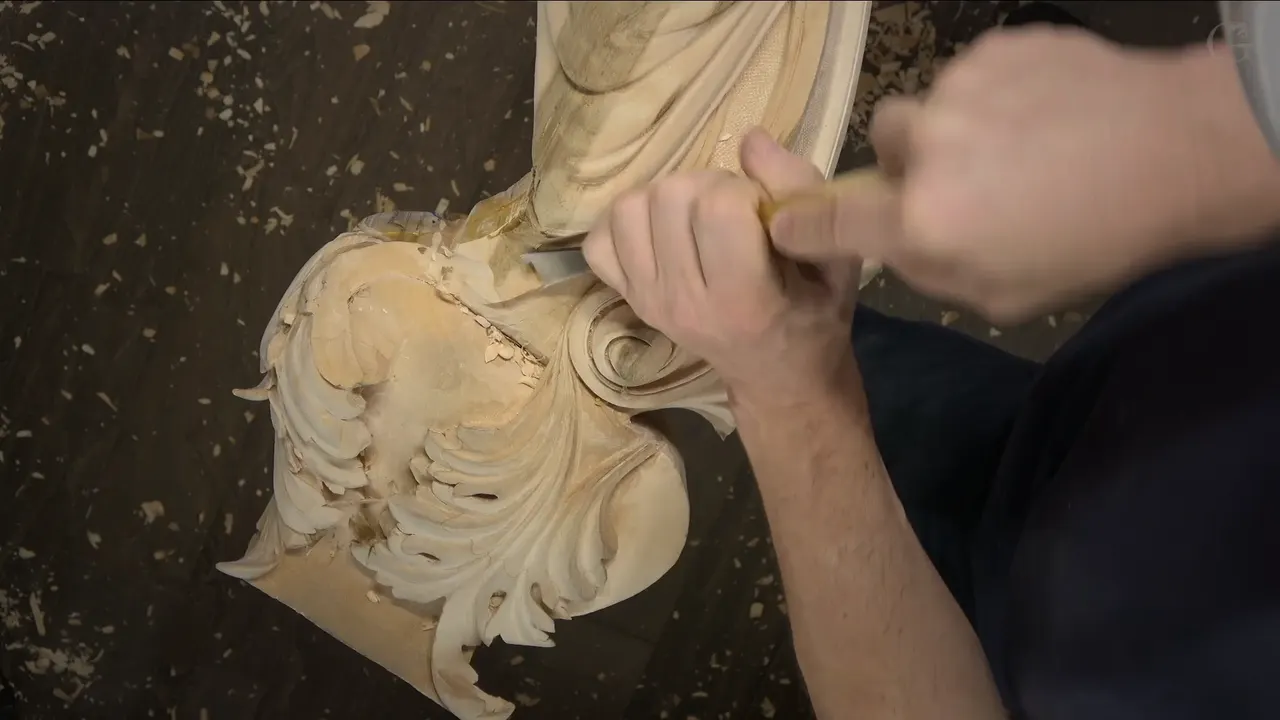

In workshop 101, part 12, I say "I think it is enough" and then "Let me clean it again with number three gouge and three-quarters of an inch, 20 millimeters." Other lessons of mine have a line like it, with another tool each time. I read them next to this one.
Ever carved a section, looked at it and wondered how to clean it once more without hurting it? This video is short, so I put it beside the places in my other courses where I say it. Each place links to its public lesson. Workshop 101 belongs to my Venice Room Part 9 course, it is wood carving, and every size is in millimeters and inches, my own figure first.
What do I do in part 12 before the number three?
A first remark is "I think I'm happy." A plan follows: "Next, what I have to do, I have to jump on a side and continue development of my acanthus." One job comes first, "But let me little give a cleanup job to this section, take just number three."
A need comes in: "of course, I need to fasten it because it's moving." The tool I plan is "number 11 and 10 millimeters" (0.39 in) to "get underneath of my drop or closed drop."

Where does the number 11 sit under the drop?
"And yes, I'm just using that with my flute," I say, "In my case, that would be 9:00 o'clock, just almost just on a side." The next words are "that's going to give me really nice chance to undercut it really nicely."
Sizes come down from there. I say "I could probably use already smaller number 11." In the next line, "Yeah, I'll take number 11 and 5 millimeters" (0.2 in), "3/16 of an inch" (4.8 mm), "and get my cut a little deeper." A thought follows, "Maybe I should take 2 millimeters. Let me do 4 millimeters" (0.16 in), "and then I'll jump on a 2 millimeters" (0.08 in).

How small does the veiner go before I stop?
I report "So now I'm using 4 millimeters" (5/32 in), and plan a veiner of 2 millimeters (5/64 in). My word on that size is "I would say 2 millimeters number 11 veiner is sufficient, but I could go to extreme and use number 11 veiner and 1 millimeter" (0.04 in) "and create even nicer shadow."
The 1 millimeter stays an option. What I say is "And I think it's enough" and again "I think it is enough." Last, "I really don't want to overdo it."

What does the number three do after that?
Here is the line this page is named for, and the lead has it in full. Three-quarters of an inch is 19 mm, and the 20 mm is 0.79 in. The tool is a gouge. It follows my decision that the veiner has done enough.
I describe the other side as well: "that part is going to come from opposite side. You don't see that, but on the opposite side, it's going to just continue that movement and then roll it on this side." Right then, "So now I can probably concentrate on my side."

What did I say about the back of the piece?
"So now I've partially can see the backside of my carving, and that's what I was talking about previously. I have some drawings on the backside that I translated that on another side." My plan is "to develop this side and continue that to the corbel actually pretty much" with a "convex right in the middle."

Next I look at it and say "clearly, you can see the backside of it, and you can see what I've done." A pause and a thought out loud follow: "Let me think how I going to approach it. Maybe I need to lower that down slightly and see."
What bothered me about the chunky side?
"Obviously, I need to take care of this side. It doesn't look too good. It doesn't look too good because it's too chunky, and it doesn't give me really nice movement."

For that side I plan "I'll create some kind of roundness on this side." A second spot is "And I also don't like what I've done right here." Then "So let me chop this out."

The last lines are about where the two sides meet: "Somewhere there's going to be some kind of connection point." Then "They have to just interact" and "I'm talking about this side and that acanthus."
What came right before this cleaning?
Part 11 plans a gouge of "number 7 and 14 millimeters" (0.55 in) for "my clean-up cut all the way like this." Near its end comes "Number three upside down, and I need to make sure the surface is actually really nice and clean and smooth." Cleaning there is with a number 11 of 10 millimeters (about 2/5 in).
Part 10 holds a check: "that's a good idea for me to measure now just to get the straight edge and just to check if I'm there or not." Of a gap there, my words are "One millimeter is not a big deal in this case anyway" (about 1/25 in).
Where else do I say it, and with which number 11?
Workshop 65 puts it in Venice Room 65, part 10, with "just seven millimeters, number 11" (0.28 in). I add "So I've got the pipe" and then I name "the eye."

Venice Room 43, part 9, opens with the same words and goes on "Just clean it with the same number 11. That's pretty much I'm using most of the time on this job." A caution follows: "if I'm going to excavate too deep underneath" and I would not be able to blend it nicely.
Workshop 21, in part 3, has the same words with number 11, then "let me use two millimeters again" (about 1/13 in). Soon after: "Okay. That is good."
Part 2 of Venice Room 140 names a number 11 of "7 millimeters. Little bigger than quarter of an inch." Seven millimeters is 0.28 in, and a quarter of an inch is 6.4 mm. A smaller one is in mind: "I can actually use even smaller number 11, maybe about even 4 millimeters" (0.16 in).

Over in Venice Room 83, part 1, a smaller tool arrives in the same breath: "and maybe with a smaller tool right away, like one and a half millimeters" (0.06 in).
The Hashemi course turns up in Hashemi Flowers 11, part 5: "Okay, let me now take number seven. Big number seven. One inch" (25 mm). A veiner follows: "And clean that again with number 11." Its goal is "I want to make it look like it's going all the way underneath. That's going to be somewhat like a deep undercutting."

That video also tells why the tool wiggles: "the reason why I'm wiggling right now, because that is end grain going this way, and that's kind of hard to cut with that tiny, small tool."
Which other gouges follow it?
In Furniture Panel 18, part 2, my tool is "number 11. There is more ways, of course, to clean it." An idea follows: "Actually, probably I need to chop with the number one, small number one, okay? Because it has a slight curvature."

Part 7 of that lesson uses the line with "number nine. Or you could use actually a little flatter gouge, to clean that area. Let's say like a bigger number four or so." It adds why that is optional: "I don't have to do that because I'm still going to use a router plane, but just to prove a point so it's possible."
Furniture Panel 20, part 6, is shorter: "And now I can clean that again" and then "number six." A remark on the work follows: "those volutes and movements on a shallow carving, they are a little different from full three-dimensional carving."
Just before workshop 101 sits Venice Room 100, part 5, with a number seven. A spoon is on my mind: "Although that would be good idea to use spoon" and "maybe even small spoon." Later it is "But this one doesn't work. I have to use different one."

A bent tool turns up in Hashemi Flowers 17, part 2. The line names "number five at the back bend." My reason is "because I have a goose neck right here, so I'm still able to work around."
Acanthus over Moldings 5, part 1, has the phrase and then "I'm going to just go ahead and take. Backbend. I want to be safe. I really want to be safe." The same lesson plans to "blend all of those facets."

What about a V-tool, a knife, a skew or a flat chisel?
The Q and A course has a video on a dotted background: "what I would do, I would take, again, a v-tool, the really tiny v-tool" and the line follows. The result is "you don't see any leftovers. You don't see any chips, and the carving is a really clean carving right now."
For Greek Acanthus Leaf 6, part 4, the tool is "I'll use a knife" and the aim is "To make my kind of undercut right in this area." My mood there was "I am somewhat happy, although not completely."

A different choice is offered in Greek Acanthus Leaf 3, part 4: "I'll clean again with just a V-tool. You could clean it with the knife. It would be exactly the same result."
Part 9 of Venice Room 51 has "Let me clean it first." The plan is "with just a skew chisel." Next comes "Yes, I'm still going to develop it."

Greek Acroterion 5, part 6, says the line with "my grouting tool." For viewers without one, "if you don't have a grouting tool, any flat, small chisel will do."
Workshop 8 of the Dining Table Apron course has the same words, then "What I'm doing right now, I'm actually doing a step cleaning. It's how I call it. It just looks like it's stepping." It is done "With the flat carpenter's chisel, I'm establishing one point. I'm resting my chisel on just the one end of it, and I'm kind of moving toward, like making a step."

How small can the tool go, and how much do I leave?
Depth leads off in Venice Room 90, part 7: "I've got about 3/16 of an inch deep, five millimeters, and that's plenty for me." The 3/16 in is 4.8 mm, and the five millimeters is 0.2 in. Next, "So don't want to overdo what I don't have to overdo." Then come "the two millimeters" (5/64 in).

Floral and Molding for the Panel 6, part 1, goes "looks like quarter inch is a little too big. So again, I need one-eighth of an inch." A quarter inch is 6.4 mm, and one-eighth is 3.2 mm. A later remark is "probably a couple more passes."
Lily Box 11, part 1, goes "Maybe even with the one millimeter, pretty much. One millimeter, and that's it" (0.04 in). Also "once we're going to put the final detail, it's going to give us even more dimension."

Leaving some wood is the point in Venice Room 88, part 1: "I'll take number three." I left "approximately a 16th of an inch to my final line" (1.6 mm), "little bit for the cleaning operation." Last on that point: "It's always good idea to leave a little bit."
In Furniture Panel 27, part 2, I plan "that rest of it, I can remove it with just the gouges." A warning follows, "Again, don't wanna go too deep." Later it is "maybe even with the number three."
Venice Room 89, part 3, tests a new tool: "This is a brand-new one I didn't use yet. So I want to try it." Afterward: "See, it takes out, right away, pretty much the high spots." I add "on the camera, you don't see that high spot, but I can feel it with the finger. And now, that rasp helped me actually establish a really nice and smooth transition downhill."
Is it ever said about a first try, or about sandpaper?
The beginner Kitchen Cutting Board 10, part 2, says "if it's not going to happen at the first try, don't worry about it. You can always come back" for the same pass. Then "But I'm really happy. It's really, really smooth."
A sharpening video, Sharpening Back Bent Gouge, has "So 6,000 now" and the phrase after it. Its next line is "It's just a really nice quality sandpaper."
Which passages name a tool and a size?
| Lesson and part | What I name for it in that video |
|---|---|
| Part 12 of 101 | Number three over the section, once I call the veiner enough |
| 83.1, Venice Room | Smaller tool right away, like one and a half millimeters (0.06 in) |
| 65.10, Venice Room | Number 11 for the eye |
| Hashemi 11.5 | Veiner, number 11, after a big seven of one inch (25 mm) |
| Hashemi 17.2 | Back bend, number five, to work around |
| Panel 18.2 | Number 11, then a small number one to chop, because of a slight curvature |
| Panel 18.7 | Nine, or a flatter gouge like a bigger four |
| Panel 20.6 | Number six, then a remark on shallow carving |
| Acroterion 5.6 | Grouting tool, or any flat small chisel |
| Q and A | A V-tool, the really tiny one |
| 43.9, Venice Room | The same number 11, with care about going too deep underneath |
| 51.9, Venice Room | Skew chisel, with a plan to develop it after |
| 90.7, Venice Room | The two millimeters, after plenty of depth |
| Apron, workshop 8 | Flat carpenter's chisel, moving and making a step |
| Panel 27.2 | Maybe the number three, after the gouges take out the rest |
| Acanthus Leaf 6.4 (Greek) | Knife |
| 140.2, Venice Room | Number 11, maybe a smaller one after |
| 100.5, Venice Room | Seven, with a spoon in mind |
| Moldings 5.1 | The back bend, to stay safe |
How do these passages line up with part 12?
- In part 12 the number three comes after I call the veiner enough.
- Elsewhere I name veiners, back bends, V-tools, knives, skews and flat chisels, each in its own lesson.
- Some of them name a size, and some name how many passes are left.
- One names how much wood I leave to the final line.
Here the number three goes over the section, and then my eyes move to the side that is too chunky. Which spot on your own carving would you clean again, and with which tool?
How it's done
- Say what you are leaving. Before reaching for the number three, I called the veiner enough and did not push it further.
- Take the gouge for the cleanup. A number three was named for the cleanup job.
- Look at the other side. The opposite side was out of view, and the movement continues there.
- Check the side that is too chunky. The chunky side got a plan of roundness.
- Plan the meeting point. A connection point was named, and the two have to just interact.
Frequently asked questions
Which gouge cleaned the section in part 12?
A number three, picked up right after the veiner was enough for that area.
Which veiner sizes did I name there?
Number 11 veiners from 10 millimeters (0.39 in) down to 2 millimeters (about 1/13 in). Going to 1 millimeter (about 1/25 in) was an option I named, and I did not take it.
Why did I want the number 11 under the drop?
The flute at 9:00 o'clock, almost on a side, would give me a really nice chance to undercut it really nicely.
Which other tools do I use for it in other lessons?
What to carve next