

Alexander Grabovetskiy, woodcarver, School of Woodcarving · Published 2021
What does a wood carver mean by "a continuation"?
Quick answer: The first part of workshop 102 has the word in one sentence about the acanthus and "this movement." Workshops 91, 103 and 152, and the Furniture Panel, Byzantine Acanthus and Grape lessons, use it for strokes, concaves, moldings and leaves. Each one is read with the lines around it.
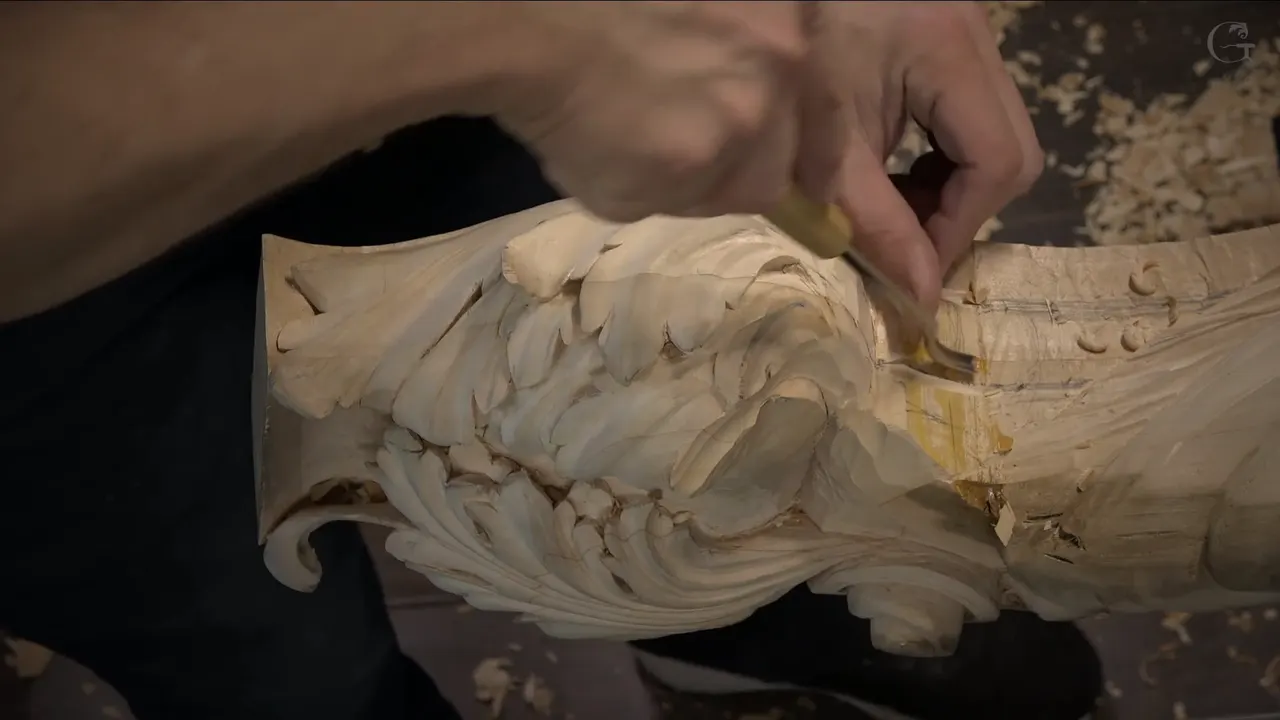

The word "continuation" sits in part 1 of workshop 102, said of the acanthus on the opposite side of a corbel. Other wood carving lessons of mine use it for strokes, lines, leaves, moldings and a shell. Each passage here is read with the lines around it.
Ever stood over a carved round middle and wondered where it carries on to? Workshop 102 comes from my Venice Room course, and the lessons below use the word too. Every size is in millimeters and inches, my own figure first.
Where does the convex go on the corbel in workshop 102, part 1?
It carries on to the opposite side. The line is "it's going to continue on the opposite side of the corbel." Before that, the opening cues are a search: "so now I need to find the line" and the idea of where the convex goes, "right in the middle." Another line reads "it still has to just be in line with overall design."

One section is "going to die somewhere right here in this spot" and I think it would be "appropriate to start my convex right on this line." Width comes next. "I don't want to do too wide. It's not going to look as nice, but I'll step approximately an inch and a quarter, maybe about 35 millimeters or so this way" (31.75 mm, and 1.38 in). Then the figure is smaller: "I'll just step about an inch" (25.4 mm).
The sentence this page is built on comes now: "So which means this acanthus, this side of acanthus, going to be a really good continuation of this movement, okay?" Doubt follows. "I'm just not quite sure if I should leave little bigger space right there." The tool plan is "let me take a number 11 and 5 millimeters and create preliminary cut on both sides" with 5 millimeters at 0.2 in. Soon after, "I'm going to need a spoon, 5 millimeters veiner."

Grain has its own line: "I have to attack it from the opposite direction. Grain changes direction, so I have to work with the grain." A shadow gets one as well: "a really good shadow spot in this section, create a really deep cut." Then comes "I have plenty of material till this corner, this edge, so which means I'm able to create beautiful shadow cast."
Flow is the test. "I have to keep an eye how it flows, this line." Then "So if you look from different point of view, so it has to be really nice and flow and continues this way." The next line is "Otherwise, it's not going to look as nice." It matters to wood carving in general, and to "any type of art." Then "Everything's supposed to flow nicely."

Depth closes the part. "And that's the question, how deep I want to go?" Next, "number seven will do. Number seven, 14 millimeters, half an inch, and I'll chop some of the excess right here" (0.55 in, or 12.7 mm for the half inch).
What happens to the movement in parts 2 and 3 of workshop 102?
Part 2 has "I want to leave approximately 6 millimeters" (0.24 in), "from the edge to the upper ridge" and "another 6 millimeters right here." Later: "So I've got about half an inch right now, I would say, to the lower spot. So that is plenty, that is enough, and that would be mistake for me to continue cut."

An extra shadow is only a possibility here: "I could actually create the anti-hero and create some concave on this side" and, in the same breath, "cast some shadow." Next, "And here is the line of the movement, but I don't know if I like it or not, what I see." A tool question closes the stretch: "Why am I using big one? I think I just have a lot more control."

Part 3 turns to a concave. "Maybe even you don't see it, but if you place a tool, there is a concave." Later: "you can see that concave goes and dies in, and that is the back line of it, the back line of our overall movement. So I can actually go to that line and work my way around that."
Blending is next. "I also need to blend that really nicely and smoothly." One line names a flaw, "Right now, it's just a little choppy, and that's not really good." A gouge comes next in the plan: "number three gouge, wood carving gouge, and blend it nicely going that direction."

On the pipe: "I have somehow exaggerated some kind of pipe, and it's going to go, but not all the way." It is "more indication than a really exaggerated one." One stroke changes direction: "Right here it's a marriage line, so I need to cut this direction." Part 3 ends with "You can catch the movement of this pipe, but then it blends in, and that is really what I'm after."

Which Venice Room workshops say it?
Workshop 11, part 12, comes from Part 1 of the Venice Room, and the words are "the movement of acanthus." The next cue holds the word "continuation" with "this side." A plan follows, "I need to probably give the right direction to it." Later in that part: "I'm able actually to dig deep and create a really nice shadow there." For the tool, the plan is "let me use number 11 and 7 millimeters and excavate" (0.28 in).

Workshop 17, part 10, belongs to Part 2. A thought about the shell part says everything is "moving with the same directions." Later: "continuation of the big-- It's still the shell." Then "I have to do a lot more stuff to it, okay? But this part is also part of same shell. That's huge shell right there."
A stroke carries on in workshop 91, part 4, from Part 8: "I want to create the cut like this, for it would look more natural." Then "a continuation of this cut." After it, "And even deeper in this case, again, for the shadow's sake." Later in the part, "Number three, upside down. That's what I'm using, okay?"

The 152nd workshop comes from Part 13. Its first video starts with a plan, "let me establish 3D form first." Then "you should be able to see the big idea. So pretty much what it is, it's a continuation of the movement on another side." It starts "somewhere right here" and sits "just about on the same line."

Closer to home, workshop 101, part 11, has "that side has to bend in" and "a continuation of design." Then "All I need is just a little bit of exposure of this corner" and the next words say "architectural." The plan after it is "I'll just create cut straight down."

In workshop 103, part 2, I say "you should be able to catch the idea what I'm after. So I've got that continuation of that movement on this side. Although it's not as clean as I would love to see it, but I'm getting close."
Part 3 sets the word beside a concave, and later beside a slope. Grain comes first: "it has to go this direction, but it is against the grain." Then "So I'm happy. So that is actually a continuation of that concave right here on this side." Later the talk is of a slope and "nice transition."

One more plan sits further into that part: "I want to try creating a concave" and then "I'm not quite sure if I want to do that or not. Let me think first, okay?" Then "I just get that cut all the way to that previous groove, to the previous veiner cut, just like that."

What do the Furniture Panel lessons call a continuation?
In Furniture Panel 24, part 2, a piece can go two ways. One is "a part of a big flower." The other is "a continuation of my molding, like this piece, straight piece." The pick follows: "Both would be legit, but I think I would probably just stick with the original idea."

Furniture Panel 39, part 1, gives a number 11 at "two and a half millimeters" (0.1 in). A sentence there starts "I do have, um, continuation" and ends "if you can see this line right here, which is gonna be on this side, but I don't remember why I did, uh, kind of this way slightly."
In Furniture Panel 30, the first video of that lesson carries "and that's continuation" and ends the sentence on "of this molding." A size follows, "One millimeter and a half, that's the most" (0.06 in). The shape plan is "the upper part gonna be raised up slightly and then it's gonna go slow, slow, slow, going down." The volute sits in that plan, and continuity of curves is the math behind a line that carries on.

Which other courses carry it?
In Byzantine Acanthus, lesson 3, part 1, the word follows a talk about a center line: "there is somewhere going to be an invisible center line, right in the middle somewhere." Then "They're supposed to be connected to that central line. Just a continuation" and a rule follows: "you really have to be flowing. Everything's supposed to flow to the same center line." The frame below shows three marker pens beside the board, and more is in the full Byzantine Acanthus course.

In Grape Leaves vase, lesson 2, part 3, the line is "Although I don't see continuation everywhere." Then "with the number three, I can create the cut blending just like that to where this section, just make it lower. That is not the final depth yet." On crossings: "wherever you see intersections, areas like that or just the stem going or whatever you call it, stem or middle line, whatever you call it. So we can just blend it."

Grape Onlay 11, part 2: "I also don't wanna lose the movement of the leaf." Then "I've got the moving this way, that way that is continuation of, uh, the leaf and, you know, goes from this side." After that, "I have to excavate right underneath of it."
In Grape Onlay lesson 4, part 2, the words are "continuation somewhere." The picture is "this part gonna go right underneath of that section, continue movement on this side." Later: "this part, it's a continuation of, uh, overall motion right here. I need to excavate some space for myself."
Part 3 of that lesson has "create some kind of continuation" and then "whatever that part is right here." I add "I know it didn't make sense at the beginning." A word of advice follows: "I would just highly suggest you just start carving and that form gonna jump on you. You'll see much clearer once you're gonna start carving."

The Tray of Blessing, lesson 5, part 1, holds a choice: "that stem is a continuation of my, like vein on top of, uh, the main vessel, the juice vessel of the leaf." The other choice is "do I wanna do this one lower and then create kinda, you know, almost like a valley connecting point." Close by, "I think both ways legit. But what's gonna give me more shadow if this one is gonna be excavated little deeper."

Where do the frames come from?
Every picture here is a frame from the videos named on this page. Eight come from workshop 102. The rest come from workshops 11, 91, 101, 103 and 152, the two Furniture Panel lessons, Byzantine Acanthus 3, the first Grape Leaves lesson, a Grape Onlay lesson and Tray of Blessing 5. A mallet lies near the clamps in the frame from workshop 152.
Lesson by lesson, what carries on from what
| Lesson and part (Venice Room unless named) | What carries on |
|---|---|
| 102.1 | The convex runs on to the opposite side |
| 102.2 | Extra shadow planned from a concave, and a big number seven |
| 102.3 | A concave that dies into the back line |
| 103.3 | Concave, slope and grain |
| 103.2 | Close, not yet clean |
| 101.11 | A side that must bend in, and a corner with a little exposure |
| 91.4 | Stroke that carries on |
| 152.1 | A movement on another side, on about the same line |
| 17.10 | A shell that goes beyond the part in front of me |
| 11.12 | The acanthus, and a deep dig planned underneath |
| Furniture Panel 24.2 | A piece that can go two ways |
| Byzantine Acanthus 3.1 | Leaf points that connect to the center line |
| Grape Leaves 2.3 | A line about not seeing it everywhere, and a blend at the stems |
| Grape Onlay 11.2 | A leaf movement that I do not want to lose |
| Tray 5.1 | A stem that joins a vein, or sits lower as a valley |
Is there a round middle on your own bench that has to carry on to the other side? Everything in this lesson sits inside one tuition plan, and more Venice Room workshops wait on the Part 9 course page. For a gentler start, try the Grape Leaves vase course or the Furniture Panel course.
How it's done
- Start with the search. Part 1 opens on "so now I need to find the line."
- Choose how far to step in. Two widths are named, and the later one is smaller.
- Say where it goes next. The acanthus there picks up the movement.
- Watch the flow. Flow is the check: "It has to flow nicely."
- Find the end of the concave. In part 3 the concave "goes and dies in."
Frequently asked questions
What does the first part of workshop 102 say goes on around the corbel?
The convex. It continues on the opposite side, and the acanthus there takes up the movement. That comes straight after a talk about width.
How far does the convex step in from the edge?
The first width is "approximately an inch and a quarter" (31.75 mm), with "maybe about 35 millimeters or so" (1.38 in) beside it. The later one is "about an inch" (25.4 mm), which I call better.
Where does the concave end in part 3 of workshop 102?
It dies into a line at the back of the whole movement, and the cue says "work my way around that."
What to carve next