
Alexander Grabovetskiy, woodcarver, School of Woodcarving · Published 2021
What does a wood carver mean by "take it to extreme"?
Quick answer: In Venice Room workshop 102, part 12, I name a one millimeter veiner (0.04 in) that could give a clean split, and my next words say this section does not need it. In my other lessons the extreme sits beside art pieces, fragile leaves, a customer's price and the work I like.
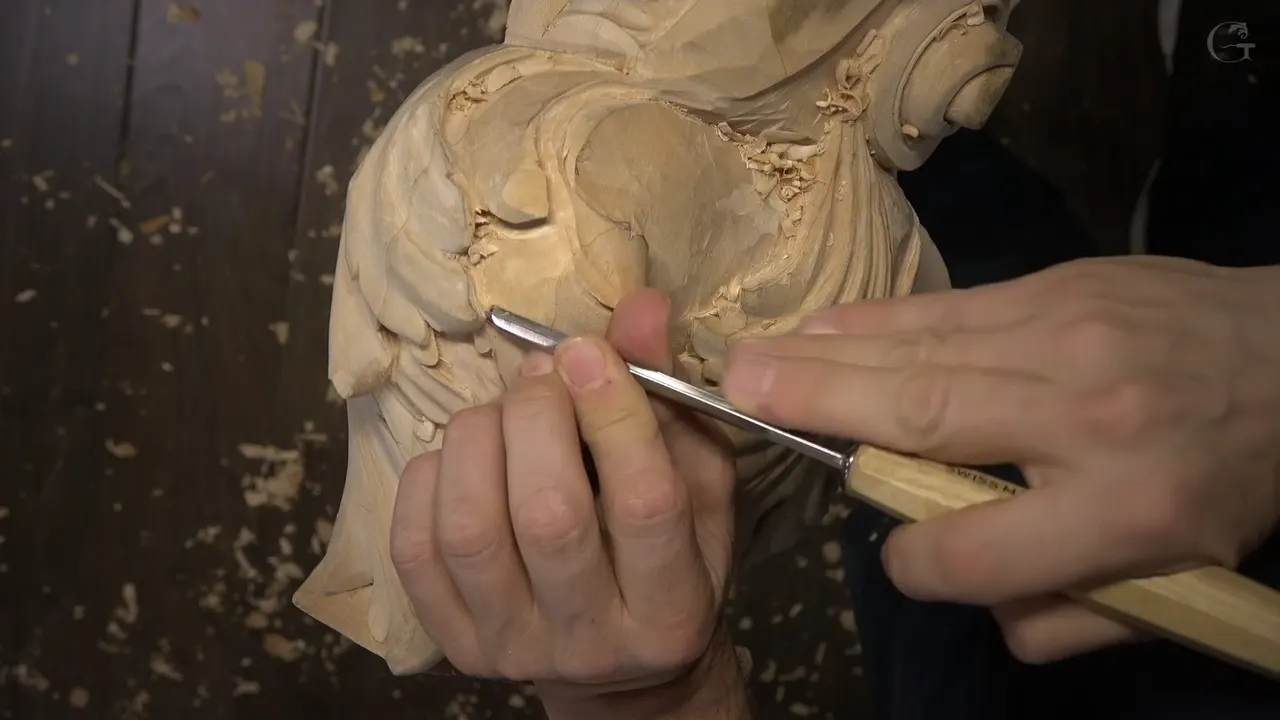

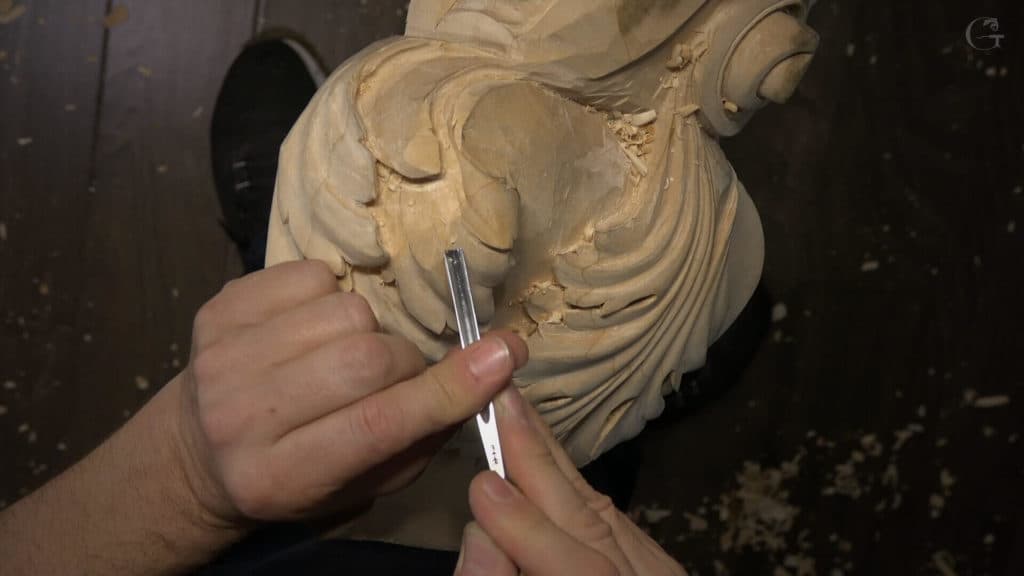
In part 12 of workshop 102 I tell you the extreme is possible for one section, and I follow it with a plain line: that section can do without it. Other lessons of mine set the same word beside art pieces, thin leaves, a customer's price and a leaf I do push far.
Ever stood over a hollow that you could still make deeper? Did you stop to ask whether the wood needed it? This part belongs to my Venice Room Part 9 course, a corbel carved in the style of Venice. The other passages come from Venice Room workshops 5 and 9, and from my Hashemi Flowers, Roman Acanthus, Corinthian Acanthus, Lily Box, Furniture Panel, Grape Onlay and Grinling Gibbons Maine class lessons. Every size is in millimeters and inches, my own figure first.
What do I say in part 12 of workshop 102?
The part opens on a clean surface: "I've got lots of junk, but it's clean now, and I can leave it like that." One job is left underneath that area. My plan for it is four millimeters (0.16 in). "I think it would be really good," I add, and the undercut follows: "And create my undercut."

Two millimeters (about 1/12 in) is back, with "let me try a straight one, just a normal veiner." A verdict arrives. "Okay. That's good. I think that is good." Another spot needs a clean-up, "the area right here" and the idea is the same: I would probably take two millimeters right away.

Then comes this: "Okay. And yes, I could take it to extreme with one millimeter, number 11, and create really nice separation." My next words are these. "But I don't really need to in this section." Then "There's no reason." For the rest, I can probably "just give it some clean-up job with knife, a small, tiny knife" and "I can take it right to the edge."

The sizes shift after that. A 2 mm tool (0.08 in) is for "all that mess I just created right underneath." Next, "I think I need one millimeter." On depth I say "And I can get as deep as I wish." On the mess: "All that fuss is just loose pieces."

Next is a shape job, which I call "not really fix." I got rid of two concaves, one on this side and one on that, and I say "I need to create the concave." They will be "not so deep." Number seven comes first, hedged with "I would say" and "Let me think" follows. I settle on number nine, "and kind of blend that in." The work itself is "Pretty much just blending."

The part ends on plans again. "I still have to create the shape of this piece or this small section." I might add a couple of concaves with a convex in the middle, "like I've done on another ones." My final words wonder aloud "which one I should use."
How do parts 10 and 11 sit beside it?
Part 10 of the same workshop brings a number 11 down in size: 2 mm (0.08 in), then "maybe even one millimeter" then "half a millimeter" (0.02 in). Nothing in part 10 uses the word extreme.

Part 11 goes after depth. I say I still have to undercut "to separate upper part from the lower part" and I say "I can remove a lot more material from this section and create even more shadow." Later: "I'm happy I made that decision to create the extra shadow spot." Even there I say I "have to keep an eye not to break overall movement, not to break overall flow." The other side is in part 12: I could push it, and I say I don't need to.
Which pieces get the extreme from me?
Hashemi Flowers 15, part 4, has a detail that is "commonly used in ecclesiastical, like a church carving" and I say those carvers "would leave it just like that." Mine is another job: "we are making piece of art." For me that means extreme work. I plan to excavate "this wall," which "is not good" and to undercut one side "that direction." The result, I say, "just flips." For more on the church side, see ecclesiastical art.
Corinthian Acanthus 5, part 1, draws a line. "Some people saying you should not do that, and that is probably true if you're doing that for furniture." Heavy use, hands that touch it "all the time," or a piece set against other pieces: for those I would not suggest extreme undercutting. A piece of art is different. "I really like to do the extreme undercutting." And some of my work is "so much undercut it can easily break."

In Roman Acanthus 10, part 1, the piece is "more decorative, ornamental" and I can frame it and place it on the wall. For a piece like that, "if it's more artistic, if it's not practical like for furniture," the extreme is open to me. My tool is "number five, quarter inch" (about 6 mm), and I add "the idea is not to rush."

The second part of that lesson says it this way. "I really like to go all the way to the extreme, which means sometimes I make my leaves almost like a paper-thin." The look is "a really unique, almost like someone said airy." Venice Room 5, part 1, carries the same words.
The third part names one tool for the job: "probably the only tool I could use to get it to the extreme, it's the back bent." The tool is a number five sweep, only 3 millimeters (an eighth of an inch). With it I can "raise it and still able to make my undercut as deep as I wish."

Does the extreme cost anything in my lessons?
The cost has a name in the second part of Roman 10: "when you do an extreme undercutting like I'm doing most of the time, you really have to control your tools and feel what you do." The reason is a fragile piece. "When the piece becomes really fragile, most of the time you can't fix" those mistakes.
Lily Box 11, part 8, has a piece that people touch. I say that if I can keep some spots thicker, I should, because "I don't want to make it too weak." Going extreme was open to me, and I say "I could go to the extreme and make it really weak." But "people are going to probably touch it" and I want it "solid to touch." My goal is to "look fragile, but still stable."

In Venice Room 9, part 9, the cost is paint. I have to think how I will paint it and finish it, and the same applies to the eye. An eye could run on until "I lost the point that how I'm going to get paint inside." So the depth gets thought out ahead. The plan: "It's going to be deep, but not as deep."
Floral and Molding 13, part 1, makes it paint again. On "projects you saw in magazines and all over online," I took those to extreme. This one "will be painted" and it is chalk paint, "not just penetrating paint." That means "a lot of those facets, what you see, will be completely covered with the paint."
Hashemi Flowers 40, part 1, adds time and money to the list. "There are certain rules I have to apply to different types of projects." For this customer, "we agreed" that I'm "not going to go all the way to the details." My reason: "the time frame I have to spend and what they expect." Then "The price, of course."

When is it enough for me?
Furniture Panel 17, part 5, has a stop for now. I call the area "kind of tiny" and "still important." Everything gets refined once we work on details, "but I'm happy with the result as of now." Next I plan a number one to "chop right on the line."
Over in Furniture Panel 20, part 8, I undercut one side, and it "looks like it's flipping nicely and still creates the shadow underneath." My own words there: "And yes, I could go to extreme and do even more than that." And "I don't really have to." The next job is a half-millimeter number 11 (about 1/50 in) on the other side. A magnifier lamp may be needed. The wood is dark, "really hard to see sometimes."

Earlier in that lesson, part 1, I say "I really don't have to," though "it's still possible to do." It would give "really interesting movements" and "I do like curly flowers in my wood carving."
A stopping line sits in Hashemi Flowers 49, part 9. "I'm not going to do any more refinement of this piece." Going further "can be even more beautiful," but it will be "enough for this particular project." Afterward I clean it, "blow it with the air compressor" and plan to try the flower on.
Grape Onlay 13, part 3, hands the choice over. I am "approximately at the depth that I am after" and whether to go further is the viewer's call: "it's up to you."
The in-person sharpening class has it on a wheel. "No tool marks, no nothing, right?" Even so, it is "not the end yet." Going on to 6,000 is possible, "whatever" and I decide against it. A leather wheel or a felt is next.
Which lessons say I like it?
The plainest answer sits in Hashemi Flowers 7, part 4. I reach for "a quarter-inch number nine" (about 6 mm) and say "I know I am taking it to the extreme, but that's the way I like." Right after: "I don't want to overdo it." Number three is next, to "take a little bit those ridges out."

On a leaf in Hashemi Flowers 8, part 1, I see the extreme open on one side, and I name "number nine or number eight." I plan number nine at 10 millimeters (0.39 in). The run goes down to the bottom of the leaf, "to the edge."

Two lines come from Lily Box 4. In part 6 I say "Okay, I like that effect" and I add that I like going that far, actually. Then "But I'm going to leave it just like that for now." A size comes in part 11: "I could actually cut with the half a millimeter, even deeper groove" (0.02 in). That spot is "kind of tricky." It "doesn't let me cut really deep."

Grape Onlay 8, part 3, I name "two and a half millimeters" (0.1 in) again and plan to "create my undercut." Here I say I can "just excavate to the extreme" until the carving looks "glued together," though it is "a solid piece."
Furniture Panel 19, part 12, has a tool and a size. The tool is a number seven of "6 millimeters quarter inch" (0.24 in), and "I can take this part more to the extreme." Earlier in that part I note that even "1/32nds of an inch" (about 0.8 mm) "still casts a lot of shadow."

Next, Grinling Gibbons Maine 16, part 2: "Actually I really love how it looks." The extreme is open there too, and "That's probably what I'm gonna do," though "the stuff it's just impossible to see you know on the camera."
And Design Principles 4, part 3, puts it on a golden ratio. I talk about divisions, spacing and lines resting on that ratio, and I say "more you take to the extreme, more beautiful it's going to be," though it is "going to take longer time."
Where do the lessons line up?
| Lesson | What I said about the extreme in each lesson | Step | What came along with it afterward |
|---|---|---|---|
| Venice 102 Workshop | Veiner of one millimeter could do it | Number 11 | Unneeded in this section, I say |
| Corinthian Leaf 5 | Art pieces get the extreme from me | Extreme undercutting | Not on furniture that people touch |
| Roman 10 (Acanthus) | Sometimes my leaves are almost paper thin | Really fragile | Those mistakes mostly can't be fixed |
| Room 9, Venice | Until I lost how paint gets inside | The eye | So I have to think ahead |
| Lily Box 11 | I want it fragile looking, still stable | Thicker spots | Used daily, and people probably touch |
| Floral Molding 13 | Not needed like on my magazine projects | Chalk paint | A lot of facets get covered |
| Panel 17 (Furniture) | Happy with the result at that stage | Details later | Extreme isn't needed as of now |
| Lesson 40, Hashemi | Detail work stops short, by our agreement | Time frame | The price and what they expect |
| Panel 20 (Furniture) | Curly flowers are something I do like | Interesting movements | Still possible to do, I say |
| Hashemi 15 (Flowers) | This one is art, not church carving | Excavate wall | Then undercut this side that direction |
| Onlay 8 (Grape) | I can just excavate to the extreme | Half millimeter | It looks glued but it's solid |
| Maine Class 16 | Actually I really love how it looks | Different tools | Impossible to see on the camera |
Where are the pictures from?
Ten of these twenty frames are from workshop 102 itself, on the Part 9 course page. The others sit beside the lesson they came from, and a tool, often a chisel or a gouge, is in a hand in most of them. Every lesson I name is inside the school.

Is there a spot in your own wood carving that you could take further, and don't need to? Could you say so out loud and go on? Everything in these lessons sits inside one tuition plan, and more of this corbel waits in workshop 101 and workshop 103.


How it's done
- Pick the tool for underneath. Part 12 names four millimeters, then two, and a straight veiner I want to try.
- Look at the next spot. The area right here needs a clean-up, with the same idea as before.
- Say the extreme out loud. I tell you I could push the work with a veiner of one millimeter, for a really nice separation.
- Say what the section needs. I tell you there is no reason for it in this section.
- Give the small knife a job. The clean-up can probably go to a tiny knife.
- Move to the concaves. I need the concave back on each side, and my plan is number nine to blend it in.
Frequently asked questions
Which tools did part 12 name?
Four millimeters (about 5/32 in) came first for the area underneath, then two millimeters (about 1/12 in) and a plain straight veiner. Later I named one millimeter, number seven and number nine, and a number 11 closes the part. A small, tiny knife was my hedged pick for the clean-up.
Did I go further with the one millimeter veiner in part 12?
My words were that I could, and then that this section can do without it. Later I said I thought I needed one millimeter, and I spoke of going deep. I named a small knife for the clean-up, and I said I can take it right to the edge.
Which lessons say I like going far with it?
Parts 6 and 11 of Lily Box 4 do. Roman Acanthus 10, part 2, says I push to the extreme and make leaves almost paper thin, and a Corinthian lesson says I like extreme undercutting on art pieces. Venice Room 5 repeats the Roman words.
What to carve next