

Alexander Grabovetskiy, woodcarver, School of Woodcarving · Published 2021
What does a wood carver mean by "I don't want to do that"?
Quick answer: In workshop 102, part 4, I say it after "I will cover my camera." In my other lessons the same sentence follows a weak edge, a hole I could break through, too much wood off, or a part I could break. A channel in a Greek lesson, workshop 16 and workshop 59 are three of them.
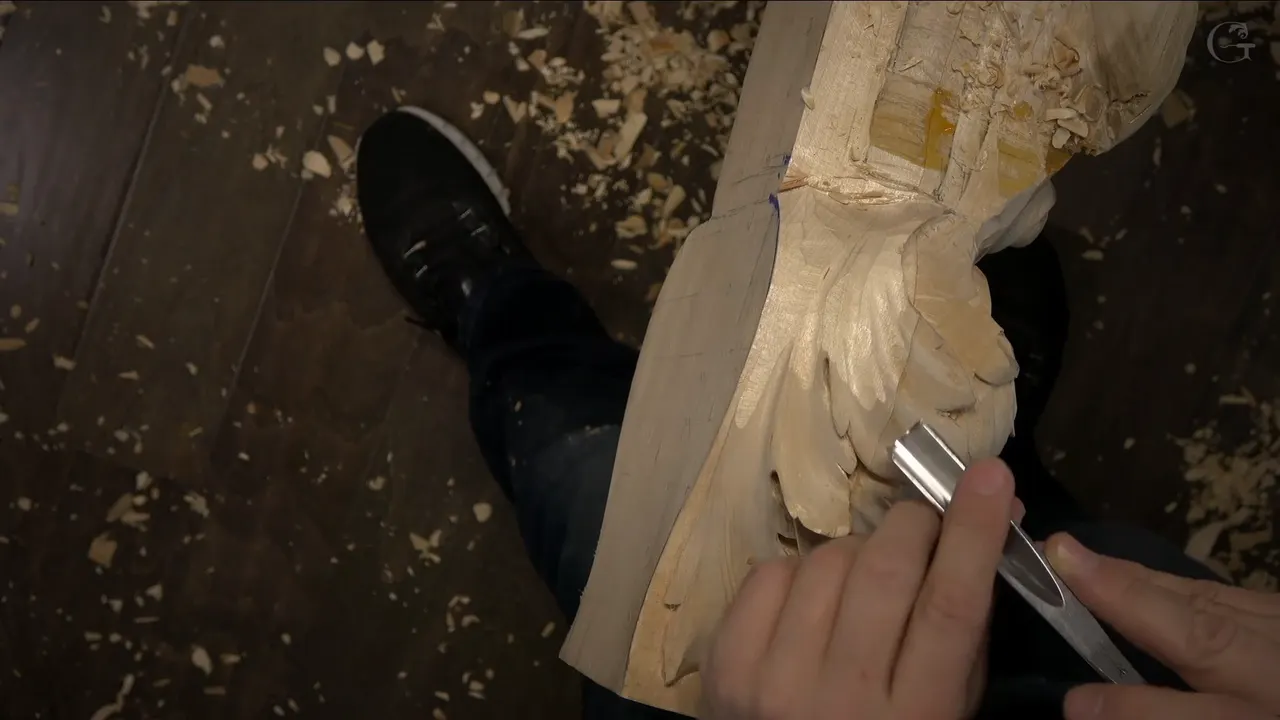

In part 4 of workshop 102 I tell you what happens to my camera if I go on another side, and I read that sentence together with the line before it. Lessons from my other courses carry the words too.
Ever stopped your gouge a hair short of a move, and known exactly which move it was? Workshop 102 belongs to my Venice Room Part 9 course. The other passages come from my Venice Room, Greek, Roman, Hashemi, Lily Box, Furniture Panel, Floral and Molding, Rosette and Maine lessons. Every size is in millimeters and inches, my own figure first.
What happens in part 4 of workshop 102?
The video is at the corbel. "I have to outline the drop pieces from my drop cloth or whatever you call that material drop covering," I say. The move comes next, "I have to just create my cut right on the side of this line, for I would have really nice convex in the middle."
A tool is named. "Number 11, that would be 5 millimeters" (0.2 in), I say, after "I'll take, again, number 5. I'm sorry, number 11." My plan is to make that pass.
"And yes, I am working against the grain right now," I say. Right after it come the words about my camera, "I don't have to, but if I'm going to go on another side, I will cover my camera, and I really don't want to do that."

I stop with "That is enough" and call the work "just kind of outlined." I add "And yes, later on, I will undercut underneath all of this area." Then "Actually, preliminary, I can do that."
Later I plan a back bend. "Maybe number five," I say, then "number five and 13 millimeters" (0.51 in), and the stamp is "marked 25 because it is a backbend." I skewed it myself and reshaped it myself, I say. I say it will be "really handy for me to work in areas like this."

Which other lines sit in part 4?
The part opens on "Same idea" and I plan to blend a movement. A slip comes next. "Oops. I just broke the edge," I say, and "So have to be careful what I'm doing." I already broke it. I do not want to glue it back. My answer is "I'll just recreate the shape."

Next I talk to you. "Okay, nobody's going to know, except you." The people watching my videos get named too, "All of those people who's watching my videos are going to know that." "I am really happy with this area," I say after that. What is left is "pretty much cleaning up" and that "could be done off camera."
Rasps are in this part. In my words, "quite often, I already used on this project my rasps, so I can use it again." A spoon is named later, "like 5 millimeters or so" (0.2 in), and I name it "Number 11 and 3/16 of an inch" (4.8 mm).

Which lines sit beside it in parts 3 and 5?
In part 3 I start with "I need to make it tighter." Then "if you place a tool, there is a concave" and I say you may not see it. Later I say "I'm not ready to the final undercut until I just get all of the details done."
A hump opens part 5. "There is a hump which I don't need," I say, and "what I'm after, really smooth and nice movement." Flow gets its own line, "it's all about flow." I think I could use "a number five and about 20 millimeters, three-quarters of an inch" (0.79 in; 19 mm), and after that "Maybe even number four."
Which lessons say it about a part that could break?
Greek Acroterion 5, part 2, is a channel. "I don't go too deep with my channel because I can easily break the outside," I say. My sentence follows. "That would be a huge mistake," I add, and then "Just taking my time to dig that."

Hashemi 17, part 3, has a V tool in my hand. "I need to make a deeper cut with the V tool," I say, and then "But not too deep because I do have an undercut right on this side, and it goes underneath." If I dig too much, "I can get actually through." That is where the sentence lands. "So let me take again the same spoon gouge and carefully remove the waste." My tool there is "#8."

In Maine class 9, part 3, I excavate a little deeper. The first line is "excavate little deeper but really careful" and "I'm keeping an eye if I'm hitting that all the way through or not." Right behind it comes my sentence. Another line is "I can always take more." Further on I say "Not sure if you can see that inside of the hole or not."

Roman Acanthus 9, part 1, has me working upside down. "I really like back bents for undercutting," I say, then "So I'll use a back bent" and "But now I'm just using upside down." "Make sure you're making sweep cut, okay" is my line, and "Like micro-rotation and little by little." The warning is "Don't push too hard because right now the piece is becoming more fragile, and you can make more damage, actually, to it." A "you" version of my sentence follows.

Floral and Molding 4, part 2, is the one with a volute. "Carefully," I say, and that I am going to get closer to my future volute, "obviously about this volute." The worry is to "damage the side of it." The sentence is here too. The next words are "it is time to switch the tool" with a plan for "a smaller tool right now."
Where does too much wood come in?
Taking wood off is the subject of workshop 22, part 6. "Just little by little, without taking out too much," I say, and then my sentence. A tool gets its own line, "See how beautiful the tool is?" The plan is to establish the main form, "either with number five or number six."

A question to myself comes in workshop 59, part 2, "how deep should I go in this area?" Movements go on "from underneath." I name two worries, "too crazy" and "removing too much of material" and I say "I could be in trouble." Then those words arrive. "Not a big gouge," I say. The size is "Three and one-eighths" (79.4 mm), then "Number seven, 80 millimeters" (3.15 in). The depth has a reason, "the reason why I really need that depth to get that flip movement the right way."

A mallet shows up in workshop 24, part 8. "When I'm pushing in it, it's moving the whole thing," I say. I am "pretty close to the extreme right now" and those words come. Then I think about a straight tool, "Could use probably even straight tool at this point" and "Let me use number 12 and a quarter inch" (6.35 mm).

A better result and a warning come in workshop 12, part 5. The result is "much better, but I got to be careful," I say. The worry is "create too weak detail." Out come those words, and I say I will blend that pass a little. Then "the mark, but not as sharp."

A weak edge is the worry in workshop 16, part 11. "I have to be careful with this edge, because right now it becomes really weak," I say. Next, "I can't go really close to this edge, or else you're going to create some mushy look." The words follow. "But right here, I can excavate really deep" and "And I can get really good looking effect, really deep looking effect right here."

Lily Box 11, part 13, has me near a leg. "I also have to look from the side" and "I am approaching pretty close to the leg," I say. What I could lose is "the effect of separation on this side." The sentence is there. How far I will go is "probably" the limit, "no more than that" and I add "I can't do any more."

Which lessons put a mistake first?
Marks matter in workshop 38, part 2. A cleanup comes first, "just because it's too many marks and I don't see clearly, I need to fix my canvas" and "Just clean it first." Then "Otherwise, it just doesn't make too much sense for me." The risk I name is "I can actually make the mistake of the moment." Those words come. The part goes on with "I have to just match the depth on both sides."

The grain is the subject of workshop 47, part 6. The words are "keep an eye grain of the wood because there's always possibility to make mistake" and out it comes. Then "But on another hand, I really need to attack it." And "Otherwise, everything is in my way."

Greek Acanthus 10, part 1, is about a knife. The knife line is "I can kind of hook it" and "if I going to force it, I can make a mistake again." That sentence follows. "It's better cut multiple times until you're 100% sure that once you're going to hook it, it's going to be removed just like that."

When does my camera come into it?
A deep area comes into workshop 74, part 2. It will be "like sticking my head in the camera again," I say, and the words are there. Later comes "Again, I have to stick my head in the camera to show that to you" and they are there too. I add "work on that off camera. Hope you understand why."

A closer look is needed in workshop 114, part 3. "Obviously, I need to get a little closer," I say, and "if I'm going to get closer, I'll cover camera." That sentence comes next. After it comes "the big one, 20 millimeters, number 11" (0.79 in), and the pass goes "From nothing, almost nothing, to that surface." And I can "just indicate movement toward the center."

A reason in the grain appears in workshop 145, part 3. "It's better I'll just attack from this side because of the grain, how it goes," I say. Then "cover the camera" and my sentence. I need to excavate much deeper, I say, because I really want to see "that folding effect."

Furniture Panel 19, part 2, has something else in the picture, my clamps. A plan comes first, "let me jump on another side" then "Well, you know what" and my sentence. My reason is "I didn't want to see on a camera my clamps." Then "So I just clamped them from down up, from the bottom up, so I can just flip like that." Part 3 of workshop 102 has a smaller case, "I apologize that I'm covering again my face."
And when is it a choice about the look?
What goes on top of what is the question in workshop 162, part 2. "Let me think," I say, then "how I show that part going on top of this part, but logically." Next comes the sentence. I plan an eye, "another one" with "I apologize if you don't see it." After that "I'll just lower that down and undercut underneath of that detail" and "I think it's going to be better."
Venetian Flowers Rosette 6, part 1, is a choice between two ways. Two ways are named, you "could develop that multiple ways" and "you can create the cuts straight like that and just everything going to wrap on its own on inside." Then "But besides" and my sentence, and "It's a little too boring." What I want is "some kind of movement, a little different" and I plan to find the spot between two lines.
Water and color meet in Lily Box 13, part 6. "More water," I say, and "because it's a carving, and if you put too much water, the wood's going to start moving." Then comes my sentence, and after it "that effect of moving."
Where do the pictures come from?
Every picture on this page is a frame from a lesson named here. Several come from workshop 102, on the Part 9 course page, and each frame sits beside the lines it matches. The wood carving lessons I name are all inside the school.
Lesson by lesson, what stands before it
| Where I say it | What the lesson names before it | Tool |
|---|---|---|
| Corbel, workshop 102 | A pass on one side, with another side still to go | Number 11 |
| Acroterion, lesson 5 | A channel that is too deep, and the outside could break | None named |
| Hashemi 17 | A deeper V tool pass where an undercut waits below | Spoon number 8 |
| Maine class 9 | A hole that I could dig clear through | Nothing named |
| Venice Room 59 | Too much material gone from the area | Number seven |
| Venice Room 114 | A closer reach, and the camera gets covered | A 20 mm (about 0.8 in) number 11 |
Is there a move on your own bench that you stop short of? Everything in these lessons sits inside one tuition plan. For more from the corbel, try workshop 102 first, and then workshop 101.
How it's done
- The edge in workshop 16. The edge becomes really weak, and I cannot go really close to it.
- The limit in Lily Box 11. No more than that, I say, once I name how far I will go.
- The hole in Maine 9. An eye on the hole, to see whether I hit it.
- A number seven in workshop 59. Not a big gouge, I say, and a number seven at 80 mm (just over 3 in).
- The side in workshop 145. One side first, because of the grain.
Frequently asked questions
Where in workshop 102 does it come?
Right after a number 11 comes a line about my camera, and my sentence comes after it. After that comes "That is enough," and the work is "just kind of outlined." I plan a back bend after that.
What could break before I say it?
Greek Acroterion 5 has a channel whose outside I could break. Hashemi 17 has a V tool pass that could get through to an undercut. Maine 9 has a hole, and I check whether I am hitting it through.
Where does my camera enter the picture?
Four workshops, 74, 102, 114 and 145, each mention the camera. Furniture Panel 19 names my clamps. My head is named in workshop 74, and workshop 145 gives a reason in the grain.
What to carve next