

Alexander Grabovetskiy, woodcarver, School of Woodcarving · Published 2021
What does a wood carver mean by "any brand"?
Quick answer: Workshop 102, part 6, has a number 11 veiner of 5 millimeters (3/16 in). I call it Swiss made, and say it doesn't really matter which brand you use. Other lessons of mine say it about a skew chisel, a knife, a number nine, clamps and vises.
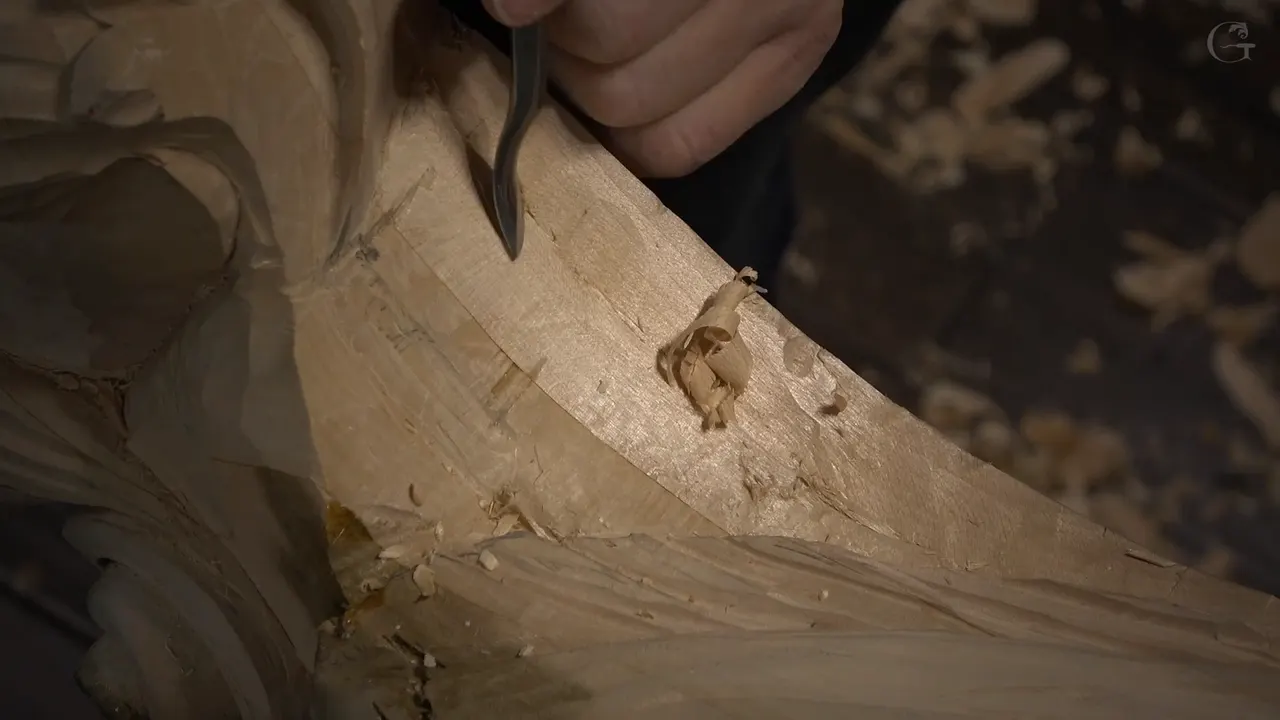

Workshop 102 has a number 11 veiner of 5 millimeters (about 3/16 in) in part 6, and I say you can use any brand, as long as it's sharp. My other lessons give the same answer for a skew chisel, a knife, a number nine, a clamp and a vise.
Ever stood in front of a rack of gouges and wondered if the name on the handle decides how well it carves? Ever put off buying a tool because you could not tell which maker to trust? Both sit behind the line above. This workshop belongs to my Venice Room Part 9 course. The other passages come from my Venice Room, Hashemi Flowers, Grape Onlay, Hazelnuts, Greek Acanthus, Butterflies and Furniture Panel lessons, from the Schaaf tools video, from the V-tool sharpening video and from one livestream. Every size is in millimeters and inches, my own figure first.
What happens in part 6 of workshop 102?
The middle of the corbel is where part 6 starts. "Now, all I have to do is just to work and just make it smooth, this convex right in the middle of this corbel." A warning follows. "Little by little, I see that area where the grain changes direction, so I have to be careful with this section."

"And yes, I will attack that from the opposite side," I say. For that I "have to do it off-camera because otherwise, I'm going to be right in the middle of my camera, and all you're going to see is just my head."
A bigger back bent is next. "Okay, let me use a different back bent. I could use probably a little bigger one" and then "maybe 25 millimeters or so" (0.98 in). In the middle, I'm "not too happy with what I've done" and "Maybe I can actually use even bigger."

On the tool, I'm "just controlling my tool because the direction of the grain changes in this area, and that's easy to make the mistake." Of my hands I say "one hand is pushing and another hand preventing from cutting." So "one hand is accelerating and another hand is braking, just pushes the brakes."

"But am I happy?" I ask, and then "I think I am." Then "It feels really nice. Maybe just a little more cleanup, and that should be fine." Next is "Now I need to get rid of all the mess I've got underneath again." My pick is "Number 11 and 5 millimeters veiner" (0.2 in), and "I'll clean it with that."

Of the veiner I say "That is a Swiss Made" and right after it, "But it doesn't really matter what brand you're using. You will be able to use pretty much any brand, as long as it's sharp. If it's sharp, you should be fine."

"Okay. And that is good. That is really good." Later I am "working around my convex" and "It also has to flow right on the side also."

What do parts 5 and 7 add to it?
A plan comes in part 5. "Okay, next, I'll take again Veiner number 11 and 5 millimeters" (0.2 in), I say. In part 7 my plan is "probably number four. Number four, and about half an inch. I would say about 13 millimeters or so" (0.51 in). Then "Number three gouge will work also."
A ruler turns up in part 7. "So I can put any type of ruler, whatever you have, right on the line," I say, and "that's going to give me a really good idea of the movement." And "I don't trust sometimes just the eye."

Does the brand decide how often you sharpen?
My Schaaf tools video opens a set that is brand new. The question is whether the set is good for someone just getting into wood carving. "So let's find out today." A page on a shopping site says "if you're not planning to sharpen those tools, don't buy those tools." My answer: "And that's actually true to any brand. Doesn't matter what brand you buy, you still have to sharpen those tools, even if they come out the box sharp and ready to go."
A pre-sharpened tool holds for a while. "One day, two days, maybe longer," I say, but "there's still going to be a certain point when you have to resharpen." My own tools come next. "In my case, any tools, any brand I buy, doesn't matter high-end or not too high-end, I still have to reshape, I have to resharpen, and I have to re-strop it or rebuff it."
Hashemi Flowers 24, part 4, has a line about new tools. "When you buy the brand-new tool, the bevel usually really short." Mine are different, "almost on all of my tools, I have a long, long bevel." About a low bevel I add "it makes it a lot easier to slice through the fibers when you do have a really, really, really low bevel." And "Make all your cuts slicing cuts."
In the V-tool problem video, the trouble is a notch. When you sharpen one, it has "like a point, like a notch almost," on the side. It happens with "cheap tools made in China" and with expensive ones. About any brand, "the most expensive you can get or most cheapest, you still gonna have the same problem."

Which tools did I say any brand about?
In my Hazelnuts course, lesson 4 names a chisel. "For those of you who don't know what type of tool I'm using, it's a skew chisel number one, and I believe it's 25 millimeters or about one inch." Then "But that doesn't have to be that brand. It could be any brand. Or you can make it yourself." And "But I kind of like how it flows."

Now a knife, in Greek Acanthus 5. "Although that is not my preferred way, I should say." My choice is "to the knife. Just a cheap carving knife." My number 12 has a maker I name, and after that "It can be any brand, any cheap carving knife, any carving knife." The reason comes next. "With the edge of the knife, I can actually really nicely get to any details without changing too many tools."

Butterflies 7 turns to knives too, in part 1. "It's just normal knife doesn't matter what knife you use. It's still gonna work." Then "you can use any type of knife any brand you like." In this case it was a Russian made knife.
Furniture Panel 15, part 1, has a knife again. "And any knife will do. I'll just use number three." The point, I tell you, is that "any knife will work pretty much." A straight line is the goal. "I want to make sure I am doing a straight line" and "That is why I am controlling that by using two hands instead of one hand."
Inside a curl, in Grape Onlay 14, part 1, I say any gouge, "like number eight or number nine, will work, and I'll probably just grab number nine and I'll excavate that." The size is "10 millimeters, number nine" (0.39 in), and the brand does not matter there either, I tell you.

When does a number change with the brand?
Workshop 65, part 5, names a number 11. Its size is 3 millimeters, "which is an eighth of an inch." A blend comes next, and "Pretty much any gouge, even number seven will work." Then "Actually, this is number nine, but it's equal to number eight to other brands because it's not a true half round."

A number nine is my tool again in workshop 66, part 11. For this one I say "Number nine and the 1/8 of an inch, 3 millimeters. That's what I'm using." Mine has a maker's name I say out loud. Then "any other brand will do as long if it's a true number nine, like a half a circle." Next, "Well, number eight will work also, but I kind of like number nine better."

"I have to attack that again. And it's, again, number seven. Yeah, just a different brand, but still number seven." Then comes "About 14 millimeters" (0.55 in), in workshop 69, part 6.

What about clamps, vises and glue?
High spots stay on purpose in Grape Onlay 12, part 1. "I need to keep those high spots because I have to remember, at some point I will have to flip it and it's gonna rest on those spots." They "gonna serve me like legs." Next I plan to get "a couple clamps" and I say the brand of clamps makes no difference there. About one of them, "I have no idea what the brand is, but this one is a Chinese stuff."
Two vises are the system in Hashemi 21, part 2. "With this type of system, I have absolutely no limit." Then "Working on big pieces, small pieces, I can always raise it, I can lower down, and all it takes is just the two vices." The vises I use come from a maker I mention, and then "It could be other brands. It's not about the brand."
I like mine, and "That is just my personal preference." Then "I have that for a long time, and it holds really nicely for many years."

The Schaaf video has super glue. I plan blue tape and "super glue, okay?" About the tube, "It's just a brand, but I'm pretty sure any brand will do. In USA, you can go in a dollar store and just buy a bunch of tubes of super glue for just a dollar."
What about small detail tools and small handles?
Detail tools are the subject in workshop 77, part 9. Of them I say "it's not really micro tools, but those tools are made to work on details. I think it's excellent tools." Then "Not necessarily just that brand, but any other brand." And "All the brands, they offer different things, but this is not the only brand." I add "That's what I'm trying to say" and "There's multiple brands."

The handle comes next. "It feels like almost pencil inside of your fingers, like you're holding a pencil or something."

A small tool is the plan in workshop 73, part 2. "A couple of ways I could probably achieve that. I could use micro tools." A maker's name comes first, and then "it's just a brand. Okay. That's 5 millimeters, 3/16 of an inch." And "that's number eight, I would say" then "It's not really marked what number it is, but it feels like it's almost like number eight."
Hashemi Flowers 11, part 1, has me naming a number nine of an eighth of an inch (3.2 mm). "As long if you have sharp tools," I tell you, "I still able to control with no problem." And "there is multiple ways you can achieve the same results. So tools are tools, and just different brands that's it."
About small handles I say "I really like the small, tiny handles of those" tools. "So it feels like I can get more control, but it's just me. Okay?"

The April 2020 livestream shows eyes on a carved panel. "Those are eyes, and they have really deep shadows," I say, and "So really deep shadows because I excavated them out." Then comes a spot where "you don't see any shadow." The way I make one, "So I place number nine, let's say, in one-eighth of an inch tool, and inside" (3.2 mm), and the brand makes no difference. Next, "And I'm rotating, and I'm removing a plug."


Do I have brands I like?
Yes, and I say so in Hashemi Flowers 23, part 1, which is "all about my favorite tools and brands." There I tell you "I do have certain brands I really like." About two of them, "those tools are really, really good tools."
Butterflies 7 goes further. "Some tools they do have a soul," I say. "You just get that tool in your hand and it just feels like part of your hand." Then "one of those brands. I really admire really love." Both lines sit in the same video as the knife talk above.
What does each lesson say, side by side?
| Lesson | What I say about the brand | Tool |
|---|---|---|
| Venice Room 102 | Sharp is enough, I say | A veiner |
| Schaaf video | Even from the box, it needs sharpening | A new set |
| Hazelnuts 4 | Buy any brand or make it yourself | A skew chisel |
| Greek Acanthus 5 | A cheap knife in any brand | Number 12 |
| Grape Onlay 14 | It does not matter which brand you use | A number nine |
| Venice Room 66 | A true half circle, from another maker | Nine at 3 mm |
| Hashemi 21 | Other brands work too, I say | Two vises |
| Grape Onlay 12 | I have no idea what the brand is | A couple clamps |
Which lessons are the pictures from?
Every picture on this page is a frame from a lesson named here. Several come from workshop 102, on the Part 9 course page, and the others come from the lesson named just above them. Every lesson I name is inside the school.
Is there a tool on your bench you keep because of its name? Everything in these lessons sits inside one tuition plan. For more from the corbel, try workshop 102 first, and then workshop 101.
How it's done
- Pick the tool. A veiner is my plan for cleaning underneath the convex, after the mess I got there.
- Look at the maker. The veiner is Swiss made, I say.
- Check the edge. Sharp is the word I give for the edge.
- Keep the grain in mind. The direction of the grain changes in the middle of the convex, so one hand pushes and the other holds back.
- Finish on the side. I work around the convex, and the side has to flow like the rest.
Frequently asked questions
What do I say about the veiner in part 6?
It is Swiss made, I say, and a sharp one in any brand should do. It is the tool I plan to clean with, after I say I need to get rid of the mess underneath the convex.
Which brand needs sharpening?
The Schaaf video says all of them do, new ones too. A pre-sharpened tool holds for a day, two days, maybe longer, I say, and after that comes a point for resharpening.
Does a brand change a gouge number?
Yes, in workshop 65, part 5. My number nine is equal to a number eight from other brands, because it's not a true half round. Workshop 66 adds that another maker's gouge works when it is a true number nine, like a half a circle.
What to carve next