

Alexander Grabovetskiy, woodcarver, School of Woodcarving · Published 2021
What does a wood carver mean by "whatever you have"?
Quick answer: Workshop 102, part 7, has me putting a ruler of any type on my glue line, and it gives me a really good idea of the movement. Other lessons of mine use the same words for a number nine, a chip carving knife and a clamp. One of them says the small tools need to be sharp.
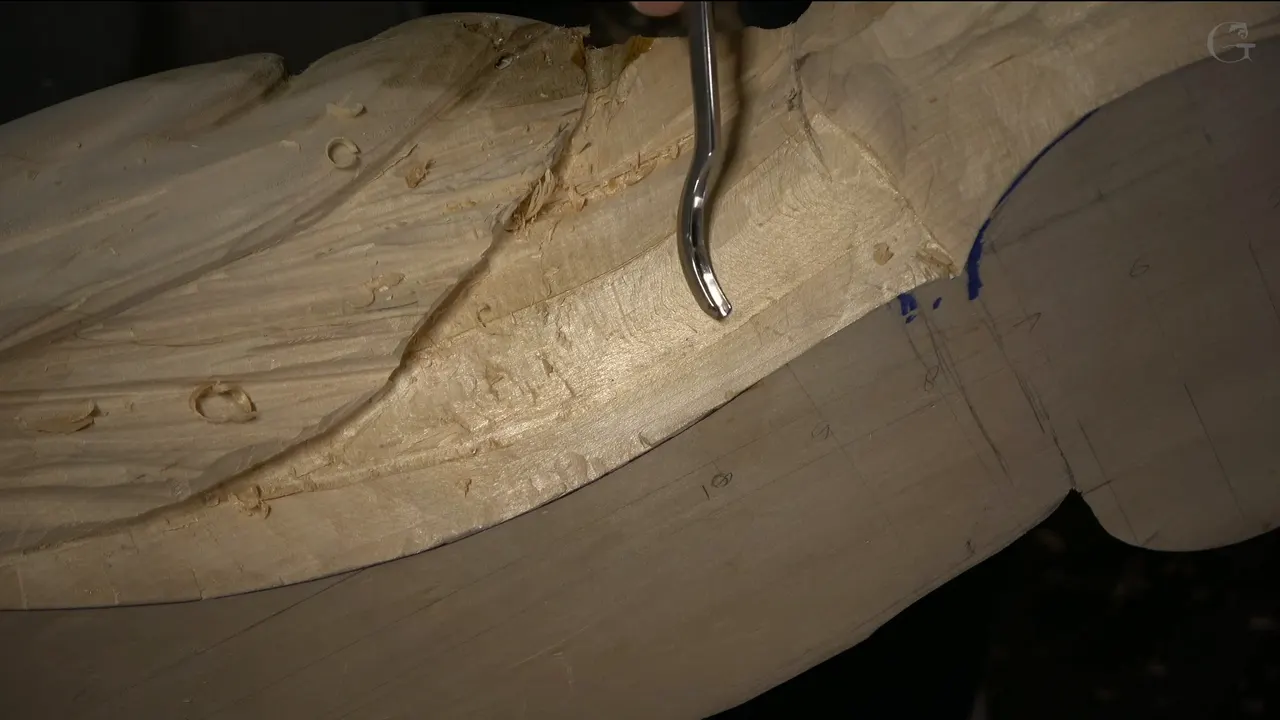

Part 7 of workshop 102 puts a ruler right on the glue line, which helps me see the movement. My other lessons use the same three words for a number nine, a knife, a clamp and the tool for a shape.
Ever sat down to carve and found that the tool in the lesson was not the tool in your drawer? Ever put off a project because your clamp was the wrong kind? Three words of mine sit behind both questions. This workshop belongs to my Venice Room Part 9 course. The other passages come from my Chamomile and Bow Rosette, Venetian Flowers Rosette, Roman Acanthus, Greek Acanthus, Byzantine Acanthus, Grape Onlay, Hashemi Flowers and Venice Room 105 lessons. Every size is in millimeters and inches, my own figure first.
What happens in part 7 of workshop 102?
The part opens with a plan to blend "from this edge inside to this cut" and I call it "my blending cut." The corbel is not named in part 7, but part 8 calls the piece by that word.

A spoon is the tool I need for the blend, and I ask which one to use. My pick is "probably number four" at "about half an inch" (13 mm). The same part adds "Number three gouge will work also."

A change of direction is in this part. "I have to change the direction how I cut," I say, and the plan is to "switch and attack that from the opposite side." One line gives the result, "really nice and clean transition." The pass itself I put as "Attacking from both sides until everything is just shaved out."

The angle of the tool gets a tip. It is "always good idea" not "to push straight down, but create some kind of angle." And "even 45-degree angle will create a lot nicer cut."

"Okay. I am happy with that," I say. A plan follows for the camera, to "clean up that off camera" and "show you the final result." Then "But it's not the end yet, okay?"
Cross cuts are the plan after that, "so it's going to have some kind of texture." Their number is "multiple cuts."

Which ruler goes on the glue line?
The cross cuts, in part 7, are "a simple cut, pretty much." One point needs watching, "it has to be perpendicular."

Checking it by eye is one idea, "Of course, I could just eyeball it." For the perpendicular part, I mean "the line supposed to be like 90 degrees." Then the glue line comes in, "that I do have my glue line, and I can use that glue line as a reference."
Here are the words this page is named for. "So I can put any type of ruler, whatever you have, right on the line, and that's going to give me a really good idea of the movement." After that, "So now I know it's a truly perpendicular movement."

Trust comes into it too. "I don't trust sometimes just the eye," I say, and "it could be really deceiving."

Another stretch has distances and a division. The words are "approximately same distance" and "right in the middle division." My plan is to place it "right to the line." Then "Draw my line, I should say."
A round shape gets its own line. "It could be really deceiving when you're just looking at it, especially if I have, in this case, convex." And "the line could just look really twisted."


What do parts 6 and 8 add around it?
Part 6 has "a different back bent" and "a little bigger one" at "maybe 25 millimeters or so" (about 1 in). That is in workshop 102 too.
The cuts across, in part 8, are "just to give some texture" and I call them "those ribs right in the middle of that corbel." The depth is "Maybe about one millimeter deep is what I've done" (about 1/25 in), and "a 16th of an inch, a millimeter and a half or so."
I am still weighing the tool in part 8. "I think I could take number nine, but I'll take number 11." On size, "straight number 11 and 10 millimeters" (0.39 in), "or maybe I should use a spoon veiner number 11." A back bent is the plan after that, "quarter-inch back bent, number eight," which "would be six millimeters back bent gouge" (0.24 in).

The back bent comes back in that part. "I can ride on top of those guys or those sections and create beautiful convex," I say. When I hit the top part, I know the depth will be "the same of every one of those." I add that it does not have to be, "but still, it's a good idea."
On the surface, "Again, it has to be really smooth and nice," I say in part 8, and "I don't want to see any tool marks." For the ribs, "I really want to be authentic to Venetian times" and "I could probably do without them, without those ribs, but I think it's a good detail."
Do I say it about other tools?
In Chamomile and Bow Rosette 2, part 2, I work with small tools near a stem, and the three words come back. "I'm just using different small tools," I say, and "you can probably use it." Mine is "number four" and "You can use number three and one-eighth of an inch" (3.2 mm). I plan "one millimeter, or even two millimeters, I'd say" (about 1/25 in and 1/12 in). And "Just take my time and work around that stem."

Venetian Flowers Rosette 2, part 2, brings talk of a curl for the first concave, and I say "this area is a little bit mushy, so I need to make sure my tools are really sharp." The curl calls for "even smaller tool, like number nine" and I plan "micro tools pretty much." A three-word line sits right there, the one from part 7. The number 11s are in the next line, "You could use number 11s if you have small number 11s, like 2 millimeters, 1 millimeter" (0.08 in and 0.04 in).

Edges are in one more line, "But they must be sharp" and "Absolutely must be sharp."
Roman Acanthus 10, part 5, has my plan to refine a shape. "Now, let me refine the shape." The line opens with those three words and goes on, "I could use just a knife, but if you do have a selection of gouges, you can find the gouge which fits the profile, and that's probably going to be the quickest."

The talk goes on in that video. "And just place it on the line and make your cut down." My tool is "number six right now and a three-quarter of an inch" (19 mm). Design gets a warning, "You have to check your design, because design could be off slightly." And "A little different from my design, which is absolutely fine."
A chisel gets a mention in that part. "I really love to use a double bevel number one in some of my carvings." I add "It works just like a knife, but it's a chisel, and I'm using the small one."
In Greek Acanthus 15, part 4, I plan "the same bigger tool" for one side. The big tool is not needed, and "just a normal number three" gives "really good results."

Another line says "Make sure don't force it, because that is a stage. If you force it, you break it." And "It's better to take your time and spend a little longer and do it the right way." My plan is "just the number 15" at "Three millimeters" (0.12 in).
Greek Acanthus 3, part 2, finds me with a knife. "A little too messy. It's absolutely fine with me," I say, and "chopping away a lot of stuff." And "any chip carving knife will do." For one more section, "I'll do exactly the same idea. I'll just stay away approximately quarter inch, 3/16 of an inch" (6 mm and 4.8 mm), and "approach and cut it from both sides."

How big a number nine do I ask for?
Byzantine Acanthus 2, part 1, opens on a size. "Get your biggest number nine," I say, and then "number nine, the biggest one." In my case, "three quarters of an inch, 19 millimeters or so." And "This one is 20 millimeters" (0.79 in). I ask for one more thing, "Please do not touch that area where you're not supposed to touch, okay?"

Byzantine Acanthus 9, part 1, is about opening a spot, "We're going to open up going all the way." A number nine of three-quarters of an inch (19 mm) is the size I name first, and "you can use 10 millimeters, 12 millimeters, okay" (0.39 in and 0.47 in). The move itself is "and we call it a plug cut." And "We're removing the plug, and then we attack toward the hole from the sides."

Grape Onlay 4, part 2, has a number 11 of two and a half millimeters (0.1 in). The size is not fixed. "It could be three millimeters, it could be two millimeters" (0.12 in and 0.08 in). My next words are "most likely you're gonna have two millimeters."

The plan after it is "I'll get a little smaller tool like number seven and pre establish my outline straight down, cut like 90 degrees toward the background." My caution is "I wanna make sure I don't dig too deep," since I need "some material" for my "future leaves."
Venice Room 105, part 1, brings a mallet. My tool is "number eight," "about seven-eighths of an inch, almost like an inch or so" (22 mm and 25 mm). By hand, "rotation motion just like that, but it's going to take just a little too long." It is fine without a mallet, I say, "but I would prefer probably a mallet." Reasons come in two lines. "That way I can go right away pretty much whatever the depth I need." And "because it gives me much more control."

"But even by hand, it's still doable." The tool need not be "exactly the same tool like I use" and the three words sit in that part too, before "the number nine or whatever." Then "So any tool. But I like bigger tools" with "my huge number seven" as the plan.
What about a clamp?
Hashemi Flowers 42, part 1, talks about clamps. "You can clamp it any type of shape," I say of those clamps, and "that's just really solid." Two clamps are an option, "Maybe I'll just reinforce it with two of them."

Depth gets a figure there. "I know approximately I have to take an inch deep, but I'm going to take a little less than an inch" (25 mm), "maybe about, I would say, seven-eighths in the beginning" (22 mm). A three-inches gouge is on my list, "I'll take about a three-inches gouge" (76 mm).
Another line covers a bench without those clamps. "If you don't have those type of clamps, you could just probably clamp it to the end of your workbench with just a normal C clamp" and the three words come once more before "and work that way."
Does that line mean any tool at all?
A few of the passages above carry a warning beside them. In part 7 I doubt the eye alone. Rosette 2 puts it as "make sure my tools are really sharp." Roman 10 says "check your design." Greek 15 says "If you force it, you break it."
One more use sits apart from the rest. In Grape Onlay 8, part 3, those words sit before "overlapping like two leaves" and the line ends "you have to also undercut."

What does each lesson say, side by side?
| Lesson | My words | Tool |
|---|---|---|
| Workshop 102 | Along the glue line, any ruler | Ruler |
| Chamomile 2 | You can probably use it | Number four |
| Rosette 2 | Micro tools, but sharp ones | Size 11s |
| Roman 10 | Maybe a knife, or a gouge that fits the profile | Number six |
| Greek Leaf 15 | A plain number three gives good results | A big tool |
| Greek Leaf 3 | Any knife made for chip work | A knife |
| Byzantine 2 | Get your biggest number nine | Biggest nine |
| Byzantine 9 | Ten millimeters or twelve will work | Number nine |
| Grape Onlay 4 | Most likely you'll have two millimeters | Number eleven |
| Workshop 105 | It need not match mine | Number nine |
| Hashemi 42 | An ordinary C clamp at the bench end | A clamp |
Which lessons are the pictures from?
Every picture on this page is a frame from a lesson named here. Most come from workshop 102, on the Part 9 course page, and the others sit beside the lesson they come from. Every lesson I name is inside the school.
Is there a gouge in your drawer that is close to the one I name, but not the same? Everything in these lessons sits inside one tuition plan. For more from the corbel, try workshop 101 and workshop 103.
How it's done
- Choose a spoon for the blend. My pick in part 7 is probably number four, around 13 mm (1/2 in), and I say a number three works too.
- Change sides. The direction I carve has to change, so I plan to come at the spot from the other side.
- Tilt the tool. Pushing straight down is out. A slant of 45 degrees is enough for a nicer result.
- Lay a ruler along the glue line. Any kind of ruler works, I say, laid on the glue line as my reference.
- Read the movement. The ruler tells me whether the movement is perpendicular.
Frequently asked questions
What goes on the glue line in part 7?
Any ruler goes there, and the glue line is my reference. With the ruler in place I can read the movement and know it is perpendicular. I say I could eyeball it, but I don't trust sometimes just the eye.
Why not trust the eye alone?
Eyeballing a line is possible, I say, but the eye can be deceiving. Looking at a convex shape, the line may look twisted. In the same stretch I talk about the middle division and approximately the same distance.
Which spoon gouge do I name for the blend?
A number four of about half an inch (13 mm), I say, with a number three that also works. Part 6 brings a bigger back bent of maybe 25 mm (1 in), and part 8 has a number eight back bent in mind at 6 mm (0.24 in).
What to carve next