

Alexander Grabovetskiy, woodcarver, School of Woodcarving · Published 2021
What does a wood carver mean by "I know that"?
Quick answer: In Venice Room workshop 102, part 9, I said it right after naming a clean-up, and added that I am still establishing the main form. In my other lessons the words come after a mistake, a hard step or a flaw I can see, or before a spot I call safe, and the carving goes on.
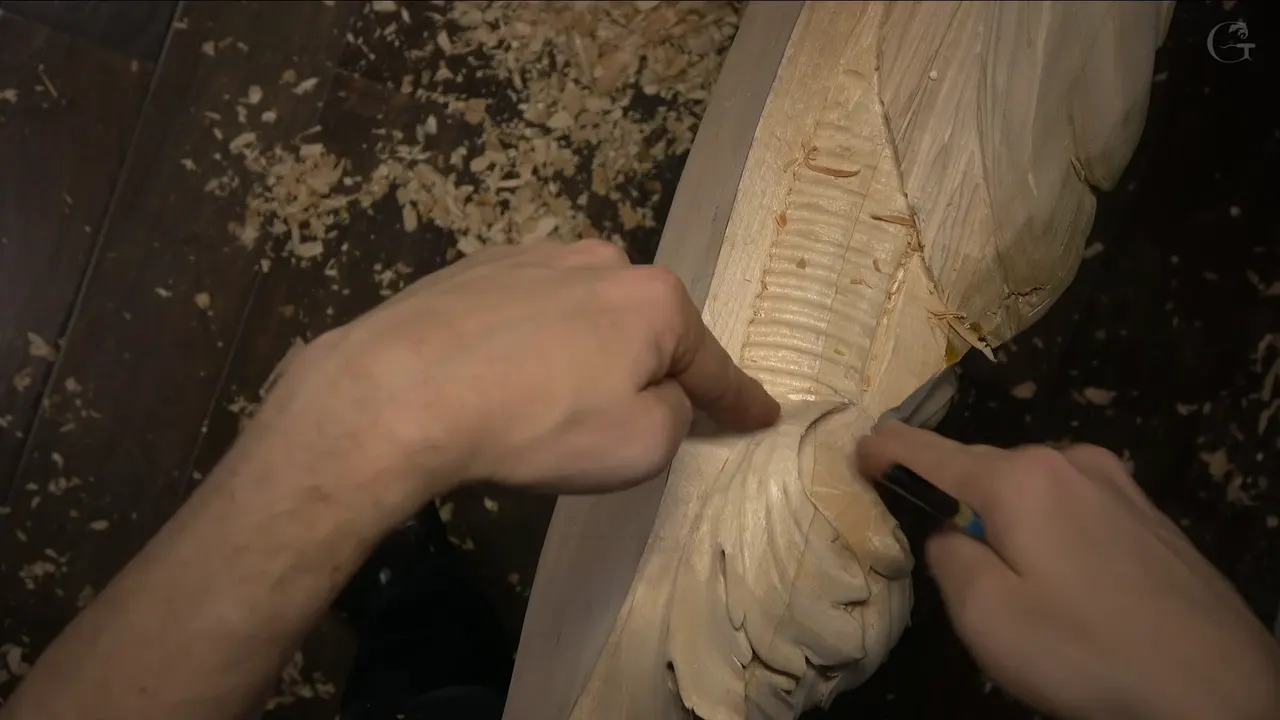

In workshop 102, part 9, I admit out loud that a section still needs cleaning, and I add that I know it. My other lessons use the same three words after a mistake, a hard step or a flaw I can see, and also before a spot I call safe.
Ever caught a flaw in your own carving and said so out loud? Ever kept working anyway, because the shape was not done yet? Both sit behind three small words. This part belongs to my Venice Room Part 9 course, a room in the style of Venice. The other passages come from Venice Room workshops 42, 69, 74, 77, 79, 85 and 112, and from my Acanthus over Moldings, Lily Box, Hashemi Flowers, Greek Acanthus, Beginner and Principles of Design lessons. Every size is in millimeters and inches, my own figure first.
What happens in part 9 of workshop 102?
It begins with a plain wish. "I also want to fix something," I say, and then "I kind of don't like this section 100%, just this section." I want "a little more nicer transition." Right away I add "Let me think how I can do that."
Next comes a side view. "If you look from the side, looking toward it, see just that this line, not really 90 degrees toward the middle." My first answer is "recreate the movement." I correct it on the spot: "not recreate, but fix little bit, this section." The aim is "make sure it is 90 degrees again." A right angle is 90 degrees.
A ruler is next. "My ruler will help me because I do have a middle line," I say, and "At least going to give me a reference point." One more line about it: "I think that is the line I need to go after."

My plan for the wood is short. "So I need to chop a little more this section and not get rid, but make this rolling from underneath." Next: "It's already giving me the right feel" and then "Yeah, it does, actually."
My tool plan comes right after: "Let me get the number 11, and I'll take five millimeters veiner" (0.2 in). Another plan: "I'm going to create a little deeper excavation on this section." Out comes "Now it feels somewhat much better."

A thought about size follows. "Maybe I actually can get a smaller tool inside there, maybe two millimeters" (0.08 in). For the tool I say "Number 11" then "cut little deeper." Next: "Little deeper. Not much, but little bit." I think "it's just going to give me much better feel, overall feel of that movement. Just like it goes right on top of the architectural detail."

"Here you go," I say, followed by "Okay. I am happy with this transition."

Which words follow "I know that" in part 9?
The line sits right behind my happy remark: "Yes, I need to clean it, and I know that." A moment later I say it again: "I know that, but I'm still establishing the main form and clean up." Also, "I can always go back if I need to and clean it." And of the clean-up: "Just preliminary, maybe clean up." Also: "Preliminary clean up, I can do it now, I should say."
A smaller size is on my mind: "Maybe I can actually get one millimeter veiner and clean that cut" (0.04 in). Next: "But I don't want to lose the sense of transition in this section I did not finish yet."

The order of work comes next. "So first cut, what I have to do probably would be number 11 veiner and 5 millimeters, and I'll just fix this section" (about 1/5 in). That is "number one cut." The second is "Not fix, but make some correction on the acanthus movement on this one." My last words in the part are "And maybe actually exaggerate this line."

What do parts 8 and 10 add?
Part 10 voices a doubt of its own: "I do have acanthus movement going from this side and flipping right on top of this section, but I'm not sure if I like it or not." Further on: "Maybe it's not bad. Maybe I just didn't finish it, that's why I kind of have doubts."

A clean-up waits there too. Of the main body, I say I will clean up a little bit, "but the main goal right now to create nice movement in this section." An apology comes too: "My apologies, my head was in the camera." Part 8 has a plan for work out of sight, "I'll work off camera in this section." It goes on "I'll just clean everything and so on, but you should get an idea." Part 8 has a plain admission about a tool, "the wrong number 11" and then the right one: "10 millimeters, number 11" (0.39 in). A point gets softened: "Doesn't have to be though, okay, but still, it's a good idea." On the ribs of that corbel, I say "I could probably do without them, without those ribs, but I think it's a good detail."

Where else does it follow a flaw?
Workshop 77 of the Venice Room, part 8, is where I name a job and a limit back to back. Before it I say "Any skew will work pretty much. Even knife will work." Then comes "And I really have to be more careful. I know that I need to get that stuff done, but I don't want to spend time on repairs if I don't have to."

Acanthus over Moldings 1, part 2, has "any gouge will work." My pick is number nine. "About 10 millimeters will work" (0.39 in), I say. Then: "Yes, I am working against the grain, and I know that. But that is okay." Afterward I will "attack that from above." Marks matter there too: "I do have a line also on opposite side. So I marked on the outside, and I also marked from inside."

Lily Box 12, part 3, is micro work. Next up is to "make a cut right beside my first cut." Right after it: "Again, that is almost invisible, and I know that." Words about the flower follow: "most of the people, they don't know how the flower is structured." And "even if you don't know that about the spiral and the golden ratio, it's going to look natural." I call the scale "the really micro level."

Sandpaper turns up in Lily Box 11, part 3. "Cheap sandpaper leaves a lot of abrasive inside of the wood," I say. A few seconds on: "I know that's going to leave, but cheap one's going to leave a lot."
Room 42 of the Venice series, part 11, has it about a point. I plan "number 11 at three millimeters" (0.12 in). I see "It's a bit too pointy, so I need to make a transition." Next, in my own words: "I know that is also too pointy, but that is really pointy." A bigger size follows: "maybe four millimeters" (0.16 in).

Hashemi Flowers 45, part 5, begins with "I'm going to bring all my cuts toward this hole." My small gouge is an "eighth of an inch" (3.2 mm). Then: "And I know that's kind of scary to drill those holes, and you really don't have to. But I really like the idea, really 3D look inside, and that's the only way, well, at least in my opinion, to do that." A bit later I say "A lot of excavation with the small, tiny gouges."

In workshop 69, a concave plan comes first. "I need to raise a little bit, I know that part. But obviously, I cannot use huge tools. But 7 millimeters will be sufficient, I think" (0.28 in). The tool is "number 11 again."
Greek Acanthus 13 has a broken piece in part 3. I call for care: "I broke this piece right here, and just want to make sure before I glue that I don't hit it again and don't completely break it." After it: "I know that was a mistake I should not do." A tool with "again" in front of it follows: "I'll take three millimeters, number three" (about 1/8 in), "and again, just carefully hook it out."

Beginner in Woodcarving 1, part 5, uses a knife. "We place that point away from ourselves, because it's a different technique." The depth I give is "maybe two millimeters down, okay, at this point" (about 1/12 in), and the step gets "And I know that" from me, and it is "not the easiest." The reason I give for doing it again: "It just trains your hand to establish the right depth, so how deep your knife going to cut."

Over in Venice Room 74, part 12, the job is a paint grade one. First I say "not digging too deep," since otherwise I would create another problem. Then: "Of course, I know that is a paint grade and everything is going to be pretty much hidden, but like in other cases, it would be a big mistake." I go on: "This one is a somewhat forgiving project, I would say. So you can get some mistakes and that's going to be covered with the paint. At least I'm telling you honestly."

In Principles of Design 3, part 2, I ask you to picture a bunch of flowers in the wrong place. Then: "It's a busy design. I know that. I acknowledge that it's a busy design, but you have to create that busyness in the right spot." The line after it is "You have to fill space based on the golden ratio."
When does it go with a safe spot?
Venice Room 79, part 11, has "So like I said, I know that" opening a line that ends "the high spot, so I'm safe to do what I'm doing right now." On tools I say "Number 11 or number nine will do the same trick pretty much." Further on, I will not remove all the way, since I will need that high spot, and I will just mark it.

From Venice Room 85, part 12: "So I know that" opens a line about "the final depth right here" and the line goes on "but I'm not sure yet." After that: "I know I can at least get that to the certain point, and I'll check my computer how deep it's supposed to be." Another line: "But as of now, I'll just do on angle." It will not be a true 90 degrees, I say. Last comes "Although, I'm safe right here because I know my drop going to go downhill this way."

Workshop 112, part 3, has a shadow that nobody sees by eye until the piece is installed. I mention it, and add that once it is installed, it will be visible. Before that, I need "the 1 millimeter to get little nicer" (about 1/25 in). Then the line about myself: "It makes me happier." Then I say I know I did it, and it will look good.

How do the lessons compare side by side?
| Lesson | What I name or admit | Then | After |
|---|---|---|---|
| Venice Room 102 | A section that still needs a clean-up | Main form | Cleaning can happen later, if needed |
| Workshop 77 (Venice) | The stuff I need to get done | No repairs | Time on repairs is not wanted |
| Moldings Workshop 1 | Yes, I am working against the grain | That's okay | Waste is next, bit by bit |
| Lily Box 12 | A cut beside the first, almost invisible | Micro level | Most people don't know its structure |
| Room 42, Venice | A point that is also too pointy | Needs transition | Less pointy, then absolutely no pointy |
| Hashemi Flowers 45 | Drilling holes that look kind of scary | Not required | But nobody has to do it |
| Greek Acanthus lesson | Again, a piece I broke right here | Careful again | Next is three millimeters, number three |
| Beginner Workshop 1 | Knife work that is not the easiest | Same again | It trains your hand for depth |
| Venice 74 Workshop | A paint grade job with hidden mistakes | Forgiving project | Some mistakes get covered with paint |
| Design Principles 3 | A busy design, and I acknowledge it | Right spot | Create busyness in the right spot |
| Workshop 79 (Venice) | Yes, a high spot, so I'm safe | Keep working | Leave it high and mark it |
| Room 85, Venice | Yes, I know the final depth here | Not sure | Check the computer for the depth |
Where are the pictures from?
Every picture on this page is a frame from a lesson named here. The first nine come from workshop 102 itself, on the Part 9 course page. The others sit beside the lesson they came from. Every lesson I name is inside the school.
Is there a flaw in your wood carving that you already see? Could you say it out loud, and still keep working until the shape is done? Everything in these lessons sits inside one tuition plan. More from this corbel waits in workshop 101 and workshop 103.
How it's done
- Check the angle. Seen sideways, a line in the section is not at 90 degrees to the middle.
- Name the fix. My own word changes from recreate to fix, a little bit, and the goal is 90 degrees again.
- Find a reference. My ruler will help, since I have a middle line, and it will give me a reference point.
- Go for the feel. Chopping a little more and making the area roll from underneath is my need. Next I say it gives me the right feel.
- Pick a smaller tool. I wonder about a smaller number 11, around two millimeters, and say little deeper, not much.
- Say what is left. My words: the area still needs cleaning, I know it, and I am still on the shape.
Frequently asked questions
What came right after those words in part 9?
Going back to clean it was an option, I said, if I needed to. The clean-up was "just preliminary," and I could do it now. I also did not want to lose the sense of the transition in a section I had not finished yet.
Which sizes did I name in part 9?
A number 11 veiner of five millimeters (0.2 in) was the first size I named. A smaller tool of about two millimeters came next in my thinking, then a veiner of one millimeter for a clean-up. My plan for the first cut named the five millimeter size again.
Why wait on the clean-up in part 9?
The main form was still being established, I said, and a preliminary clean-up was something I could do now. In my order of work, the acanthus correction was second.
What to carve next