
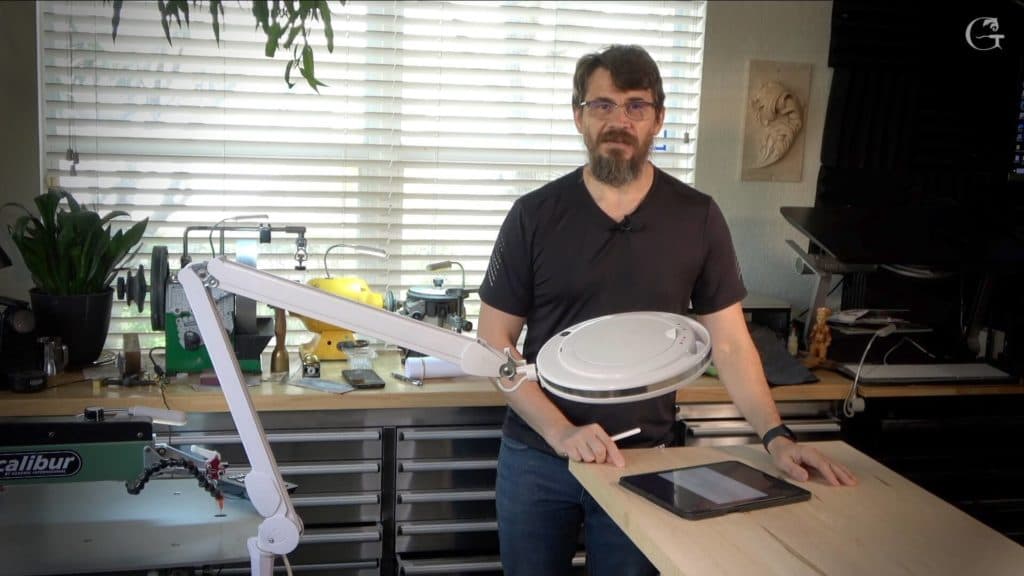
Alexander Grabovetskiy, woodcarver, School of Woodcarving · Published 2021
What does a wood carver mean by "high-end"?
Quick answer: In Venice Room 104, part 1, I said the high-end architects I work with sometimes just like to do changes, and called that normal. Other lessons of mine use the word beside cabinets, a kitchen, custom homes, saws, steel, tools and a finish.

In part 1 of workshop 104 I said, "I'm working with the high-end architects, and sometimes those high-end architects, they just like to do changes." My other lessons use the same word for a kitchen, custom homes, cabinets, a finish, steel and tools, and each place is below with its link. A lesson with a link is open to everyone, and names like 56-9 mean part 9 of lesson 56.
Ever drawn one design again and again? Here is my line about it, and what else I call high-end.
What was I working on in workshop 104, part 1?
A board. In my words, "I've got board, and this board is about two feet wide and about six feet long, so 24 inches by about 60 inches long, and about an inch and a half thick." That is about 61 by 152 cm and 38 mm.
It is one piece of a long detail: "That's actually about 10 feet long overall" (about 3 m). The next line is "I divided that in multiple parts." I offered to mark the place for you: "what I'm going to work on right now, it's this area right here."

Before any wood, I told you I would explain how I got the drawing onto the board. It is "really interesting trick for you to use," and it matters most for big parts, "because sometimes it's challenging just to transfer the big idea right on the board."
What did I do before the iPad?
Years ago I stretched a big sheet of paper and drew "everything by hand." The opposite side had its own cost: "I have to flip it and I have to, again, just draw the detail. And that would take me a long time." Then comes the line, "Lately, I am using technology, okay?"
My story has a project that was "About 10 feet long project and about 36, actually, high" (10 feet is about 3 m), and it was "just like a headboard." There was no "technology" in it, just paper, and "it took me about a couple weeks to develop all the details, all the acanthus leaves, and so on, on that piece of paper."

What happened when the architect wanted changes?
The client asked, "would you change that acanthus leaf? I want to get that higher." I said I could. Then the razor: "I had to take a razor and erase everything and get rid of whatever I just drew and spent hours and hours of drawing, and then redraw and submitted that."
He called back with "I like it, but I would like to move it toward right." I told him, "I have absolutely no problem. I'll just redraw that." What followed was "back and forth, back and forth. It was like dancing."

Right after "And that is normal," comes the sentence at the top of this page. After it I gave the stage a name: "I call that stage dancing stage."
On paper, "it just takes so much time. It's just a waste of time." Here is the other side of it: "If you don't have technology, you don't have any other choice, but if you do have technology, it just makes it a lot easier." With the iPad, "I can change in a second. If I don't like something, I just click and undo and redo."
How did the iPad help with this board?
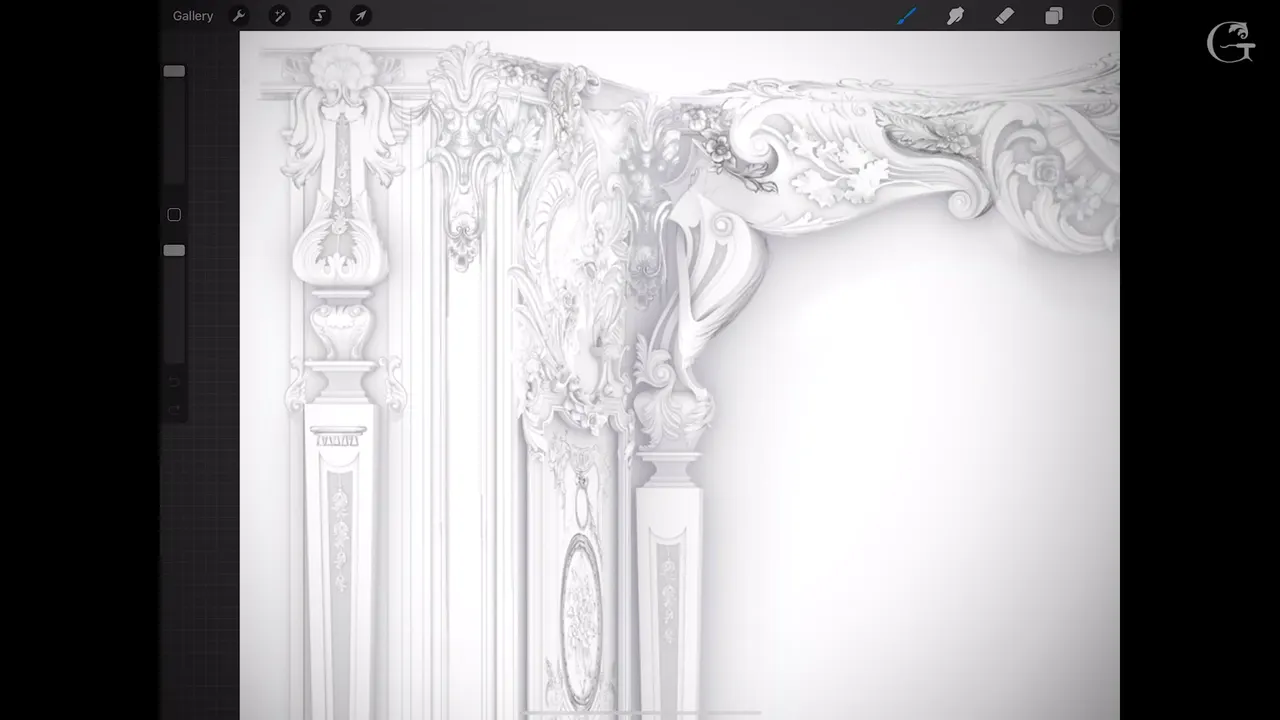
The original was more than a drawing: "Not just the drawing, it's actual 3D model." I "communicated with a client" about more: "they wanted to add some details and actually expand and so on," and "I didn't want to create 3D model again because it takes so long." My idea was, "Why don't I just pull iPad and just draw some details?"

A huge job was my example in part 1: "Let's say you've got 36 inches by 120 inches" (about 91 by 305 cm), and "you really don't want to pencil it" on paper. The reason I gave for not using paper was "because it changes."
In part 2 the print comes next. It had to fit "perfectly to the millimeter," because "everything is just perfect when it's going to be applied on the walls." I exported a PDF, went to a print store and printed "the whole 36 inches by 120 inches paper" (91 by 305 cm). "I paid $27." For SketchUp, I said to look "in the courses under tips and tricks." You can also find this talk in my Techniques course.

Who gets called high-end in my lessons?
Workshop 104 has architects. Cabinets come in Greek Acroterion 5, part 4: "I've done a lot of cabinet work for a living. Mostly it's high-end cabinets, but I love to do all types of woodworking."

Let me introduce myself, part 8, tells of years of doing "whatever pays the bill if you understand what I mean." Then: "If they would come and they need the kitchen, I would do the kitchen, and that would be" what I call a "high-end kitchen and so on." About the big machinery I sold, my words were "really high-end," and "sold it pretty much and just started to carve full time."

Venice Room 56, part 9, gives a number: "It's about nine years I was a builder of custom homes. Okay. Mostly high-end custom homes." There was more: "I also had a kitchen and bathrooms company, like a cabinet company."

One day, I said, a famous woodworker came to my shop. His words: "Why don't you just concentrate on wood carving?" He said that "not too many people who left in the world who can actually carve." I "just switched to carving full time, pretty much, quite a few years ago." Then, "Did I lose anything economically, financially? Probably a little bit in the beginning." After "a few years of doing that work," I added, "I actually gained."
What shop did I run before I carved full time?
The livestream about clay modeling describes it: "I had a much bigger shop with multiple employees, with big machinery." It made "high-end cabinetry and furniture pieces, unique pieces," and it "wasn't like a one-man shop." That stretch has "I used to build houses. I had multiple crews."
A friend of mine put it this way there: "There's a lot of people who do cabinetry. There's a lot of people who's able to do custom furniture." Then, "But not too many people who are able to actually carve wood."
How does a high-end saw fit in?
My first million dollars is the livestream with a big house in it: "We built beautiful three-story house, huge, big house, and we framed everything ourselves." The saws came with it: "my people who used to work for me, employees, we did everything with a really high-end compound sliding saws. I mean, all the framing."
A list of trades came next: "Framer, finish carpenter, cabinet maker, furniture maker. And there is another level." My words were "professionals only," and then I named a wood carver. The list covers carpentry, framing and finish work.
Do I charge for drawing?
The same livestream has the client side of that story. "Yes, I do charge for time I spent on the drawing," and I "didn't do that at the beginning." I "just thought that should be a process included in a wood carving project." Later, "I found no, it depends on the client. Some clients are so crazy, and they just dance so much and so long."
The customer in the next story was also a "high-end woodworker, and he got some of my wood carvings and stuff like this." His line was "Well, he charges for the drawing." I asked him how much he charged, "and I found out he charged so much. I thought, well, I should probably just draw, and that's it. But it's not what I love to do."
Architects write to me too. One email asked for "a professional wood carver who would be able to carve for us a 17th-century mantel or chimney if you're in England." My answer: "Yes, absolutely. I have no problem carving it, and that would be a joy for me to carve that chimney."
What about high-end tools?
Venice Room 50, part 3, shows a set of seven tools: "There's absolutely no difference between really high-end, expensive tools and this one, which costs you $10 a tool. Not expensive at all. Still carves beautifully."

You also cannot compare "high-end tools with those tools," I said, because "It all depends what you mean when you're saying quality." My example was a steak from a special Japanese cow for about $1,000 against a $12 steak in the USA: "I'd rather pay $12 than $1,000. The purpose is still the same."
Next came "I can get a job done with much cheaper tools, and it's still going to look beautiful and nice." Before that: "So you can create beautiful stuff with less expensive tools."
A lesson in the tools course comes at it from the other side: "Doesn't matter what brand you buy, you still have to sharpen those tools, even if they come out the box sharp and ready to go." Then: "any tools, any brand I buy, doesn't matter high-end or not too high-end, I still have to reshape, I have to resharpen, and I have to re-strop it or rebuff it." Later there: "There's some pluses and some minuses in the higher-end tools, and there's some really good tools, but the price tag is much cheaper."
Does high-end mean the steel?
The April 2020 livestream on wood movement had me say that one of the companies had contacted me, and "they making professional level, high-end woodcarving tools." Then: "Absolutely high-end, okay," and "talking about the steel they use" gives "a high-end steel, and that's forged."

Can a finish be high-end?
In Lily Box 13, part 10, I show a powder for the inside of a box, and it is "just going to give me really nice texture, like felt on inside." About where I buy it: "inexpensive solution with a really high-end finish." And, "It comes like a kit." This is flocking.

What about a high end home?
Carving Plate with Butterflies 12, part 2, says the technique can "dress up some mirror. So the mirror frame or something like that." Next, "I even done with that same style casing inside of the" high end homes, "just the detail on the inside." The casing was "really big right there," the detail "around the windows, around the doors."

Where does the workshop 104 board end up?
Video 2 has "there's going to be two of them on both sides," and "it's going to go on the walls." Next, "a door with the carving in it, okay?" I called the whole thing "really unique, really beautiful," an "absolutely gorgeous project," and "I love it."

The third part of 104 adds a limit: "I'm not expecting anybody to do that to that scale, but you can take some parts of those lessons or those video segments and use it." It also says "that type of carving, what I'm doing on the walls, could be applied to any type of framing."

Which lessons use the word?
The table lists the lesson, what the passage was about and the word with what it described. Numbers alone are Venice Room lessons, and each row is a lesson you can watch.
| Lesson | Subject of the passage | The word and what it described |
|---|---|---|
| 104-1 | Architects who send a design back for change after change | Architects, high-end |
| Greek Acroterion 5-4 | Cabinet work that I did for a living | Cabinets, mostly high-end |
| My introduction, part 8 | People who came to me and needed a kitchen | Kitchen, high-end |
| My introduction, part 8 | The big machinery I sold before I carved full time | Machinery, high-end |
| 56-9 | Homes I built for about nine years as a builder | Custom homes, mostly high-end |
| Livestream, clay modeling | A shop with many employees and big machinery | Cabinetry and furniture, high-end |
| Livestream, first million | Framing a three-story house with my crew | Compound sliding saws, high-end |
| Livestream, first million | One buyer who got some of my wood carvings | Woodworker, high-end |
| Butterflies 12-2 | Casing around the windows and doors inside of homes | Homes, high end |
| 50-3 | A tool that costs $10, set next to costly ones | Tools, expensive and high-end |
| A tools lesson | Reshaping, resharpening and re-stropping a tool of any brand I buy | Any brand, high-end or not |
| Livestream, wood movement | Tools from a company that makes them professional level | Woodcarving tools, high-end steel |
| The Lily Box, 13-10 | The inside of a box, with a powder kit | Finish, high-end |
Where can you watch the lessons I name here?
This page belongs to Venice Room 104, one of the twelve workshops, 98 through 109, in the Part 9 course. The other pages named above come from Venice Room Part 5, Greek Acroterion, my introduction lesson, the April 2020 livestreams, the Butterflies plate, the Lily Box and my tools course.
Plain definitions of a few words here are one click away: wood carving, gouge, inch, millimeter, Venice, acanthus, cabinetry, architects, jigsaw, mirror and steel.

Want to hear all of this in my own voice? Start here.
How it's done
- Draw the change. "Why don't I just pull iPad and just draw some details?" is how part 1 puts the idea.
- Print it. Part 1: "I can just print, pretty much, a piece of paper."
- Transfer it. Then, in the same part, "transfer that to the piece of board."
- Undo what the client dislikes. The part ends on "I can change in a second. If I don't like something, I just click and undo and redo."
Frequently asked questions
How long did the paper drawing take me?
In my words, "it took me about a couple weeks to develop all the details, all the acanthus leaves."
How big was the board in workshop 104?
About two feet wide, about six feet long and about an inch and a half thick, in my words: 24 inches by about 60 inches (61 by 152 cm), and 38 mm thick.
Do cheaper tools carve a good result?
In Venice Room 50, part 3: "I can get a job done with much cheaper tools, and it's still going to look beautiful and nice."
What did one architect's email ask for?
What to carve next