
Alexander Grabovetskiy, woodcarver, School of Woodcarving · Published 2021
What does a wood carver mean by "practical"?
Quick answer: In Venice Room 104-3 I called my wall carving practical and said it fits framing of any kind. In my other lessons the word comes up where a carving is used, touched or filmed: furniture, a tray, a box, my bench, my lamp.
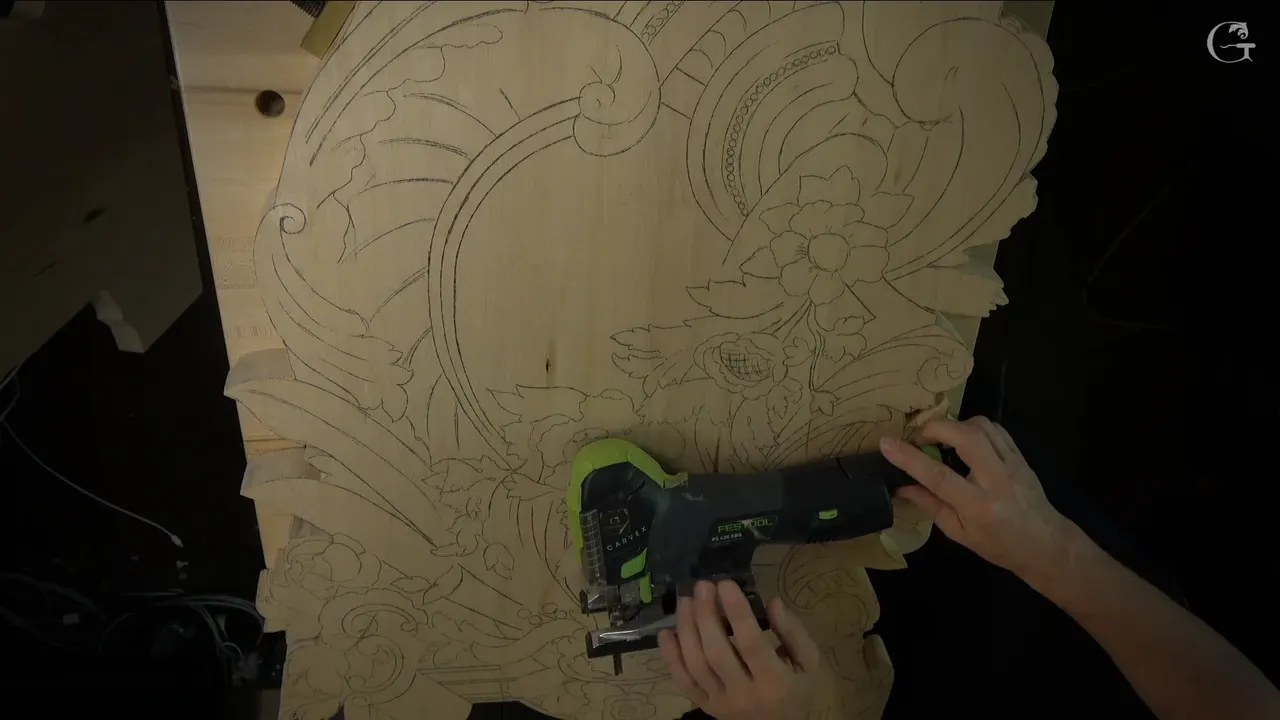

In workshop 104, part 3, I said about the carving on the walls, "that type of carving, what I'm doing on the walls, could be applied to any type of framing," and then, "So, it's practical." My other lessons use the word where a carving meets real use: a tray, a box, a model for casting, a bench, a lamp. Each place is below with its link, and a name like 21-4 means part 4 of lesson 21.
Ever run a hand along a carved edge? Ever set a carved box on a shelf you reach into every day? If you have, you already know what the word asks, and here is where I said it.
Practical in five lines
- Two lessons, one on a box and one on a Roman leaf, say that wall and art pieces can go further than furniture and everyday items.
- On two furniture panels I held back from a see-through spot.
- A model for casting got no undercut in my Greek acanthus story.
- A setup can fail the word too: bench hardware in the way, or a lamp while I film.
- In workshop 104 the word closes a line about wall carving that fits any frame.
What was I carving in part 3 of workshop 104?
A shape for a wall, sawn out first. I called it "just the jigsaw I mentioned in previous segment," and I even liked its name, which "sounds like it is almost made for wood carvers." I had put tape on the guard "just to get that guard out of my view, because it just blocks the view."
Then the piece was ready. "This piece is ready to be carved, and I have to be, I don't know, somewhat fast on this piece." Then, "that piece will be applied on a piece of plywood. I have to make a wall, and one of the sides has to be curved wall." The wall goes "behind the main structure." I still had "some columns and so on" to do.
What is the bossing step?
Step number one, in my words, was "just the bossing. It's pretty much the normal step what you do with any of the projects." The point is "to create overall shape, so how it's supposed to be."

The high spot is "of course, the flowers." My plan was to add details and "glue up, laminate some more." Right in the middle, "this actually looks almost like a shield on inside." The piece will flare out and "just go much thinner," to "no more than maybe a quarter inch thickness" (about 6 mm).
How deep did I plan to go, and with what?
With a "10 millimeters number 11" (3/8 in) and a mallet. The gouge is "also about 10 millimeters" between its edge and its depth, "maybe 11 millimeters" (7/16 in). My reason: "When I'm going to dig that inside of the wood, I can actually reference this point, the upper point, and I'll know how deep I went. So it's going to be consistent."
Along the side of the future flourish, the high spot and the low spot sit "about 10 millimeters, maybe about 11 millimeters or so" apart (0.39 in). For the outline I planned "probably a heavier mallet, like 30 ounces or so" (about 850 g). Another page of mine, on the 104 mallet, follows what that weight does.
Where does the word sit in the wall lesson?
In this part I did not stop to define it. The lines around it give the sense. Framing comes first, and then "some unique framing going on later on and so on." After that comes the word.

A limit on scale follows. "I'm not expecting anybody to do that to that scale, but you can take some parts of those lessons or those video segments and use it, whatever the application." About my pace, "most of the time, this process is not that fast."
Why not go through on furniture?
Two furniture panels, one answer. In part 4 of the Furniture Panel 21 upper part I was undercutting an edge. "Yes, it is possible to go all the way through, but then in the furniture carving, it would not be too practical in this case." Then, "Some spots we will, maybe."

Furniture Panel 31 gives the longer answer. Working on a furniture panel I planned a number 5, "a quarter inch, about six millimeters," and said "I can always refine it." My worry was "I wanna make sure I understand overall movement." The height I had in mind was "one and a half millimeters from the background," which I also called "one 16th of an inch."
Then the line: "and you can see all the way through, but it would not be practical. That is the huge difference between carving for furniture versus like ornamental carving." Low carving gets hit, I said, so "people gonna hit that. Okay? So that is not, not good idea."
How did I weigh an airborne section on the tray?
With a question to myself. The tray lesson 7, part 1, has "So now do I wanna do the airborne or not? Again, you have to think about practicality, what you're gonna place in it."

Seconds before it I had said "It looks simple, but once you're gonna start carving it, it's not as simple as it seems."
How does a wall piece differ from a tray?
I held back on the tray. In tray lesson 6, part 3, it says "Don't stay too deep inside because it's gonna be too fragile. You're gonna be able to break it." I planned to stay "10 millimeters or so" (3/8 inch) deep, and then "I'm gonna carve up to the knife edge." That gives a thin look, and the thin look is "only visual."

Two jobs sat side by side in my words. For a decoration "which is gonna be on the wall, I would do extreme under, but not in this case," because this one is a "practical use thing." The edge looks "like a paper thin, but it's not." Ten millimeters, I added, can run to "the half an inch" (about 13 mm). "It's not a big deal."
Why go easier on an item people use every day?
Less material means a weaker piece. In the Lily Box lesson 6, part 9, I said I could take a number 3 of "5 millimeters, 3/16 of an inch" to clean a rough wall. Then, "I really like extreme undercutting. And again, that is just my personal taste. Sometimes it's not too practical if it's everyday use item, because more material you're taking out, more fragile you make it."

A piece of art on a wall is the other case. "It's just going to hang right there. So you can undercut as extremely as you wish." One way to make a piece last came with a finish of lacquer or shellac. Dilute it "as much as possible by using spirit and penetrate multiple times," I said, and it will "bind all those fibers on inside" and "hold really long." I called that "one of the ideas which you could do."
The Lily Box lesson 8, part 10, set a layer of the box against a wall decoration. Such a decoration could be separated "completely without connection downhill." Not here. "In this case, it's a practical thing," and it will be used. "I want to make sure it's not that easy to break."

What about a decorative piece?
Roman Acanthus 10 has a number 5 and a warning. "I have to be careful not to overdo, because I still have to keep some meat. Otherwise, I'm going to make it too fragile." Then I eased up. "Although, I don't really worry about to make it fragile, because this piece, yes, it is architectural, but it's more decorative, ornamental."

I can "frame it and I can place it on the wall," I said. If it is more artistic, I said, and "not practical like for furniture," I can "go to the extreme."
How small can a part go before it breaks?
Smaller than real life is a risk too. Part 8 of lesson 11 of the Lily Box has "in real life, they are a little smaller, and I am aware of it, but wood carving is about exaggeration sometimes." I did not want to make it too small, because it is "absolutely unpractical. It will be broken for sure." So the plan was "a compromise between how it's in real life" and how it looks on the flower.

Part 10 of that lesson is about the backside. Of the opposite side I said, "I have to just make sure it's going to be practical, okay?" The reason was the wood. "Especially with wood like this, it's crunchy, like I said many times."

A little too much off and "I can make it almost too fragile and unpractical." I would be happy "just to give the main form."
Is the word only about breaking?
Not at all. In the molding course, lesson 1, part 1, it was about my workbench. "If you do have a workbench same like what I have, and you have some hardware just like that, you can probably, to a certain degree, just use that and hold it on the workbench, but I don't think it's really practical." It is "in the way."

My choice was "a sandwich method, which is a piece of plywood, what I usually use, and use a printer's paper." The board I reach for most "is only a half an inch" (about 13 mm). For glue, "Titebond is kind of hard to clean. Lately, I use more spray glue." And that glue is "really easy to peel."
Then there is the lamp. In Hashemi Flowers 49, part 7, I said "when I'm doing that off camera, when I'm not talking, when I'm not trying to teach anything, I am using lamp. Okay? So that type of lamp with the magnifier glass, and I could see much better." The lamp lets me "get to the tiniest of details with no problem. But it's not practical when I'm filming it."

A composition can pass the test. Molding lesson 10, part 1, has "It's not complicated composition, but I really like the idea. Especially how practical that is." It suits this: "If you like mirrors. And you want to create molding and acanthus over that molding. That is a good one."
What about a model that someone will cast?
There the answer is no undercut. Greek Acanthus 9, part 2: "I've done some work for a company who would do some plaster work, and they needed some models made, and I could not undercut because they would cast it later. And for the mass production, it's not practical."

A standalone piece is the other side. "But if it's a standalone piece, a standalone wood carving piece as a art, I'm always undercutting." My reason was "because of the shadow, and I just like how it looks." Of a small undercut I said "that's already creating the shadow line, which is actually what we are looking for."
Does touching count as practical?
In Byzantine Acanthus 5, part 2, it did. "Byzantine used dowels. Just on a practical side, people would come to churches, and people love to touch. Which is okay." Then, "We feel much better than we see."

Which lessons use the word?
The table lists the lesson, what was at stake and the word with the call I made. Names like Box 6-9 give the lesson and then the part, and every lesson named is one you can watch.
| Lesson | What the passage was about, in a few words | The word and the call |
|---|---|---|
| 104-3 | A wall carving that fits any type of framing | Framing, practical |
| Panel 21-4 | Undercutting an edge through to the other side on a furniture panel | Furniture, kept solid |
| Panel 31-1 | A see-through gap on a furniture panel that people will hit | Gap, avoided |
| Tray 6-3 | Wall decoration set against a tray made for use | Practical use, held back |
| Tray 7-1 | Whether to carve an airborne section on the tray | Practicality, what goes in it |
| Box 6-9 | Extreme undercutting on an item for everyday use | Everyday use, fragile |
| Box 8-10 | Whether a second layer connects down to the first | A practical thing |
| Flower 11-8 | Carving a part of the lily flower smaller than I did | Too small, unpractical |
| Flower 11-10 | Taking wood off the backside of the flower | Backside, practical |
| Roman 10-1 | A decorative piece that I frame and hang on the wall | Art piece, not furniture |
| Greek 9-2 | A model that a plaster company would cast later | Mass production, no undercut |
| Moldings 1-1 | Holding a board with the hardware of my workbench | Hardware, in the way |
| Moldings 10-1 | A composition of molding with acanthus over it, for mirrors | Composition, a practical idea |
| Hashemi 49-7 | Carving under a magnifier lamp while the camera is running | Lamp, off camera only |
| Byzantine 5-2 | What visitors to a church love to do with their hands | Touching, a practical side |
Where can you watch the lessons I name here?
This page belongs to workshop 104, one of twelve in the Part 9 course. The other lessons named above are Furniture Panel 21, Furniture Panel 31, Tray of Blessing 6, Lily Box 6, Lily Box 8, Lily Box 11, Roman Acanthus 10, Greek Acanthus 9, Acanthus over Moldings 1, Hashemi Flowers 49 and Byzantine Acanthus 5.
Plain definitions of a few words here are one click away: wood carving, gouge, jigsaw, plywood, shellac, mallet, tray, framing, dowels, plaster, cast, mirrors, relief, millimeter and inch.

Want to hear all of this in my own voice? Start here.
How it's done
- Name the use. Tray 7-1 puts it as "Again, you have to think about practicality, what you're gonna place in it."
- Sort wall pieces from everyday ones. Box 6-9 says "more material you're taking out, more fragile you make it."
- Leave some wood. Roman 10-1 says "I still have to keep some meat."
- Bind the fibers. Box 6-9 gives one idea: dilute shellac "as much as possible by using spirit and penetrate multiple times."
Frequently asked questions
How thin did I plan the wall piece in workshop 104?
At the flare I planned "no more than maybe a quarter inch thickness," about 6 mm. The board itself is about an inch and a half thick (about 38 mm). I planned an outline 10 millimeters (3/8 in) deep, maybe 11.
Why did I put tape on the jigsaw?
The tape held the guard out of my view, because it just blocks the view. I like that jigsaw so much that I like even its name, which sounds almost made for wood carvers. The pattern was transferred, so the piece was ready.
Why not hold the board with the hardware on my workbench?
Hardware like mine can hold a board to a certain degree, I said, but it gets in the way. My choice is a sandwich method: plywood, printer's paper and, lately, spray glue.
What to carve next