
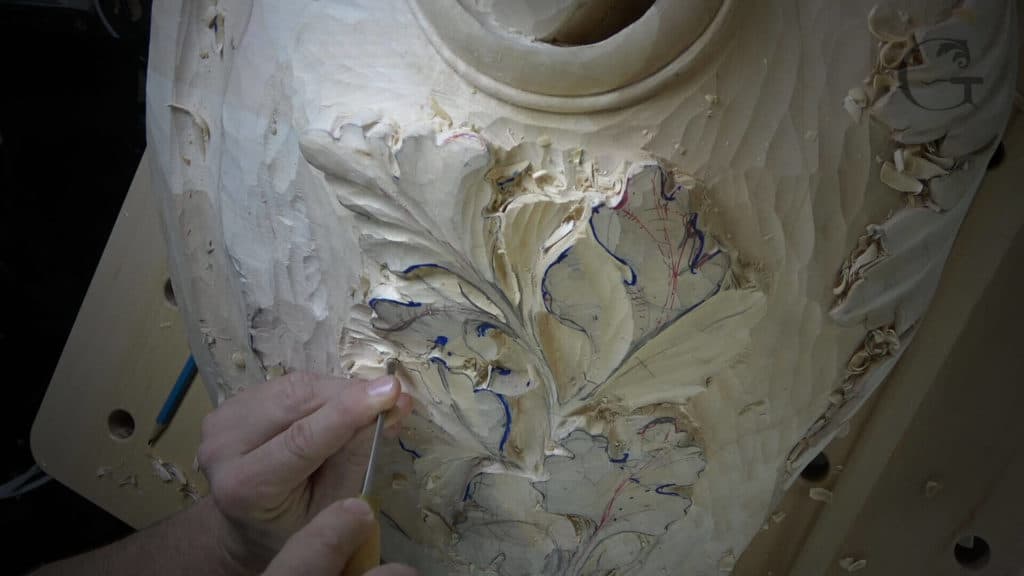
Alexander Grabovetskiy, woodcarver, School of Woodcarving · Published 2021
What does a wood carver mean by "super clean"?
Quick answer: In the first video of Venice Room 98, I say I do not worry about one spot being super clean, and the reason I give is a shell on that area. Other Venice Room workshops, my vase, panel, onlay and rosette lessons, and my sharpening course carry the same words.
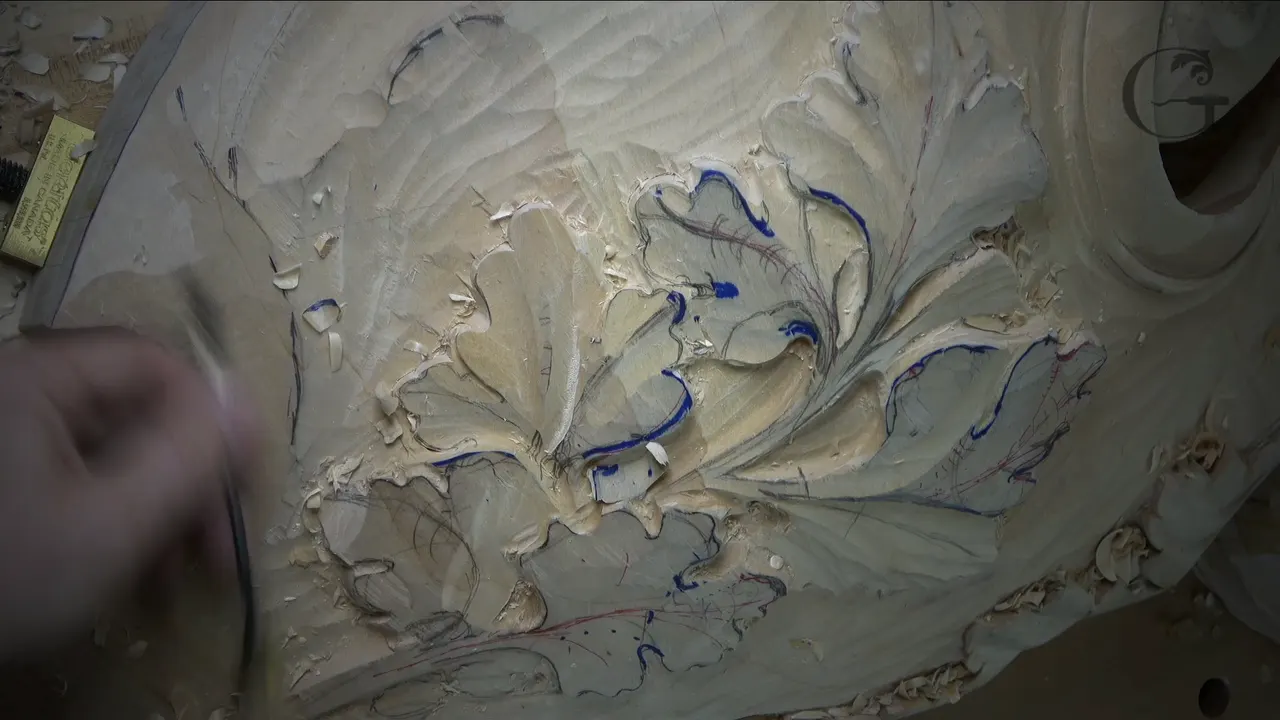

In part 1 of workshop 98, I say I do not worry about one spot being super clean, with a shell as my reason. The same two words come back in many of my lessons, and each passage below is read with the lines around it.
Ever looked at a carved leaf and wondered why the carver left one spot alone? Workshop 98 gives my reason, and my other wood carving lessons give more. Each gouge is named by number in part 1. Every size is given in millimeters and inches, with my own figure first and the other system in parentheses.
What do I say about super clean in part 1 of workshop 98?
I open part 1 with a tool I do not have to use. "Number eight and 6mm in this case is Back-bent, I don't really have to use it, but it was on my bench." Six millimeters is 0.24 in. My plan after that is "let me use some kind of spoon and clean slightly this area." A number five at about 6 mm comes up too.

Then comes the line this page is about. "And I don't really worry about to make it super clean right here, because there's going to be some shell going on, just a little bit". Preliminary is my next word.
A plan for the next tool follows: "Let me use again number 11", and the size is "10 mm", which is 0.39 in. The jobs are to "create some waviness" and to "clean outline of this leaf". A second wave calls for a smaller tool: "they're going to need a smaller number 11 to create another wave right here."

An edge is on my mind. I will undercut a little later, I say, and the need of the moment is "To establish overall look, but later on, everything going to go pretty much to the edge". After that, "But what I need to do now, I need to establish Convex right in the middle."

For that I write "I'll take number 11 again and 10mm", and I add 3/8 inch (9.5 mm). Then I start "creating my concaves on the side of future convex."
Blending comes up here too. "And I'm going to need to use probably the number 7 upsidedown." Some limits are named: "Though some limitations I have right now, so Back-bent would help me a lot, but all I'm doing is just blending." And then "I really don't need to see sharp ridges."
One side still bothers me: "I'm still not so happy about this side, and I need to blend it nicely." Another spot waits for "That part a little later". Then "But it's Ok. That's Ok." Next comes a maybe, "Maybe I should do some kind of small wave right here." Near the last lines, "Preliminary cut like that and I'll do exactly the same".
More lines from part 1 follow. A nicer outline is on my list: "Maybe number 5 to create nicer outline." Of one section, "go a little deeper in this section". Another line, a little further on, says "Maybe give a movement downhill slightly." Of one more side, "I need to exaggerate that side".
What do parts 2 and 3 say beside it?

Part 2 has a plan, "let me draw just one section", and I state a wish, "I really want to see my middle lines." A doubt shows too: "I don't know if I like it or not, maybe I don't." Then "Maybe I just want to clean and I can create an extra movement".
A bigger shape is wanted as well: "I really want to exaggerate a little more this section make it more convex". A blend is followed by a check, "So there is a wave and I need to make sure it looks good."

The third video starts with "I need to use smaller number 11, so remove that little guy." It goes on with "Looks good" and then "And what I see, I could give a slightly deeper concave right here". Another line adds "Just to give a little more shape."
One sentence names the stage: "And yes, later on, I'm going to do some more movements on this side. But for now, that's the stage I want to see it." And then "Okay, let me jump to this one."
Blending returns on the next leaf, with a maybe for a number seven upside down. The reason is "Because back bend would help me a lot more." A need is stated too: "I need to clean that from opposite side." Later comes a plan for one more tool, "Let me also take number three and shape it a little nicer."

That leaf gets "Same idea, very much." It needs "to create convex right in the middle." About its shape I say "And that's a really good 3D shape. I really like it." The last lines read "Going against the grain" and then "That's okay."
Is super clean needed at the beginning?
My Floral and Molding course says it in plain words, in lesson 2: "It doesn't have to be super clean at the beginning because a lot of that material is going to be gone." I add that I can probably take a number nine at 10 millimeters (about 0.4 in) and go at a small detail right away.

The vase course puts it another way, in lesson 2. "I've got pretty much all my background removed," I say, and a super clean finish right now is "not the goal".
Next I say "And I am ready to work on leaves and also on the sections." My tool is a number three, probably any one, at 10 mm (about 0.4 in), and I "slice it just like that, just to create the feel like it's going underneath of here." The edge is not final: "Although that is not the final edge".
Which Venice Room workshops give the same line?

In workshop 99, part 4, I say I will use probably just a number five, a quarter inch (6.4 mm), six millimeters or so. My reason is long: "Again, I don't need to do it super clean yet because like I said many times". A shell will go that direction right here and fan out in that section.
That workshop gives another reason in part 3. There I'll just go around and create some movements, and I will have a chance to clean everything. For that reason, a super clean pass is not my concern right away.

Workshop 93, part 12, gives a texture as the reason. My words are that I lowered that down and did not worry much about a super clean finish. The plan is the same punches I used previously.

Over in workshop 141, part 1, the reason is beads: "So I've got a quarter-inch bead all the way," a quarter inch being 6.4 mm. Most of that wood will be gone once I make those beads, so a clean pass is not my worry. After it, "So now I need to clean those lines again." The tool is "number 11 and 3 millimeters, one-eighth of an inch", which is 0.12 in, and 1/8 in is 3.2 mm.
In workshop 85, part 10, the reason is a chunk: "Again, it doesn't have to be super clean because I need to remove chunk." Later in that video, "But I need to restore the line."
What if a result is not super clean?
Way back in workshop 1, part 8, I say "I did not get my results super clean, which I don't really worry about it." A marriage line follows: "I've got about maybe 1/32 of an inch marriage line, pretty much. But for me, it's actually good." That is about 0.8 mm.
A fix is named: "I can always take number one or even knife if I need to." Then "That marriage line is gone. It's just absolutely perfect." And "Yes, you could go to the extent if you wish."
How much clean do I want while the shape is still open?

The Grape Onlay course shows how little: I take a number three at six millimeters (about 1/4 in), "just attacking from two sides". Super clean can wait, I say, since I can attack from the back side. Then comes "But still, just remove as much as you wish."
In panel lesson 26, part 1, super clean is not the aim as of now, and I say "I am after outlining". Then "So I'm gonna just relieve it just like that", and "And then I can fix overall movement."
Panel lesson 28, part 3, goes at the background: "Well actually with the same tool, I can probably fit right here and clean the background little bit." Super clean is not required there, but "at least I can remove some of". Later, "if I don't have a really good line yet".

The rosette course has the words in lessons 1 and 4. Lesson 1 starts with "I have to kind of clean a little bit just to get closer to my final depth, or height I should say." I take "a flatter gouge" and "number two. And that would be 30 millimeters", about 1.2 in. The line I want is "I don't really need to make it super clean, but a little bit."
One line must stay: "Almost to the line. But I don't want to lose the line", and the reason is that the line is the boundary of my molding.

Lesson 2 of Acanthus over Moldings has a chance for cleanup: "I will have a chance little later". It goes on with "use a number nine. It still would give you about the same result." The Tray of Blessing, lesson 2, puts it off at this point, with "just indication of overall movements." And "That's probably enough as of now." And "We don't even have the complete shape of the leaf yet", with a reason, "since we just designed on the fly pretty much."
When do I say super clean as praise?

Praise sits in the same words. Rosette 4, part 3, has "It gives me really nice and beautiful transition underneath. Really clean undercut, I should say" and "but it is super, super clean undercut."

Workshop 83, part 1, counts the sides: "So one side, second side, and from above, so three sides." It says "I need smaller one to attack from above" and then "And now everything is super clean on inside." And "Beautiful and clean." About the extreme I say "you can take it to extreme if you wanted to".
Workshop 64 says it in part 1: "see that extra division right here gave me actually super clean and beautiful look. Now, of course, that's what I think." Part 7 of workshop 36 has the lines "super clean results" and "Really nice and clean results."

A sharper tool changes it too. In the stropping lesson of the sharpening course, "It just shaves so easily because it's already super sharp." Then "Beautiful and super clean cut." And "And I can actually break the rules of the grain with the sharp tools."
My vase course, lesson 2, does it after sharpening: "I think I need to sharpen it a little more" and "It's much better." The result is "Just gives me super clean cut."
Lesson by lesson
| Lesson and part | What I say beside super clean |
|---|---|
| Workshop 98.1 | A shell going on there is the reason I give |
| Workshop 99.4 | Shell direction named, fanning out across that section |
| Workshop 99.3 | Having a chance to clean everything is the reason given |
| Workshop 93.12 | Texture from punches is the reason given in that part |
| Workshop 141.1 | Beads will take most of that wood away |
| Workshop 85.10 | A chunk to remove, then a line to restore |
| Workshop 1.8 | A marriage line near 1/32 in (0.8 mm) feels good to me |
| Floral and Molding 2.1 | Much of the material going away, said at the start |
| Vase 2.3 | Background removed, with clean not the goal right now |
| Rosette 1.3 | Ridges ridden with a flatter gouge, and the line kept |
| Furniture Panel 26.1 | Outlining first, then a fix to the overall movement |
| Furniture Panel 28.3 | Some removal now, with no good line yet |
| Grape Onlay 14.3 | The back side stays open to attack, and removal is up to you |
| Acanthus over Moldings 2.1 | A chance for cleanup comes little later |
| Tray of Blessing 2.2 | Indication of overall movements, and an incomplete leaf shape |
| Workshop 83.1 | Attacking from three sides ends with these words as praise |
| Rosette 4.3 | A clean undercut beneath a leaf earns the words |
| Sharpening 6 | The edge shaves so easily, and the pass is called clean |
Is there a rough spot on your own piece that you want to fix too early? Every lesson here sits inside one tuition plan, and the rest of Part 9 waits on the course page. For a gentler start, try the panel course or the grape leaf vase.
How it's done
- Find the sentence in part 1. It comes after the number five and before the number 11.
- Read the reason beside it. I give a shell for it.
- Check part 3. I name the stage I want, and I plan more movements on one side later on.
- Compare the reasons. Wood going away, a texture, beads, outlining, and a later pass.
- Hear the praise. Workshop 83 and rosette 4 use the words for a result.
Frequently asked questions
Where in workshop 98 does super clean come up?
In part 1, after I name a number five and before I reach for the number 11. The words sit in a sentence about the spot I am working on, with a shell named as my reason. I follow it with the word preliminary.
Which tool sizes does workshop 98 name?
Part 1 names 6 mm (about 1/4 in) for a back bent number eight, and 10 mm (about 3/8 in) for the number 11. Part 3 asks for a smaller 11, then goes back to 10 millimeters. I also give 3/8 inch, written with the inch mark, as another way to say the size.
How does the panel course treat the start of a pass?
At the start of a pass in lesson 2, I say a clean surface is not needed, because much of that material will be gone. A number nine at 10 millimeters is named right after, for a small detail I can attack right away.
What to carve next