
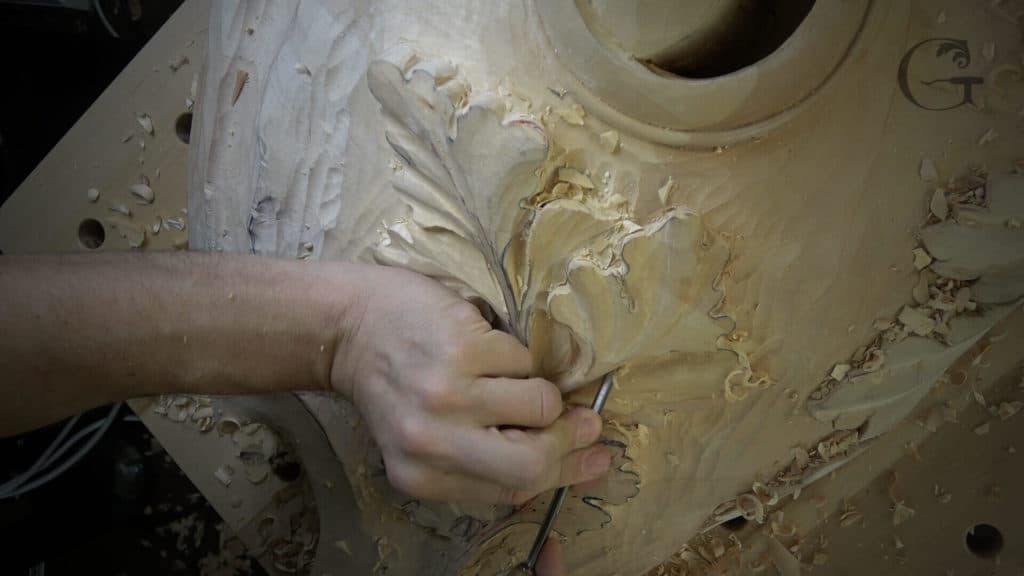
Alexander Grabovetskiy, woodcarver, School of Woodcarving · Published 2021
What does a wood carver mean by "what I want to see"?
Quick answer: Workshop 98, tenth video, has the phrase soon after "That's good," and then a back bend gets named for the final wave, with an undercut still to come. Some lessons put approximately, probably, somewhat or exactly before it, and some swap I for you.
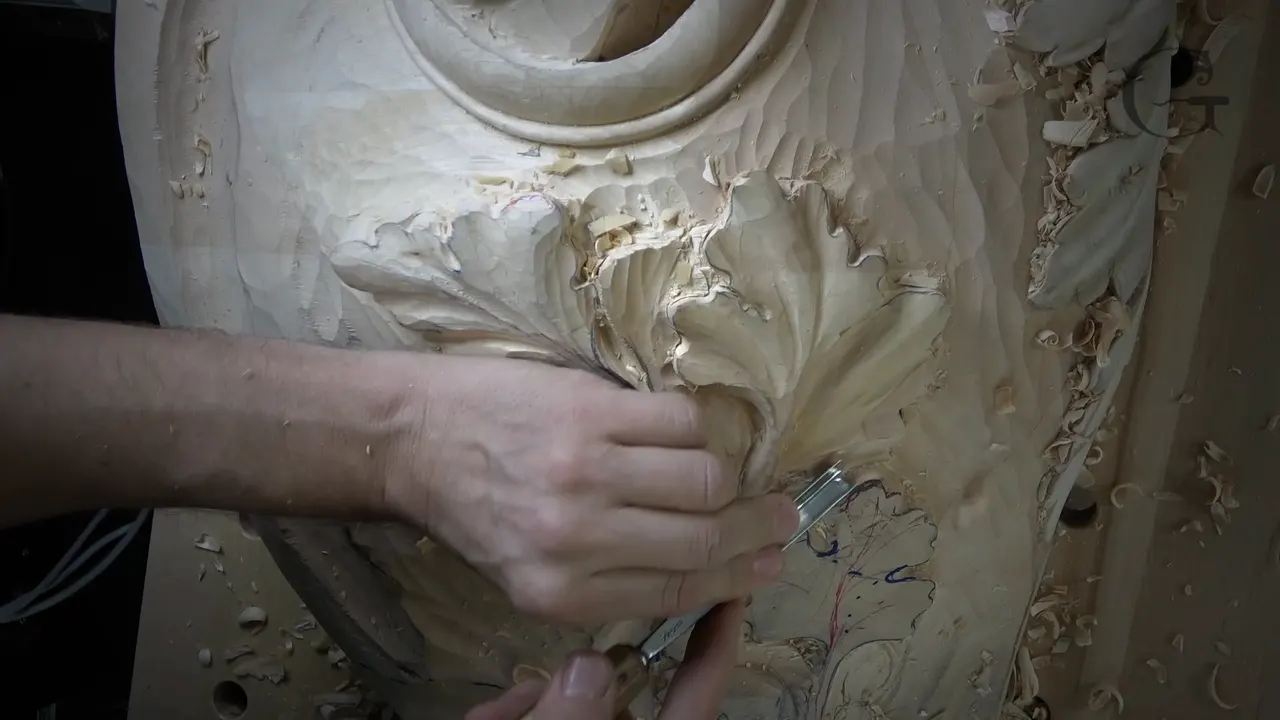

In the tenth video of workshop 98 I say "That is what I want to see" just after "It's going to be undercut a little later" and then I name a back bend. The phrase turns up in more lessons, each with a word in front of it.
Ever paused a gouge mid-pass to study the board? That pause is the whole subject here. Sizes come in millimeters and inches, my figure first and the conversion after it, for the wood carving I show.
What happens in part 10 of workshop 98?
The video starts in the middle of the work. "And opposite side of it," I say, then "I need to blend it now." My plan is a seven, "I guess."

Movements get my attention next. "Now, I can just concentrate on movements," I say. Then I list what I have: this movement, that movement, "got that movement." Small ones are still to add. Then comes "You know what? I'll just do a bigger one" and "a smaller one like that." A secondary stays open: "I don't know," I say, and then "Maybe, yes." The stretch ends on "hope it's going to look good."

The seven did not work in this case. I take a number three and outline with it, "because number seven didn't work in this case." Cleaning waits on my list: "And now I need to clean it."

Digging deeper is the next idea. "I can probably excavate even deeper underneath," I say, adding that I "need to attack that from the right position." Sizes follow: "maybe even three millimeters" (0.12 in), then "I'll just switch to two millimeters" (0.08 in). When the switch is made I say so, "now it's two millimeters" and the tool is "Number 11, of course" with the same idea as before.

The phrase itself comes next. "All right. That's good," I say, and the undercut is for "a little later." Next comes "for now" and the phrase itself, first with "we" and then with "I."

A limit follows right behind it, and the limit is a tool. "Now, use a back bend to get inside of here. Otherwise, there's no other tool I can fit underneath and get that final wave." After "There we go," a small plan closes the video, some cleaning with the number 11, "maybe two millimeters number 11."

Part 9 of the same lesson, just before it, said the undercut out loud: "later on I will undercut" with "a shell" to come. There I add "I'll bring everything to the edge." Part 11, right after, opens with "Just slightly give a little angle to this undercut."
Which word comes before the phrase?
Other videos add a word to it. Approximately is one, and workshop 69, eighth video, has it. Of a skew I say, "I think skew was a really good idea to use in this case." Pipes enter the plan once the phrase is said. "So multiple pipes," I say. My plan is "a smaller number 11 first, like 3 millimeters" (0.12 in), "like one-eighth of an inch" (3.2 mm), "just to pre-establish my cuts."
A decision about what overlaps comes next. The decision is to overlap the main body. The reason I give is that it will be visible from the bottom.

The first Venice Room course has the same word. In lesson 11, eleventh video, I clean underneath, after "I need to sharpen that again" and "approximately" leads the phrase. "Some more details on that" come next, I say, then "an extra movements" and the goal is to "make it look really nice."

Probably is the word in workshop 72, twelfth video. I plan "number five and half an inch" (13 mm) for "just a cut on those slopes" to "refine the overall movement." Sharp lines are not on my list: "I really don't need sharp lines." It follows, then "that is going right underneath that section."

Probably shows up again in workshop 45, fourth video. "Two millimeters, that's what I'm using" (5/64 in), I say, and one millimeter is the extreme: "If I want to go too extreme, I could use one millimeter" (0.04 in). Some spots do get one, but "if I don't have to, I'm not going to do it." The last division brings the phrase, and a flaw comes with it: "I can see this side is a little too rough." Cleaning "could be done with just a skew," I say, and later "it looks clean now." One ridge stays, "which is a good thing."

Somewhat stands in front of it in workshop 48, tenth video. "That's really good movement," I say. Then "Not detailed yet" and after the phrase, "Let me get little nicer division right here." Another idea follows, "I could probably hit straight down like that" then "I have a big chunk of material, so I should be safe" and "I'll be able to see much better where I'm going."

Somewhat appears again in workshop 82, sixth video. First comes "Let me create a second separation" then "Again, relief cut." Two options follow. One is "I could leave it like that." The other is more shaping "just to create nicer shape," because "it's a paint grade, so why not?" The plan runs on to "beautiful transition" and then "I think it looks good."

No word at all stands in front in workshop 84, third video. "Tools must be super sharp. Let me outline this section," I say, and "All right. So that is good." "So I can see," I say, and the phrase follows. A small job is next: I need to clean "a little bit this ridge" and "I don't need it." The grain gets a remark too: "Not too convenient."

More or less is the wording in workshop 67, first video, after "I use just a spoon gouge." A warning shares the sentence, because more concaves are coming and I "really want to excavate that eye also." A bigger tool is the next try: "Let me try 7 millimeters" (0.28 in). The area is "tricky" since it cuts along the grain, so I plan to attack from the opposite side.

That wording returns in workshop 59, ninth video. A limit comes with it, "as far as the concave." Before it, I say "I would like to see a lot more pronounced concave," going "this direction." After it, "let me relieve that area" and I "can probably excavate much deeper in this area, too, and connect with my main undercut."
What do I say when it is exactly right?
Exactly takes the front place in the lessons below. The Furniture Panel course, lesson 18, part 6, has me say "probably just shave this direction" and "that's absolutely perfect." Next, "Exactly" and the phrase. Next comes a tool, "Let me use again number three" then some cleaning "on inside right here."

The next lesson there, number 24, has it after a try. "It doesn't go. Now it goes," I say, then "Let's see how deep shadow I just created" and "it feels like this petal curls from this point all the way underneath." "So that's exactly" opens the phrase there, in part 6. A blend is next: "All right, that's good. Kind of blend it."

A plainer version sits in Furniture Panel 17, part 10. "I'm not sure what happened right here," I say, and then "That is the same depth" and the phrase follows with no extra word. After that: "Let me take care of this area." That lesson moves on to "number 11 again and three millimeters" (about 1/8 in), to "outline it again really close to the line."

The Hashemi course uses the same word. In lesson 42, part 3, a try goes right. "Okay, let's try that again. Oh, yes. That's absolutely perfect fit," I say, and "exactly" leads the phrase. "So it fits inside," I add, with the main form to establish, "more like a round, I would say."

What do I do when the cut is not there yet?
A no can come with it, as in workshop 40, ninth video, where I say "probably use number three, I would say" and "let me try, actually, a skew back bend." The result is "little better, but not exactly" the phrase. A new plan follows: "Maybe I'll just use a straight number one and blend little better this way."

Plain words for the no come from workshop 61, eighth video. The words "not exactly yet" come ahead of the phrase, then "Pretty close." More pronounced concaves are my plan, "right here." The look I describe is a "wave." An undercut waits too, and the same work is planned for the opposite side.
A curve with limits is the ask in workshop 74, first video. "Yes, three-dimensional, but gradual, okay? But gradual," I say, and I rule out "extreme lines." Later, that same video says "looks like I achieved the result" and "of course you don't see the details yet, but at least I've got what I wanted to see. I've got a really nice movement going on."

It can open a plan, too. In workshop 62, seventh video, I say, "Let me use a back bend again. Pre-establish my half-round movement." What follows is "in this case actually, I could use an even bigger back bend" and "It's still number eight."

The Vase with Grape Leaves course, lesson 2, has a red middle line. I want that ridge, "the center line in all of those five divisions," to be visible, and I plan the tool upside down: "I'll take number three," I say, "10 millimeters, three-eighths of an inch" (0.39 in), and "I'll just shave it to that line." My reason is "we really need to see that middle ridge. Otherwise, we're going to lose the movement." Last, "Number three, number five will work, but" and the phrase, with "that middle ridge, and on every one of them."

A wavier version sits in the Carving Hazelnuts course, lesson 3, part 3. I plan to subdivide a main shape into three and want "extreme subdivisions" there. "Number 11 probably better tool for this," I say. "I'm not undercutting because I still want to create more waviness." After that, "I'm just reestablishing overall" and the phrase follows it in the same breath.

Do I say it to students too?
I do, with a different pronoun. Byzantine Acanthus 6, part 1, has me draw a pattern and say "what I'm drawing right now should work on your piece also." Then the phrase comes back with "you" in place of "I."
Byzantine Acanthus 10, part 3, has the other half. "Position your piece on that board, find the best movement," I say, and "try to hit that main idea." My own piece is to go "a little closer to this edge," so the bulk of it comes closer to the golden ratio. Again "you" closes the thought.
What does each lesson show?
The table gives each lesson and what follows the phrase, read from the passages above.
| Lesson | What follows, in my words |
|---|---|
| Workshop 98, tenth video | A back bend reaches inside for the final wave |
| Eleventh video, lesson 11 | Some more details come next, with extra movements |
| Eighth video, workshop 69 | A smaller number 11 is named for the pipes |
| Lesson 72, twelfth video | Cuts on the slopes are planned, with no need for sharp lines |
| Fourth video, lesson 45 | One side is a little too rough, and cleaning fixes it |
| Workshop 48, tenth video | Nicer division is next, and a straight hit down is possible |
| Lesson 82, sixth video | Leaving the cut as it is stays an option |
| Third video, workshop 84 | A ridge needs a little cleaning, and I don't need it |
| First video, workshop 67 | A 7 millimeter tool is the next try on a grain problem |
| Ninth video, workshop 59 | Relieving that area is the next job |
| Eighth video, workshop 61 | More pronounced concaves are planned, then an undercut |
| Furniture Panel 18, sixth video | A number three comes next, to clean a little inside |
| Furniture Panel 24, sixth video | A blend is the next small job |
| Ninth video, workshop 40 | A number one is a possible next try |
| Hazelnuts 3, third video | More waviness is still wanted, so no undercut yet |
Who is part 10 for?
Anyone who pauses a gouge to study the board before the next pass, in an ornament or a sculpture alike. Twelve videos make up workshop 98, and this one sits inside the Part 9 course of Venetian style wood carving.
Which cut would you stop and check first? Would a named tool next to each check help you at your bench? Tuition opens the whole school, and every lesson above, in the Venice Room and the Hashemi course alike, sits inside it.
How it's done
- Hear the phrase. The tenth video of workshop 98 says it after "That's good," with an undercut still ahead.
- Read what came before. Earlier in that video come an outline with a three and two millimeters of number 11.
- Read what follows. The final wave needs a back bend, to reach inside.
- Compare the words. The table lists the next move in each lesson.
- Pick a lesson. Choose a row and watch the cut just before it.
Frequently asked questions
Which tool comes right after the phrase in workshop 98?
To get inside, I name a back bend. Otherwise, I say, there is "no other tool I can fit underneath and get that final wave." After "There we go," I plan a little cleaning with the number 11, maybe two millimeters (0.08 in).
Which words stand in front of the phrase?
Approximately in workshops 69 and 11, probably in workshops 72 and 45, somewhat in workshops 48 and 82, and more or less in workshops 67 and 59. Exactly shows up in Furniture Panel 18 and 24 and in Hashemi 42. Workshop 40 has "not exactly."
How does a cut change when it is not there yet?
Workshop 40 gives a new plan, "a straight number one" to blend it better. Workshop 74 asks for gradual lines and rules out "extreme lines." Over in the grape leaf vase course, number three goes upside down to shave to the line.
What to carve next