
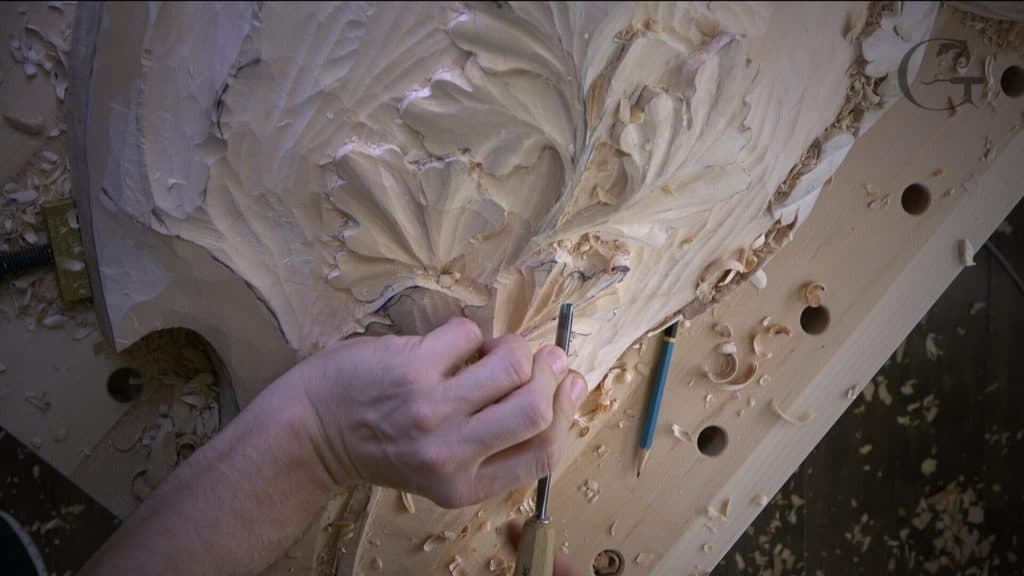
Alexander Grabovetskiy, woodcarver, School of Woodcarving · Published 2021
What does a wood carver mean by "a little angle"?
Quick answer: In Venice Room workshop 98, part 11, the first line I say is "Just slightly give a little angle to this undercut." Other lessons of mine put "a little angle" and "a slight angle" beside a knife, a skew chisel, a number nine or a number three, in Lily Box, Butterflies, Furniture Panel and Venice Room.
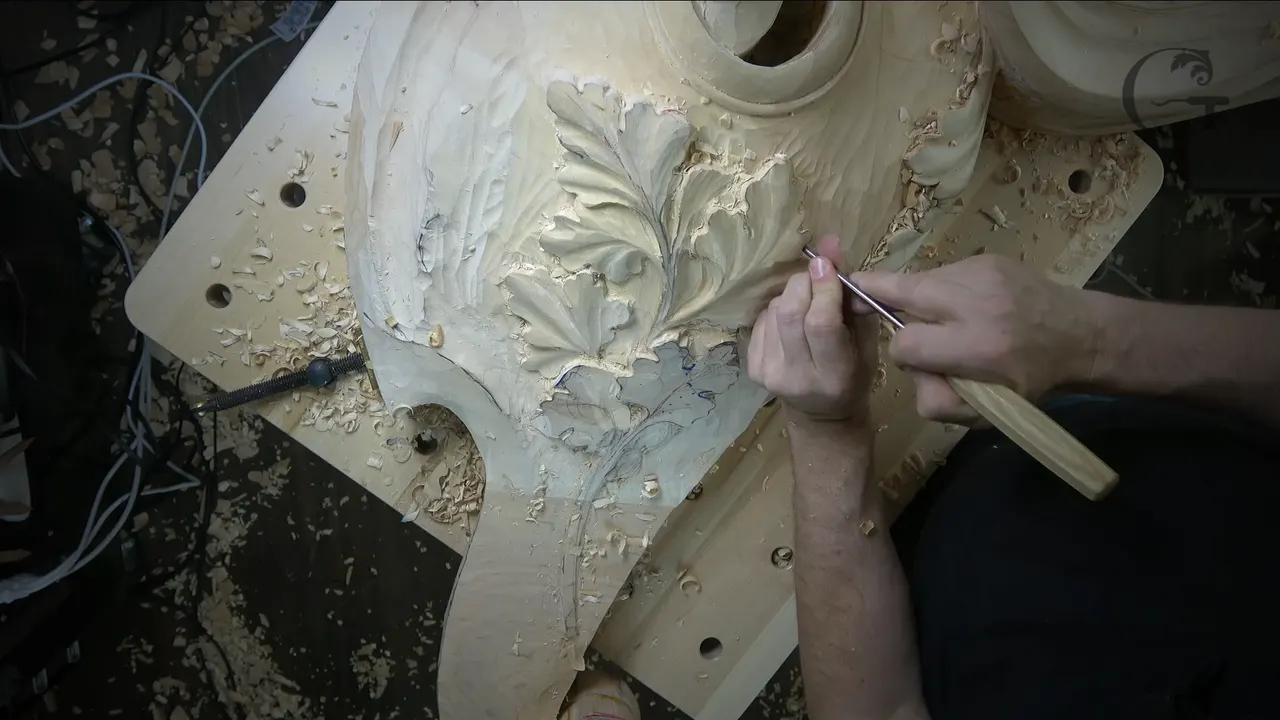

In part 11 of workshop 98 the first line is "Just slightly give a little angle to this undercut" and a number seven gets named later in the part. The same idea turns up in the Lily Box, Butterflies, Furniture Panel and other Venice Room lessons.
Ever set a gouge straight down on a line and looked at the wall it left? How far to lean the tool from there is what this page follows. Sizes come in millimeters and inches, my figure first and the conversion after it, for the wood carving I show.
What happens in the eleventh video of workshop 98?
The video opens at a leaf group. After the first line, the form is "approximately somewhat finalized form" and "this section needs to make sense."

Next, I say I will "jump on those two" before "all the stems" are done and "maybe just some extra movements." For them I plan to "establish the main idea of those two" with "this one first" and then "Same idea."
"So that is the main movement," I say, "and I've got three main divisions." One part is "going to go a little bit underneath." For the blend I name "number seven," to "blend that better."

Next, a number 11 at 10 millimeters (0.39 in), plus a notch to finish, "this notch done also." After the notch, I will work on "my convex in this area."
"And I'll attack right away this section, too," I say, then "the last one right here, same idea." A new direction brings a doubt, "although it doesn't really make any sense." The middle point gets named, a movement "like that" and "my concave going to go all the way this way."

The plan turns to "change slightly my movement" and a second doubt follows: "it doesn't make any sense if we're going to change it. So let me actually keep it." A pause follows. "Let me think," about whether one part should sit "on top of left side or the opposite." The answer is hedged: maybe the main body stays on top, I say, which is "probably going to make more sense."

Tools return: the number 11 at 5 millimeters (0.2 in). And 10 millimeters (0.39 in) is needed again. On my list sit "establish outline, the waviness of this area," a "Number seven" and "let me clean it." The last lines say "I have opened up this area," "for I can just establish the movement on this side." Then "I'll take 10 millimeters again" (about 0.4 in), with "Number 11."

Before it, part 10 puts an undercut off ("Going to undercut little later"), and after it, part 12 names a back bend and a final form. The captions of workshop 98 carry the word angle in part 11 only, so this page goes looking for it in other lessons.
Why do some carvers leave a wall almost straight?
Lots of them do. In Venice Room 52, part 10, I say "Lots of people, they just do almost a straight cut." The name is "wall undercut" and it is "almost 90 degree, just a slightly angled little bit."

Two reasons come first for why people don't undercut too much. A piece done "too thin" becomes "fragile, so you can easily break it," which I call reason number one. Some of my really extreme undercuts did not break, I add. Place is the second reason. "It depends how this piece is going to be used," I say, and this one goes "close to the ceiling." "The people not going to touch it so much" and only a cleaning crew will clean it.
Then the angle itself. "If you don't undercut extremely like I do, it's a lot easier to cut straight," I say, "a little angle it like that." Even so it will "look beautiful." I say "let me go back" and "I'm going to excavate today. This is just one of the approach."

How does the angle show up in Lily Box 3?
In the Lily Box course, lesson 3, part 6, half a millimeter (0.02 in) is the plan, "But carefully," toward "the thorn or spike." A little later: "I really didn't have to do that, and you don't have to do that." The subject is "undercutting as deep as I do." "It's still going to look really nice," I say, "if you're going to create just a slight angle with your cuts."

Two spots sit in part 7. Near the start I say I will "take probably number seven at first," a quarter inch (6.4 mm), for a pass that is "not really straight down, almost straight down, okay, I should say" with "I'm still giving some angle." Later comes a warning about a tool set "true, 90 degrees down." That one "is still going to remain right there" and it is "not going to look too professional." The fix is short: "just give some angle if you do that. Angle on inside, inward of the design."

The next part, 8, has me name a number four and plan "a little angle" in this case. The seven, at 6 millimeters (0.24 in), "should fit in this curvature." Because of a relief cut, "all that waste is just flying out" and that is "especially important if you are working with the hard woods." This wood is "crunchy" and "not forgivable," I say, "not like basswood."
A little later comes "number five and about 10 millimeters again" (25/64 in) to "reshape this form" with "don't forget, I am giving some angle." "Pretty much it's undercut from the step one," I say.

What do the second-layer Lily Box lessons add?
In Lily Box 4, part 9, I plan relief cuts with a number nine, "straight down, or almost straight down" and maybe just "a little angle." The plan stays "close to the line, but not right on the line," about one millimeter (0.04 in) away. "About one-eighth of an inch deep right now" (3.2 mm), I say, so "I have to step farther and remove a little more."

Over in Lily Box 5, part 4, the tense is past, and the angle sits on the inside. "I gave a little angle on inside," I say. More depth stays open: "I could go even deeper. Maybe I will. We'll see." More depth is open, but "for now, it's good" and "we can jump on this side and work the details out right here."
A plan sits in part 11 there. "I also need to continue this line all the way down" and "that is going to be waste. So that is what I need to give an angle." I plan "a little angle inward" and I "probably could use a flatter gouge, like number three." Shape is my reason: "it has a movement like this." And "I have to create that illusion."

Over in Lily Box 6, part 9, comes a number five at 12 millimeters (0.47 in). "Not straight down cut, but little angle it. Okay? Just little bit," I say, and "that just created a really nice transition." A remark on grain follows: "Sometimes visually it doesn't look as a straight line just because the grain has curls." And "it is straight."

In Lily Box 9, part 1, a number three goes in with a "straight down cut." An undercut is for later, "undercarve it or undercut it." The angle is planned "for now," a slight one: "Not much, just a slight." My plan for the undercut is a number 11, to "kind of give an undercutting" and "first I need to develop overall movement of this part."

The lily flower lesson, Lily Box 11, part 8, is about chamfering. "When I'm chamfering, I'm actually trying to keep a little angle. I'm not hitting straight," I say, and "I'm rotating my tool a little bit and trying to slice." Reach is a limit: "not everywhere I'm able to get with the tool." The back bend is why: "I can reach really in those hidden spots."

How does the angle work with a knife?
The butterflies course gives a knife the job. In Butterflies 11, part 1, the plan is "just the 90 degrees cut right on that line," called "one approach." The other is "a slightly angle cut" and the reason is the convex that comes later: "easier for me to establish later on in this section convex."

Size of the angle is a question there: "I don't know." It is "almost 90 degrees" and "Of course, the camera does not show exactly, but that would be my exact 90 degrees." My plan is to "slightly bend toward the inner part" and the knife is to lean "toward myself slightly." That way, I say, I plan "the cut on the pull with the slight angle."
Butterflies 8, part 2, has the knife work "around the body itself." "It's gonna be somewhat straight like a 90 degree cut. Although I don't really have to," I say, "I can actually create a little angled cut." Then comes "pay attention to the angle" and how I'm "holding my knife in a hand just like that."

How do a skew chisel and a number nine take the angle?
Take Venice Room 139, part 3, where I name a chisel: "Skew chisel, I should say." Starting straight down is my plan, "maybe slightly angled" and "you don't see it, but it's the only way I can create the cut." Later: "Slightly I give an angle." Color helps too: "just because I use different colors, it makes it easier for me to see."
Part 1 of Venice Room 158 has me at the inside of an eye. I could "create my shadow right away on the inside of this eye" with a number nine and two millimeters (0.08 in). Of the cut I say "Not straight down, but a little angled." One millimeter (0.04 in) is next, "and remove all that what I don't need." Then "that's giving me a beautiful shadow."

One side can keep an angle, I say. Back in Venice Room 96, part 2, "I do have to keep an eye how deep I'm going" and "a really good wall" is still needed. "I can leave a little bit like this side angled slightly," I say. "It's going to give me some really good movement, but not as much."

Another wall sits in Venice Room 67, part 5, with "maybe just the number one double bevel." "You're looking at a slight angle at this moment, so that's why you see that wall," I say, but "it's actually undercut. It's already undercut underneath." Then "Let me get actually a little deeper."
A first undercut sits in Venice Room 60, part 7: a number 5, angled "a little in right away," for "preliminary undercut." More undercut waits for "a development going from underneath," which is "a shell work." And that is why I "don't take too much of the material in the middle yet."

Part 4 of Venice Room 72 has "I just made the same mistake," I say, and "I did not crack completely, but later on" comes "maybe put some glue." Then: "it is much better to create the relief cuts first. And I will just angle it on inside like undercutting" and that is "much safer."
How steep is a wall near a slope?
Furniture Panel 38, part 2, has a stabbing cut that is "slightly, uh, angled" because "I do have this motion." "I really wanna see some kind a wall right there, which is the angled wall," I say, and "I'm not stepping that straight down, like 90 degrees, but slightly, slightly angle it that way. It's gonna give me a wall." A near miss gets a line too: "So I almost made a mistake almost."

Near the slope the angle changes. "Right here, I'm actually closer to 90 degrees," I say. Closer to "that area because I have a slope right there," the angle goes "much lower." One question and a guess come next: "See how low I got? I don't know, about 45 degrees." Then, "You don't really have to measure it."
What does each lesson show?
The table gives each lesson and the words that sit beside the angle, read from the passages above.
| Lesson | What the angle sits beside, in my words |
|---|---|
| Workshop 98.11 | Seven is the plan, to blend it better |
| Venice Room 52.10 | Almost 90 degrees, only slightly angled, makes a wall undercut |
| Lily Box 3.6 | Slight angle in the cuts still looks nice |
| Box lesson 3.7 | Some angle goes on the inside of the design |
| Lesson 3.8 (Lily) | Number four is named for the angle, number seven follows |
| Second layer 4.9 | Number nine is planned straight down, maybe angled |
| Layer two, 5.4 | The inside angle is made, and deeper stays open |
| Second layer 5.11 | Flatter gouge is a maybe, angled inward is the plan |
| Lily lesson 6.9 | Number five, just little bit, gives a transition |
| Layer 9, part 1 | Slight angle for now, undercut later |
| Flower lesson 11.8 | Chamfering keeps a little angle, no straight hit |
| Butterflies 11-1 | Knife leaning toward me is the plan |
| Butterfly plate 8-2 | Knife around the body, a little angled cut is an option |
| Venice Room 139.3 | Skew chisel starts maybe slightly angled |
| Venice 158.1 | Little angled, number nine gives a beautiful shadow |
| Workshop 96.2 | One side angled slightly should give some good movement |
| Lesson 60.7 | Number five angled in gives a preliminary undercut |
| Room 72, part 4 | Relief cuts first, then angling inside, which is safer |
| Panel 38-2 | Stabbing cut slightly angled makes an angled wall |
Who is part 11 for?
Anyone who sets a tool straight down and wonders about the wall it leaves, in a leaf or a scroll alike. Twelve videos make up workshop 98, and this one sits inside the Part 9 course of Venetian style wood carving.
Which wall on your board would you lean a tool at first? Would one named tool per lesson help you at your bench? Tuition opens the whole school, and every lesson above, in the Venice Room, Lily Box and Butterflies courses alike, sits inside it.
How it's done
- Hear the line. Part 11 of workshop 98 opens with a line about an angle on an undercut.
- Read the wall. Workshop 52, part 10, calls an almost straight wall "wall undercut."
- Pick a tool. The Lily lessons name a number nine, a number three or a number four for the angle.
- Try a knife. Butterflies 8 and 11 name a slight angle for the knife, and 11 adds a lean toward me.
- Check the slope. Panel 38 gives a lower angle where a slope sits.
Frequently asked questions
Which tool comes right after the line in workshop 98, part 11?
Number seven comes first, as "number seven and blend that better." Later come the number 11 in 5 millimeters (0.2 in) and in 10 millimeters (about 0.4 in) again, and a "Number seven" after "the waviness of this area."
Which tools sit beside a slight angle in the other lessons?
Number nine shows up in Lily 4 and workshop 158, number three in Lily 5 and 9, and number four in Lily 3. Butterflies 8 and 11 use a knife, workshop 139 a skew chisel, and workshop 67 a number one double bevel.
Can a wall go nearly straight down?
In workshop 52, I say lots of people do "almost 90 degree, just a slightly angled little bit," and call it wall undercut. A thin piece can break, I say, and the piece I show is for a place near the ceiling.
What to carve next