
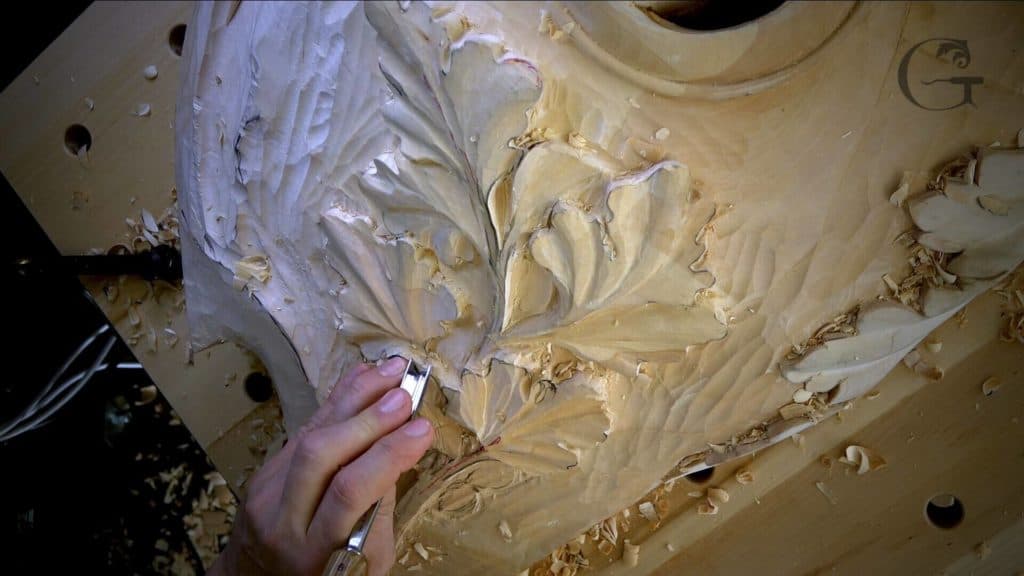
Alexander Grabovetskiy, woodcarver, School of Woodcarving · Published 2021
What does a wood carver mean by "final cleanup"?
Quick answer: In Venice Room workshop 98, part 12, I say "now I'm going to establish my outline before I going to give a final cleanup." Other lessons of mine put "final cleanup" and "final cleaning" beside a spoon, a number 11, a router plane or a glued layer, in Venice Room, Hashemi Flowers, Furniture Panel, Grape Onlay and more.
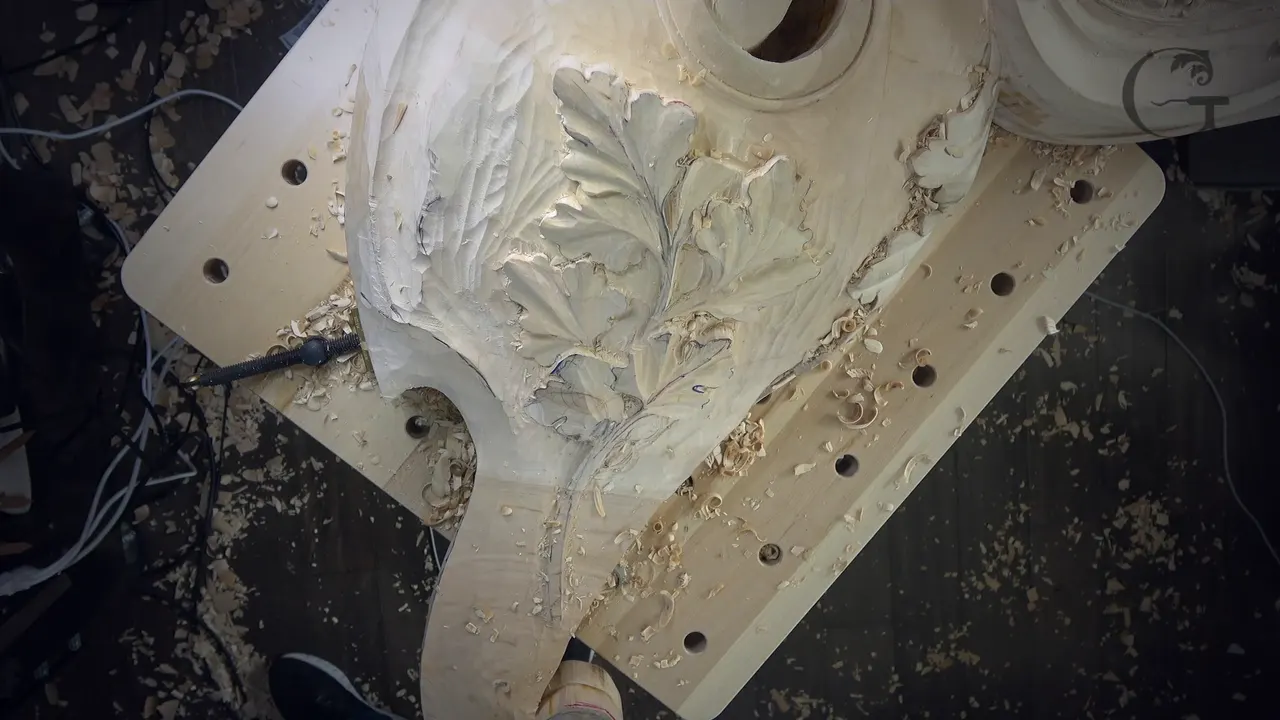

In the last video of workshop 98 I say, "And now I'm going to establish my outline before I going to give a final cleanup." Other lessons of mine set those words beside a plan, a tool or a reason to wait.
Ever finished a pass and wanted to wipe the whole surface clean right then? What I do between that urge and the last pass is what this page follows. Sizes come in millimeters and inches, my figure first and the conversion after it, for the wood carving I show.
What happens in the twelfth video of workshop 98?
The video opens on a plan: "I'll take number three and work around the perimeter." After that, "you should be able to get an idea how it's supposed to look. All of them actually, the same idea, pretty much."

Next comes "So now I need to blend it and establish the final form, and I'll be super happy." A tool is named: "going to need back bend." Number five follows. "And I'm using number five. It's a sweep number five and half an inch," I say (12.7 mm).

Position comes up. "Though I need to attack that from the right position," I say, and then, "Had this good idea to always work with the grain if it's possible." A slip is named too: "looks like I made mistake right here in this section, so I got to be really careful how I approach it."

The next tool is 10 millimeters (0.39 in). After it comes the line this page is named for, with my outline first and the cleanup waiting behind it.

A doubt follows. "I kind of don't really like how this one looks," I say, then "Let me think." Maybe, I say, I will "leave it for now and jump on this one, and then go back and work on that one." The next line is "But I need to fix it first. Not fix it, but give somewhat logical shape to it."

Two tools are named in the closing lines: "Let me take again number 11 and 10 millimeters, and I'll go around and just create those waves" and "Okay. Number seven." The video before this one ends on "Okay, I'll take 10 millimeters again. Number 11." This page goes looking for the words final cleanup in other lessons.
Why does the final cleanup wait in the early Venice Room workshops?
A 2 millimeter number 11 (0.08 in) comes up in workshop 13, part 4, "to clean all that mess." The cleaning is not the last one: "it's not the final cleaning yet because I still have to work around it." My next plan is a concave with "the same number nine" at "5/8 of an inch" (15.9 mm).

Over in workshop 18, part 5, an "upside down number three at first" comes up. Then "Clean little bit this side." It will be "like final cleaning" with no cuts and no tool marks showing. The aim is to "make it look nice and clean" and "I need to create the final form."

Part 8 of workshop 22 has "time to attack the edge" and the next words are "Not the final cleaning, but clean little better."
A spot gets a name in Venice Room 27. "I call it the marriage line, because the grain meets together two directions, and you kind of have to blend that together," I say. Cleaning waits, because the spot still needs development. For now the job is to "Just eliminate potential danger for me."
More cleaning is "going to help even more," I say in workshop 32, part 4. Final cleaning is for "a little later," I say, "When all of my decisions are going to be made up."
One more sits in Venice Room 2, part 12. "Well, I could clean it actually with the number nine," I say. "It's just initial for not losing the details." Next, "maybe I need to use something else for cleaning. Maybe number three and a spoon gouge."
Later in that part: "That is just the initial cleaning, okay? So it's not like a final cleaning of this project." And maybe "number nine and get rid of some of that mess, which is kind of a little bit distracting."
What stands between the outline and the last pass in later workshops?
Pipes come first in workshop 42, part 6. A last clean cut waits for "some pipes," which I describe as "Pipes from the eyes." Otherwise, "it's not going to look as it should look."

The cut gets its own name in workshop 46, part 12. Later on, a clean cut is planned: "Final clean cut, I would say" and my reason is "I have to double-check how tangent my line is." Before the final cut, "I really need to check everything." A smaller tool is possible: "I could actually use an even smaller, not 2 millimeters, maybe 1.5 millimeters tool" (0.06 in).

Shells show up in workshop 54, part 5. "With the same tool, I could probably just give little bit of cleaning," I say. A shell is ahead, and it will give me "extra level of shadow, by the way."
Part 9 of workshop 57 has a short line: "I can always clean that little later, somewhat final cleaning, I should say." Nearby I say, "I'm not excavating too deep yet."

A longer one comes from workshop 60, part 6. "Yes, I will clean it little bit, but now it's a little too early yet," I say, "or I should say I still have to work on more details until I get the final cleanup." A smaller tool follows: "maybe two millimeters number 11" (about 5/64 in), for "on inside."
The order sits in workshop 68, part 3. Acanthus comes first. "The final cleanup I'll do a little later because like I said," I say. Once that is done, "I'll be able to clean everything up." For now, "let me use 10 millimeters and number 11 spoon" (0.4 in), for the insides of "those concaves."

A tiny line comes from workshop 69, part 10: a final cleanup is held back until the shape is "somewhat round-y." In workshop 84, part 7, I say "Probably clean it with the number seven. Just one side of the number seven" then "but approximately."
Over in workshop 90, part 6, once everything is cleaned, "one millimeter is not a big deal to take out" (0.04 in), "but I want to make sure" first. The cut waiting is a "final cleanup cut." Further on, workshop 95, part 8, brings "So I can do that a little later." I correct myself: "final clean cut, I should say, that's what I was trying to say."

From this same Part 9 course, workshop 103, part 4, has "Yeah, I will clean it a little later, but that is how it's supposed to look." Then "the last thing what I want to show you" is "like veins on a leaf," ahead of the final cleanup. On the oak, I say, "sometimes you can see the movement is actually more different angle, I would say."

Later Venice Room courses say it too. Preliminary cleanup is named in workshop 121, part 1: "number 11 again, and preliminary cleanup. Again, just preliminary, like I said. There is no reason to create final, final cleanup yet, because we have to establish some details on inside."

A "2 millimeters number 11" (5/64 in) is named for the inside in workshop 140 (part 2). I add "Not final clean yet. I mean, not final clean up, I should say." Then comes "the 4 millimeters" (0.16 in), for "couple cuts, actually."

Where is the final cleanup done, and where do I skip it on video?
At workshop 124, part 1, I say, "I don't have to create any videos how I going to clean it off-camera. I'll do my final cleanup right here."
Also in workshop 147, part 4: "the final cleanup, I'll do it probably again off-camera. You really don't need to see that." After it, I say there will be no "really sharp ridge" in that area, "just a movement."

In the Lily Box course, part 13 of lesson 11 has "Let me hit this one. And maybe the final cleaning, I'll do just off-camera." After that: "exactly the same what I'm doing right now. Just make it more round everywhere."

How do the other courses say it?
The Hashemi Flowers course has it in lesson 17, part 2. "Definitely, I will need to clean that to make it look clean and nice." Final cleaning comes "once I establish this piece right here." My plan is "to develop another leaf on the inside curling out, and then I'll clean everything."

In lesson 31 of that course, part 1, comes the plan "a number five again and make final cleaning." And "I really like the result, what I see right now," I say.

Lesson 49 has glue. "off-camera, I decided to glue my second layer on the top of the first layer." Once it is "assembled together," the final cleaning can come. No "extreme cleaning," I say, and "I'm not going to use any sandpaper or anything." Of the marks, "I really like the chisel marks or tool marks." And "Even tiniest shadow casting will do a big difference."
The Furniture Panel course, lesson 15, part 9, names a tool for the cut: "Let's say this one is number four and quarter inch" (6.4 mm). "But the final cleaning cut, I'll do with the router plane." A fit is checked: "So let me check if it's going to fit in this profile." Then "Yep, and it does. Perfect." And "It doesn't have to be exact on the line. As close as possible, but if you're just slightly off, that is okay."

A background gets it in lesson 36, part 1: "Final cleanup of the background. I can do a little later, but now is just preliminary idea, although I could probably clean a little bit."
The Grape Onlay course gives reasons. In lesson 3, part 3, "whatever the chemical reaction gonna happen between the body oils and the wood itself, it's gonna look somewhat dark." And "That's why I'm cleaning only at the end." I add, "I prefer not to do the final cleaning until everything is done. Besides, maybe I'm not gonna like something" and "if I'm gonna change something, I'm gonna spend too much time."

Another pass is held back in lesson 5, part 1. The reason is "I wanna make sure I have, uh, plenty of the material to clean up a little later."

A line to watch sits in the hazelnuts course, lesson 6, part 2, and it reads "I still keep an eye on the final line because if you remember, we left that line right there." That line marks "the final, final cleanup." Then "Not at this point yet."
In part 2 of Venetian Flowers Rosette 4, I say, "I am somewhat happy. Let me clean a little bit around. That's not final cleanup," I say, and "I don't want to see too much mess right here." A mistake is named too: "looks like I did some cuts super deep, so that is not good." I use "just number three spoon."
Then Corinthian Acanthus Leaf 6, part 3: "I would call it a background tool." And "it's a really good tool to make the final clean." And "you should see the results are really, really clean."

Which lesson says what?
The table gives each lesson and the words that sit beside the cleaning, read from the passages above.
| Lesson | What sits beside it, in my words |
|---|---|
| Workshop 98.12 | Outline first, then a last cleanup, said as a plan |
| Venice 18.5 | Upside down number three, a nice clean side |
| Room 27.9 | Marriage line to blend, development still ahead |
| Venice Room 46.12 | A clean cut, with the line to double-check |
| Workshop 121.1 | Preliminary cleanup now, and no final, final yet |
| Hashemi 17.2 | Cleaning once this piece is established |
| Hashemi 49.1 | Layers put together, then the cleaning |
| Furniture Panel 15.9 | Router plane for the last cleaning cut |
| Furniture Panel 36.1 | Background cleanup can wait a little |
| Grape Onlay 3.3 | Prefer no cleaning until everything is done |
| Grape Onlay 5.1 | Plenty of material kept to clean later |
| Hazelnuts 6.2 | A line left earlier marks the last cleanup |
| Rosette 4.2 | Number three spoon takes some mess off |
| Lily Box 11.13 | Maybe off-camera for the final cleaning |
Who is part 12 for?
Anyone who wants to see an outline set first and a cleaning put off. Twelve videos make up workshop 98, and this one sits inside the Part 9 course of Venetian style wood carving.
Which spot on your board would you leave messy for now? Would one named lesson for every plan help you at your bench? Tuition opens the whole school, and every course above, the Venice Room, Hashemi, Furniture Panel, Grape Onlay and the rest, sits inside it.
How it's done
- Hear the line. Part 12 of workshop 98 says the outline comes before a final cleanup.
- Read the wait. Workshop 32 puts the cleaning "a little later" than my decisions.
- Pick a tool. The lessons name a spoon gouge and the numbers 11, seven and three.
- Name the cut. Workshop 46 calls it a clean cut and says the line needs a double-check.
- Check the layers. Hashemi 49 puts the layers together, and then the final cleaning can come.
Frequently asked questions
Which tools does workshop 98, part 12, name near its end?
Ten millimeters (0.39 in) and a number 11 come up in the plan to "go around and just create those waves." The final line says number seven.
Which tools sit beside the cleaning in the other lessons?
Workshops 13, 60, 68 and 140 name a number 11, workshop 84 a number seven, and workshop 18 a number three. A router plane comes from Furniture Panel 15, and Hashemi 31 names a number five.
Do the details come first, ahead of the cleaning?
Workshop 60 puts "more details" first. Workshop 32 puts the cleaning after my decisions, and workshop 121 says a preliminary cleanup comes first.
What to carve next