
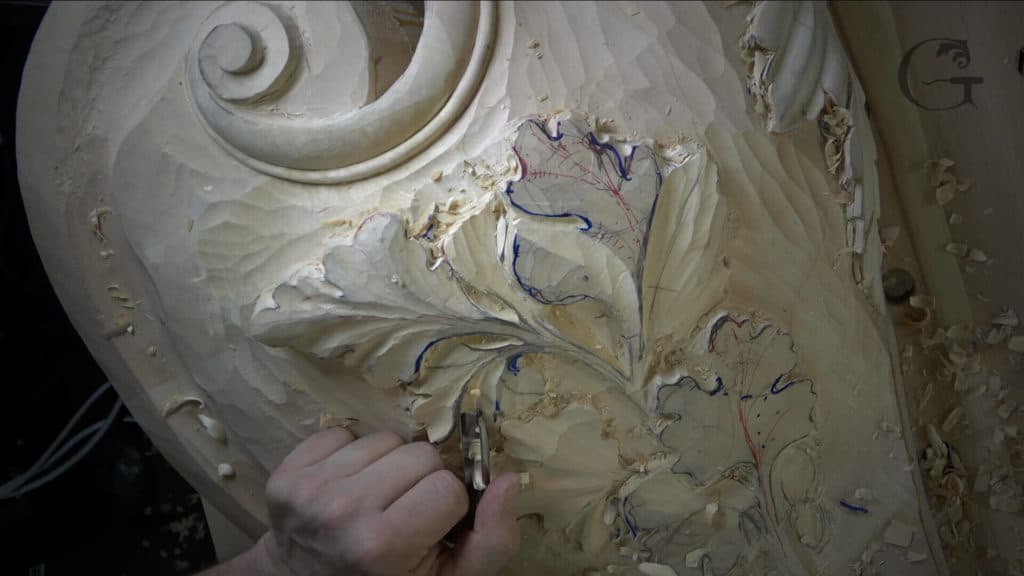
Alexander Grabovetskiy, woodcarver, School of Woodcarving · Published 2021
What does a wood carver mean by "able to or not"?
Quick answer: Workshop 98, third video: I name a number 7 turned over, say my try-it line, and give a reason that starts with a back bend. The same line comes before a gouge, a knife, a rotation and a zoom in other lessons. Each one is read here with its nearby words.
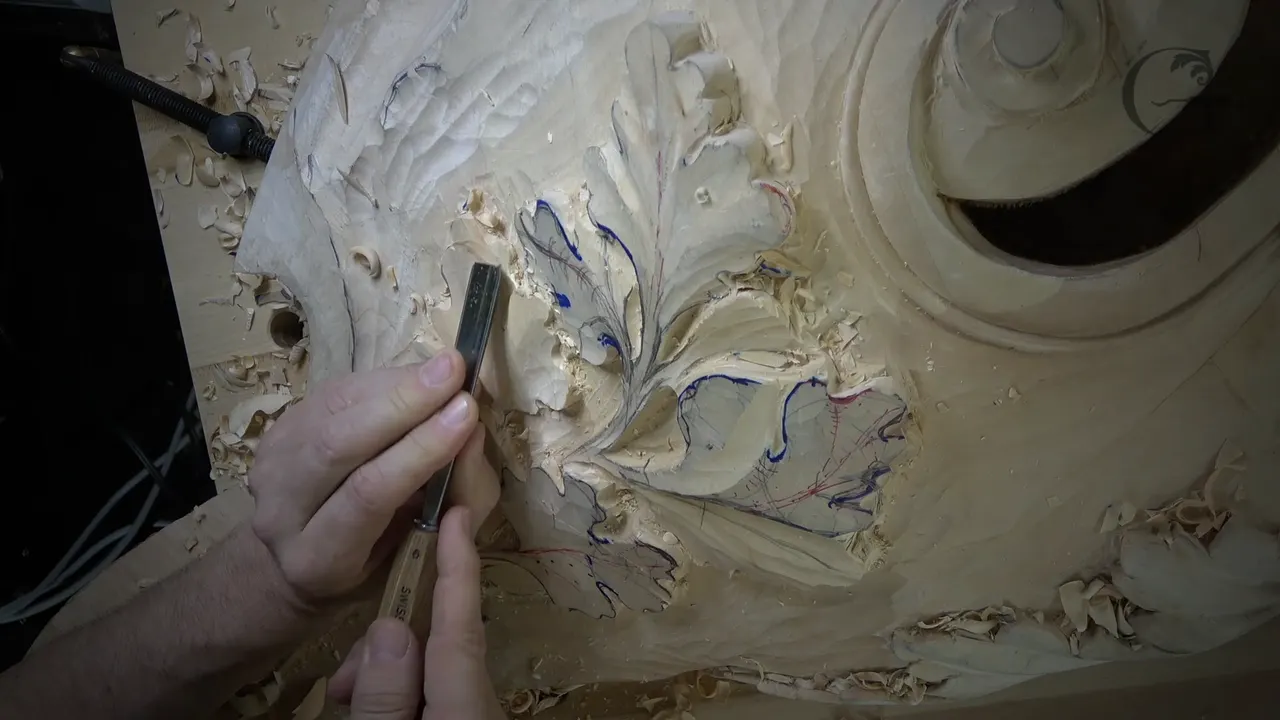

In part 3 of workshop 98, I name a number 7 held upside down and say "I'll see if I'm going to be able to or not." The very next words are "Because back bend would help me a lot more." That line comes before a gouge, a knife, a rotation and even a camera zoom in other lessons, and each passage below is read with the lines around it.
Ever lifted a gouge over a spot and wondered if it would reach? I say so out loud in workshop 98, and in lessons far from it. Sizes come in millimeters and inches, my own figure first.
What do I say around that line in part 3 of workshop 98?
A size opens the part, "I need to use smaller number 11" and then "And again, 10 millimeters, number 11." That is 0.39 in. Next come "Going to clean up this area" then "Looks good" then "Clean a little bit this edge."

Then a possibility, said as one: "And what I see, I could give a slightly deeper concave right here." My pick is "just number 11" with "10 millimeters" for "a little more shape." One more line, "Though I probably should rotate and attack from opposite direction," stays a possibility as well. None of that is reported as done.
A stopping point comes after it. There is more to do on this side later, I say, "But for now, that's the stage I want to see it." Another spot is next, with "Okay, let me jump to this one. Same idea, very much."

The need on that one is "I need to create convex right in the middle." My route is to "just establish concaves first" with "the same tool," a number 11 at 10 millimeters (0.39 in), and then "the left side of it also." The verdict, "And that's a really good 3D shape. I really like it."
Where does the line sit in that part?
Between a need and a reason. First "I need to clean that from opposite side" then "And maybe I'll use number seven upside down" then the line from the top of this page. Then, in the next breath, "Because back bend would help me a lot more."

After it, a number five and a size, and then one word, "Back bend" and then "And blend nicely." These are plans on the video. This part does not say if the number 7 did the job, and I leave it there.
A flip is next, as a plan: "attack that from this side." A number three comes after it, as a plan: "Let me also take number three and shape it a little nicer." The last words are about the grain, "Going against the grain. That's okay."

Over in part 4, I say "backbend right in this section because it fits much better." Earlier there I say "Let me try to use my number seven upside down" and "Give it a little better shape." Part 2 has a sibling. "I think I am going to use number 3 upside down," I say, then "blend my movement." Upside down comes up in parts 2, 3 and 4 alike.
Smaller tools show up there too. "I can actually remove some of that material" is one line, with "the number 11" and "2 millimeters" (0.08 in). A doubt about depth follows, "Maybe I've got little too deep of a cut, but it's okay for now" with a shell planned below. Close to the end I say "I'll use a mallet" and "need to use a spoon."
Does the line come before a tool that may be too big?
Venice Room 8, part 7, names "quarter-inch number nine" as the try, and the words come right after it. Then "Or maybe it's a little too big for now." A quarter inch is 6.4 mm.

A smaller tool follows, "Maybe I should use a much smaller tool." The size I name is "number nine and one-eighth of an inch," which is 3.2 mm.
Workshop 72, part 10, aims at a pipe. I want "a little deeper cut in this section" and then the same words come. Next comes "I want to exaggerate this part as a pipe" with "the smaller number 11, maybe about 7 millimeters, a little bigger than a quarter inch" (0.28 in) as my pick.

In workshop 29, part 4, a doubt about the move itself comes first, "not always you should do that." Then "Not every eye and not every pipe." A variant of my line follows, with a smaller 11 as the try, and "that's what I'm using" for a size of an eighth of an inch (a little over 3 mm). After it, "I think I'm able to" and "it's going to go underneath and go like that."

And when the answer comes back no?
Workshop 34, part 11, says it plainly. I pick a number 11 at three millimeters (0.12 in), and it is "a straight one." The answer, "Looks like I'm not." Then "either long bend or short bend" and a little later "Going to use probably long bend number 11."

A bigger tool is the try in workshop 54, part 7, "number nine" then "maybe 5/8 of an inch" (about 16 mm). Next comes "Maybe yes, maybe no" and "16 millimeters" (0.63 in). The answer is plain, "it's not going to work" and I look for something else. My swap is "number seven, 14 millimeters" (0.55 in), and "number seven is actually much better."

Lily Box has a quick version in lesson 7. "Let me use a number seven and a quarter inch," I say, just over 6 mm, and "I think that one would be a little too big." Next, "Yep." Then "Maybe I'll just use a number three and one-eighth of an inch," about 3 mm.

Over in lesson 9 of the Lily Box course, an idea gets the try, not a tool: "the same idea" with "a little curl." My own answer is "Maybe not."

A natural crack gets the line in lesson 8 of that course. "I have a natural crack on the inside," I say, and I ask if I can use it "as advantage." Then "I doubt." And "I kind of don't like to see this crack." The plan is "maybe I'll just leave it for now like that."
What happens on a yes?
Short and plain, workshop 35, part 11, carries a need to "do exactly the same on this side" with "the same tool because it's already going underneath." Next, "Yes, I am able to." And "Looks like yes, I'm able to."

In workshop 74, part 1, the question comes first: "what tool I should use" and "That's the question." The reason is "I don't want to see a U shape on inside." My try is "just the number nine" at 10 millimeters (0.4 in), "to blend it nicely." The verdict comes later, "looks like I achieved the result."

In the Furniture Panel course, lesson 21, a rotation is in doubt, since "it already hits the lines." Then "it still helps" and after my line, "Yes, I am." A warning rides with the yes, "be careful because you can drill too deep." Then a plan: "one millimeter." That is 0.04 in, the size I want for "little closer to the triangle." The upper part of the panel carries acanthus movements in that lesson.

Lesson 20 of the same course checks a tool before using it: "maybe I could use number three, I should say," I tell you, and the line follows. "Yes. Number three should work," I say, and "that's a quarter inch" (6.4 mm). Afterward, "a really nice, beautiful cut."

Lesson 19 gives a softer answer, "Take care of this one right away" then "but I should be." After that, "Attacking from one side." And then, "Now I know in the middle, it's exactly what I need."

Is a gouge the only thing I am unsure about?
A knife is in my hand in Hashemi lesson 44, where I say "Let me take a knife" and "Just create that curl." After the line comes my plan, "what I have to do, I have to excavate this area right here" and "make like undercut inside."

In lesson 10 of the Lily Box course, a lily is the work. "I can actually chop it," I say, and the line follows, and then "Try a knife again."
The spot in Lily Box lesson 11 is awkward from one side. I put it this way: "from this side, it's almost impossible for me to do anything." My option is "I could attack from opposite side." Past the line I say "That is the backside, never going to be visible, but still."

A flip is on my mind in Venice Room 10, part 11. "I kind of like the idea of flipping this part," I say, since "it gives me more interest, actually."

Shape is the need in part 9 of that workshop, "I need to give a really good shape to this one" and I say I could use "a big number seven." Then the line, and "To give that rounds."

Venice Room 9, part 12, ties the line to a first pass. The plan for the first pass is "the preliminary cut inward just by wiggling" and my pick is "the same number nine." Then "attack that from opposite direction."

A long pass is tied to the line in workshop 15, part 5, "I can probably get really nice and long cut." Afterward comes "Nice and long and clean" and "That is good."

Size is the question in workshop 27, part 1. "I want to make it a little bigger," I say, and then comes "because I already excavated a lot."

A veiner gets the line in Furniture Panel lesson 18. I start with "Let me try to work this area" then "maybe just little by little" and my plan is "my veiner" to "remove most of the material." Later, "that's probably as close as I can get."

Do other courses carry the same words?
The Grinling Gibbons class in Maine carries them, and so does a camera zoom, as you will see. In class 15, "about 1/8 of an inch thickness" (3.2 mm) is what I have to work with. Then "rolling up for it, but let me just to show you."
Class 18 turns the line on the camera. "Let me actually try to zoom in," I say, and then the words, "because there's a maximum Zoom I can do." The zoom has its limit, and I say so. I add "I know it's kind of hard area."
Lesson by lesson
| Lesson and part (Venice Room unless named) | The tool or move in doubt, and what comes next |
|---|---|
| 98.3 | Number 7 flipped over, then my reason, the back bend that I say would help a lot more |
| 98.4 | Back bend, because it fits much better |
| 8.7 | Quarter-inch number nine first, too big for now, then a smaller nine in its place |
| 9.12 | Nine again, then the opposite way |
| 10.9 | A really good shape is the need, so I say I could use a big number seven, with rounds |
| 10.11 | Flipping a part, for more interest |
| 15.5 | One long pass first, then the verdicts clean and good, both said later in that video |
| 27.1 | A wish to go bigger, with a lot already excavated |
| 29.4 | A small number 11, which goes underneath, and my answer is a yes, I think |
| 34.11 | No, so a long bend |
| 35.11 | Same tool on this side, and the answer is yes, with a second yes right after it |
| 54.7 | Maybe yes, maybe no |
| 72.10 | A small number 11 for a pipe, as a first pass, in a section I want a little deeper |
| 74.1 | Number nine, to blend nicely |
| 18.9 | A veiner, little by little, to remove most of the material, in Furniture Panel |
| 19.2 | One small section, in Furniture Panel |
| 20.4 | Number three, a quarter inch, and my verdict that it should work, in Furniture Panel |
| 21.2 | A rotation, in Furniture Panel |
| Hashemi 44.4 | A knife on a curl, then my plan to excavate the area and make an undercut inside |
| 7.8 | Number seven at a quarter inch, then number three, in Lily Box |
| 8.11 | A natural crack as an advantage, left alone for now, in Lily Box, with a doubt beside it |
| 9.2 | Same idea, maybe not, in Lily Box |
| 10.7 | A chop first, then a knife again, in Lily Box, with the line in between |
| 11.7 | A backside, in Lily Box |
| Gibbons 15-2 | Rolling up a part, which I show instead of explaining, in the Maine class |
| 18-2 | A camera zoom with a maximum, in Maine |
Is there a spot on your own board that makes you stop and ask the same thing? Every lesson here sits inside one tuition plan, and more Venice Room parts wait on the Part 9 course page. Other wood carving courses wait too, such as the Furniture Panel carving series and the Hashemi Flowers course.
How it's done
- Find the line in part 3. It sits between a number 7 flipped over and the words about back bend.
- Read the lines around it. A need to clean from the opposite side comes first. A number five and a back bend come last.
- Look at part 4. A back bend gets the nod for one section there.
- Hear a no. A no and then a long bend sit in the eleventh video of workshop 34.
- Hear a yes. Workshop 35, part 11, has a yes, and it is short.
Frequently asked questions
Which tool comes right before the line in the third video of workshop 98?
The number 7, turned over. My reason for it follows the line at once, and it is about a back bend.
What does part 4 say about a back bend?
I call it a better fit for one section. Earlier in that part, a number 7 gets its try, and part 2 plans a number 3 upside down.
What did I say in workshop 34, part 11, after a no?
"Looks like I'm not." Next come a long bend or a short bend, and then my pick, probably the long bend.
Is the line only about gouges?
What to carve next