
Alexander Grabovetskiy, woodcarver, School of Woodcarving · Published 2021
What does a wood carver mean by "messy area"?
Quick answer: Workshop 98, fifth video: I say that word about a section just before "But overall, I like it." Other lessons carry it too, before a clean-up, over chips, and over glue. Each one is read here with the lines around it.
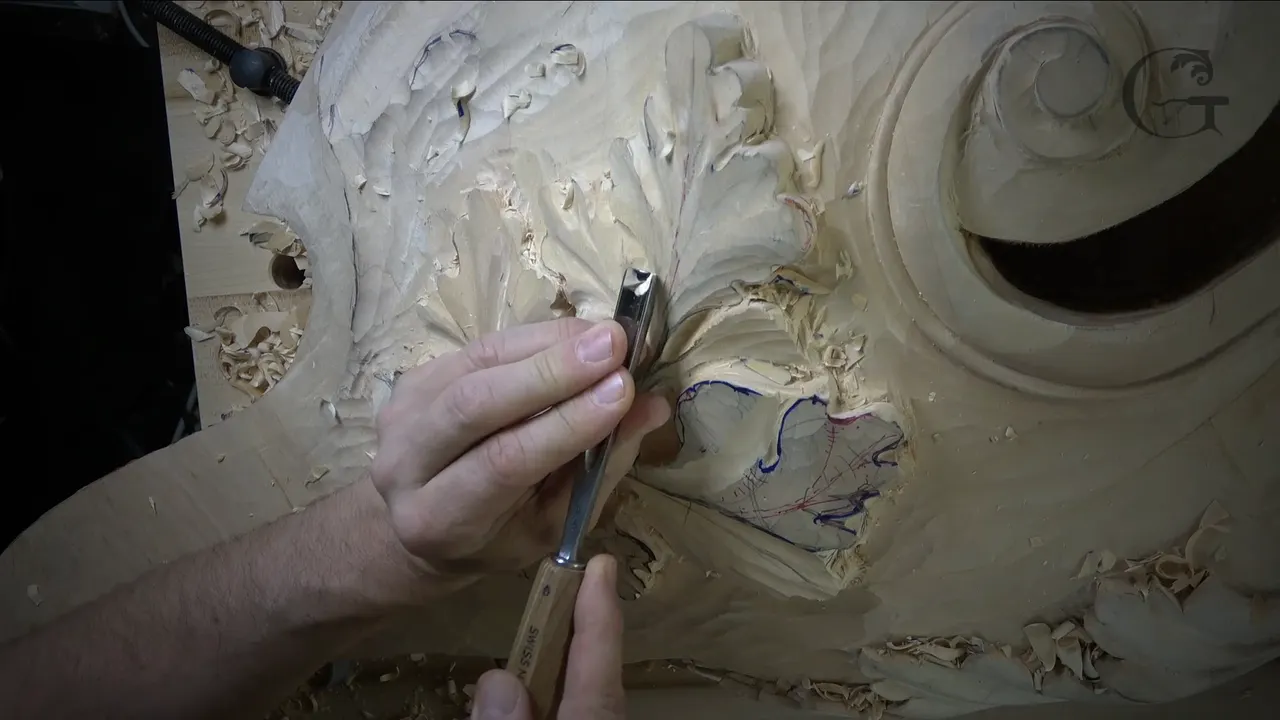

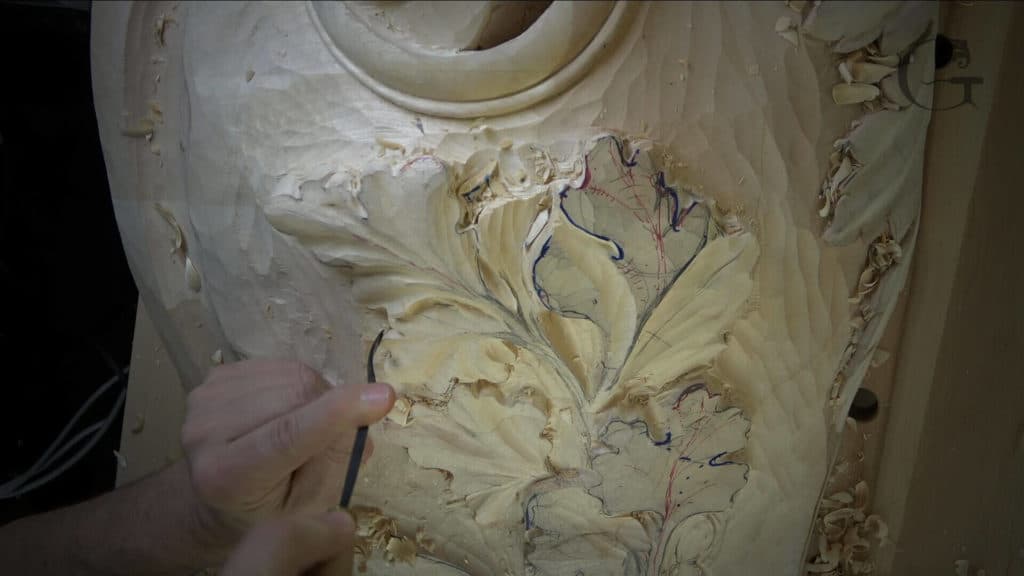
In workshop 98, fifth video, I look at a spot and say "This section is also kind of messy." Two more lines follow it, "Messy area" and "But overall, I like it." Other lessons carry the same word, each with its own reason and its own next step. I read every one of them with the lines around it.
Ever winced at your own carving halfway through? Ever wondered if the carver on the video sees the same mess you do? I do, and in these lessons I tell you so. Sizes come in millimeters and inches, my figure first.
What do I say around the word in part 5 of workshop 98?
The video opens with housekeeping. I say I want to clean up "this marker," because "it just doesn't look too good." Next is a maybe, a little deeper concave right on the side "to exaggerate that middle line." I fix my own word: "Not line, but convex. Middle convex."

One more pass from that side is in my plans. The blend follows, "And now I'm going to blend that middle" and then "Let me try again, number seven upside down."
A number 11 at 10 millimeters (0.39 in) is the next tool I name, to "get rid of those marks I just created." I add "And fix those waves" in the same breath. After that I say "I'll use a mallet."

My reminder is that I'm "not worried about how it looks on outside yet, because there's going to be a shell." I can clean it "nicer a little later," I say, and "But preliminary, that's okay."

"Just go around and just check. Simple." Then comes the line itself, and after it the next words, "Messy area." My verdict is "I like how it looks overall."

A need comes next: to finalize a little more, and the tool I name is "maybe about three millimeters, number 11" (about 1/8 in), to "excavate a little closer to the final form." The last cues are "That is good," a plan to clean "a little bit those pencil marks" and a need to attack that "from opposite side."
Do I say it about a stage that is not finished?
"It's supposed to look messy at this stage," I say in workshop 37, part 11. I really want to see "that convex beautifully developed." I plan to clean that side a little more, then attack from the opposite direction with a straight number 11.

A different video, workshop 70, part 12, has "When you look at this stage, it looks really messy, not really appealing, but it's okay." I have "the main movements going." I can round this part now, I say, and "Any gouge will work, like number six, number seven."

"It looks really good, actually. And I know it's messy, but see those bits?" It is workshop 58, part 1. The bits "will look awesome once it's finished," I tell you, and "I know it's not finished yet."
In workshop 98, part 7: "Well, actually, I'm not ready to work on the thing because I see a lot of messy areas." Then "That's okay. I'll fix it a little later." The plan is to "establish the outline first" and "I'll clean everything."
The Greek Acanthus Leaf course, lesson 2, part 3, has you "leave some space for clean cut" and finish "before you hit the wall." I admit the mess and add "once it's done, it's not going to be looking messy anymore."

Vase with Grape Leaves, lesson 1, part 7, has a messy stage, with a note that it will look "really good." Later in that part come "same idea" and "same divisions."
Workshop 27, part 1: "I know it looks a little messy right now, but you will understand once I get this done." You will see how my idea develops, I say. A small excavation with the number 11 or number 9 is planned, "doesn't really matter" and my pick is "Number 11 and 10 millimeters" (0.39 in).
Over in workshop 90, part 9, I tell you it looks messy right now and that it will look really good. A plan follows: "Maybe I can just roll this one out like this and make it look even nicer." A need follows, "I need to remove lots of material from the backside."

"I know it looks messy, but it depends how you look at it, because if you see the final result in your head, you're going to agree with me." So it goes in the Hazelnuts course, lesson 7, part 2. Next I plan "the airborne effect of this main stem" with probably five millimeters (0.2 in), number 11.
Does the word come right before a cleaning pass?
For workshop 20, part 8, the words are "Use number five and clean a little bit over all boundary." Digging inside the background is not what I want, but "I need to clean around because right now, just too messy. Too messy to my taste." The aim, in my words, is "I need to create clean canvas."

Seven millimeters (0.28 in), number 11, is the pick in workshop 66, part 6: "I use just seven millimeters, of course" and "and I can clean it." The reason for the pass is "a little too messy" and "too messy is not good." Then "maybe a little more" and "I can start my divisions."
Pipes get a size too in workshop 90, part 8, where the pipe "should not be that far because I don't want to excavate that deep." My pick is "four millimeters" (0.16 in). Then comes "I don't want to be too messy." The plan is a four millimeter number 11, "to indicate that eye a little better."
Almost the same sentence as mine in workshop 98 is in the Furniture Panel course, lesson 24, part 7. That lesson goes on with "At three millimeters, number three, let me fix it" (0.12 in), and "And yes, I do not want to lose that part."

Furniture Panel lesson 28, part 3, has "it's okay as long if I'm not too deep," so "I should be fine." I want "some kind of straighter tool, maybe number three" and in that case "a quarter inch number three" (6.4 mm).
Lily Box lesson 8, part 12, has the word for the area below. I call the previous one a messy area. The edge needs a final form, with number three, and "Let's remove all that waste."
I am willing to spend a long time at one spot, I say, "because I want to make sure it looks good." Going "somewhere else" and forgetting "that I left some mess right there" is what I want to avoid. Still, "Sometimes I do jump to another area if I'm tired of this one."

Roman Acanthus lesson 16, part 5, has "Allow me also clean little bit." Then "I see there is some messy area. I don't like it right here." A chamfer on the opposite side, done the same way, is planned. After it, "Now it looks much better and cleaner, but I still don't like how those look." I could leave them as they are, but "I think there is a better way to treat them."

Hazelnuts lesson 7, part 1, has "Yeah, I know it's kind of messy. Let me actually clean up." A quarter inch (6.4 mm) number three is the "some kind of flatter gouge" I will need. "Just get rid of some of the mess," I tell myself, and "Just be careful." The direction of the grain "is really important in this case."

Messy is followed by "but that's all right" in Hazelnuts lesson 4, part 2. I need a different gouge, "like number nine or so. Or even 11." The one I could probably use is a 12 millimeter veiner (0.47 in).
A middle ridge stops me in workshop 53, part 9, "which I know it's messy and you don't see it, but it's there." Then "I need to blend a little better because it doesn't look too good" and "clean also because it's a little too messy as of now."

Lesson 19, part 8, of the Furniture Panel course: "I got too messy. Going to brush this out." Still the same tool, a number three, "creating that shadow." About that shadow: "It's really important because every little bit going to create the play shadow and light."
Undercut first: workshop 113, part 2, has none yet, and "it looks somewhat messy, but I can take care of it really easy." My question is "do I really need to do a super deep undercut?" Grape Onlay lesson 8, part 3, tells you not to worry yet about the look. What I'm after at that stage is "the huge big shadow." Next I plan "Let me actually clean it light" because I don't like how messy it looks.

What is the mess made of?
Chips, in workshop 22, part 12. "It still gives me that shadow, but not excavating too deep." Then "those are just chips" and "It looks messy, but they're just chips."

Chips again in workshop 18, part 8. There is "a lot of chips, and I'm not talking about potato chips, I'm talking about carving chips." They are why it looks messy. "it just gives me really clean cut," I say. I go in underneath and I can get really deep. I can't see it anymore, but "I know it's clean because I can hear my cut. Okay. I'm carving by ear now."

Hashemi Flowers lesson 47, part 5: "Again, don't worry about all that messy look." Then "It's just all those chips fell inside, and later on, I'll just blow and remove it."
The April 2020 livestream has me looking at a section and saying "there's a lot of mess, okay? And it just looks messy. And my goal is to bring shadow out." "I believe in shadows and lights, so woodcarving is actually pretty much all about the shadow and light." My tool is a number nine, approximately half an inch (12.7 mm), "about maybe 14 millimeters or so" (0.55 in), rotating and "kind of excavating that way."

Another place in that livestream is "little messy area for now." A smaller number 11 is an option, then "Clean it with that number five."
A close look comes in workshop 132, part 1, and the warning is that it's going to look messy, "but just pay attention to my finger." I point out "the edge of the long leaf" and on the opposite side "this side is raised up."
"I did my first pass." That is workshop 107, part 2, and I admit it looks messy. I plan a height of about 16 millimeters (about 5/8 in) from the highest spot, and "I'm going to lower that down."

Is the word only about wood?
Glue lessons show it. Greek Acanthus lesson 2, part 1, has "I used just the photo mount glue" and it "holds really nicely, and it's not as messy as commercial glues, what I'm sometimes using." The block is "about one inch and an eighth" (28.6 mm), and I plan to go about five-eighths down (15.9 mm). I'm "just eyeballing," I say.
In lesson 4, part 4, "that's a fine spray, not messy at all. There's no mess left after that glue." It became one of my favorites lately, I say. In stropping and compound lesson 3, "this one doesn't produce too much mess" and then "it doesn't produce a mess."
A bench gets the word in Furniture Panel lesson 38, part 3. "My bench getting messy and I don't like that," I say. Then "Pardon my mess."
Lesson by lesson
| Lesson and part (Venice Room unless named) | Words that go with the word |
|---|---|
| 98.5 | Marker clean-up, middle convex, shell planned, then praise for the spot |
| 37.11 | A messy stage, said to be normal, and a straight 11 planned |
| 70.12 | Really messy, not appealing, and the main movements going |
| 58.1 | Messy but good, with small bits that will look awesome when finished |
| Greek 2.3 | Space for a clean pass, finishing before the wall, and a promise |
| 66.6 | A 7 mm number 11 to clean, since too messy is not good |
| 20.8 | Number five around the boundary, to make clean canvas |
| FP 24.7 | Almost the same sentence as mine, then 3 mm and a number three |
| Lily 8.12 | The one below needs a final form on its edge |
| Roman 16.5 | A chamfer, then the same treatment on the opposite side |
| 22.12 | Only chips, with the shadow kept |
| 18.8 | Carving chips, not potato chips, and carving by ear |
| Hashemi 47.5 | Chips fell inside, to blow out later |
| Greek 2.1 | A glue that is not as messy as commercial ones |
| FP 38.3 | A bench getting messy, and my pardon |
Is there a spot on your own board you would call messy and still keep going? Every lesson here sits inside one tuition plan. More Venice Room videos wait on the Part 9 course page, and other wood carving courses wait too, with hazelnut husks, a vase with grape leaves, and Greek and Roman leaves. Venice itself is there, with chips on the bench.
How it's done
- Find the line in part 5. It comes after "Just go around and just check. Simple." and before "Messy area."
- Read what follows. A verdict, then a need to finalize a little more.
- Check the size. Toward the final form, I name about 3 mm.
- Compare another stage. Workshop 37, part 11, says it is supposed to look messy at that stage.
- Look at the mess itself. Workshop 22, part 12, says those are just chips.
Frequently asked questions
Which words come right after my line in the fifth video of workshop 98?
"Messy area." After it I say I like it overall.
Which tool and size do I name for the next step in that video?
I name a number 11 of maybe about 3 mm (about 1/8 in), toward the final form. Earlier in the video I name the number 11 at 10 millimeters (about 3/8 in) and a number seven upside down.
Am I worried about the outside of the carving in that video?
The outside is not my worry yet. A shell is coming, and a nicer clean-up can come a little later.
Which lessons put a cleaning tool near the word?
What to carve next